Vector editors are supporting a workshop on applied SF at the University of Lagos as part of a larger collaboration with the African Speculative Fiction Society and Aké Arts & Book Festival.
If you are in Lagos, join us: www.africansfs.com/events

Vector editors are supporting a workshop on applied SF at the University of Lagos as part of a larger collaboration with the African Speculative Fiction Society and Aké Arts & Book Festival.
If you are in Lagos, join us: www.africansfs.com/events
Disco Elysium is a CRPG (Computer Role-Playing Game) developed by the Estonian game studio and publisher ZA/UM. Originally released in 2019, the game was re-released in 2021 as a “Final Cut” version with new voice acting and quests. The game’s main premise is to investigate a murder in the imagined city of Revachol playing as Harry DuBois, a detective from the Revachol Citizens’ Militia (RCM). Yet, this is just one of the mysteries that the game offers and, at certain points, this objective might take a backseat.

Disco Elysium creates a universe of nostalgia, disappointment, and decay, where the pickets have blocked the harbour with union strikes, the remnants of a not-so-distant war are ever-present in the streets, and the everyday dialogues of characters are often infused with political and philosophical talk. In this world, our playable character, Harry, is not the heroic good cop fighting to uncover the murderer. Instead, the game paints him an almost unlikeable character to whom the player might eventually warm up, particularly if he is not taken too seriously. The start of the game presents Harry in his darkest hour, slowly regaining consciousness from a night of excesses and bad decisions. The game opens with a black screen and a dialogue with the mysterious voice of “Ancient Reptilian Brain”, which tries to convince the player to do nothing, embrace the silence, and accept death. In an unusual opening scene, Disco Elysium offers the player the possibility of not playing by refusing to wake up and instead giving up to the pessimism of a futile existence, leading to a game over within the first couple of minutes of the game. In these first minutes, the dialogue options withhold more information than they give, creating disorientation instead of revealing who our character is or what is happening. This sense of confusion is heightened by the sudden involvement of more voices, such as “Limbic System” and “Encyclopedia”. These and many others are Harry’s internal voices, parts of his personality that offer advice throughout the game, both hindering and aiding the player. When Harry finally manages to wake up, the player meets him lying face-down on the floor of a trashed room, in their underwear, and visibly hungover. Further examination of the room allows the character to find most of his clothes, and also reveals that Harry suffers amnesia after a night of drinking of “world-ending proportions”, as stated by the mirror. In the world of Revachol, objects might interact as if alive and sentient. They share thoughts, they provoke, they are sad, they die. Mostly, they keep Harry company, and act as one of the voices that plague his mind. A high “Inland Empire” skill (linked to the subconscious and foreboding) allows Harry to speak to some of his clothing, not always with the best results but quite often with amusing dialogues and surprising discoveries, whereas other skills like “Shivers” allow the player to get more information from the city and the environment, among others.
Continue reading “Review: Disco Elysium (2019), ZA/UM”Hi Gabriel, thanks so much for chatting today. Why don’t you start by introducing yourself and your background in roleplaying games?
Sure. I’ve loved roleplaying games since I was a kid, maybe ten or twelve years old. My first experience was with a Brazilian system called 3D&T. There were a couple of games like World of Darkness that were available too.
After a break, I eventually got into D&D 5e. I enjoyed it for a while, but I became disillusioned for various reasons. Especially issues with representation. I got involved with communities such as Three Black Halflings. At some point I just realised that D&D was a corporate product that would never actually be any good. It was fundamentally flawed, and couldn’t be fixed, because the people making the money didn’t care.
Then I discovered Wanderhome by Jay Dragon, which uses the Belonging Outside Belonging design approach. That’s a token-based system, that allows for collaborative storytelling without relying on constant dice rolls. Dungeons & Dragons really sets the tone for what many people think roleplaying games can be, but Wanderhome showed me that roleplaying games could be something entirely unique — not just another battle simulator, or game of colonizer make-believe. The community was part of that as well, such as the Wanderhome unofficial Discord (kisses and hugs, if you are reading this!).
So Wanderhome became a way for me to explore more games, and eventually get into game design myself. My first reaction was to go to almost the polar opposite of D&D. Even designing Roots & Flowers, and getting into Solarpunk, was kind of a rebound from D&D. “Let me get this shit out of my system!” Since then I’ve drifted in a few different directions. Now it’s more of a personal, mindful effort to create things I enjoy.
Brilliant, thanks! I want to get into your game design work soon. I enjoyed the recent Game Master Monday actual play of Roots & Flowers. But first, can we talk a bit more about D&D’s issues with representation?
You know, these games often involve stories of venturing into perilous wilderness and grabbing everything you find. It’s a structure that can perpetuate colonialist attitudes. You just take up your weapons, go into someone else’s house, tear shit down, kill everybody, pick up relics and stuff. Then you come back, call everybody you just killed ‘monsters,’ and call it a day. Then the cycle begins again.
Of course Wizards of the Coast will say, “We can improve this, we can fix it.” No, you can’t. It is the core premise of your game. You may be able to make it more and more palatable to certain sensibilities, but it will fundamentally be the same thing. At the end of the day, it’s just about D&D making money, and Hasbro shareholders lining their pockets. It’s for the benefit of a couple white billionaires somewhere. You’ve got to trash it.
You’ve got to trash it, and make something new. You can’t fix it.
Continue reading “We can play more than fantasy cops: An interview with Gabriel Caetano”We were lucky enough to chat with Kellynn Wee, researcher and designer of tabletop roleplaying games, about solarpunk, utopia, memory, narrative and chance, the TTRPG scene in Singapore, and much more.
Hi Kellynn. Why don’t you start by introducing yourself?
Sure, my name is Kellynn Wee, and I’m currently a PhD candidate at UCL. I’ve been looking at play communities in Singapore, and how players relate to fantasy and speculative worldbuilding in tabletop roleplaying games. I have a background in anthropology, so I’m interested in the social relationships and meanings that emerge from these play communities – in how games can become sites to explore different relationships and identities, and how games allow us to deal with different forms of value, different approaches to uncertainty, or new ways of imagining the self. I’ve also been working on a climate futures game, Move Quietly and Tend Things, which I describe as a bittersweet utopia.
This research involves a lot of playing games, right?
Oh for sure. I’ve never played so many games in my life! I recently calculated and it was nearly 250 games in about twenty months of ethnography, which should kill my passion for games, but somehow hasn’t. And I think that’s a good sign.
Wow! Has the play sometimes felt like work?
It’s a good question. There are always interesting tensions between play and work, right? Have you read Play Money by Julian Dibbell? It’s about quitting his day job and becoming a full-time loot farmer …
No, but that sounds kind of up my street.
Well, there were definitely games that felt like drudgery. I think it’s because of the volume of games I played. Some games just didn’t spark. It might be the dynamics of the players at the table, the kind of energy people are bringing to it. Roleplaying games are so dependent on the particular constellation of individuals at that point in time.
Right.
But even when they don’t quite spark, it’s not exactly like work. I mean, I still had fun!
That’s good! I guess ‘work’ and ‘play’ is one wobbly binary, and then ‘work’ and ‘fun’ is another wobbly binary? There is some interesting writing by Bo Ruberg about the variety of emotions associated with play — fun is an important one, but it’s not the only one.
Sure.
You are researching the games and the players and the communities. But can I ask about games themselves as research tools? I’m wondering how games and play have been used in anthropological research historically, and whether you see potential for using them in new ways in the future.
Well, it’s pretty common for games to be pedagogical tools, right? They’re ways to place students into an anthropological frame of mind. I know that games have been successfully used to reframe research findings beyond textual outputs. For instance, I recently attended a talk by Andrea Pia, who designed a game for students to explore the topic of Chinese rural migration. They transformed their research into an interactive digital narrative where you’d make choices for a migrant character to proceed through the world, and it used photos, videos, quotes and characters that derived from Pia’s fieldwork.
That sounds interesting.
Yes, it was really interesting. Using games as research methodologies though? Maybe that’s something that hasn’t been explored all that much, or at least it’s something I’ve yet to fully grasp myself. I wonder why not though, right? Playing, especially role-playing, and ethnography share many principles. The first thing that comes to mind is the art of asking questions well. There’s this act of iteration, of only understanding whether a method works by doing it, and then coming back to ask what sort of tools or approaches you need to get to an understanding that you want. There’s the act of making the implicit explicit, of paying attention to what is unsaid as much as what is said. There’s the consideration of different relationships, different identities, how people are going to come together and interact in the same space. There’s this element of sharing sensorial or bodily space.
These are all aspects that anthropologists pay attention to. And so do tabletop roleplayers. A roleplaying game can also make aspects of relationships and elements of social currency visible. I also think games can act almost like a kind of meta-reality tool. While anthropologists and other social scientists often act on the principle of making the familiar strange when thinking about their work, I think games can often carry out the opposite act of making the strange familiar–exploring peculiar worlds and peculiar viewpoints by using everyday tools that help us frame our capacity for action regardless of the circumstances. So yes, many game practices resemble ethnographic practices and ethnographic thinking. It’s exciting to think what might be done with that, but it’s still a question I’m exploring.
Your answer is making me think of this interview as a very rules-lite roleplaying game.
Should I roll some dice?
Continue reading “Bittersweet Utopias: An interview with Kellynn Wee”This piece contains mild spoilers and mild mind scrambling if you haven’t seen the 2018 film Spider-Man: Into the Spider-Verse.
Margaret Thatcher had something to say about Miles Morales, so too did narrative theorist Seymour Chatman, as well as those fighting the idea of a “half-black, half-Hispanic” Spider-Man (Rose, 2018). It wouldn’t be a stretch of my tingly senses to say these folks share the belief that there is no alternative, there is a single, right, way. Thankfully, the opening sequence of the film Spider-Man: Into the Spider-Verse (screenplay by Phil Lord and Rodney Rothman, story by Phil Lord), sets the scene for social change with some cool emancipatory narrative devices.
It’s the kind of interventionist work that needs to be done because audiences have been trained to approach their story experiences, and much of life, with closed thinking. As part of his work on The Psychology of Closed Mindedness, social psychologist Arie Kruglanski explains that ‘the need for closure is the desire to have certainty, to have a definite answer to a question and avoid ambiguity’ (Kruglanski, 2021). A consequence of this is we can ‘jump to conclusions about others, and to form impressions based on limited and incomplete evidence’ (Kruglanski, 2004, 2). That character is the killer! Capitalism is the answer!
Former British Prime Minister Margaret Thatcher found it hard to imagine alternatives, and encouraged everyone else to find it hard. Thatcher is associated with the slogan ‘There is No Alternative’ — which refers to the neoliberal logic she popularised. In a speech, Thatcher not only said ‘there’s no real alternative,’ but also said ‘What’s the alternative? To go on as we were before?’ (Thatcher, 1980). As if the future is a long, single, inevitable, line of progression and the only choice is to stick with what isn’t working or proceed in the only available direction. Do nothing and crumble, or do the only change available.
In Capitalist Realism, Mark Fisher connected the belief that there is no alternative to capitalism with dystopian films and novels that don’t imagine ‘different ways of living’ (Fisher, 2009, 2). Instead of representing or prefiguring different ways of living together, many works of fiction depict the destruction of the world by unbridled capitalism. Even our fiction jumps to conclusions.
Continue reading “Into The Spider-Verse and (Side)Setting the Scene for Social Change”In spring 2020, amid the global COVID-19 pandemic and the reignited Black Lives Matter movement, institutions were being called on to respond to deeply ingrained structural racism. Media organizations drafted commitments towards building more equitable and inclusive spaces for both creators and audiences. Dungeons and Dragons (D&D)publisher Wizards of the Coast (WotC) issued their version of a commitment to anti-racism on June 17, 2020. The announcement, ‘Diversity in Dungeons and Dragons’[1] led to varied responses online, from praise and excitement for the coming changes[2], to warnings that WotC risks harming its product and alienating ‘true players’ to appease the current social conflict[3]. The responses illustrate a familiar tension within ‘geek culture’ and gaming communities, marred by racist gatekeeping, and yearning for an imagined past[4] where social and cultural diversity are conversations for ‘the real world’ and the fantasy worlds of games and play are for escape.[5]
Some players appealed to their agency to adapt and extend official rules (‘homebrew’) to create the fantasy worlds they want to play in, partly, as some have suggested, to distance themselves from the conversation regarding diversity in D&D[6]. Yet as well as the risk of foreclosing diversity, homebrew content can allow players to develop characters and worlds in ways not offered by D&D’s standard rules[7], an opportunity which for marginalized individuals allows for a kind of visibility and player agency still rarely seen in mainstream media, and going substantially further than the changes made by WotC so far. While some responses to WotC’s commitment to diversity suggest a player’s relationship to homebrew content insulates them from shifts towards more inclusive content, I argue the practice of developing homebrew content positions players as active participants in D&D’s political and cultural economy, and that they are therefore affected by similar tensions around diversity and inclusion that WotC has committed to addressing.
Roleplaying game scholarship has focused on the history of racism in D&D‘s commercial content and other RPG products[8] or on the experiences of players during gameplay[9]. In her examination of gamers with marginalized identities, Adrienne Shaw argues ‘representation is part of a process of meaning making, but textual analyses tend to focus on the finished product’[10] and proposes that more attention should be paid to representation within play practices. Tanner Higgin urges that research about racism in representation must turn its focus toward the industry that produces content rather than only documenting and evaluating practices of racial representation.[11] Antero Garcia similarly argues that games ‘cannot be studied as if [they] are isolated from the cultures that influence them or in which they are embedded.’[12] Yet there is a paucity of research that addresses the community of homebrew creators despite their crucial role in the development of D&D content and culture.
I situate this research between well-developed feminist game studies scholarship which critiques the long-standing tradition of white cishetero patriarchy[13], and critical fan studies scholarship engaged with unpacking racism and marginalization in fan spaces and cultural production,[14], to examine the vast community of D&D players that tell stories based on rules in a book, extending those rules to create sprawling social cultural fantasy worlds.
I begin by framing the discussion within broader contexts of racism in the fantasy genre, and within D&D specifically, through the case study example of Arcanist Press’ Ancestry & Culture: An Alternative to Race in 5e (A&C). While A&C is by no means the only homebrew publication that responds to social issues in D&D in this way, it has been chosen as a relatively recent and popular example — at the time of writing, it is listed fifth among the most popular titles on DriveThruRPG with the ‘Dungeons and Dragons’ tag.
Homebrew is distinctly part of tabletop roleplaying games, and has long been an encouraged practice in D&D. Where video game modding and writing fanfiction have at times been clouded by conversations about authorial control and copyright infringement[15], homebrewing elements of your D&D game is part of creating new and different worlds to play and tell stories in. The Player’s Handbook and Dungeon Master’s Guide, official rulebooks published by WotC,both include caveats that the rules are guidelinesmeant to give your game a sense of structure and balance. With the release of the third edition, WotC went further, encouraging third-party publishers to create content based on D&D‘s ruleset using their Open Gaming License (OGL)[16]. This is distinctly different from players deciding among their friends at the table to adopt certain ‘house rules’ or abandon published rules that don’t fit with their home game. The System Reference Document offers D&D players foundations that they can develop into their own commercial D&D products. WotC makes space for the active homebrew community through their partnership with OneBookShelf on the homebrew marketplace Dungeon Masters Guild, and the Guild Adept program. Homebrew is not only encouraged as a legitimate way to engage with D&D products, but includes a significant proportion of the D&D player community. Therefore, while WotC’s diversity statement addresses the changes they’re making to their commercially available products, this only goes part of the way in addressing discourses of harm and marginalization in the D&D player community. By examining homebrew content as a legitimate extension of D&D’s transmediated franchise, and by positioning creators within the wider D&D labour economy, we are better able to examine discourses surrounding inclusion and diversity in the D&D player community.
Continue reading “‘Putting Racism Aside’: Dungeons & Dragons, Ancestry & Culture, and Race Discourse in the Homebrew Community”In a shareholder ‘fireside chat’ with Hasbro CEO Chris Cocks (former president of Wizards of the Coast from 2016-2022), and Cynthia Williams, the current CEO and president of WotC, both parties outlined Wizards’ four-quadrant strategy for investment growth with D&D: offering blockbuster entertainment, AAA high-end gaming, products for tabletop gamers, and products for the more casual fan.[1] Williams begins her response about Dungeons and Dragons by saying, ‘D&D has never been more popular, and we have really great fans and incredible engagement, but the first thing I saw with it is the brand is really under monetized.’[2] From their new acquisition of D&D Beyond giving them market insights into personal games,[3] to creating an environment which encourages ‘recurrent spending,’ much like paid DLCs and pay-to-play models of digital games,[4] Wizards is working towards taking advantage of D&D’s 50-year legacy but also its position as ‘a cultural phenomenon right now.’[5] By ‘engaging and surrounding the consumer’[6] with game products, entertainment media, and personal accessories and collectables, Wizards is building a unified lifestyle brand, under the codename One D&D. Wizards has already seen the success of D&D becoming a ‘generic trademark,’ where Dungeons and Dragons has colloquially become the shorthand or stand-in for the genre of tabletop roleplaying games. With more brand recognition than their most profitable property, Magic: The Gathering,[7] Wizards is working to expand beyond manufacturing simply TTRPG ‘products,’ and instead capitalize on fandom in all its forms – from film and video games to actual play performances[8] and lifestyle accessories.
While the shareholder seminar focused on how to increase spending opportunities for consumers to increase profits, WotC’s outward facing PR has instead – since at least 2014 – marketed the D&D lifestyle as a community, one which sees Wizards’ products as secondary to fostering a community of players and game masters (GMs). In the opening pages of the 5th Edition Player’s Handbook, Mike Mearls writes, ‘Above all else, D&D is yours.’[9] After the recent controversy with proposed replacement of the Open Gaming License (OGL), Kyle Brink echoed a more sheepish form of this sentiment, saying, regardless of whether the community trusts Wizards again or not, “either way, play your game with your friends. You don’t need to have [Wizards] at the table if you don’t want to. You know, your game is for you. We’ll make stuff for it, and if you want it, we’ll be over here making it. You can come get it. But, honestly, we should not be messing up your game. You should be playing your game.’[10] Statements put out by Wizards, Dungeons and Dragons, and D&D Beyond often invoke the community, while often simultaneously diminishing their own role in shaping that community. Wizards of the Coast (WotC) is actively and aggressively working towards, not just strengthening Dungeons and Dragons as a brand, but more importantly, pushing towards greater monetization of Dungeons and Dragons as a lifestyle. The first part of my work in this chapter is an analysis of published game materials, public statements, and recent events since Wizards of the Coast’s commitment to diversity in 2020.
Ultimately, this work aims to uncover what benefits are afforded to Wizards as a result of their push towards diversity and inclusion as part of rebranding and how this commitment allows greater control over reconciling D&D’s problematic history with monetization plans for the future. This reconciliation, tied with a unification and tightening of the ‘community’ of D&D fans, works more towards the security of D&D’s brand than as a platform for political progressivism. While there should not be any expectation for social change emerging out of a multi-million dollar corporation, the importance of my chapter’s intervention is to demonstrate how Wizards has used the language of social justice and progressivism to create an appearance of a utopian D&D community. My focus in analyzing WotC and D&D is not whether WotC’s revisions of game materials to move away from their racist, sexist, and ableist origins are beneficial to the brand. Rather, I investigate whether these utopian moves are demonstrably present in D&D products, in WotC as a workplace, and in the types of social relationships the game promotes.
Continue reading “Just Make-Believe: Assumed Neutrality, Archetypical Exceptionalism, and Performative Progressivism in Dungeons and Dragons”The Treasure
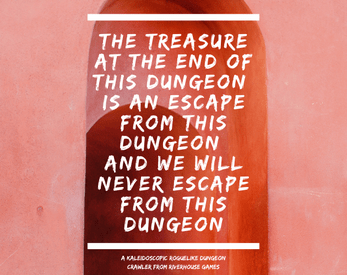
In the tabletop roleplaying game The Treasure at the End of the Dungeon is an Escape From This Dungeon and We Will Never Escape From This Dungeon (hereafter The Treasure), players enter the game’s imagined world, a dungeon, knowing that the ‘treasure’ they seek by playing the game is impossible to acquire. The game cannot be won, only perhaps eventually abandoned. It may seem counterintuitive to discuss utopia in a game that announces from the beginning that its systems and structures are permanent, and that any attempt to escape them is ultimately futile. However, it is through this surrender to the process that players learn the lessons of continued hope, perseverance, and community that serve as a foundation for much of contemporary utopian thinking. For these reasons, in this chapter I describe The Treasure as a utopia, while also recognising that it may appear dystopian.
The Treasure can be understood as a process for utopia that, through play, invites the players to build their own counternarratives about what is valuable in the world they enter into, and also work together to change that world, even knowing that practically they will never ‘win’ the game. It is necessary to adapt an in-flux knowledge of utopia through a queer and feminist understanding of a future that will never reconcile the painful past. If the players cannot escape the dungeon, then the focus shifts to developing their characters’ relationships through roleplaying. The absurdity of the players’ situation, the cycle of endless dungeon rooms, and the descriptions of characters and rooms, encourage a sense of camaraderie and community. In this sense, the game reflects the structure of utopian hope. For the players, the importance lies in fighting the cycle even when the outcome may never change for, as the game states in the world description, ‘We will never escape this dungeon. We will always try to escape this dungeon.’[1] It is possible to work towards utopia while being pragmatic in the knowledge that a perfect future does not exist. In the rest of this chapter, I examine the function of archetypal characters, the utopian dimensions of the players’ roleplaying, and how the game mobilises themes of pragmatism in relation to its feminist and queer utopian ideals.
Utopia is a complex term, and how different pieces of media create and present utopia varies wildly. For this chapter, I approach utopia as a practice stemming from discontent that arises from problems in the present, and exploration of possible futures where these problems are solved or nonexistent. Later in this chapter, I will explore how this vision of utopia shifts into focus through a queer and feminist lens. As suggested by Lucy Sargisson’s Fool’s Gold?: Utopianism in the Twenty-First Century (2012)and Erin McKenna’s The Task of Utopia: A Pragmatist and Feminist Perspective (2001), utopia can present visions of a future in which deeply entrenched social, economic and political problems are resolved or transformed. Sargisson writes that utopia is working towards ‘identifying core problems with today […] and placing them in a new imaginary context. They thus imagine how the world might be if the core “wrongs” identified by the author were transformed.’[2] McKenna explores utopia in relation to the philosophical tradition of pragmatism, and also emphasizes the centrality of hope in interacting with utopian ideals: ‘Utopian visions are visions of hope that can challenge us to explore a range of possible human conditions.’[3]
Utopia is ostensibly where problems are fixed. The creation of a completely separate and carefully integrated fantasy world has often been central to utopian thinking; and not just that it is separate, but that it is totalising. Fredric Jameson describes the movement away from causal utopias as either obsolete due to an inability to solve any and all social disintegration or due to the unparalleled global wealth and technology; however he argues using utopia as an idea to examine politics is still useful.[4] Thomas Moylan in Demand the Impossible similarly describes this developing idea of utopia as imperfect and rejects utopia as blueprint, he describes utopia as ‘[f]igures of hope’ through opposition where utopia is ‘produced through the fantasizing powers of the imagination, utopia opposes the affirmative culture maintained by dominant ideology’.[5] The completely separate utopian world — with readily available solutions for all the problems it seeks to overcome — has fallen out of favor. As Sargisson writes, ‘Most contemporary utopias tend not to offer visions of complete worlds. And most contemporary utopias avoid depicting a single solution; they decline to offer one complete and finished vision of the good life.’[6] In contemporary society, where political, religious, social, and environmental issues have remained at least as divisive as they have been historically, the idea of a perfect utopia that solves all the major conflicts of our current society seems impractical. The Treasure is fundamentally focused on creation and exploration, while providing enough character descriptions to spurn new identity formation without homogenising identity experiences. For example, there is no perfect solution to climate change, and scientific consensus on its causes has not translated to broad political and public agreement, but this does not preclude the struggle for environmental justice. So progress must be made in a more improvisatory, patchwork way. Similarly, contemporary utopias usually don’t try to articulate one single vision of society that is so compelling nobody could refuse it.
Continue reading “We Will Never Escape Utopia: Gender, Queer, Pragmatic, and Hopeful Utopia in The Treasure at the End of the Dungeon is an Escape From This Dungeon and We Will Never Escape From This Dungeon“By Nicholas L. Stefanski

The worldbuilding TTRPG Arium: Create by Adept Icarus promises a utopian procedure for creating gameworlds that are generative, safe, and liberating environments for roleplayers, an undertaking animated by recent debates over the prevalence of harmful, stereotypical, or simply repetitive tropes throughout the TTRPG industry. While the shift away from these problematic tropes is admirable and perhaps overdue within the industry, Arium’s approach to addressing this issue is also notable for its enthusiastic endorsement of creativity techniques stemming from the world of corporate management and innovation consulting. Specifically, Arium’s Lean Worldbuilding approach shares many commonalities with the Lean management philosophy that emerged in the 1990s, largely inspired by Toyota’s operating model. Both Arium’s Lean, and Lean as it is now understood in business, are associated with the pervasive use of Post-it notes for ideation and collaboration.

This article explores how Arium’s utopian solutionism and endorsement of a signature technique of post-Fordist management presents both pitfalls and opportunities for inventive, utopian roleplay. Beginning in the critical mode, I suggest that by adopting techniques that reduce the art of imaginative worldbuilding to a ritualized formula, Arium: Create risks building worlds that are creative merely for the sake of creativity, and consensual mainly in their appeal to the lowest common denominator. Inspired by Adorno and Horkheimer’s critiques of jazz and the culture industry, and following Eitan Wilf’s ethnography of Post-its and critiques of the innovation and creativity industry, the first movement of the article asks whether such strategies of routinized, commodified creativity can only ever produce the ‘freedom to choose what is always the same.’[i] Nevertheless, while this danger should not be ignored, I argue that it would be wrong to dismiss Arium or to label it as utopian in only the pejorative sense. Taking cues from theorists responding to Adorno’s pessimistic stance toward popular culture, notably Adorno’s Frankfurt School colleague and interlocutor Walter Benjamin, the second movement of the article suggests that despite its embrace of corporate solutionism, Arium’s collaborative worldbuilding contains a generative kernel, revealing an additional movement in the dialectic between oppressive technologies of control and the utopian impulse.
Continue reading “Post-it Utopia: The Promises and Pitfalls of Arium’s Lean Worldbuilding”
Reviewed by Kerry Dodd. This review first appeared in The BSFA Review.
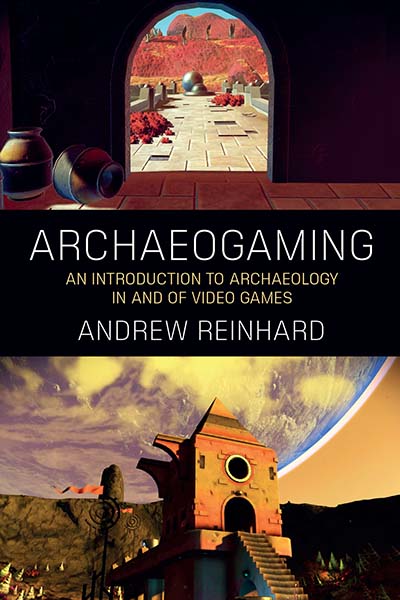
From the dual-pistol wielding Lara Croft from Tomb Raider (1996-present) to the suave Nathan Drake from Uncharted (2007-2017), video games are replete with heroic archaeologists and their exploration of lost worlds. While surely a far-cry from its real-world counterpart, these is a certain pervasiveness to excavational practice within digital media that demands further attention. Can video games themselves be artefacts? How would we excavate a virtual world? Can this medium extend archaeological practice? It is precisely these questions that Andrew Reinhard engages with in his compelling and lucidly written Archaeogaming – a fascinating study of the ‘archaeology in and of games’ (2).
Throughout Reinhard identifies that this is not just archaeology within video games, but also a perspective which encourages the identification of games as artefacts themselves. Fittingly, then the first chapter, ‘Real-World Archaeogaming’, examines the significance of video game physicality – arcades, retro shops, and developer studios – alongside the field’s potential to scrutinise recent cultural products. As the author outlines, video games are irrefutably artefacts of material culture and offer a fascinating insight into such intersections as 1980s popular culture and nostalgia. Take, for example, the urban myth of Atari burying multitudes of E.T: The Extraterrestrial (1983) cartridges in the Alamogordo city landfill – after its wide-spread acknowledgement of being ‘the worst game ever made’ (23) – a perfect encapsulation of real-world archaeogaming at play. Reinhard narrates their own experience as part of the excavation team that dug up the ‘Atari Burial Ground’, a fascinating insight which unseats archaeology as merely the study of ancient history to suggests its applicability to the recent past. This archaeology of garbage – or Garbology – thus allows a more faithful appraisal of contemporary material culture and how the waste left behind is intrinsic to artifactuality. Reinhard then turns to the virtual, cogently examining how video games have their own historicity too, one which can instead be identified through version and build numbers.
Video game archaeological characters have a massive impact upon public awareness of the field, which Reinhard appropriately explores through their prominence of ‘Playing as Archaeologists’. Providing a brief, but informative, survey of the different roles which archaeologists plays in a multitude of texts, this study not only demonstrates the voracity of the trope but also its variance between back-drop setting and the implementation of excavational practice. The separation between archaeologist Non-Playable Characters (NPCs) and mechanical process poignantly queries how an ethical excavational practice can be deployed within the game format. For example, if we can study material culture through the waste left behind, how can this be translated to the digital? Exploring object looting and disposal in World of Warcraft (2004-present) and Elders Scroll Online (2014-present), Reinhard considers the historicity of virtual objects, how they each embody their own ‘fake’ and ‘real’ history while existing across multitudes of player-based instances. Crucially video game worlds can therefore become landscape to not only test and explore archaeological theory, but also one to challenge methodological practice.
It is within this vein that Reinhard next turns to ‘Video Games as Archaeological Sites’ to explore the multifarious ways in which excavational practice can be applied to digital spheres. Utilising No Man’s Sky (2016) as the main example, the author identifies how the ‘No Man’s Sky Archaeological Survey’ (NMSAS) – established by Catherine Flick with L. Meghan Dennis and Reinhard – is a platform that deploys a rigid archaeological structure to study the game’s procedurally-generated universe of over eighteen quintillion planets and its resulting material culture. Outlining an extensive and impressive background of archaeological theory, Reinhard’s meticulous approach offers a compelling framework through which the reader can also establish their own excavational study – the NMSAS’ ‘Code of Ethics’ are replicated in full at the end of the book, a compelling read indeed for interested parties. Certainly, one of the greatest strengths of Archaeogaming is its enthusiasm and openness to wider public immersion. I am particularly interested to see NMSAS’ future excavations now that No Man’s Sky has implemented full multiplayer features – arguably is applicability is as limitless as the procedurally-generated universe itself. Reinhard’s own documented landscape excavation of a Moon within No Man’s Sky is refreshing for its innovative approach, one which is not above commenting on the draw-backs and frustrations incurred from limited mapping mechanics in the game’s early versions.
The final section, ‘Material Culture of the Immaterial’, engages with the complexity of studying the ephemerality of digital presence. Reinhard explores the importance of video game archives alongside the challenges of arranging these artefacts within a museum – are they categorised by genre, by publication date, are the games playable? Museums, of course, equally feature within games, a location which Reinhard interrogates similar to the previous archaeological character study. For indeed, while video games often point or gesture towards a narrativized history, often these are merely artificial or illusionary. In Massively Multiplayer Online (MMO) games no ‘past’ can be verified, as any traces of a player – such as discarded trash – are quickly eradicated. As Reinhard notes, although there may be no material trace to this intangible physicality, this does not preclude archaeologists from exploring the rich didacticism of these increasingly immersive frontiers.
While some may challenge the validity of archaeological study within video game worlds, Reinhard steadfastly and convincingly presents their unique application for expanding excavational processes. To disregard this singular potential is thus to overlook the manners in which they enrich and challenge current practice, questioning our mediation of waste, artifactuality, and ‘presence’. Archaeogaming is by no means an exhaustive study of every excavational video game – and as the author notes, nor can it be – rather Reinhard provides a productive and compelling framework that indeed encourages the reader to enter the field and see what artefacts they too may uncover.
 vector-bsfa.com