Chisom Umeh in Conversation with Adedapo Adeniyi

Adedapo Adeniyi (also goes by Dapo The Abstract) is a Nigerian artist working in literature, film and photography, music (DJ) as well as art curation and counterculture archiving. He expresses his art through abstract avant-garde sensibilities. His debut novel, Wanderer, is available in stores.

Dapo holding his novel, Wanderer

Chisom Umeh is a Nigerian fiction writer and poet. His short stories have been featured in Omenana, Apex, Clarkesworld, Year’s Best African Speculative Fiction 2023, African Ghosts anthology, Isele, Mythaxis, Scifi Shorts, and elsewhere. His short story, “Ancestor’s Gift”, won the 2024 Tractor Beam short story contest. He was a finalist for the Seattle Worldcon Short Story Contest and is the winner of the 2025 Nommo Award for Best African Speculative Fiction Short Story.

Chisom, holding a copy of the Wanderer. Image: African Imaginary

Chisom: Hey Dapo.

Nice to have you do the interview.

I finished reading your novel Wanderer a couple of days ago, and I must say, the journey feels like one long dream. It’s a steady flow of alternating sentences and logic that sometimes contradict each other and yet, strangely enough, feels complete and cohesive. Can you tell me how you were able to keep the story you were trying to tell in focus, even while spinning such a wild tale?

Dapo: Thank you, Chisom. I’m excited to have this interview with you.

I want to start by saying the story mostly wrote itself; I was just a conduit. Most of this book was written in an automatist, stream-of-consciousness style. They were retellings of dreams, memories, and reality, and I wanted them to appear that way. I never lost sight of the story because I welcomed getting lost as I was writing it to find myself.

Chisom: Oh, that’s pretty interesting. To me, the novel reads like Amos Tutuola’s The Palmwine Drinkard crossed with Vajra Chandrasekera’s luminous prose. It definitely felt like older hands were guiding yours on the page. Were there literary influences you were channeling when writing the book?

Dapo: Yeah, I mean, I try to stay away from direct influences while I’m writing, and I didn’t read The Palmwine Drinkard until after I wrote Wanderer. I took influences more from films and cinematic sensibilities than literary, but in that regard, Borges, Philip K. Dick, Timothy Leary, André Breton’s Surrealist Manifesto, Aldous Huxley’s The Doors Of Perception, and my editor and friend, Manuel Marrero. I think these are the ones I can remember right now, plus I don’t want to go overboard. But these people and their works across surrealism, psychedelia, paranoid fiction, sci-fi, metafiction, and so on influenced me in many ways and were formative for how I approached writing and this book.

Chisom: It’s interesting that you mentioned Surrealist Manifesto, psychedelia, and paranoid fiction, because in an essay in Medium titled Abstractism Manifesto, you talked about how ‘abstractism’ is a term that subsumes all of these concepts and more. I like the way you explained it in the essay and how it relates to your work. But could you do a quick description of the term (abstractism) so we could understand it in relation to your work?

Dapo: Absolutely! So when I wrote the Abstractism Manifesto in early 2023, I defined it as being an amalgamation of solipsism, surrealism, psychedelia, subjective reality, and the physics of psychosis. I believe abstractism brings these concepts together to take reality and the world around us from a state of form to an abstract sensory state of formlessness, and that’s what I try to do with my work — the dissolution of some absolute real into an abstract cosmic real.

Chisom: In your experience as a filmmaker, what is the major difference between visual storytelling and written one? Do you prefer one medium over the other?

Dapo: I mean, writing is definitely cheaper. Making films is more expensive and taxing. I also think it’ll kill me faster so that might be why right now it excites me more than writing does. But, frankly, the major difference is the painting. With words, I’m guiding the readers’ imagination. At the end of the day, everyone will come out of it with different images. But with film, I have to literally represent those images on the screen. I’m doing the painting for the audience, they just have to watch and engage.

Chisom: Besides making movies, I know that you do some DJ work on the side. You had a collaboration with NTS, which is really great. How did that happen?

Dapo: Let me put it in context: I work with this new-age collective called Freewater, which was founded by my friends. I serve as its curator and co-director. Freewater secured a residency with NTS Radio, and since I also DJ, they featured one of my mixes as part of the collective. We’re having an underground, new wave music festival/concert on the 11th of December (I think the interview will be out after it?), and NTS is our major partner.

Chisom: That’s incredible, actually. So, does your music influence your writing in any way? Some writers like to curate playlists for particular writing projects. Something they listen to just to put themselves in the mood. Are you that kind of writer?

Dapo: Music definitely plays a huge part in my process. When I was writing Wanderer, all I listened to was shoegaze. I found a shoegaze playlist that had over a hundred songs and it was all I listened to while I slept and dreamt and while I wrote as well. I’ve been DJing for almost 2 years now, and it’s made me understand music as well as how different people interact with it. There are sensibilities of transience I borrowed from writing and translated to how I DJ.

Chisom: I kept wondering about the shoegaze reference when I was reading the book. Something told me there was more to it than just being an element in the story, and I’m glad you just confirmed that. Which brings me to your process with writing your stories and how you edit them. Do you edit while writing or after?

Dapo: Oh yeah, shoegaze has a very dreamlike, haze-inducing feeling and I wanted the book to feel like that. I do very minimal editing while writing. I finished the entire thing then read it over a couple of times before sending it to my editor, and we had this period of sending drafts back and forth and conversations on the subject matter.

But enough about me, I want to hear what type of music you listen to and how editing works for you. I mean, you just won the Nommo, haha.

Chisom: Oh, lol.

Well, I’m very mundane with my music. I don’t have any playlists or do any sort of curation. In fact, when I’m writing, I wouldn’t want to hear any music at all as it easily interferes with my thought processes and breaks my stream-of-consciousness, AKA “flow”. But when I do listen to music, outside writing, it’s very Davido and Asake and Victony, and whatever Dlala Thukzin just released. For edits, I can’t move forward with writing if I feel like there’s something wrong with a previous sentence. So I tinker with that till it feels fine to me. So we’re maybe kind of opposites on this.

Dapo: Correct me if I’m wrong but you seem like a very calculated writer. You’re delicate about detail, you’re careful. I think it’s beautiful. I wish I could be that type of writer. Like I said before (this may sound a little pretentious but I fully believe it), I don’t really do any writing, these things write themselves and use me as a conduit. I don’t know where they come from or where they are going or why; they come raw and I write in real time. My flow can be erratic most times.

Chisom: I like to think I have an eye for detail, but, trust me, I’m not really that meticulous. I know writers who would draw up elaborate plots that cover the first scene to the last, and fill up a board with sticky notes. Me? I mostly just sit down and write a story as it comes into my head. I think both our approaches are valid, so long as the outcome is something folks can read and enjoy. When I’m done writing and send the work out, that’s where my effort ends. But I’ve seen you go through hell and high water to publicize your book. And it has really paid off. Maybe that’s something you’d teach me someday?

Nardwuar holding a copy of Dapo’s first novel, Wanderer

Dapo: You’re amazing, so we’re kin.

Thank you, I think it’s been a learning curve. A lot of how this book has been handled is experimental, constantly trying to see how to reinvent whatever a rollout is supposed to be. Some days before the book came out I’d post videos of just my legs as I was walking around. Wandering, if you will. I made cards and handed out googly eyes. I’ve had readings and talks. I even had an abstractism lecture and played a psychedelic techno set. I keep thinking of ways to present a work of literature outside of just the confines of literature, especially as a multimedia artist. I look forward to reinterpreting the book and presenting it in so many other formats: photograph, sound, installation, you name it.

Chisom: Say I wanted to try my hand at writing abstractism, are you holding one of those lectures anytime soon?

Dapo: Hopefully sometime early next year. I’m working on writing another edition of the manifesto that’s more professional, but I think that through reading the manifesto that’s up right now, as well as Wanderer and some of my short stories, anyone could get the gist of what abstractism is.

What’s next for you now Chisom? In the world of African Speculative Fiction.

Chisom: For me, I’m also trying to piece together a collection of short stories that hopefully might be my debut in the book-publishing space. I want most of the stories in the collection to be centered around two themes, so that means I’m writing mostly new stories.

Anyway, it’s really been wonderful having this chat with you. I’m looking forward to reading more of your stuff in the future.

Dapo: Sending you love and the best of wishes Chisom, excited to see your collection. I’ll send you mine as it comes along. You’re a refreshing voice in the scene here.

Wanderer, cover art

‘The Utmost Sail’ by Karel Janovický: A Neglected Czech SF Opera 

By Cyril Simsa

My late father, the Czech composer and broadcaster, Karel Janovický – born Bohuš František Šimsa in Pilsen in 1930, but better known under the pseudonym he adopted in the 1950s to protect his parents, whom he had left behind in Communist Czechoslovakia, when he skipped the border during the Cold War – died in January 2024. He left behind a four-storey Victorian terrace in North London, crammed with music, books, and papers, including 250 or so classical compositions and a not inconsiderable personal archive. 

It was in his papers that I found a booklet with the libretto of his one-act opera, The Utmost Sail, which he wrote in 1958 to an English-language text by another Czech émigré, Karel Brušák (1913-2004). The booklet is mimeographed, fanzine-style, so it is not a professional publication; but to anyone familiar with the history of fanzines or sf fandom, the format will be immediately recognisable, and I assume this is something that he or Brušák must have had printed for the benefit of future producers and performers at around the same time they were finishing the work itself.

Karel Janovický, Ludwigsburg refugee camp, Germany, ca. 1950

I had been long aware that my father had written an opera, and back in my teenage years, when I was at the height of my initial involvement with science fiction, he had even told me it was set on a spaceship. However, in the way children have of ignoring their parents, I had never actually seen a copy or read the text. And while I have still not seen a performance, the libretto can stand on its own as an interesting example of mid-20th Century European sf theatre. 

Continue reading “‘The Utmost Sail’ by Karel Janovický: A Neglected Czech SF Opera “

Jean-Paul Garnier interviews Tara Campbell

Tara Campbell is an award-winning writer, teacher, Kimbilio Fellow, fiction co-editor at Barrelhouse, and graduate of American University’s MFA in Creative Writing. Publication credits include Masters Review, Wigleaf, Electric Literature, CRAFT Literary, Uncharted Magazine, Daily Science Fiction, Strange Horizons, and Escape Pod/Artemis Rising. She’s the author of the eco sci-fi novel TreeVolution, two hybrid collections of poetry and prose, and two short story collections from feminist sci-fi publisher Aqueduct Press. Her sixth book, City of Dancing Gargoyles, was released by Santa Fe Writers Project (SFWP) in September 2024. She teaches creative writing at venues such as Johns Hopkins University, Clarion West, The Writer’s Center, and Hugo House. Find her at www.taracampbell.com

Jean-Paul L. Garnier is the owner of Space Cowboy Books bookstore and publishing house, producer of Simultaneous Times Podcast (2023 Laureate Award Winner, 2024 BSFA, Ignyte, and British Fantasy Award Finalist), and was the editor of the SFPA’s Star*Line magazine from 2021-2025. He is also the poetry editor of Worlds of IF & Galaxy magazines. In 2024 he won the Laureate Award for Best Editor. He has written many books of poetry and science fiction. https://spacecowboybooks.com/

JPG – CITY OF DANCING GARGOYLES has a really interesting format: it switches between epistolary and more traditional novel narratives. What made you decide to mix these formats to tell your story, and what advantages did it provide you?

TC – Well, I hadn’t actually planned on writing a novel. During COVID I was having a hard time concentrating enough just to read, let alone write, but I was inspired by a novel pre-writing technique by Michael Moorcock that centered on imagery containing deliberate paradoxes. The image he gave as an example was “In the city of screaming statues.” That image created so many questions in my mind: I had to know what the city looked like, what it sounded like, what set these statues off, were they screaming words or just sounds, did they ever stop, etc. I was excited at how many questions that one image created, so I created a writing exercise for myself based on nouns and verbs, putting together words that absolutely do not belong together, like floating wolves and sailing statues and glaring chocolates and all of these things that simply can’t be.

I wound up writing a couple dozen stories, and when I started thinking about how to bring them together in a collection, I created a chart to figure out how to group them, looking at commonalities of theme or tone or perspective or any way they would cohere. Then a writer friend suggested using an element I mentioned in one of the stories—alchemical testing—to imagine all of the stories as part of the same universe.

Once I started thinking in terms of a novel, I had to be more ruthless in how to change or cut stories for the purposes of the narrative. Some of the stories turned into setting or characters instead of self-standing works. But on the other hand, the epistolary sections let certain stories be as weird as they wanted to be in this future US that’s been that’s been altered by climate change and alchemical testing.

Continue reading “Jean-Paul Garnier interviews Tara Campbell”

Tony Conn Interviews Catherynne M. Valente

Catherynne M. Valente has packed a lot into the first 20 years of her career. Her genre-busting work runs the gamut from alternative history to fairytale fantasy to cosmic horror. In addition to writing 27 novels and novellas, she has multiple collections of short fiction and poetry. She is also the creator of a six-year-old human, but motherhood shows no signs of slowing her down. Space Opera, her 2018 bestseller about an interplanetary Eurovision Song Contest, was shortlisted for Best Novel at the Hugo Awards. Her new novel, Space Oddity, picks up where Space Opera left off and reflects contemporary concerns like pandemics, online misinformation, and the threat of all-out war. https://www.catherynnemvalente.com/

Tony Conn is a writer and filmmaker with an interest in all things strange. He is perhaps the world’s leading expert on the Megatron, a flying saucer-shaped restaurant that used to adorn the Cambridgeshire countryside and now features in Space Oddity. https://tonyconn.com/

TC: Could you tell us about your background and early influences?

CV: My parents met at UCLA and divorced when I was very young. I had two stepparents most of my childhood and went back and forth between Seattle and northern California. My dad was an aspiring filmmaker who went into advertising instead, which is very much a family thing on my father’s side. A lot of them intended to be artists and ended up in the family business. My mother is a retired political science professor. She was in her master’s and PhD programmes through almost every portion of my early life that I can remember. She was working for the mayor of Seattle, getting her degrees in public policy, doing advocacy work, and she’s a pretty hardcore statistician as well.

They were in their early twenties when they had me. They had no sense of what was appropriate for a child. I had no boundaries as to what I could read, or watch, or anything. I just had to be vocal about when it was too much for me, which is kind of a modern parenting idea. My mother read Plato’s Republic to me as a bedtime story, specifically The Myth of Er, which is this allegory about what happens when we die. At five, she had me read The Breasts of Tiresias by Apollinaire. It’s above the pay grade of adults, let alone a small child. My mother had no sense of that. In my mom’s house, there are stacks of books that are now end tables. Cairns of books everywhere.

Both of my birthparents are big musical theatre people, so I grew up seeing musicals all the time. I’ve always had this really low voice, since I was ten. I wanted to be a singer, but there weren’t any parts for somebody with a voice like mine. My mom also has a master’s degree in drama, so I remember when Beaumarchais was a big thing in our house. At eleven, all that anybody talked about was The Barber of Seville.

I had a lot of influences from my parents. My mom read every murder mystery. My dad is hardcore science fiction. And then, my stepmother Kim is the world’s biggest Stephen King fan. Horror was my first love, both as a reader and a writer.

Continue reading “Tony Conn Interviews Catherynne M. Valente”

Jean-Paul Garnier interviews A. D. Sui

A.D. Sui is a Ukrainian-born, queer, disabled science fiction writer, and the author of THE DRAGONFLY GAMBIT and the forthcoming Erewhon novel, THE IRON GARDEN SUTRA (2026). She is a failed academic, retired fencer, and coffee enthusiast. Her short fiction has appeared in Augur, Fusion Fragment, HavenSpec, and other venues. When not wrangling her two dogs you can find her on every social media platform as @thesuiway – https://thesuiway.ca/


Jean-Paul L. Garnier is the owner of Space Cowboy Books bookstore and publishing house, producer of Simultaneous Times Podcast (2023 Laureate Award Winner, BSFA, Ignyte, and British Fantasy Award Finalist), and editor of the SFPA’s Star*Line magazine. He is also the deputy editor-in-chief of Worlds of IF & Galaxy magazines. In 2024 he won the Laureate Award for Best Editor. He has written many books of poetry and science fiction. https://spacecowboybooks.com/

JPG – The Dragonfly Gambit has all of the elements of space opera: a big story, politics, empire, worldbuilding, etc., but unlike most modern space operas the book is short – how did you manage to create such a large-scale story in so few words, and what are your feelings on space opera as a sub-genre?

A.D. S – First, thank you so much! I want to say that space opera has a long-running tradition of glorifying empires. They’re almost the natural default government system in far-future science fiction, which positions them as a sort of inevitability. But historically, we know this isn’t true. Empires fall all the time. That’s the whole point. So, I really wanted to focus on a time of an empire falling.

As far as the structure goes, I can’t remember who said it, it might have been one of my agency siblings, but in a novel, each scene fights for its right to exist. In a short story, every sentence does. A novella is somewhere in between, so my editing wasn’t as ruthless as it would have been for a short story, but I was definitely focusing on each sentence delivering either character development or new information, and preferably both. Also, as much as it is a space opera, it also has *one* location where most of the action takes place. So, I could really go into a lot of detail about the world/order of things by describing this one place instead of jumping between locations.  

JPG – One of the themes in the book is sacrifice and martyrdom, sacrifice being an arcane tradition to the culture in the book – can you speak about the nature of sacrifice and weighing individual characters against large-scale problems?

A.D. S – It’s a bit of a pipe dream to think that one person can shift the tides of history. I don’t think anyone is that special. It’s one of the reasons why, as a genre, science fiction and fantasy are moving away from, or challenging, the Chosen One narrative. But how often do you see a disabled protagonist who is a woman, in her thirties, and by every marker, a failure, be The Chosen One? That was fun to write, and yes, very self-indulgent. 

Now, sacrifice and martyrdom were two themes that felt natural when having a conversation about militaries. Martyrdom is baked into military culture, you can’t escape it. Historically, militaries uphold and immortalize those who lose their lives in combat. We label these people as heroes while simultaneously treating them terribly while they’re still alive or if they remained alive (see the utter lack of any decent veterans’ services). It’s easier to herald someone as a hero than to actually treat them as such. There is a tension in there between the shine of heroism, and the loss of life and the absolute meaninglessness of it while it’s still there. 

Continue reading “Jean-Paul Garnier interviews A. D. Sui”

Jean-Paul Garnier interviews Pedro Iniguez

Pedro Iniguez is a Mexican-American horror and science-fiction writer from Los Angeles, California. He is a Rhysling Award finalist and a Best of the Net and Pushcart Prize nominee. 

His work has appeared in Nightmare Magazine, Never Wake: An Anthology of Dream Horror, Shadows Over Main Street Volume 3, and Qualia Nous Vol. 2, among others. 

Forthcoming, his horror fiction collection, FEVER DREAMS OF A PARASITE, is slated for a 2025 release from publisher Raw Dog Screaming Press. https://pedroiniguezauthor.com/

Jean-Paul L. Garnier is the owner of Space Cowboy Books bookstore and publishing house, producer of Simultaneous Times Podcast (2023 Laureate Award Winner, BSFA, Ignyte, and British Fantasy Award Finalist), and editor of the SFPA’s Star*Line magazine. He is also the deputy editor-in-chief of Worlds of IF & Galaxy magazines. In 2024 he won the Laureate Award for Best Editor. He has written many books of poetry and science fiction. https://spacecowboybooks.com/ 

JPG – What made you want to take on the themes in Mexicans on the Moon through speculative poetry, and where did specpo take you that other mediums might not have allowed? 

PI – I think there’s a power in the brevity and playfulness of poetry that really worked in my favor with this collection. Speculative poetry allows me to shift gears quickly from poem to poem. For example, in Mexicans on the Moon, you’ll find poems that are heartwarming, funny, sad, chilling, or thought-provoking. It allows the poems to take on their own life, be tonally different, while still feeling thematically coherent in the grand scheme of things.  

Continue reading “Jean-Paul Garnier interviews Pedro Iniguez”

Henry Farrell talks to Kim Stanley Robinson

Henry Farrell teaches democracy and international affairs at Johns Hopkins University. Kim Stanley Robinson is a science fiction writer whose most recent novel is The Ministry for the Future. Their conversation took place in March 2023 at Stanford’s Center for Advanced Studies in the Behavioral Sciences, around Tor’s forthcoming June 2024 re-issue of Robinson’s 1984 novel, Icehenge.

HF – How did you come to write Icehenge?

KSR – When I was a kid I loved stories about archeology, including pseudo-archaeology. There were quite a few fake archaeologies about when people first got to the Americas – the Phoenicians; St. Brendan; the Welsh – I read all these with huge pleasure. Everybody got to America, it seemed. I was perhaps 10 or 12.  Whether I was making any distinctions as to whether these were real or not, I’m not sure.  I just loved them so much as stories. 

One of the stories was about the Kensington Stone, which was discovered in Minnesota in 1898. A Swedish American farmer found a piece of stone, with runes carved onto it saying more or less ‘we’re out here, the natives are killing us, mother Mary save us.’ It’s actually quite moving as a prose poem or last testament.  It was dated to 1362, and Hjalmar Holand, a scientist from Chicago, decided that this was a genuine stone and spent his career trying to find an expedition from that era that would explain it. He found that a pope of that time had asked the Danes to find out what had happened to the church in Greenland, and an expedition had gone off to do so, and never was heard of again. Hjalmar Holand said these people got to Greenland, found it abandoned, went up the Hudson Bay looking for the missing Greenlanders, then went up one of the rivers leading southwest, and in two weeks were in the middle of Minnesota, where the locals killed them with arrows. 

You can still go to Kensington Minnesota, where there is a 10 ton, 20 foot high copy of the stone, which was just a little thing. The original stone was displayed in the Smithsonian for a while as evidence of Vikings in America, but many experts in runes were dubious from the start about the language on the stone. They thought it was all wrong, but Holand defended it until he died. A couple of years later, someone noticed that all the runes were multiples of one inch long, suggesting it had been carved with a one inch chisel. It turned out that the Swedish farmer who found it was a country intellectual, who wanted to bother the brains of the learned, as he once put it. He’s almost certainly the guy who did it.   But since Holand had died, he didn’t see it being removed from the museum. 

At that point I began to get interested in hoaxes as such.  The Vinland map was thought to be a hoax, and then was thought to be real, and now we think it’s a hoax again. I was interested in how hoaxes got found out, what the methodologies are and so on. Then in the midst of my reading, they found a real Viking site in Newfoundland at L’Anse aux Meadows. At that point I was 11 years old, so that dates my reading of this stuff.  The news was announced in National Geographic, and I was thrilled. 

So, when I became a science fiction writer, I was wondering what kind of stories to tell. I was young, nothing in particular had happened to me, so I was often telling stories out of books. Then a friend sent me an article in Forbes magazine saying that we could live up to 500 years if we could repair our DNA when it got damaged. I thought, Wow, what if Hjalmar Holand had lived a little longer, and thus saw his entire life’s work knocked down like a house of cards—what would he have said? How would he have felt?  And I thought that would make a story. 

Continue reading “Henry Farrell talks to Kim Stanley Robinson”

David Rix interviews Alexander Zelenyj

Alexander Zelenyj is the author of the books Blacker Against the Deep DarkSongs for the LostExperiments at 3 Billion A.M.Black Sunshine, and others. His most recent book is These Long Teeth of the Night: The Best Short Stories 1999-2019. His books and stories have been translated into several languages, including German, French, Romanian, Italian, Spanish, and Ukrainian. He has a collection of brand new stories forthcoming from Eibonvale Press in Fall 2024.

Zelenyj lives in Windsor, Ontario, Canada with his wife and their growing menagerie of animals. Visit him online at alexanderzelenyj.com.

Alexander Zelenyj
 

David Rix: Thank you for taking the time to talk! How are you finding this new year so far? 

Alexander Zelenyj: My pleasure, thanks! I’m finding the year so far very busy. Busy with mostly good things. We have a new kitten and she’s a handful. She adopted us. Showed up at our back porch door on a cold night, tiny and frail. How could we turn her away? 

DR: I feel we may need some kind of ‘cat tax’ here – that would definitely get all this off to a good start! But anyway – I have been involved with your writing in various ways for quite a long time now and I have published several of your books, so this is a good chance to dig in a bit and explore what is going on – what makes you tick, as it were.

When reading your stories, one gets the feeling of a lot of different threads coming together, from nostalgia for classic forms of writing to the much more surreal and experimental. Can you tell us a bit about the influences that came together to make you? And maybe which ones came first and which were added later?

AZ: My home library tells the story most clearly, I suppose because I’ve always bought a lot of books and rarely get rid of them. This means I still have all the ones I had when I was a young boy, certain of which had the most profound influence on me. I was most drawn to the stranger books, which turned out to be a lot of science fiction, fantasy and horror. Those genres and many key works from each became foundational influences for me. Especially authors like Robert E. Howard, who has stood the test of time, still has a primal power and weaves a very strong spell. I remember reading Howard’s story, “The Tower of the Elephant” as a boy and having a true moment of clarity—one of just three such moments I’ve ever had in my life—and understanding that I’d just discovered something magical and very powerful, something that called to me in such a strong way that I knew I had to write stories, too.

Authors like Arthur Machen, Ray Bradbury, Edgar Allan Poe, Richard Matheson, and James Tiptree Jr. also had a huge impact on me, and continue to do so. Harlan Ellison as well. His The Beast That Shouted Love at the Heart of the World was a revelation for me. All of his collections are amazing but this one has a huge amount of variety between its covers that I’m not sure he matched anywhere else, and it’s some of his most original work. The novella “A Boy and his Dog” does a wonderful job of establishing the lead character’s amoral motivations within a post-apocalyptic wasteland, which turns out to be the most disturbing aspect to the story because it asks (and answers) the question with a kind of unerring logic: how far away are we from being this boy, in this world?

Going back even further, I have an early memory of my mother reading to me from a book of Czech fairy tales by Karel Jaromír Erben. One story in particular, called “Otesánek”, really frightened me—it was about a couple who cares for a baby that has come to life from an inanimate piece of wood. 

DR: Yes, people might be more familiar with this story from the film by Jan Švankmajer – Little Otik. That had quite an effect on me as well.

Jan Švankmajer – Little Otik

AZ: Yes, that’s the one. The baby’s appetite soon becomes much more voracious than its adoptive parents could have foreseen. Looking back on it, I see a deep pathos to this story about a childless couple wanting so desperately to have a baby that, through some magical means, the universe seemingly grants them their wish, only to have their dreams turn into this deeply disturbing, nightmarish scenario. I still have my childhood copy of the book, and it has a special place on my shelves. This might have been one of my earliest exposures to the supernatural, or the unknowable.

Continue reading “David Rix interviews Alexander Zelenyj”

Interview with Renan Bernardo

By Jean-Paul L. Garnier 

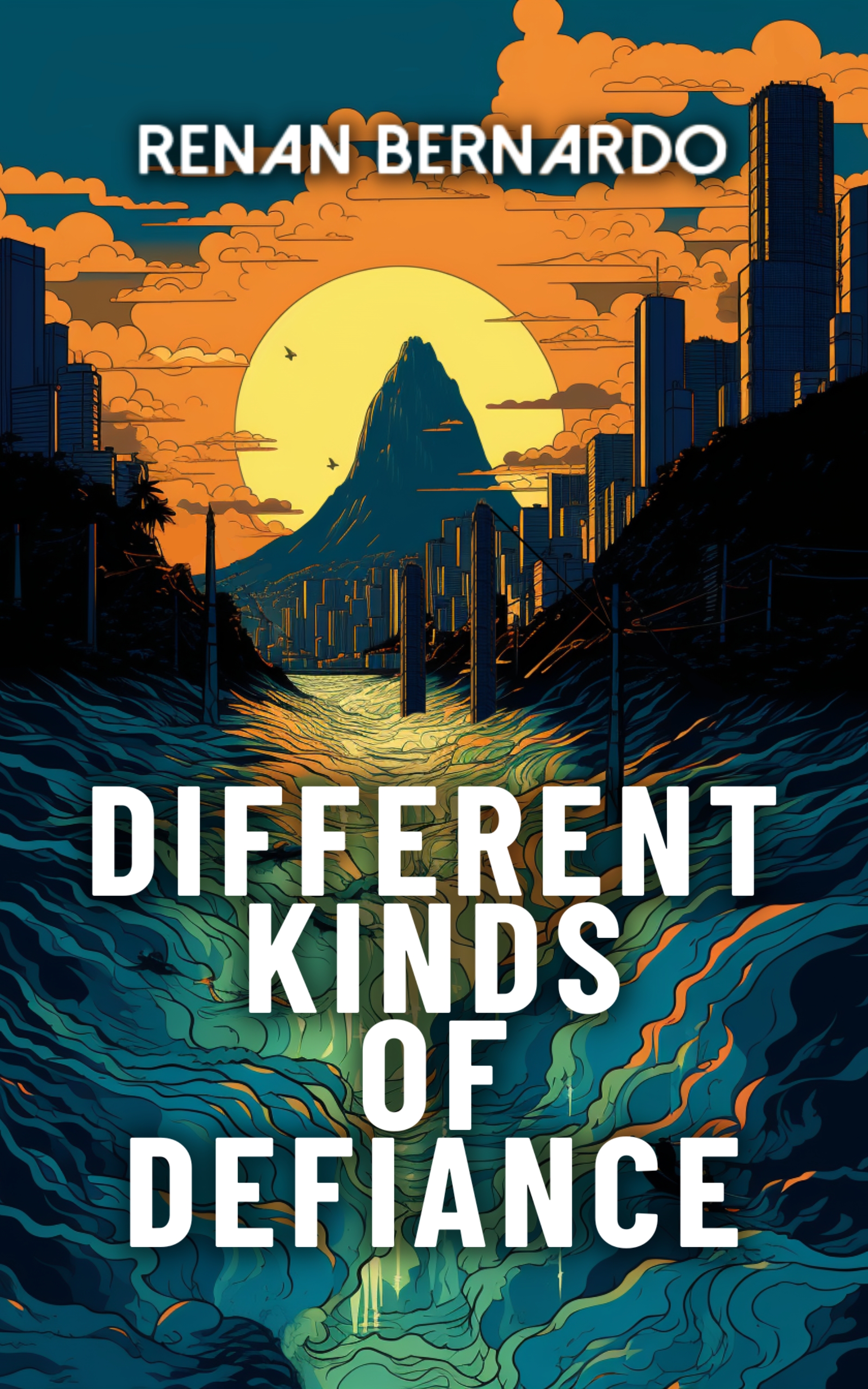
Renan Bernardo is a Nebula finalist author of science fiction and fantasy from Brazil. His fiction appeared in Reactor/Tor.com, Apex Magazine, Podcastle, Escape Pod, Daily Science Fiction, Samovar, Solarpunk Magazine, and others. His writing scope is broad, from secondary world fantasy to dark science fiction, but he enjoys the intersection of climate narratives with science, technology, and the human relations inherent to it. His solarpunk/clifi short fiction collection, Different Kinds of Defiance, was published in 2024. His fiction has also appeared in multiple languages, including German, Italian, Japanese, and Portuguese. He can be found at Twitter (@RenanBernardo), BlueSky (@renanbernardo.bsky.social) and his website: www.renanbernardo.com

Jean-Paul L. Garnier is the owner of Space Cowboy Books, producer of Simultaneous Times Podcast (2023 Laureate Award Winner, BSFA Finalist), and editor of the SFPA’s Star*Line magazine. He is also the deputy editor-in-chief of Worlds of IF magazine & the soon to be relaunched Galaxy magazine. He has written many books of poetry and science fiction. https://spacecowboybooks.com/

JPG – In many of your stories you juxtapose the past with the present, layering multiple times together, tell us about using this narrative device, and how you use it for emotional effect? 

RB – Layering past and present together without necessarily resorting to flashbacks is an excellent device to make the reader flow along with the main character’s feelings without breaking the pace of the story. I believe the past has a lot of things to say. Our past shapes who we are, so it always adds an interesting layer to my stories. Many answers to the present and the future are in the past. I believe that you were thinking of “Soil of Our Home, Storm of Our Lives” when you thought about that question. In this story, there are three timelines layered separately: past, present, future, each with different things to say about the characters, different emotional cores to introduce that end up fusing in the end. The challenge is always to weave them all together, so they don’t feel detached from each other, but I like to believe that I achieved it in this particular story.

JPG – Your stories often present utopias, but as you mention in your forwards, one person’s utopia can be another person’s dystopia. Can you speak about this concept and why cultures have a difficult time envisioning positive futures that include everyone?

RB – There are two stories in the collection that introduce this concept: “Anticipation of Hollowness” and “To Remember the Poison.” In “Anticipation of Hollowness,” there’s a sustainable city where everything seems perfect but the city is extremely gentrified and no one from lower or middle class is able to live in it anymore. And “To Remember the Poison” is an extreme version of it: a society based on justice, sustainability, and equality that got so detached from the rest of the world that it became an exclusive haven closed to the world. And though its focus is on education and expanding their “green” world, its inhabitants tend to follow a line of thought not so different from what billionaires imagine with their projects of selective bunkers or space stations. And given the concentration of resources and knowledge of Verdoá (the city in the story), it becomes a colonizing power in the region.

Continue reading “Interview with Renan Bernardo”

Interview with Samantha Mills

by Jean-Paul L. Garnier

Samantha Mills is a Nebula, Locus, and Theodore Sturgeon Memorial Award winning author living in Southern California, USA. You can find her short fiction in Uncanny Magazine, Beneath Ceaseless Skies, Strange Horizons, and others, as well as the best-of anthologies The New Voices of Science Fiction and The Year’s Best Science Fiction & Fantasy 2023. Her debut science fantasy novel, The Wings Upon Her Back, is out now. You can find more at www.samtasticbooks.com

JPG – The culture in The Wings Upon Her Back is a theocracy where labor and religion are intertwined, can you tell us about using this as a worldbuilding device? 

SM – When developing The Wings Upon Her Back, I wanted a claustrophobic, monocultural setting to reflect the isolation of the main character and the fraught history of her city. Everything had to revolve around the five gods that are sleeping overhead. 

In the book, the division of labor is a core tenet of their religious and social framework because they are emulating the gods, who arrived with very clearly defined roles. I ended up with five sects: the workers and farmers are the biggest groups, who keep the city running; the scholars and engineers are documenting and implementing the teachings of the gods; and the warriors keep the city isolated from outside forces. The primary conflict of the book comes from the unbalancing of these factions, as the warriors take more power over the others. 

One of my favorite worldbuilding techniques is to build out social expectations – what everyone is supposed to believe, what everyone is supposed to do – and then to imagine the characters who do not fit the mold. I set a limit at five sects because it automatically creates tension: you can’t actually sort the breadth of humanity or the tasks needed to keep society running into such a small number of categories!  

This tension permeates the book. There are jobs, such as medicine, that rely on teachings from multiple gods, and therefore arouse some unease. And there are many individuals who don’t fit neatly into their sect. My main character, Zemolai, was born into a family of scholars, but left them to be a warrior. The hodgepodge group of rebels she falls in with later in life have all either changed sects, or are revolting against the expectations placed on workers specifically. The right to question the division of labor (and therefore, the teachings of the gods) is central to the story. 

Continue reading “Interview with Samantha Mills”