Issue 300, ‘Community’— Call for proposals

Solaris (1972), Andrei Tarkovsky

Science fiction, for all it encompasses strange new worlds and fantastical creatures, is a literary genre that is built and sustained by human communities. Writers, artists, and creators have imagined new social formations, technologies, economic, ecological, and sociopolitical systems for centuries; indeed, science fiction may be the most nakedly political of all literary genres, as thought-provoking as it is beguiling. Who is present in narratives of futurity? What kinds of technologies enable—or stymie—human connection? How can inter-species communities develop and flourish? 

Pre-internet, fanzines and conventions were the spaces where editors, authors, and fans met, shaping the genre in new and exciting ways. Praise and critique and conflict and collaboration were equally already common before social media. Some landmark dates include: the first WorldCon (1939), the first British science fiction convention, Eastercon (1937), the Maleyevka seminars, Nihon SF Taikai (from 1962), and many others, around the globe.

In 2024, the ideologies of ‘community’ are under pressure and scrutiny. Violent geopolitical events shadowplay on smartphone screens, small enough to fit in the palm of our hands, fulfilling the most dystopian dreams of the genre; we venture to fight and commiserate and celebrate with people from all over the world, instantly. Where wealthy industrialists were (and are) once praised as saviors of humanity with the glittering promise of their space programs, now SF tends to show how the relentless logics of capitalism undermine any notions of transcendence. The challenge of space travel was supposed to unite us. What would the pioneers of SF make of the now-straining politics around the International Space Station, scheduled for dismantling by 2030? 

In light of these challenges, the Vector team—for the journal’s milestone 300th issue—invites contributions that reify the notion of ‘community’ as it manifests in speculative cultures. What tools can SF offer us to construct better tomorrows, together? How can we innovate new ways of collaborating, such as the world-building projects of Syllble? What does ‘community’ look like in fiction, non-fiction, conventions, awards, conferences, collaborations, online spaces, and other literary and paraliterary formations?

Suggested questions / topics

  • history of fandom/conventions 
  • the practice of writing: zines, magazines, letters 
  • science fiction publishing: editors and collaborators on the printed page 
  • utopias and dystopias 
  • terraforming
  • defining personhood 
  • future societies 
  • sex and sexuality 
  • navigating conflict 
  • political divides, past and present 
  • interspecies alliances
  • the posthuman 
  • the future of communication 
  • translating SF 

Please submit your proposal by June 15th, 2024 to vector.submissions@gmail.com, including:

  • a 150-500 word proposal, including estimated length;
  • something about yourself, either a 50-100 word bio or a CV.

Articles should be between 1,000 and 8,000 words. Please let us know your estimated word count. We seek articles that are carefully grounded in scholarly research, while also being clear, engaging, and suitable for a broad audience (including non-academics). Articles will be due by July 31st, 2024.

Please also feel free to make queries about other formats, e.g. reviews, interviews, curated reading lists, roundtable discussions, unusual / innovative formats. 

Ukrainian Women in SF: A Roundtable Conversation

Interviewed by Michael Burianyk

Nataliya Dovhopol, Natalia Matolinets, Iryna Hrabovska, Daria Piskozub and Svitlana Taratorina are five young, diverse Ukrainian women writers of Science Fiction and Fantasy. Not only is their fiction significant but they also have a YouTube channel “Фантастичні talk(s)/Fantastic talk(s)” (@fantalks) where they discuss the history and current state of Ukrainian fantastic literature and interview foreign writers. All are fluent and articulate in English. More importantly they are expressive in their understanding of their own work and the importance of Science Fiction and Fantasy in understanding real life. Their insights into their writing reveal how it fits into contemporary Ukrainian culture and literature. Their responses are often touching and even harrowing, considering the horrific war they are experiencing.

Note for the following that both Nataliya Dovhopol and Natalia Matolinets share the same first name, spelled the same in Ukrainian, but use different English spellings.

What themes and topics do you explore in your work? 

Nataliya Dovhopol I combine my interests in local history, mythology, art history and cultural studies with my degree in Theory and History of Art. I consider my novels to be historical fantasy (To Find the Amazon’s Land, The Knight of the Drevlyanian Land and the Lady Eagle) and ethnic fantasy (Wandering Circus of the Silver Lady). I also explore urban fantasy and like to experiment with genres and topics to reveal unknown pages of Ukrainian history, but always in the context of the real world. As well, suffering a lack of coming-of-age stories in my childhood, I want today’s youngsters to easily find exciting books by Ukrainian authors.

Iryna Hrabovska I’ve written in many genres, including detective stories and adventure novels. But most of all I love researching history. My debut was the steampunk duology Leoburg mostly set in a world with an alternate European history. My new trilogy (The Crystal Castle) is a sword and sorcery fantasy based on the events of the Hundred Years’ War. I am particularly proud of my mystical story The Closest to Hell, about the disappearance of miners in one of the first mines in Donbas in the early 20th century. It’s based on historical material about the small mining town of Snizhne, where I was born, and I want Ukrainians to see the Donetsk region not only as a place of war but also as a place of beauty and fantasy.

Continue reading “Ukrainian Women in SF: A Roundtable Conversation”

Duchamp’s time machines: Paul Minott in discussion with James Gillham

Paul Minott worked as a leading graphic designer for over thirty years, working for
numerous international design consultancies in London and abroad. He ran a
successful partnership in London before embarking on a teaching career at Bath Spa University. He now works making one-off abstract prints using an etching press.

James Gillham completed a practice-led Ph.D. in Fine Art at the University of Reading in 2014, researching capability via the intersection of institutional demands and intersubjective expectation. He continues this research by painting the Humpty character from Olaf Stapledon’s Last Men in London, and by seeking similar representations in Science Fiction.  James lives and works in Wiltshire, and is the cover artist for the latest issue (299) of Vector.

Marcel Duchamp, The Bride Stripped Bare by her Bachelors, Even (The Large Glass), 1915–23. VIA CREATIVE COMMONS/COURTESY PHILADELPHIA MUSEUM OF ART

Marcel Duchamp’s famous work The Large Glass (1915-23) has been duplicated numerous times, by artists such as Richard Hamilton (1965) and Ulf Linde (1961).  Duchamp’s approval of these pieces emerges from his established interest in the ready-made, but also points to a more nuanced conception of time situated in popular contemporary European Modernist thought.  

Nude Descending a Staircase, No 2 (1912) is perhaps the most explicit example of this interest with temporality, but the glass mechanisms such as Rotary Demisphere (Precision Optics) (1925) bring these engagements into clearer focus.  These spinning devices suggest an investigational approach to time’s passage – expansions and contractions operating between objective measurement and subjective experience.

Duchamp’s ludic approach to time has interested artist and printmaker Paul Minott for many years, and is the impulse behind Minott’s latest work: Portrait de Voyage dans le TempsPortrait de Voyage dans le Temps is an Artificially Generated visual essay, showing Marcel Duchamp alongside his various time machines.

Minott discusses Duchamp’s Modernist conception of time and how this appeared in Duchamp’s artwork – while finding parallels with contemporary use of Artificial Intelligence to generate images – with fellow artist James Gillham.

Continue reading “Duchamp’s time machines: Paul Minott in discussion with James Gillham”

Interview with Eve Smith

By William Davies

Eve Smith is the author of three speculative thrillers. Her latest novel, ONE, published in 2023, is set in a one-child policy Britain that has been ravaged by climate change. It was longlisted for the 2023 British Science Fiction Association Best Novel award. Her debut, The Waiting Rooms, set during an antibiotic crisis, was shortlisted for the Bridport Prize First Novel Award and selected as a Guardian Book of the Month. Off Target, her second novel, imagines a world where genetic engineering of children has become the norm. It was a Times Book of the Month, who described it as ‘an astute, well-researched and convincing novel of ideas.’ Eve’s books are published by Orenda Books. Her website is www.evesmithauthor.com 

Before writing full-time, Eve worked for an environmental charity on research projects across Asia, Africa and the Americas. 

This interview developed out of an in-person event held at Ewell Library, UK, in September 2023. 

Thanks for your time, Eve. Let’s start with ONE. It’s a chilling speculative thriller that covers many themes, from climate change to women’s rights. How did the novel come about and what was your process for writing it? 

The premise for ONE was born out of two ideas. First, what if birth was a crime? How might a one-child policy play out in Britain? Second, how might the climate emergency change the UK, not only in terms of environmental impacts, but also the social and political ramifications? How would it affect how we’re governed and how we treat people?

During my research, I read Shen Yang’s More Than One Child, a powerful memoir about growing up as an illegal excess child in China under their one-child policy. The author had committed a crime just by being born. During China’s one-child policy over half a billion birth control procedures were carried out over more than three decades. Many of those sterilisations and terminations were forced. Given the recent abuses of abortion rights in the US, with Roe vs Wade being overturned, the fact that such a thing could happen today in a Western democracy made me question what else a government in the West might do to curtail reproductive rights.

In ONE, I also wanted to explore how a totalitarian party might take advantage of the climate crisis to secure power. In Europe, several far-right groups have adopted the clothes of an environmental agenda to promote nationalist policies. In my novel, on the surface, the UK appears to be doing pretty well. Through climate tech investment and radical shifts in policy and laws, the country has adapted to cope with many climate change effects. Britain is self-sufficient in food, water and energy. Jobs are plentiful. Healthcare is good. But it has come at a cost: freedom and choice. 

Continue reading “Interview with Eve Smith”

Jean-Paul L. Garnier interviews Michael Butterworth

Michael Butterworth is a UK author, publisher and editor. He was a key part of the UK New Wave of Science Fiction in the 1960s, contributing fiction to New Worlds and other publications. In 1975 he founded Savoy Books with David Britton, co-authoring Britton’s controversial novel Lord Horror. In 2009 he launched the contemporary visual art and writing journal ‘Corridor8’. His latest works are the eponymously titled Butterworth (NULL23, 2019) – a collection of his New Wave-era fiction – and a novel, My Servant the Wind (also NULL23), based on his 1971 writing notebooks, which develops themes found in his early writing and Complete Poems.

Jean-Paul L. Garnier is the owner of Space Cowboy Bookstore, producer of Simultaneous Times Podcast, and editor of the SFPA’s Star*Line Magazine. He is also the deputy editor-in-chief of Worlds of IF & Galaxy Magazines. He has written many books of poetry and science fiction.

JPG – On top of being the author of many books (SF and otherwise), you’ve also had a tremendous output as an editor. How have these two roles played off each other, or interfered with each other, and how have you found a balance between the two?

MB – They are not separate. I started publishing and editing magazines and later books when J. G. Ballard, who collaborated with me on two pieces of fiction for New Worlds, told me I needed to be more prolific. I’m not a prolific writer, or wasn’t then, so I began exploring the idea of publishing. I published work that I liked, and discovered I could move between the two literary forms in alternation, and that they fed off one another, and writing and publishing are all the stronger for it. The only sense in which they ‘interfered’ with one another is that I sometimes got impatient with the view that a publisher is not a creative entity. I felt that I was not being properly assessed as a writer, and that my contribution to the New Wave of SF, and the direction in which I eventually took it with Savoy Books, was being overlooked. I still feel that only parts of my career have been seen, and that the dots haven’t been joined. I am using past tense because, apart from a couple of Savoy projects, still ongoing, publishing may have finally run its course with me, and I’m busy writing. But never say never.

Continue reading “Jean-Paul L. Garnier interviews Michael Butterworth”

Vector interviews Hoa Pham

Hoa Pham is the author of eight books and a play. Her last book Empathy is also out with Gold SF. Her first novel Vixen won the Best Young Writer Award from the Sydney Morning Herald and was shortlisted for the Best Fantasy Novel Aurealis Award. Her novella Wave was translated into Vietnamese. Her play Silence was on the VCE Drama List. More about her work can be found at www.hoapham.net.

Spoiler alert: for the end of The Other Shore

Does your novel The Other Shore have an origin story, what inspired the book?

The Other Shore was inspired by the existence of a Vietnamese government psychic bureau who reunited the remains of the war dead with their descendants. A BBC documentary was made about it in 1996 – so it must be true. I haven’t seen the documentary so I have been free to make up my own world of psychics and spirits. To me the very existence of the bureau poses interesting questions about the Communist government, when they first came to power they denounced all ancestral worship and Buddhism as being contrary to the creed of the new nation. However this stance has softened as it has become evident that the spirituality of the Vietnamese people is not easily oppressed. There is now state sanctioned Buddhist monasteries and other religions are tolerated such as the Cao Dai and Christianity. The government has done a U turn, inviting formerly exiled Zen Master Thich Nhat Hanh to teach on pilgrimage in the country in 2007, in order to be admitted to the UN security council- they could not be seen to be oppressing religious activities.

How are the wishes of the dead taken into account? Is it always clear who wants to be reunited with whom?

My questions in the novella revolved around a single premise- how can you reconcile the ethics of the dead where there are no sides, with working for the communist government as a psychic? The stance of the Vietnamese government regarding the Vietnam/American War is complex, they have made peace with the Americans but have not laid aside enmity towards the South Vietnamese war veterans that fought alongside them-the so called Imperial puppet forces. So if a government employed psychic came across the remains of the Southern dead what is s/he to do? All ghosts wish to be reunited with their descendants so they can look out for them and receive offerings in the cosmology of the novella.

It is interesting that the story is told from the perspective of the mediator,  please tell us more about her.

I made my protagonist Kim a young girl of 16, naïve to Vietnam’s recent history to navigate through this ethical minefield. Her guides include Ba- her grandmother, and Buddhist abbots and abbesses that she meets through her work as a psychic. She chooses to reunite the Southern Vietnamese war dead with their descendants against her orders and she ends up defecting to America with an American “missing in action” team including a Vietnamese-American psychic. Finding the remains of the American soldiers “missing in action” issue is also a live one for the US administration today.

Defecting in the actual or to the psychic America? Is the psychic world as divided as the real one? 

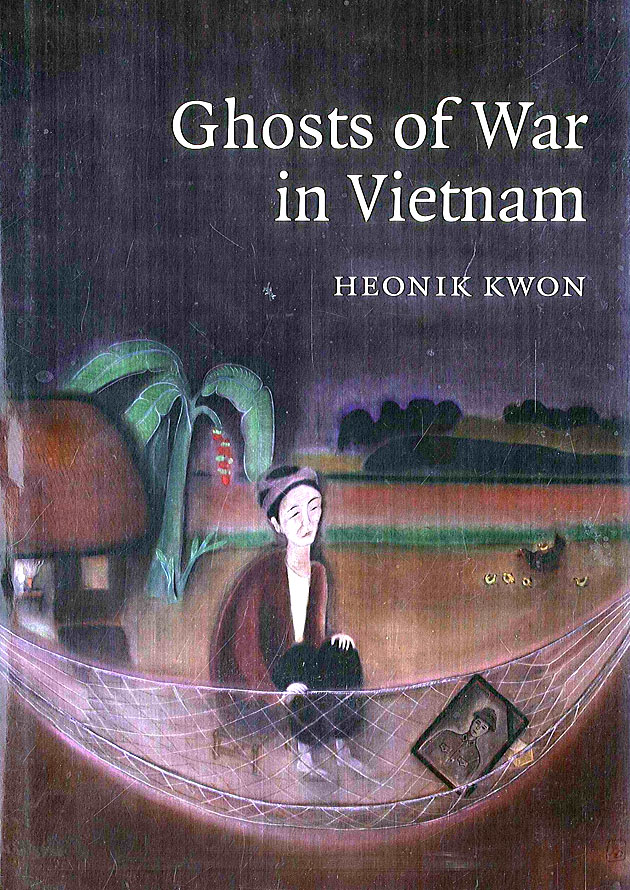
I built the psychic world drawing heavily from “Ghosts of war in Vietnam” by Henrik Kwon a Korean anthropologist who spent two years researching war ghosts in villages. He ascertained that the war dead did not hold sides in Central Vietnam where he investigated, and emphasised the importance of the war dead remains to be reunited with their descendants where possible. With the existence of mass graves holding bodies from all sides of the conflict, local domestic shrines in people’s homes also have altars for wandering ghosts to receive offerings and some measure of peace. 

An ancestral family shrine

That is a moving image of hospitality. Are there no fears that ghosts seeking revenge might show up?

Ghosts seeking revenge are termed “hungry ghosts” and there is a special day for them in mid August where people give offerings to the restless undead.

What of the Buddhism in the book? What philosophy underlies the narrative?

The philosophy of the Buddhists in the story come from Thich Nhat Hanh teachings (called Thay meaning teacher), the Zen Buddhist Master I follow. Thay teaches that mankind are not the enemy, fear and anger are the enemy. He travelled to America in the sixties to lobby for peace in Vietnam and was nominated for the Nobel Peace Prize by Martin Luther King. His pilgrimage in 2007 included Great Ceremonies of Mourning for all those who have suffered in the war. He has said that the Vietnam/American War was a war of ideology pitting brother against brother. He has established monasteries of practice around the world including in America.

The protagonist is responsible for guiding others through a very complicated terrain, what about her own journey?

Kim undergoes an awakening in the book to the possibilities of being a psychic in a democratic country and her potential as a woman. At the beginning of the book she is defined by what she doesn’t have, good looks or a boyfriend. Her sister is getting married and that seems to be Kim’s destiny too. But being a psychic complicates this future She discovers her Buddhist spiritual heritage through her grandmother and the Buddhist abbot she comes into contact with while working for the Communist government. She chooses a Buddhist ethical way to practice as a psychic but it goes against the government orders she has.  She ends up marrying a Vietnamese American psychic for her defection to America rather than for love. 

The statue is of Quan Am the female Buddha

You allude to the role of storytelling in Buddhism, how would you position your novel in relation to Buddhism? 

The Other Shore aims to be an exploration of ethics and the spiritual, pragmaticism and Buddhism. It is a tale whose second edition is dedicated to Thich Nhat Hanh who passed away in 2022 in Hue at his root temple in Vietnam. 

Ghosts are conventionally transparent – you can walk through them – but they’re also opaque because they are radically Other to our lived experience. How did you try to capture that tension of creating characters that are human and yet not entirely knowable?

The benign ghosts I write about are archetypal the wise woman, the maiden etc They all have knowledge of the spiritual realm that Kim as a naive protagonist does not have (and one assumes the reader does not have). In the cosmology that I write from ancestral ghosts are their human selves except they are on the other shore in the spiritual realm. I do not explain every manifestation, Kim takes it on faith and I ask the reader to as well.

Fiona Moore interviews Oghenechovwe Donald Ekpeki

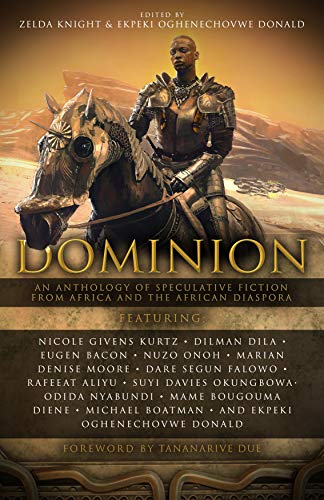
Your “breakout” book was Dominion: An Anthology of Speculative Fiction From Africa and the African Diaspora. Can you tell us how that came about?

Zelda Knight, my co-editor, reached out to me, after publishing my short story “Ife-Iyoku” in their short fiction mag, Selene Quarterly. They wanted to do the anthology and asked if I would like to contribute a story or co-edit. I chose both, and the rest is history. 

You also edited Bridging Worlds: Global Conversations On Creating Pan-African Speculative Literature In a Pandemic. How does editing non-fiction compare with editing fiction?

It’s interesting. More work I believe, as fiction comes naturally to me. I automatically know and have a feel for what I want in fiction. But non-fiction in my experience requires more to get it to say the things it wants to in the ways that’s most fitting. Still as rewarding though. 

Do you see the two works as complementary, or separate, efforts?

I believe they are complementary, like one stream that flows into another. One fed into the other. Naturally, after reading stories by African writers, I felt we needed to hear the story of the storytellers. The story behind the story. 

As well as an editor, you’re also a writer of short fiction. Can you talk about how the two fit in with each other in your life?

I have more of a sense of stories since I started editing. What might work and be needed, in addition to what I want to write. It broadens one’s horizons. 

Do you think you might try writing longer fiction in the future? If so, what?

Yes. Definitely. I have already written and am working on more of those: a novel, and a bunch of novellas. And looking to go on sub after several more drafts. 

You trained as a lawyer. Do you feel like your professional background influences your fiction (and/or non-fiction)?

Yes. It definitely does. Case laws exposed me to so many scenarios and how stories unfold in real life. Legal reasoning meanwhile allows you to be able to parse your thoughts in a manner that’s very helpful with non-fiction.

What does Nigeria, as a writing scene, bring to the SFF world?

As the largest Black nation on earth, with over 200 million people of hundreds of languages and ethnic groups, a wealth and beauty of diversity, Blackness and the African continent. 

Africa, and Nigeria in particular, seems to be breaking out on the genre scene. Why now, and what can the SF writing community do to sustain this breakout?

I would say it’s a combination of the culmination of the work done consistently over decades to build some sort of structures, like the Nommo award, African speculative fiction society, and the hard work of writers coming today. 

Continue reading “Fiona Moore interviews Oghenechovwe Donald Ekpeki”

We can play more than fantasy cops: An interview with Gabriel Caetano

Hi Gabriel, thanks so much for chatting today. Why don’t you start by introducing yourself and your background in roleplaying games?

Sure. I’ve loved roleplaying games since I was a kid, maybe ten or twelve years old. My first experience was with a Brazilian system called 3D&T. There were a couple of games like World of Darkness that were available too. 

After a break, I eventually got into D&D 5e. I enjoyed it for a while, but I became disillusioned for various reasons. Especially issues with representation. I got involved with communities such as Three Black Halflings. At some point I just realised that D&D was a corporate product that would never actually be any good. It was fundamentally flawed, and couldn’t be fixed, because the people making the money didn’t care.

Then I discovered Wanderhome by Jay Dragon, which uses the Belonging Outside Belonging design approach. That’s a token-based system, that allows for collaborative storytelling without relying on constant dice rolls. Dungeons & Dragons really sets the tone for what many people think roleplaying games can be, but Wanderhome showed me that roleplaying games could be something entirely unique — not just another battle simulator, or game of colonizer make-believe. The community was part of that as well, such as the Wanderhome unofficial Discord (kisses and hugs, if you are reading this!).

So Wanderhome became a way for me to explore more games, and eventually get into game design myself. My first reaction was to go to almost the polar opposite of D&D. Even designing Roots & Flowers, and getting into Solarpunk, was kind of a rebound from D&D. “Let me get this shit out of my system!” Since then I’ve drifted in a few different directions. Now it’s more of a personal, mindful effort to create things I enjoy.

Brilliant, thanks! I want to get into your game design work soon. I enjoyed the recent Game Master Monday actual play of Roots & Flowers. But first, can we talk a bit more about D&D’s issues with representation?

You know, these games often involve stories of venturing into perilous wilderness and grabbing everything you find. It’s a structure that can perpetuate colonialist attitudes. You just take up your weapons, go into someone else’s house, tear shit down, kill everybody, pick up relics and stuff. Then you come back, call everybody you just killed ‘monsters,’ and call it a day. Then the cycle begins again.

Of course Wizards of the Coast will say, “We can improve this, we can fix it.” No, you can’t. It is the core premise of your game. You may be able to make it more and more palatable to certain sensibilities, but it will fundamentally be the same thing. At the end of the day, it’s just about D&D making money, and Hasbro shareholders lining their pockets. It’s for the benefit of a couple white billionaires somewhere. You’ve got to trash it.

You’ve got to trash it, and make something new. You can’t fix it. 

Continue reading “We can play more than fantasy cops: An interview with Gabriel Caetano”

Bittersweet Utopias: An interview with Kellynn Wee

We were lucky enough to chat with Kellynn Wee, researcher and designer of tabletop roleplaying games, about solarpunk, utopia, memory, narrative and chance, the TTRPG scene in Singapore, and much more.

Hi Kellynn. Why don’t you start by introducing yourself?

Sure, my name is Kellynn Wee, and I’m currently a PhD candidate at UCL. I’ve been looking at play communities in Singapore, and how players relate to fantasy and speculative worldbuilding in tabletop roleplaying games. I have a background in anthropology, so I’m interested in the social relationships and meanings that emerge from these play communities – in how games can become sites to explore different relationships and identities, and how games allow us to deal with different forms of value, different approaches to uncertainty, or new ways of imagining the self. I’ve also been working on a climate futures game, Move Quietly and Tend Things, which I describe as a bittersweet utopia. 

This research involves a lot of playing games, right?

Oh for sure. I’ve never played so many games in my life! I recently calculated and it was nearly 250 games in about twenty months of ethnography, which should kill my passion for games, but somehow hasn’t. And I think that’s a good sign.

Wow! Has the play sometimes felt like work?

It’s a good question. There are always interesting tensions between play and work, right? Have you read Play Money by Julian Dibbell? It’s about quitting his day job and becoming a full-time loot farmer …

No, but that sounds kind of up my street.

Well, there were definitely games that felt like drudgery. I think it’s because of the volume of games I played. Some games just didn’t spark. It might be the dynamics of the players at the table, the kind of energy people are bringing to it. Roleplaying games are so dependent on the particular constellation of individuals at that point in time. 

Right.

But even when they don’t quite spark, it’s not exactly like work. I mean, I still had fun!

That’s good! I guess ‘work’ and ‘play’ is one wobbly binary, and then ‘work’ and ‘fun’ is another wobbly binary? There is some interesting writing by Bo Ruberg about the variety of emotions associated with play — fun is an important one, but it’s not the only one.

Sure.

You are researching the games and the players and the communities. But can I ask about games themselves as research tools? I’m wondering how games and play have been used in anthropological research historically, and whether you see potential for using them in new ways in the future.

Well, it’s pretty common for games to be pedagogical tools, right? They’re ways to place students into an anthropological frame of mind. I know that games have been successfully used to reframe research findings beyond textual outputs. For instance, I recently attended a talk by Andrea Pia, who designed a game for students to explore the topic of Chinese rural migration. They transformed their research into an interactive digital narrative where you’d make choices for a migrant character to proceed through the world, and it used photos, videos, quotes and characters that derived from Pia’s fieldwork. 

That sounds interesting.

Yes, it was really interesting. Using games as research methodologies though? Maybe that’s something that hasn’t been explored all that much, or at least it’s something I’ve yet to fully grasp myself. I wonder why not though, right? Playing, especially role-playing, and ethnography share many principles. The first thing that comes to mind is the art of asking questions well. There’s this act of iteration, of only understanding whether a method works by doing it, and then coming back to ask what sort of tools or approaches you need to get to an understanding that you want. There’s the act of making the implicit explicit, of paying attention to what is unsaid as much as what is said. There’s the consideration of different relationships, different identities, how people are going to come together and interact in the same space. There’s this element of sharing sensorial or bodily space. 

These are all aspects that anthropologists pay attention to. And so do tabletop roleplayers. A roleplaying game can also make aspects of relationships and elements of social currency visible. I also think games can act almost like a kind of meta-reality tool. While anthropologists and other social scientists often act on the principle of making the familiar strange when thinking about their work, I think games can often carry out the opposite act of making the strange familiar–exploring peculiar worlds and peculiar viewpoints by using everyday tools that help us frame our capacity for action regardless of the circumstances. So yes, many game practices resemble ethnographic practices and ethnographic thinking. It’s exciting to think what might be done with that, but it’s still a question I’m exploring. 

Your answer is making me think of this interview as a very rules-lite roleplaying game.

Should I roll some dice?

Continue reading “Bittersweet Utopias: An interview with Kellynn Wee”

Beat the Boss: An interview with Doug Geisler

Hi Doug, thanks for talking to us today. You are the creator of Beat the Boss, a TTRPG about union organising. You’re also a union organiser yourself. Can you tell us a bit about your background? What first drew you to organising?

I started organizing in 2001. I had gone to the World Trade Organization protest in Seattle, which is a short drive for me. The labor unions that showed up on the front line really made a significant impact on me. I was with this group of ten folks that were holding down an intersection, and the steel workers broke away from the big AFL-CIO march and pushed the cops back a block. Just physically confronted them. It was like nothing that I’d experienced before. 

After the protests, I wanted to figure out a way to get more actively engaged in making big changes. I was looking around, and it was clear that labor unions were one big, structured way to make an impact. 

That’s an interesting answer. You were kind of thinking of unions as agents of broad social change right from the start.

Well, changing the material conditions of workers became kind of a guiding orientation for me. For example, there’s not enough leisure time in industrialized America for people to even appreciate the woods or the outdoors. So how are you going to have a conversation with someone about environmental protection, if they don’t have any experience of nature in their everyday lives?

Continue reading “Beat the Boss: An interview with Doug Geisler”