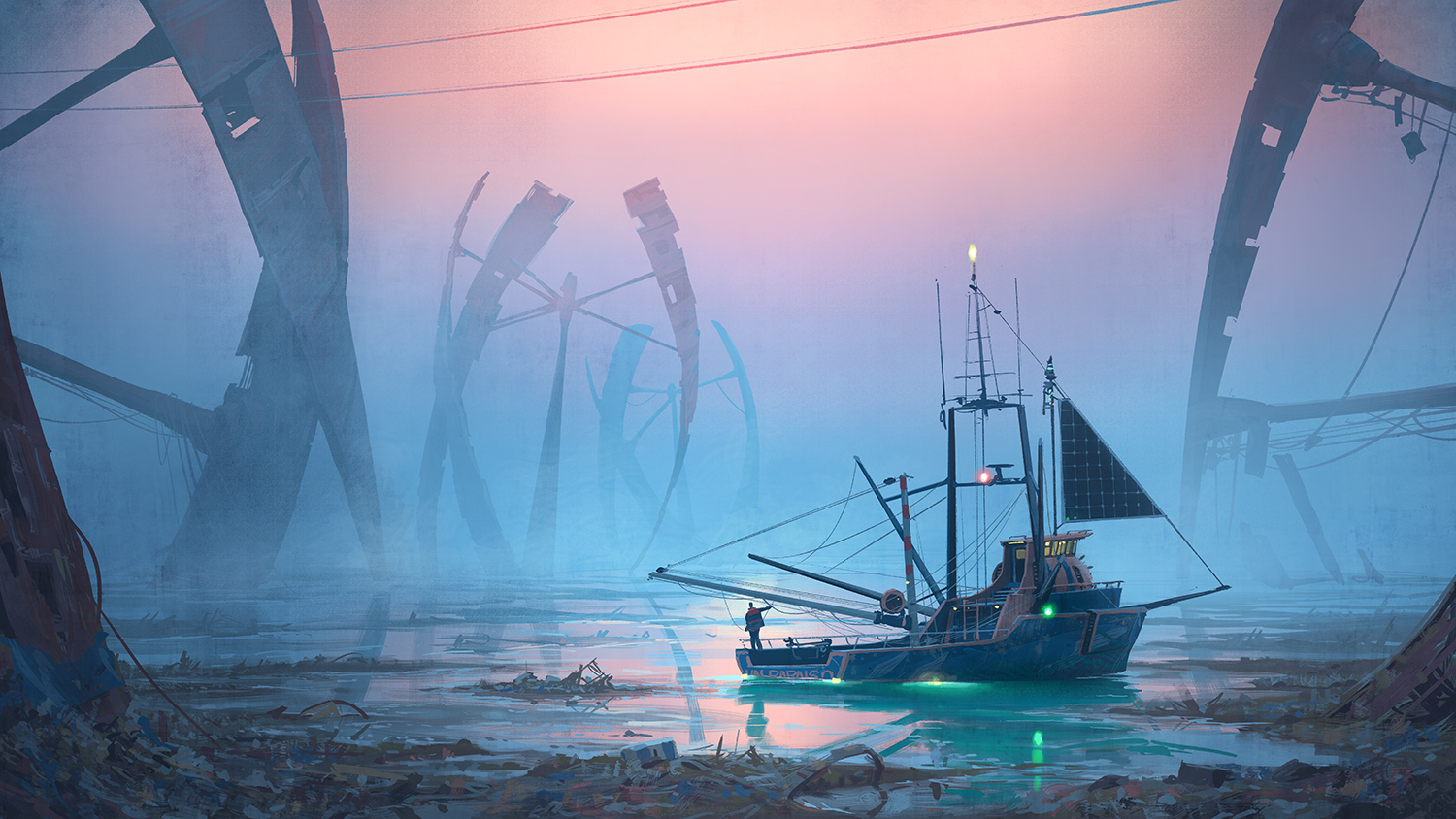
Bittersweet Utopias: An interview with Kellynn Wee

We were lucky enough to chat with Kellynn Wee, researcher and designer of tabletop roleplaying games, about solarpunk, utopia, memory, narrative and chance, the TTRPG scene in Singapore, and much more.

Hi Kellynn. Why don’t you start by introducing yourself?

Sure, my name is Kellynn Wee, and I’m currently a PhD candidate at UCL. I’ve been looking at play communities in Singapore, and how players relate to fantasy and speculative worldbuilding in tabletop roleplaying games. I have a background in anthropology, so I’m interested in the social relationships and meanings that emerge from these play communities – in how games can become sites to explore different relationships and identities, and how games allow us to deal with different forms of value, different approaches to uncertainty, or new ways of imagining the self. I’ve also been working on a climate futures game, Move Quietly and Tend Things, which I describe as a bittersweet utopia. 

This research involves a lot of playing games, right?

Oh for sure. I’ve never played so many games in my life! I recently calculated and it was nearly 250 games in about twenty months of ethnography, which should kill my passion for games, but somehow hasn’t. And I think that’s a good sign.

Wow! Has the play sometimes felt like work?

It’s a good question. There are always interesting tensions between play and work, right? Have you read Play Money by Julian Dibbell? It’s about quitting his day job and becoming a full-time loot farmer …

No, but that sounds kind of up my street.

Well, there were definitely games that felt like drudgery. I think it’s because of the volume of games I played. Some games just didn’t spark. It might be the dynamics of the players at the table, the kind of energy people are bringing to it. Roleplaying games are so dependent on the particular constellation of individuals at that point in time. 

Right.

But even when they don’t quite spark, it’s not exactly like work. I mean, I still had fun!

That’s good! I guess ‘work’ and ‘play’ is one wobbly binary, and then ‘work’ and ‘fun’ is another wobbly binary? There is some interesting writing by Bo Ruberg about the variety of emotions associated with play — fun is an important one, but it’s not the only one.

Sure.

You are researching the games and the players and the communities. But can I ask about games themselves as research tools? I’m wondering how games and play have been used in anthropological research historically, and whether you see potential for using them in new ways in the future.

Well, it’s pretty common for games to be pedagogical tools, right? They’re ways to place students into an anthropological frame of mind. I know that games have been successfully used to reframe research findings beyond textual outputs. For instance, I recently attended a talk by Andrea Pia, who designed a game for students to explore the topic of Chinese rural migration. They transformed their research into an interactive digital narrative where you’d make choices for a migrant character to proceed through the world, and it used photos, videos, quotes and characters that derived from Pia’s fieldwork. 

That sounds interesting.

Yes, it was really interesting. Using games as research methodologies though? Maybe that’s something that hasn’t been explored all that much, or at least it’s something I’ve yet to fully grasp myself. I wonder why not though, right? Playing, especially role-playing, and ethnography share many principles. The first thing that comes to mind is the art of asking questions well. There’s this act of iteration, of only understanding whether a method works by doing it, and then coming back to ask what sort of tools or approaches you need to get to an understanding that you want. There’s the act of making the implicit explicit, of paying attention to what is unsaid as much as what is said. There’s the consideration of different relationships, different identities, how people are going to come together and interact in the same space. There’s this element of sharing sensorial or bodily space. 

These are all aspects that anthropologists pay attention to. And so do tabletop roleplayers. A roleplaying game can also make aspects of relationships and elements of social currency visible. I also think games can act almost like a kind of meta-reality tool. While anthropologists and other social scientists often act on the principle of making the familiar strange when thinking about their work, I think games can often carry out the opposite act of making the strange familiar–exploring peculiar worlds and peculiar viewpoints by using everyday tools that help us frame our capacity for action regardless of the circumstances. So yes, many game practices resemble ethnographic practices and ethnographic thinking. It’s exciting to think what might be done with that, but it’s still a question I’m exploring. 

Your answer is making me think of this interview as a very rules-lite roleplaying game.

Should I roll some dice?

Continue reading “Bittersweet Utopias: An interview with Kellynn Wee”

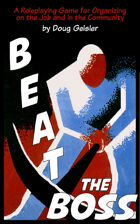
Beat the Boss: An interview with Doug Geisler

Hi Doug, thanks for talking to us today. You are the creator of Beat the Boss, a TTRPG about union organising. You’re also a union organiser yourself. Can you tell us a bit about your background? What first drew you to organising?

I started organizing in 2001. I had gone to the World Trade Organization protest in Seattle, which is a short drive for me. The labor unions that showed up on the front line really made a significant impact on me. I was with this group of ten folks that were holding down an intersection, and the steel workers broke away from the big AFL-CIO march and pushed the cops back a block. Just physically confronted them. It was like nothing that I’d experienced before. 

After the protests, I wanted to figure out a way to get more actively engaged in making big changes. I was looking around, and it was clear that labor unions were one big, structured way to make an impact. 

That’s an interesting answer. You were kind of thinking of unions as agents of broad social change right from the start.

Well, changing the material conditions of workers became kind of a guiding orientation for me. For example, there’s not enough leisure time in industrialized America for people to even appreciate the woods or the outdoors. So how are you going to have a conversation with someone about environmental protection, if they don’t have any experience of nature in their everyday lives?

Continue reading “Beat the Boss: An interview with Doug Geisler”

Adventures in Science Fiction Prototyping

Andrew Merrie and Pat Keys in conversation with Jo Lindsay Walton (and briefly Polina Levontin) about science fiction prototyping and the Radical Ocean Futures project. 


Radical Ocean Futures project

JW: We’re lucky enough to be joined by Andrew Merrie and Pat Keys. Andrew is a Research Liaison Officer at the Stockholm Resilience Centre, Stockholm University (Sweden) and the Head of Futures at Planethon. Pat is an Assistant Professor in the Department of Atmospheric Science at Colorado State University (USA).

We want to find out more about your very intriguing Radical Ocean Futures project, and Science Fiction Prototyping in general—as well as adjacent ideas like applied science fiction, critical design fiction, diegetic prototyping, speculative design, all part of the theme of this special issue. But I guess let’s start with the high seas themselves. How do we define the high seas? What are some of the issues that arise in their governance? Surely mighty Poseidon is ungovernable? To me, those words already feel strange in a sentence together: ‘governing the high seas.’ 

AM: The high seas are areas of the ocean that are not managed by any single authority. In some ways they represent this largely unexplored ‘wild west’ of the global ocean. When you’re trying to think about how to govern the high seas, you are thinking about things like climate change, overfishing, deep sea mining, genetic resources and so on. But you also have to contend with the pace of change. The ecosystems are changing, and the technology is changing, and companies and other kinds of actors can basically take advantage of these gaps or delays in regulation, and sort of do what they want in this ocean space. Interestingly enough, just a few weeks before this issue of Vector went live, a historic deal was made, after nearly 20 years of talks to put in place a legal framework, the UN High Seas Treaty. That said, monumental governance challenges remain and though very consequential, this is really the start of another 20 years of work.

JW: In this context, does ‘governance’ refer to international law?

AM: Partly. Governance is actually broader than that. It refers to a variety of laws, regulations, institutions, certifications, norms and so on. It’s everything that is relevant to how we look after the oceans, or fail to look after them. For example, for the governance of marine ecosystems, computer modelling is very important. But you can’t just look at a model and go, ‘OK, here is what will happen, if we follow this management strategy.’ There are all kinds of questions about what is possible or plausible. About what models to use, what their assumptions are, how you should interpret and use their outputs. All that could be part of governance. 

JW: OK. And these questions are more than technical questions, right? They quickly get us into the realm of politics and ethics. But sticking with ocean ecology for a moment. Honestly, when I think of the ocean, I mostly think, ‘I have no idea what’s going on in there.’ I want to quote a 2016 WIRED article about your project. ‘Earth’s oceans are having a rough time right now. They’re oily, hot, acidic, full of dead fish—and their levels are rising.’ Can you tell us a bit more?

Continue reading “Adventures in Science Fiction Prototyping”

Utopian Drama: An interview with Siân Adiseshiah

In your book Utopian Drama: In Search of a Genre, you distinguish two wellsprings of utopian thought. There is the early prose tradition, which includes texts like Christine de Pizan’s The Book of the City of Ladies, Thomas More’s Utopia, and perhaps also Plato’s Republic. Your research focuses on the second tradition — the theatrical tradition. This is something you trace back to the Old Comedy of Ancient Greece, and something that has been comparatively less studied. How do you think that the priority on prose has shaped Utopian Studies?

The frameworks of Utopian Studies, as they have developed over recent decades, have typically assumed the object of study to be prose fiction. So features of this early prose tradition have of course informed how interpretation has operated within Utopian Studies. Utopia, at least by default, is something described. It also generally gets constructed by a gaze that is located outside of that utopia. Thomas More’s Utopia, for example, needs to be set within the context of early modern travel narratives, and the whole range of colonial encounters which these describe. 

Right, the traveller who visits a far away place or time, sees strange things, and learns just to rethink the institutions back home. Presumably that has played into the high regard with which defamiliarization is held, certainly within adjacent fields like Science Fiction Studies?  But then, does it need to be that way? Couldn’t we get to know utopia through the experiences of characters who have always lived there and are deeply familiar with different aspects of utopia?

Another feature of the early prose tradition is that assumption of anonymity. More’s Utopia is again a good example. There’s a striking shift between Book One, where there is a conversation of sorts among various real and fictional people, and what happens in Book Two. In Book Two, Raphael recounts his travels on the island of Utopia, and suddenly all sense of character disappears! 

So I think that’s very much a feature of the early prose fictional examples of utopia, and absolutely not in the case of dramas. In More’s Utopia, you don’t get to know individual Utopians. In later prose utopias, that does change, partly due to the emergence and development of the novel, but also as a response to accusations of the genre being boring — but even in the later utopias, there isn’t very much character interiority, or much of  a sense of agency, et cetera

You do sometimes get defences of a utopian rhetoric of generality, abstraction, anonymity. Like the idea that a wide range of readers will identify with an Everyman narrator. But of course, every ‘Everyman’ is really an ‘Actually Pretty Specificman.’ He is a particular subject position, elevated in a way that rejects the reality of other subject positions, or suggests that such differences are negligible. On stage, I suppose that Everyman myth might be even harder to sustain? Simply because there is always a very specific voice, face, body, occupying that role?

Yes, absolutely. The particularity. But also just the fact of a body on stage at all!— people on stage, humans, rather than a kind of distant description, a kind of external gaze. Another feature of the early prose fiction tradition is using setting as foreground. So in More’s Utopia you have long descriptions of the number of districts and the way that towns are laid out, housing, agriculture, et cetera. What’s usually registered as background setting in the novel becomes part of the foregrounded narrative in utopian prose. Character, if it figures at all, is there as background. So again, this is something that’s immediately reversed when you’re looking at a play, when you’re looking at stage drama. 

Continue reading “Utopian Drama: An interview with Siân Adiseshiah”

Mikhail Karikis: Activism and audiotopia

Phoenix Alexander interviews Mikhail Karikis

All images are part of No Ordinary Protest project, with permission from Mikhail Karikis.

Please briefly introduce yourself.

I am a Greek-born artist based in London and Lisbon. I work mostly in moving image, sound and performance. I develop projects through collaborations with individuals, collectivities and communities that are often located beyond the circles of contemporary art. In recent years, I have been working extensively with children, teenagers, young adults and people with disabilities. 

Since the early stages of my practice, the politics and materiality of the voice have been key concerns, while at the same time engaging with themes that give voice to different ways humans relate to the environment. There has been an instinctive journey that I began with films exploring voicing conditions of labour in the context of extractivist practices. This moved forward by looking at models of sustainability and eco-feminism, and more recently eco-activism and emerging forms of labour that service nature. 

I would say that my works prompt an activist imaginary and rouse the potential to imagine possible audiotopias (i.e. speculative places invoked through sound) and desired futures. I employ listening as an artistic strategy to help determine the content of my projects with the aim to highlight alternative modes of human action and solidarity, and to nurture critical attention and tenderness.

To what extent do you consider your work and practice to be ‘science fictional,’ if at all? Do you actively think about genre in your work, or do the labels come after the fact? (Surrealism, social realism, performance etc.)

I find science fiction and fantasy literature inspiring, but I do not think of my own artistic work through the lens of a specific genre. Perhaps where some science fiction literature and my art practice align is the way I employ my work to imagine and propose different worlds. I often start projects by embedding myself in different community contexts, and as such, social realism is always my starting point. Reflection, imagination and fantasy play an important role as I develop the themes and the projects mature and take shape. A decade ago and after I’d spent several years producing work that was furious and acutely critical, I took the decision to go further and invest my energy and imagination to proposing ‘better’ alternatives. My use of the word ‘better’ here implies a world with social and environmental justice, egalitarianism and practices of care. 

Sounds plays a central role in much of your work. Can you say a little bit more about how you see the relationship between the sonic and visual aspects of a new project?

I am currently developing a project which explores our relationship to weather phenomena. I am approaching it from three sonic perspectives: folk songs that call out to the elements, capture and transmit traditional knowledge about seasonal change and meteorology; a second angle is that of music instruments that imitate the sounds of weather and bring the environment into the concert hall through sound, like, for example, wind machines and thunder sheets; and a third perspective is the acoustics of resistance generated through eco-activism and protest. I am working with folk singers, professional experimental musicians and young school children on this project to bring together these three different forms of auditory culture that are testimony to our profound connection and entanglement with the weather. As is common in my work, the performance of these different forms of sound will determine the visual dimension of the project. Be it on a macroscopic or microscopic dimension, all my films capture acts of communal sound-making, resonance and vibration, and document the power sound has to set into motion the material universe, activate our sentiments and mobilise political thinking and action. 

Are there any works of science or speculative fiction (in any medium!) that have particularly inspired you?

Every child and teenager should read The Iron Woman by Ted Hughes for its environmental focus, for empowering children heroes with activist ecological thinking and rebelling against adults, and for the central role listening and noise play in the story as superpowers that activate empathy toward more than human beings. The Dispossessed by Ursula Le Guin is a book everyone ought to read for its acute reflections on capitalism, gender politics and anarcho-communism. 

Everybody makes monsters: An interview with Kim Newman

Kim Newman is the author of Anno Dracula (1992), a novel set in an alternate Victorian London where Dracula has become the Prince Consort and vampires have emerged as the new ruling class. Since then he has written many more books in the series. Anno Dracula is being reissued by Titan Books in October 2022 as a deluxe signed hardcover edition with an introduction by Neil Gaiman and a new short story by the author. Under the name Jack Yeovil, Newman has also published books which helped to build Games Workshop’s Warhammer Fantasy and Dark Futures universes. In addition to writing fiction, Newman is a major critic of horror cinema whose work can be found in Nightmare Movies (1985) and his Sight & Sound columns. He also served as the executive producer of Prano Bailey-Bond’s Censor (2021).

Updates about Newman’s work can be found at his website and on Twitter @annodracula. We are delighted to have Kim back to chat to Vector, as Jordan S. Carroll asks him about Anno Dracula, shared world writing, film criticism, as well as Kim’s latest novel, Something More Than Night (2021), a horror-detective mystery set in Hollywood during the 1930s and starring Boris Karloff and Raymond Chandler

How did you get started writing?

I hate defaulting to other people’s quotes, but somebody asked George Bernard Shaw that question, and he said he couldn’t remember — because writing was like the taste of the water in his mouth. It was something he’d always done.

I mean, I wrote from childhood. I’m not quite sure at what point that went from writing stories for my own purposes to writing for an audience. I think I always wanted to communicate. It took me a while to consider that this might also be a way of making a living. But as a teenager, I wrote plays and comedy sketches with my friends at school. I wrote novels, or rather novel length manuscripts, in my teens.

The useful thing about starting early is you get a lot of the embarrassing stuff out of the way early on when nobody can see it. Now, you just put your stuff online free for people to read, but it is there forever. It comes back to haunt people. I’m not even sure if I have copies of the stuff I wrote as a kid. I think if I do, it’s in a trunk somewhere very deep.

What drew you to horror in particular?

I started out being interested in monsters, I suppose. I was one of those kids who liked monster movies. I liked the effect of horror, I read a lot of it. But I read a lot of general stuff as well. I’m interested in genre, but I’m not necessarily somebody who wants to be confined by it. I don’t self-identify as a horror writer, or a science fiction writer, a crime writer, a mystery writer. I’ve done all of those things. But I do recognize that I operate best in that kind of arena.

When you tag yourself as a horror writer, that comes with an obligation to be frightening, in the same way that picking comedy comes with an obligation to be amusing. And I think some of my stuff is scary. Certainly other readers have reported that. But I think for a lot of my writing, being frightening is not its primary purpose. I’m interested in exploring other things. I tend to write more about what makes me angry than what makes me frightened. Although obviously there’s an overlap.

So what is it that makes you angry?

The world! And what’s more, I have not calmed down with age. Having written a series of books about what happens when really truly terrible evil people come to power … well, the last ten years have just made me think I overestimated people.

How would you describe your writing process?

Continue reading “Everybody makes monsters: An interview with Kim Newman”

Contemporary Greek Speculative Fiction: A Roundtable

With Natalia Theodoridou, Eugenia Triantafyllou, Eleanna Castroianni and George Cotronis

By Phoenix Alexander 

Hi everyone. Let’s start by introducing ourselves to readers / each other!

ET: Hello! I am Eugenia Triantafyllou, a writer and artist currently based in Athens. My fiction has appeared in places like Uncanny, Strange Horizons, Apex and has been nominated for Ignyte and Nebula awards.I am also a Clarion West 2019 alumna. My preferred genres are dark fantasy and horror, although I do like to mix genres and switch it up a lot. 

Twitter: @FoxesandRoses

eugeniatriantafyllou.com

NT: Hi! I am a speculative fiction writer and game designer. Originally from Thessaloniki, Greece, with roots in Russia, Georgia, and Turkey. I now split my time between Greece and the UK. I’ve published over 100 short stories in places like Clarkesworld, F&SF, Kenyon Review, Beneath Ceaseless Skies, and Nightmare, among others, and have three games/interactive novels out by Choice of Games. If you want a taste of my work, I’d recommend starting with “Ribbons” in Uncanny Magazine, “The Birding: a Fairy Tale” in Strange Horizons (which won the World Fantasy Award for Short Fiction), or my Nebula-nominated game, Rent-a-Vice. My work is queer and dark, and I tend to overstep genre boundaries. 

Twitter: @natalia_theodor

natalia-theodoridou.com

EC: Hi, I’m Eleanna, a writer and poet with work in Clarkesworld Magazine, Strange Horizons, Fireside, Beneath Ceaseless Skies and elsewhere. My usual setting is literary science fiction or fantasy where the repercussions of war and oppression feature prominently. I draw a lot from my background as a human geographer and, in particular, from Anthropocene humanities and landscapes of de-industrialization and decay. I am also heavily inspired by contemporary Greek history with its share of complex politics and violence, by the pagan darkness of folk traditions, and by the fragility and cruelty of childhood.

Twitter: @nomadological

eleannacastroianni.wordpress.com

GC: Hello! I’m George Cotronis and I’m a writer and illustrator from Greece by way of Sweden, where I was born. I’ve created book covers for authors like Stephen Graham Jones, Livia Llewellyn and Harry Connolly. When I’m not illustrating, I write short stories. I’ve sold a handful of stories mostly to anthologies like Lost Signals, Robots & Artificial Intelligence and places like Pantheon Magazine and Tales to Terrify. 

Twitter: @ravenkult

cotronis.com

Continue reading “Contemporary Greek Speculative Fiction: A Roundtable”

“Part of the attraction was fear…” an interview with Alexis Panayiotou

Interviewed by Phoenix Alexander and Jo Lindsay Walton

This interview first appeared in Vector 295.

Hi Alexis. Could you introduce yourself and say a little bit about your background?

Hello, my name is Alexis Panayiotou. I’m a fine artist and a drawing tutor on the BA: Fashion course at Central St. Martins.

As you know, this is a special issue of Vector focused on Greek SFF. So our first question is: do you consider yourself a Greek artist?

I think of my identity as mixed or somewhere between cultures. I was born and raised in London. My parents are both Greek, from Cyprus, both came to London very young, my mum nine and dad fourteen. They have lived here ever since. I have never been to Cyprus so I only have a vicarious idea of the place, through my parents and other relatives, and a bit from TV and radio. 

I grew up in a Greek household, eating Greek food, hearing Greek music every day. Greek was my first language until I started school, although now I only have a rudimentary grasp. At home I was steeped in Greek culture and as a young man I would have described myself as solely Greek, and I remember feeling very lucky and proud to be so.

As for ‘artist,’ I’ve only recently started being comfortable using the term — it comes with lots of lofty aspirations! When I was young I drew a lot, like most kids, so there were always parents or teachers telling me I was an artist, or that I would be one. 

Mother pinching her baby affectionately while breastfeeding
Continue reading ““Part of the attraction was fear…” an interview with Alexis Panayiotou”

Five questions for SF Club of Athens

Interviewed by Hephaestion Christopoulos

Instead of introducing you to one or two artists, interviewing them thoroughly, I chose to present here a number of them, as I think they are all noteworthy and you should definitely get to know them. Besides, their work speaks for itself. So I gave ten authors plus one visual artist a limited space to answer the same set of questions:
  1. Name one of your works that is special to you and briefly explain why.
  2. It’s often said that artists have a central theme their work revolves around. Can you spot such a theme in your work?
  3. What do you consider your greatest success in your creative career and what was your greatest frustration, if any?
  4. What have been the challenges in getting your work known? What are the pros and cons of your local market vs getting your work abroad? Do social media really help?
  5. Finally, please tell us what your next plans are.
I sincerely hope their answers will intrigue you enough to check them out.
Lina Theodorou. J-scape, 102 cm X 222 cm, acrylics on canvas, 2021.
Continue reading “Five questions for SF Club of Athens”

Jobs and Class of Main Characters in Science Fiction

By Marie Vibbert.

This article first appeared in Vector #294.

I was at a massive mixer for members of the Science Fiction Writers of America, a group I had just joined, wondering how I could even talk with these big, important people. The question everyone asked when you walked up to them was, “What type of science fiction do you write?” After mumbling some self-deprecating responses like “bad” or “oh you know like … the kind with robots and spaceships?” I tried to express what made my work different. “I write working-class science fiction,” I told the next gentleman. “Stories with waitresses and janitors in space, you know? I feel like there’s too many stories about rich guys without real problems.”

I picked the wrong man to try this tactic on. He laughed condescendingly and said, “The opposite is true. Everything is about some worker everyman. There aren’t enough stories about rich characters!”

My first thought was, Ooookay time to start never talking to this dude ever again, but my second thought was a worried, Is he right? I had this gut feeling that a lot of the science fiction I had read didn’t represent my social class, but was I just biased?1

The only answer was, of course, to collect some statistics! This paper is the culmination of my efforts to answer the question for myself, “Is there a class bias in main characters in science fiction, and if so, are poor or wealthy characters more predominant?”

Methods

Choosing the Books

The first question I had to answer was, “How do I take a sample set of science fiction?” I limited myself to novels, because novels or their detailed discussions were easy to find, and that way I’d be comparing apples to apples.

Reading every science fiction novel ever would not be feasible, especially with a staff of just me. I searched for recommended reading lists, but which to choose? Many were simply “The Best of 2019” or such. While it would be interesting to look at a specific period of SF, I wanted a cross-section of what an average reader might have in mind, and that meant including recent books as well as old classics. I googled “Top Science Fiction Novels” in an incognito browser tab (so as not to bias the results with my search history) and took the first 50 novels the search returned. I liked that list better: it felt eclectic, and included recent novels as well as Mary Shelly’s Frankenstein. Of course, the Google search results, while incognito, still would be skewed toward my location in the Midwest United States.

The British Science Fiction Association’s magazine, Vector, announced a call for papers on class and science fiction. I could hardly contain my excitement (and imposter syndrome) as I typed and re-typed my email asking if this statistical analysis was the sort of thing that maybe they’d want to see? And so, my next data set was BSFA award winners. These would skew British to balance my American bias. How better to kiss up to the editors? I started my spreadsheet!

BSFA award winners include fantasy novels with no science fictional elements, however, maintaining genre purity would open up a can of worms (how to draw the lines? Who gets to say what is or isn’t SF?). I would keep the results of each list separate, to see if there was any bias.

On accepting the paper proposal, editor Polina Levontin suggested adding the titles from the Orion SF Masterworks book series, a somewhat curated list, limited only by what titles Orion had the rights to. So now I had three piles of representative works: award winners, a hodgepodge recommended by Google, and a curated list for a total of 194 separate titles. It seemed as close as I was going to get to a reasonable sampling of notable science fiction novels.

Continue reading “Jobs and Class of Main Characters in Science Fiction”