Sometimes a spaceship is just a spaceship: Lavie Tidhar interviewed by Konrad Walewski

The British Science Fiction Association holds regular events in London, usually on the last Wednesday of the month, at the Artillery Arms near Old Street. These events are free, and open to members and non-members alike. Keep an eye on the BSFA website for news of future events. In September, award-winning author Lavie Tidhar was interviewed by critic and editor Konrad Walewski.

Andrew Wallace engages the metadata…

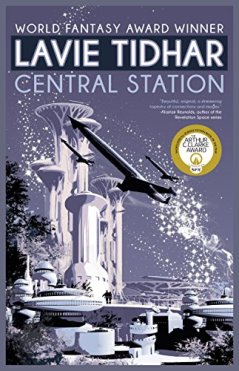
lavieLavie Tidhar’s style is well-suited to original narrative forms that subvert Western genre fiction tropes, while still engaging with them almost as props. For example, he says this year’s Clarke Award-nominated ‘Central Station’ gave him the opportunity to employ Golden Age imagery, like the action around a spaceport, and then let it fade into the background as if it’s being ignored. However, it’s an approach that can backfire. Another twentieth-century genre that appeals to Lavie is noir detective fiction, and he recalls a synopsis he wrote using the idea of a gumshoe searching for his niece, only for the story’s editor to point out that Lavie had forgotten to include the fate of the girl at any point in the story.

The noir angle could be the reason Lavie has been linked with cyberpunk, although he considers the association inaccurate, describing ‘Neuromancer’ as ‘Chandler with computers’. He decries the ten years between that novel and ‘Snow Crash’, in which people emulated what they thought was a new formula for success. Also, there is nothing hard-boiled about ‘Central Station’. While cyberpunk is about cool, hi-tech cowboys saving the world from a rogue AI, Lavie’s books are about people who get the kids to school and then go to work defeating the AI. Indeed, he sees ‘Central Station’ as a romance novel; its wedding-and-funeral climax more Richard Curtis than William Gibson.

Continue reading “Sometimes a spaceship is just a spaceship: Lavie Tidhar interviewed by Konrad Walewski” →

Visions of Space: An Interview with David A. Hardy

By Alex Storer.

Any science fiction or space art aficionado should instantly recognise the name David A. Hardy – perhaps from the early part of his career working with Sir Patrick Moore on The Sky at Night and their award-winning books, including Challenge of the Stars and Futures / 50 Years in Space, or perhaps from his film and television credits, which include Blake’s Seven and The Neverending Story. Maybe you’ve got books in your SF collection adorned with David’s stunning cover art (maybe you’ve even read his own SF book, Aurora), or have encountered his work on the convention circuit. At the very least, if you’ve ever bought Cadbury’s chocolate, you’ll recognise the logo that Hardy originally designed during his time working at their Bournville factory, Birmingham, in the 1960s!

First published in 1952, David A. Hardy is the longest-established living space artist. Hardy started out as an astronomical artist, and the inevitable expansion into science fiction did not come for some years. Hardy’s work can transport you to the remotest corners of the Solar System, or into remote alien worlds and future times. What’s more, Hardy is still working and in as much demand as ever, regularly supplying cover art for the likes of Analog and The Magazine of Fantasy & Science Fiction, and countless science fiction paperback and e-book titles.

Initiation of Akasa_F&SF

F&SF: Initiation of Asaka

Hardy’s artwork continues to move with the times – in tandem with spaceflight technology and our ever-expanding scientific knowledge about the planets in our Solar System, and advancing with the advent of computer technology and digital art.

I grew up in awe of Hardy’s work, courtesy of its inclusion in the most marvellous book, Space Worlds, Wars & Weapons (published in 1977 by the sadly defunct Paper Tiger imprint), and an art print that hung on the wall at home, entitled Stellar Radiance. This artwork my young imagination; it was like having a window into space. It sparked my obsession with science fiction art and ultimately led to me working as a science fiction artist myself, years later.

Stellar Radiance

Stellar Radiance

When I rediscovered my love of science fiction and space art in 2007, I realised it was time to start creating my own – and David A. Hardy’s work was my first port of call.

However, at the time, I did not know the name of that wonderful painting that I used to lose myself in, nor the artist’s full name – though the carefully scribed signature of “Hardy” in the bottom corner of the painting had always stuck in my mind. Thanks to a quick Google search, in no time at all I was in touch with the man himself, and soon found myself discovering his decade-spanning portfolio, starting with the books, Hardyware and Futures / 50 Years In Space. David’s enthusiasm and encouragement were invaluable and enough for me to know that I simply had to give it a shot.

One of the things which appeals to me about Hardy’s art is that whether it is paint or pixels, the work is still distinctly Hardy. When it comes to digital art in particular, I’ve always found it crucial to still have the touch of the artist’s hand, which I feel adds soul and personality to a digitally piece, eliciting just the same kind of emotional response one gets from looking at a canvas painting – and Hardy achieves this masterfully.

Despite being in the age of photographic imagery and photorealistic 3D graphics, hand-rendered art has remained important in science fiction circles, as it is another medium in which we can escape into other times or worlds – and more often than not, the art goes hand in hand with the SF literature we read; either adorning the covers of the books we love or simply inspired by them.

A ‘Hardy’ is immediately identifiable, not only by that kind of vibrant colour palette (regardless of medium), but by a consistent style and approach. Decades of experience and expertise all go into making each and every piece a work of wonder that one never tires of viewing.

I caught up with David to chat about all aspects of his work and career …

The first time I encountered computer-aided artwork in the early 1990s, it felt like a life-changing moment; a glimpse of the future. Do you remember the first time you saw computer art and did you realise it was going to be a significant way forward, especially in terms of science fiction art?

DAH: I had a similar “Eureka!” moment when I discovered the airbrush in 1957! Here was a way to paint atmospheres, glows, nebulae in a way that was realistic yet wouldn’t take hours of painstaking blending of paints. I have always kept up with new technology, and started using photography, especially ‘derivative’ (manipulated) images, in my work. In the 1980s I did all my own darkroom work and even became a LRPS. I also bought a large-format camera and started taking photos of my work to send to publishers as transparencies (slides) rather than entrusting valuable artwork to the tender mercies of the Post Office! I became aware of the intrusion of computer art in publishing, and it was exciting, but I couldn’t afford any of the equipment. Then when the Atari ST came along in 1986 I got a 520, then a 1040 and finally a Falcon before getting my first PowerMac in 1991. But it was still some time before I felt able to use this professionally. (I did however produce graphics for an Atari/Amiga game, Kristal, which won an industry award.)

Kristal

Kristal

Many SF artists have continued to work with paint while others have moved to digital or only work digitally – yet you have maintained a healthy balance of both. What do you feel you can achieve with digital art that you can’t with traditional media – and vice-versa?

Continue reading “Visions of Space: An Interview with David A. Hardy” →

The Geography of Fear: Dave Hutchinson interviewed by Tom Hunter

The BSFA holds regular events in London, usually on the last Wednesday of the month, at the Artillery Arms near Old Street. These events are free, and open to members and non-members alike. Keep an eye on the BSFA website for news of future events. In June 2017, Tom Hunter rendezvoused with Dave Hutchinson, author of the acclaimed near-future spy series, Fractured Europe. Our asset Andrew Wallace returns safely to HQ with the following intelligence …

Any writing career has its highs and lows, and in Dave Hutchinson’s case, quite literally. One of the jobs he applied for after leaving university (he graduated from Nottingham with a degree in American Studies), before beginning a career in journalism, was air traffic controller. Dave credits the absence of planes falling from sky to the fact that he didn’t get the job. Still, it’s intriguing to think of Dave Hutchinson, author of the award-winning near-future Fractured Europe series, as an air traffic controller in a parallel universe … managing the borders between nations, between earth and sky …

Continue reading “The Geography of Fear: Dave Hutchinson interviewed by Tom Hunter” →

“Not everything I write is covered in bees”: Adrian Tchaikovsky interviewed by Ian Whates

Wasp - Transparent Background

The BSFA holds regular events in London, usually on the last Wednesday of the month, at the Artillery Arms near Old Street. These events are free, and open to members and non-members alike. Keep an eye on the BSFA website for news of future events. In February 2017, Ian Whates caught up with SF and fantasy novelist Adrian Tchaikovsky. Andrew Wallace chronicles the encounter …

Adrian Tchaikovsky is known for his ten-volume epic fantasy series, Shadows of the Apt, whose clashing civilisations are based around insect species. More recently, Adrian has been lauded for his science fiction, with his novel Children of Time winning the 2016 Clarke Award. Children of Time starts from the premise of a nano-virus sent across the stars to seed life on a distant world. Unexpectedly, it is the spiders and ants – species meant to play mere bit parts in the glorious epic of mammalian expansion – who get sped towards sentience, and the kind of richly detailed space-faring society that great SF does so well.

So the question we all want to ask Adrian Tchaikovsky is: what’s with the bugs?

Continue reading ““Not everything I write is covered in bees”: Adrian Tchaikovsky interviewed by Ian Whates” →

An interview with Shana Worthen

As promised, here’s a short interview with Shana Worthen, Vector’s incoming Features Editor, whose first issue, to which I am very much looking forward, should be out shortly after my last. You can find her current online home here. And many thanks to her for taking the time to answer my questions.

How did you get involved with the BSFA?

I started with the London pub meetings. I moved back to London from Toronto in early July of 2005 and my first BSFA pub night was later that month. After a year of attending, I became a member. It was shareware logic: pay for something after I have already had my money’s worth — not that memberships actually subsidize the meetings. How I first heard of the pub nights, I don’t specifically know, but I had been looking for regular fannish meetings here before I moved over. My inbox tells me that I started following Ansible in that May, so that’s a possibility.

What are your interests within sf?

Novels, poetry, and criticism, primarily. i also really like tie-in reference books! I have a small but growing accumulation of science fictionally-related cookbooks, for example. Movies, occasionally. I am very much interested in science fiction-related artwork, especially landscapes and maps, but can’t say I follow it in any systematic way at this point.

I often read through self-imposed projects, whether an award-related list or a friend’s set of recommendations. For the last several years, I’ve been getting to know the subgenre of science fiction romance in particular. I’m currently reading a short list of books recommended by a friend as a way of getting to know some of the more recent American science fiction publications.

Although I have caught at least one episode per season of Doctor Who, I don’t usually remember to watch television series. I grew up without a television and still have poor televisual instincts. iPlayer is useful, but only if I’m reminded in time to catch something. I did have a long spell back in Toronto of watching lots of anime, but most of it had not been broadcast locally in the first place.

And what do you do outside sf?

Professionally, I’m a historian of medieval technology. It still seems improbable that my day job is teaching online for a university on the other side of the ocean, but it’s true.

Food is my major hobby. I love eating good things, and will cook if need be to have them. I love trying new restaurants, and reading food criticism and related essays and blogs. I mostly read cookbooks rather than cook from them. This also explains my science fiction cookbooks, many of which are only partially designed to be cooked with. I’ve been thinking a lot in the last year about why science fiction and fantasy tend to be so conservative in its use of food technologies. I’ve been dabbling in related academic work too: I have an article coming out next year on smoked foods in fantasy literature.

I like seeing new places, whether industrial tourism, museums, or countryside. I like theatrical musicals, drawing with watercolour pencils, and photographing reflections.

What plans do you have for Vector? What can we expect from your first issue?

My plan is to try to live up to the standard set in the last few years! I will be trying for clusters of related articles rather than the entire themed issues, however.

I’m starting off with the usual year-in-review issue, so the majority of the content will be looking back at 2010. I am happy to report that there will also be two new columns appearing in my first issue. Paul Kincaid is writing one which will revisit older short stories. Terry Martin began a column on graphic novels and comics for Matrix which will now be appearing regularly in Vector. Also, Anthony Nanson has an article on an Arthurian trilogy by Stephen Lawhead.

Are you looking for any sort of submission in particular?

Although Vector‘s focus will remain primarily on text, I would love to see interesting and varied submissions which look at science fiction more broadly. For example, I would love to read more critical work on science fiction drama and science fictional art exhibits. I’d be interested in seeing articles on the relationship between original texts and their adaptations, whether to film or graphic novel. I am actively looking for more articles on science fiction poetry.

Any submission I can learn something from is a good one.

How can people contact you?

I’ll be taking over the vector.editors@gmail.com email address soon; sworthen@owlfish.com is my usual email address.

London Meeting: Dan Abnett

The guest at tonight’s BSFA London meeting is Dan Abnett, author of a lot, including the “Gaunt’s Ghosts” series of Warhammer 40,000 novels, and the recent alternate history Triumff. He will be interviewed by Lee Harris.

As usual, the meeting will be head in the upstairs room of The Antelope: 22 Eaton Terrace, London, SW1W 8EZ. The closest tube station is Sloane Square, and a map is here.

There will be people in the bar from 6-ish, with the interview starting at 7. The meeting is free, and open to any and all — not just BSFA members — and there will be a raffle with a selection of sf books as prizes.

BSFA Survey Response: Richard Morgan

Survey coverRichard Morgan is the author of six novels: the cyberpunkish Takeshi Kovacs trilogy beginning with the Philip K Dick Award-winning Altered Carbon (2002); standalone near-future satire Market Forces (2004), which won the John W Campbell Memorial Award; Black Man (2007), which won the Arthur C Clarke Award, and fantasy The Steel Remains (2008). All are notable for their engagement with masculinity, and with forms of oppression; also for being violent, action-driven thrillers. He has also written two volumes of Black Widow for Marvel Comics. Morgan was one of more than 80 writers to respond to the 2009 BSFA survey, and his responses are reproduced below.

1. Do you consider yourself a writer of science fiction and/or fantasy?

Yes, I do. I can rattle on about noir crossover and slipstream with the best of them, but in the end, what I’m writing is quite recognizably SF (and more recently Sword and Sorcery), and pretending otherwise would just be deeply sad!

2. What is it about your work that makes it fit into these categories?

Well, take your pick – space travel, alien worlds, dystopian futures, jacked up gene engineered super-soldiers, exotic weaponry and tech … It’s all in there somewhere.

3. Why have you chosen to write science fiction or fantasy?

It’s funny because I don’t remember ever actually making that choice at a conscious level. I think it was simply a case of writing the kind of books I wanted to read. At the time I took my first tottering steps towards writing publishable material, I was also wedded well and truly to the SF&F genre. I just never thought to change. And to be honest, SF&F is still my first love, even now. There’s really no other type of fiction out there that gives you the same latitudes of discretion with regard to the reality you’re creating.

4. Do you consider there is anything distinctively British about your work, and if so what is it?

A pervasive sense of cynicism and despair, maybe?

To be honest, I think the overall flavour of my work probably owes far more to American templates than it does British. Noir is largely a US invention (with a little focal help from the French), violent anti-heroes have had their modern testing bed in American fiction since at least the thirties, and so really has science fiction as a mass market dynamic. And what’s often forgotten these days is how dynamically subversive all of that stuff was. Currently, we have this perception of American SF as a bit staid and conformist/conservative, while the UK is the powerhouse of brutal malcontent genre work full of edgy political and cultural content. But most of us included in that stable are actually mining the rich seams of style and subject matter laid down by former practitioners on the other side of the Atlantic – guys like Sheckley, Heinlein, Bradbury, Bester, Pohl and Kornbluth, and of course the whole cyberpunk crew, who in turn owe a huge debt to old style American noir. I don’t think there’s anything specifically British in my influences that can stack up against all that.

5. Do British settings play a major role in your work, and if so, why (or why not)?

No – though British protagonists have, a couple of times. I think my problem with British settings is that I find most of the UK just too comfy to be useful as landscape. An American once said to me, on the subject of wilderness, Yeah, you guys don’t really have any of that, do you. The whole country is just like this big park owned by the Queen. A little harsh, maybe, but I know what he means. Give me the deserts of Arizona, the mountains of the north Norwegian coast, Istanbul and the Bosphorus, the Peruvian altiplano or western Australia’s coral coast; there’s an exotic appeal to these places, a drama of place even before you start to tell a story located there. And then, of course, there’s off-world, which is even better because it can be anything you want it to be. What I’m interested in exploring in my fiction is human intensity, whether that be via a dynamic plot or desperate characters or both. And I find that intense landscapes or exotic cities work best as backdrop to that kind of story-telling. Of course, there’s no reason you can’t tell an intense, dynamic tale in a British setting – many authors do, and I’ve even done it once myself – but for me the inspiration of place just doesn’t hit as often or as hard on my home turf.

6. What do you consider are the major influences on your work?

In genre, William Gibson, Poul Anderson, Bob Shaw, M. John Harrison and Robert Sheckley, probably in about that order. Out of genre, the whole of the American hard-boiled crime writing tradition right back to Chandler and Hammett, but most notably Lawrence Block’s Matt Scudder novels, James Ellroy’s LA Quartet and American Tabloid, and James Lee Burke’s early Dave Robicheaux novels. To that you’d also have to add the influence of cinema, but that covers everything from Bladerunner to Jesus of Montreal, and it’s very hard to play favourites.

7. Do you detect a different response to your science fiction/fantasy between publishers in Britain and America (or elsewhere)?

Not really – I’ve been lucky in both cases to get publishing houses and editors who are quite content to let me do my own thing and apply only the necessary minimum of professional oversight when the manuscript comes in. I keep hearing horror stories out of the US about massive editorial pressure to mutilate manuscripts so that they fit better into this or that template or demographic appeal, but I have to say from a personal point of view I’ve never suffered even the hint of that. Both Gollancz and Del Rey have always been behind me a hundred percent.

There was of course the briefly (internet) famous Black Man/Thirteen controversy, but what got lost in the flurry there was the fact that – though I was, and remain, somewhat bemused about the why of it – I really wasn’t bothered about changing the name; my books, after all, are often re-titled in European translation, and even the original UK name sometimes changes from the working title (Altered Carbon was originally called Download Blues, Black Man started life as Normal Parameters, and so forth…) so bitching about the US change would have seemed a little hypocritical. Thirteen was my own idea as an alternative title, and the conversations I had with my New York editor about it were very much along the same lines as the ones I had with my London editor about dumping Normal Parameters in favour of Black Man. My only real concern when my books are published is that the content should remain unadulterated, and in that, I’ve detected no measurable difference in attitude anywhere I’m published.

8. Do you detect a different response to your science fiction/fantasy between the public in Britain and America (or elsewhere)?

Well, yes and no. You do see some minor cultural hiccups sometimes when my work crosses the Atlantic – for instance, there were a number of comments criticising the amount of foul language used by the characters in my last novel, and these complaints were almost exclusively American in origin. The British (and Australians and Norwegians and French and Italians and just about everybody else) just took it in their stride. Ditto complaints about the explicit sex in my books, and bad reactions to the explicit political commentary in a couple of my nearer future scenarios. So it would certainly appear that, in general terms, there is within the US SF&F readership a group of people who are far more uptight and tender in their expectations than any you’d find on this side of the Atlantic. Sort of controversy virgins, I guess you could call them, going to the literary marriage bed in the expectation that it’s all going to be dewy-eyed candle-lit, air-brushed cuddles.

That said, I think my books have found a readership in the US which is very much at ease with the kind of fiction I’m writing and relates to it every bit as enthusiastically as my British readers. And it has to be said that it was the Americans who started garlanding me with awards first. I picked up the Philip K Dick and John W Campbell awards a long time before I got the Clarke. So clearly I was speaking at least as effectively to the American readership (or at least a portion thereof) as I was to anyone in the UK. And there is maybe a more whole-hearted, passionate enthusiasm in play across the Atlantic, which embraces new things in a way the rather more conservative British literati take longer to do. Maybe. Truth is, in the end, I think it doesn’t do to make too much of this cross-Atlantic cultural divide – there are, of course, substantial cultural differences between the UK and the US, and I think anyone who’s been paying attention is probably aware of them; but within both populations, there is also quite sufficient variance of taste and mindset for a writer to find his or her audience and flourish in both countries.

9. What effect should good science fiction or fantasy have upon the reader?

That’s a bit of a minefield question, to be honest. I’m extremely wary of making prescriptive templates for literature, cinema, drama, genre, what have you, not least because hard on the heels of prescriptive comes proscriptive, and after that we’re all just down to tribal fucking squabbling and beating our sad little chests for attention in our particular corner. I have an instinctive dislike of the kind of person who can turn on a dime and give you a cut-and-dried answer to questions of this sort – science fiction should do X, good fantasy is Y, literature must be Z, and so forth.

That said, the project of creating fiction requires a skill set, like any other activity, and like any other activity, you can do it better or worse. So it’s not unreasonable to lay out some broad guidelines for best practice, and I don’t believe in special dispensations for genre here. A good SF or fantasy novel must be, first and foremost, a good novel full stop. That means engaging characterization, convincing sense of milieu, compelling story – in short, the salients of any good fiction. I have no sympathy for (or, really, understanding of) the mindset that says sure, the writing style is for shit, the characters cardboard, the settings unconvincing, but hey it’s a cool concept or a good fast moving story, so who cares? To me that’s like ordering a meal and saying you don’t mind the fact the steak is burnt to a crisp, the sauce cold, and the salad unwashed, because, hey, the chips are good. I mean, come on, people.

As to what all this adds up to in terms of effect upon the reader, I quite like Kafka’s “a book must be an ice axe to break the seas frozen inside our souls”. Good fiction moves you, I think, forces you to feel something when the storm of experience and day to day existence very often dulls that ability in us, especially as we grow older. And then there’s Bradbury’s argument for “telling detail”, as specified in Faber’s speech in Fahrenheit 451: “The good writers touch life often….[books] show the pores in the face of life.” Those two quotes balance out quite nicely, I think – you’re looking for something that provokes emotional responses and engagement, but from a basis that’s anchored enough in reality to convince. Without the latter, you’re just not going to buy into the fiction enough to care, but without the former you’re not going to care enough to buy in. So, as regards genre writing, I’d say that if your imagined future or fantasy landscape and the characters that inhabit it feel real and emotionally engaging enough to care about, then you’ve done your job well.

10. What do you consider the most significant weakness in science fiction as a genre?

A preparedness to accept very poor levels of quality in fiction (as discussed above) so long as the gosh-wow factor is cranked up sufficiently high. Recently I was asked in an interview if I watched much TV and in response I cited The Wire as the finest TV drama around. This wasn’t what the interviewer was after, so he rephrased the question and asked me if I watched much SF&F TV. But the way he prefaced the remark was, I think, very telling. Of course they’re not in the same class as The Wire, he said, but have you seen the new Battlestar Galactica or Heroes?

Now my question is why isn’t there any SF&F TV drama in the same class as The Wire? There could be – look at movies like Bladerunner or Alien, novels like Geoff Ryman’s Air or Peter Watts’ Blindsight, comic-book work like Alan Moore’s From Hell or Shaun Tan’s The Arrival. It’s not that the talent isn’t out there – it’s that the genre as a consumer demographic assigns negligible value to that talent. We would rather wallow in threadbare franchise mediocrity and clichéd visions thirty years past their sell-by date. So sure, Watts and Ryman are in print – but set their sales against those of the latest interchangeable pastel-shaded elf or magician-in-training brick or the interminable Halo/Star Wars-type franchises. There’s just no comparison. Moore, on his own admission, can’t make a living out of stuff like From Hell – he’s forced back time and again to the superhero template. There never has been another SF movie to touch Bladerunner, and the Alien franchise has degenerated, god help us, into Alien vs Predator Requiem. People would – apparently – rather watch the same old same old: Spider-man 5, Iron Man 3, Batman Again, and yet more bloody Star Trek and Star Wars. And the sci-fi channel can get away with cranking out product that HBO would blush to be associated with. To briefly paraphrase the movie Trainspotting – it’s a shite state of affairs, Tommy, and all the CGI in the world won’t make any fucking difference.

11. What do you think have been the most significant developments in British science fiction and fantasy over the past twenty years?

Hmm – tough one. Would depend a lot on your defining parameters. In purely demographic terms, of course, you’re talking about the re-launch of Doctor Who and the advent of Harry Potter. Both of those have unquestionably sown the seeds for a massive influx of fresh, young readers and viewers into the genre, and we should all be very grateful for that. But taking a more quality-based and adult approach, I suppose I’d prefer to cite Iain M Banks’ re-invention of space opera in his Culture novels and China Mieville’s paradigm-shifting Bas-Lag fantasy trilogy – both those sequences have been a huge tonic for the genre in terms of imaginative power and reach; in many ways you could say that they were the base building blocks for the so-called British SF&F Renaissance.

London Meeting: Ian McDonald

The guest at tonight’s BSFA London meeting is Ian McDonald, author of Cyberabad Days, Brasyl, River of Gods and many other books. He will be interviewed by Simon Bradshaw (and not, as previous announcements have indicated, Tony Keen, because Tony is ill. Get well soon, Tony!)

The venue is the upstairs room of The Antelope, 22 Eaton Terrace, London, SW1W 8EZ. The closest tube station is Sloane Square, and a map is here.

As usual, there will be people in the bar from 6-ish, with the interview starting at 7. The meeting is free, and open to any and all, though there will be a raffle with a selection of sf books as prizes. See you there, I hope.

A Discussion about Matter, part two

As promised, here’s the second installment of that discussion about Iain M Banks’ new book, Matter. Part one is here, and part three will be over at the Velcro City Tourist Board tomorrow. Enjoy!


Niall: And so to question three, the big one: what did you think of Matter?

Jonathan: Matter put me in mind of that Helix column by John Barnes where he argued that all artistic movements and genres passing through three phases. You have the initial phase when ideas are laid down, then the second phase when you get the great masters of the genre and then the third phase when it’s all about being a virtuoso, about not challenging the limits of your genre but rather producing art that relentlessly pursues beauty as defined by the genre with no interest in innovation or change.

In those terms, Matter is not just a virtuoso work of SF, it’s also a virtuoso Culture book.

The previous three Culture books were more “difficult” because rather than following the formula laid down by the early Culture novels, Banks went out of his way to examine the Culture from new perspectives. Matter has no difficulty. In fact, it’s probably the most accessible Culture novel since The Player of Games. The concepts in it are all familiar and were developed in previous books, a lot of the characters are familiar and really there’s nothing new in it. It’s just a well constructed Culture novel. There are neat character arcs, big plot lines and quests for those readers who want escapism. Matter will probably be one of the most commercially successful Culture books ever written.

However, I couldn’t help but feel that Banks has just stopped trying to be clever and has settled down into a commercially successful franchise that will doubtless keep him in single malts and Porsche Boxters until the end of his days. His fans will adore the book, as will most SF fans looking for a bit of adventure with some witty remarks but personally, I thought Matter was disappointing in its complete lack of ambition.

James: I thought Matter was disappointing, and not just in lack of ambition, but more generally. Maybe it was my expectations? To me it read like an overlong fantasy epic, and when it finally got going it ended. I want to see more Culture, not the societies they’re messing with, or the aliens they’re sharing the galaxy with. I want Minds, Ships, SC. Culture stuff. Basically, I want Excession.

I also thought it was far too long. Banks was obviously having fun with his mega-BDO and pretending to be a fantasy writer, but I got bored. Compare that to something as huge as the Night’s Dawn Trilogy, where whatever else you want to say about it I can’t remember ever being bored. It crossed my mind that maybe Banks was suffering from the JK Rowling syndrome of being too succesful to be edited.

Niall: Overlong fantasy epic? No, no, that was The Algebraist!

More seriously, space opera and epic fantasy are one of the points on the literary spectrum where sf and fantasy come closest to each other (and then mingle, in Star Wars), so I can see where you’re coming from. But in Matter it didn’t bother me, largely because the characters on Sursamen know full well they’re not living in a fantasy world. They know they’re in a giant artificial world, they know there are vastly more advanced species above them, and they have to deal with that.

So I enjoyed it. I have to say I didn’t even find it overlong; big, yes, but not padded. I read it in a much shorter timeframe than most of you, which probably gives me a different perspective, but on the level of basic reading pleasure it kept me fully engaged – it was fun, often funny, sometimes dazzling, with a couple of proper emotional punches towards the end. What I think Matter adds to the Culture series as a whole is a much clearer sense than there has been before of (a) how the different species in the galaxy are trapped into a hierarchy and (b) what it’s like for them to try to live within that hierarchy. And many-levelled Sursamen is of course the perfect setting for literalising those ideas.

James: Yeah, I do agree with some of what you’re saying Niall. I’m pretty sure a lot of my disappointment was down to my expectations. I agree with your last point about what Matter adds, and there were definitely enjoyable parts – witty bits that made me laugh, cool mega-tech etc. But by the end I was left thinking “what was all that actually about?” There seemed lots of, not so much padding, but meandering away from the plot; quite literally in the case of some of the characters.

Paul: I enjoyed Matter very much, possibly because I came to it with no prior expectations beyond it being a Banks novel set in the Culture universe. Which may sound counter-intuitive, as that’s exactly what seems to have disappointed others, but it may clarify if I say I read Banks for the way he writes as much as the what he writes.

Granted, I’d have been pretty stoked if we’d had another Excession-scale Minds’n’conspiracies fest, or a Use of Weapons literary effort. But what we have instead is something that seemed pretty inevitable (and was clarified in the interview) – it’s the edges where things happen in a stable society like the Culture, and that’s where Banks’ thinking has shifted to.

If anything, as a function of the above, I think Matter‘s flaw is that it is unconsciously pitched to readers familiar with the franchise more than to the newcomer – though not in a cynical way, just in the same way that any franchise universe becomes self-contained and slightly exclusive over time, not least in part because its creator becomes so attached to (and familiar with) it.

I’d agree that Matter meandered – but that’s not a flaw for me, Banks meanders in a way I enjoy. And I’ll agree there were loose threads (a function of that stated deliberate effort to make it seem like the start of a trilogy even though it isn’t one?) – but again, that’s not an issue, as I think similar loose threads of plot are what has filled in much of the fine grain detail of the Culture universe over the years.

I think what we’re highlighting here is indeed how expectations and mind-sets make a book different to different readers. I’ve been accused of being a forgiving reviewer before (in music as well as books), and it’s a fair cop. I try to look for the best in things if I can, that’s just my way, though I try as best as possible to leave predisposition to the side. On the other end of the scale, we have Jonathan, who subscribes to the “test-to-destruction” method – setting the highest of standards for everything without favour or compromise, a position I often wish I could emulate (not least because it comes across as a lot less wishy-washy than my own).

I can see all the things that have been pointed out as flaws in Matter, and noticed them while reading it too (I have the post-its to prove it!). But the simple fact is I just enjoyed reading it. A metaphor for this phenomenon just occurred to me, but it’s a trifle earthy and colourful and deals with the fairer sex, so I’ll let your imaginations do the work …

Final point – Jonathan’s accusation of a lack of ambition is one that could be made to stick, I think, but only in one sense. Banks certainly had no ambition to further the field of space opera, or of sf in general. But I think there’s a case to be made that he has tried to do something different and ambitious within the field of Culture novels. Determining its success or failure on its own terms would take being privy to the man’s inner creative processes – which he either doesn’t examine (as he claims) or guards like a junk-yard dog. So, we have to let the reading public (and us critics, natch) decide its worth on whatever terms we bring to the table, I guess … and it appears mine are unfussy!

Niall: It’s interesting that you talk about Matter being pitched to readers familiar with the franchise because if anything, I got the opposite vibe – I couldn’t shake the feeling that this was a Culture novel intended as an introduction to the Culture for those readers, primarily US readers, who may not have encountered it before. It’s quite true that this could be another result of expectation on my part. After all, I knew before I started reading it that (a) Banks hasn’t had huge success in the US, historically, and (b) Orbit are planning to make a fuss about the US launch of Matter – but it meant that I read some of the digressions as cluing-in-the-newbies rather than self-indulgent-wandering.

Jonathan: Yes, I’d agree with all of that.

I think that Matter is a work of little artistic ambition but some quite considerable commercial ambition. I know it’s generally considered a bit “off” to speculate about author’s mindsets but if this book wasn’t written with the explicit intension of “cracking” America then I’d be very much surprised.

This leads us to my first question: How did people feel about the plotting?

I thought that the individual plot threads worked on a tactical level but failed on a strategic level. What I mean by this is that the arcs associated with all of the characters worked well in and of themselves. You had the young Prince having to work out what politics was all about, you had the older prince realising that the world he inhabits really is incalculably larger than the courtly dances and bawdy houses he frequents, and you had the SC agent juggling the ethical and practical demands of the Culture (her adopted culture) and of her native culture. So you had Need For Vengeance vs. Career Management and Non-Intervention Vs. Using Your Culture Training To Go Home And Kick Arse.

I thought all of these threads were well written and nicely handled but they made little or no sense as parts of a larger story. The older Prince escaped from the Shellworld and went off to find an ally who delivered a speech and sent him home. The younger prince learned some politics but it didn’t make a difference in the end since he never got to rule, and the SC person was completely passive, just turning up and watching some other stuff going on.

Furthermore I felt that, even by the standards of the Culture novels, the plot with aliens wanting to kill some other alien was all a bit convoluted and silly.

I got the impression that Banks was mining the Big Book of fantasy plot lines – wrangling tropes effectively but with little real attention given to the wider political issues that tended to characterise the previous Culture novels, which would all have little threads going on but they’d all fit into a wider picture. Matter has no wider picture… just pleasing little stories that are nicely unchallenging and unadventurous.

Paul: Points taken, Niall – another perspective issue. I dunno, I just figured if he was going to do a “Culture 101”, there’s be a lot more close detail set within the core Culture, a la The Player of Games, Excession etc. But again, we’re assuming conscious agency where the man claims there was none, so we’ll never get a definite answer, I suspect.

Niall: I have to think he was being just a little disingenuous when he said that to Farah – I mean, I’m willing to believe he’s a pretty instinctive writer, but I do find it hard to imagine writing any novel, and certainly not one this big, without at least some idea of what I want to say and who I want to say it to. On the other hand, I’m of the school of thought that says that everything on the page is the result of a writerly choice, on the grounds that if we want to hold them responsible for some of it (either to praise or to criticise) we have to hold them responsible for all of it, even if the choice is not always an excruciatingly concious and thought-through one.

Back to the plots … as Paul alluded to, in his BSFA interview Banks also said he wrote the book to feel like part one of a trilogy, with no intention of ever writing parts two and three. I think he succeeded entirely in that goal, but if you’re not prepared to roll with that – the realisation, about 80% of the way through, that the book you’re reading is not the book you thought you were reading – it’s going to be unsatisfying, because of the way various plots either change direction suddenly or end up unfinished. On the other hand, if you do roll with it it’s a nice inversion.

In the case of Oramen, I disagree with Jonathan’s assessment; I thought the fact that, in the end, his journey didn’t go anywhere was tragic in the best sense. (It helps that I was starting to worry, at that point, that the whole book would be irredeemably cosy, and that none of the protagonists would get seriously hurt.) In the other two cases, I think Jonathan has a point, and in particular the length of Anaplian’s journey did feel contrived to make sure she was in the right place at just the right time.

More broadly, I think you could make a case that plot and character end up subservient to idea and theme. For me the book was so strongly about hierarchy and differing ideas of what power and freedom mean at different points in a hierarchy that I could certainly see someone making that case against the book. (Which means I’m not sure I can go along with your argument that the book has no wider picture.) But then, most of the time when I was reading Matter I was quite happy to be swept up in the development of the idea.

Jonathan: Fair enough Niall, in that case I think that we should address the “wider message” once we’ve all had a go with the plot.

James: Niall, I don’t agree with you about intent – I often think that critics over-analyse work, and found it quite amusing when Farah analysed Banks’ writing and he more or less said, I don’t know, that’s your job. (And at this point, if you haven’t already guessed, I should point out that I’m not a critic in any sense, as my reviews on BDO will reveal!) I’m not exactly in the same league as Banks (understatement) but I have definitely written stories that just come out, writing in the headlights as it were. Admittedly when writing a novel the length of time it takes often leads to deeper thought, but surely the writer can just aim for a “good story”?

On plots, I pretty much agree with Jonathan. Everything was setup in the first few chapters, and I was feeling optimistic, and then everything just bumbled along until the very end, when everyone died. Everyone went on a journey somewhere, during which nothing much happened of importance. And everything seemed subservient to the shellworld. It reminded me of Rendezvous With Rama, or Ringworld in this aspect, both of which I found dreadfully dull.

And then there’s the monster under the falls! What was that all about? It came from nowhere and just tried to kill everyone. Why? Because it was nasty and wanted to kill Shellworlds. I didn’t like it at all, and By the end I was left wondering what had really happened? Was the whole big picture just random? Did anyone really know what the monster under the falls was? Did the higher level Involveds really care? It all felt so unresolved. The plot for me was the worst aspect of the book.

Paul: Well, I think saying it (they) were bad would be a stretch too far, but they weren’t the stars of the show either. I agree with James that there are a lot of unresolved threads (though not as many as all that – I seem to remember some signposting about the critter beneath the falls earlier on, a remnant of one of the various factions of species that vie for control of the shellworlds, IIRC). But again, we’re back to the “false trilogy” issue – which means there was very possibly a deliberate attempt to make the situation seem wider and more complex than it would actually be shown to be.

I think the analogy here is that Matter, if it were a film, spent more production time on the CGI and eyeball kicks than it did on translating the story as conceived into the story displayed, if you see what I mean. It’s the ‘blockbuster’ phase of the Culture oeuvre, perhaps. But again, I think the unoriginality of plot threads is probably meant to be subservient to the wider theme. The theme is the engine, the plots are the roads the vehicle drives upon.

Note: Link to Part 1 redirected to Internet Archive in Feb 2021. Part III is also in the Archive.
Politics Is What Humans Do

A little light reading for you: Martin Lewis’ interview of Richard Morgan, from Vector 253:

So your time in Turkey and Spain was helpful to you as a writer?

Yes, very. It’s a powerful shock to the system to go and live in a place where millions of people exist day-to-day on a set of cultural assumptions markedly different from your own. As with seeing the feminist (or more simply the female) perspective on things, you are forced out of your accustomed world-view, forced to consider its validity as against any other. The result is ultimately very empowering – you come away with a far better sense of what is of real value in your own culture, and of what could really do with being changed. Plus (if you can beat your own nasty knee-jerk prejudices) you get an overwhelming sense of common humanity, a (one would think fairly obvious) understanding that at basic levels people are similar wherever you go – but you get that understanding at an emotional rather than an intellectual level. And then of course, there’s the wealth an experience like that brings to your life in terms of getting to know different food, different music, different languages, different kinds of humour … and all of those will feed into your fiction, and make it correspondingly richer, more human and more textured.