Vibranium, Nigerium, and the Elements of a Pessimistic Afrofuturism

By Kate HarlinVector289_Cover

This academic article explores T.J. Benson’s short story “Jidenna” and Ryan Coogler’s film Black Panther in relation to Afrofuturist and Afro-pessimistic discourse. Afro-Pessimism seeks to critique politics based around a “we” — even the best kind of “we,” made up of marginalized people united in the pursuit of justice. Rather, I hope this analysis reveals the ways two vastly different texts that deploy elements of Afrofuturism can be enriched using the lens of Afro-Pessimism.


In his debut short fiction collection, We Won’t Fade Into Darkness, Nigerian writer T.J. Benson imagines a post-apocalyptic Nigeria. Several of the stories trace the apocalypse to the same inciting moment: the release of a previously unknown element dubbed Nigerium into the air, after its discovery deep beneath the Nigerian soil where crude oil had been completely extracted. Taking a single story from Benson’s collection — “Jidenna” — as my example, in this essay I will explore WWFID’s technologically advanced but politically pessimistic vision of an African future. Furthermore, I will use another ostensibly Afrofuturist work from 2018, Ryan Coogler’s Black Panther adaptation, to consider the place of Afro-pessimism within the paradigm of Afrofuturism.

We Won’t Fade Into Darkness was released by Parrésia Books, a small Nigerian press, in 2018. Benson, a writer and photographer based in Abuja, has gained notoriety within Nigerian literary circles, but is not (yet) known to an international audience. His collection is specifically located within Nigeria, rather than a vague or fictionalized African city, and this specificity of place is especially crucial to his story “Jidenna.”

Pessimistic Afrofuturism?

“Jidenna” is titled for the young man at its center, but the story’s true protagonist is Jidenna’s unnamed “Father.” The two live in an improvised shelter built into the crumbling Nyanya Bridge in a post-apocalyptic version of the Nigerian capital of Abuja. The story-world is in many ways a hyperbolic imagining of inequality and social segregation in an African city: post-apocalypse, futuristic technology coexists with poverty and political tyranny. In the case of “Jidenna,” women have gained control of and developed reproductive technology to the extent that men are rendered biologically unnecessary. The matriarchal regime, led by a series of woman rulers referred to only as “Mama,” has subjugated men into mainly domestic and reproductive roles within The Citadel, forcing those men who do not comply (including Jidenna’s father) into hiding. Struggling to cope in this post-apocalyptic society, Father has grown addicted both to alcohol and to his Zivini, an augmented reality helmet that infuses the user’s blood with a less dangerous form of the Nigerium isotope, allowing him to travel to the past, apparently by using their genetic material.

There are two distinct and potentially contradictory terms that can both be useful in understanding “Jidenna,” Black Panther, and the resonances between them. Afro-pessimism is a critical paradigm that values the interrogation of racist and imperialist structures in society, but is skeptical as to whether dismantling them is an achievable goal. Jared Sexton explains it thus:

“Afro-Pessimism is thus not against the politics of coalition simply because coalitions tend systematically to render supposed common interests as the concealed particular interests of the most powerful and privileged elements of the alliance… [But also] because coalitions require a logic of identity and difference, of collective selves modeled on the construct of the modern individual, an entity whose coherence is purchased at the expense of whatever is cast off by definition.”

In other words, Afro-Pessimism seeks to critique politics based around a “we” — even the best kind of “we,” made up of marginalized people united in the pursuit of justice. In any identity-based coalition there will almost always be some contingent that is relatively marginalized, so that even when the coalition succeeds, it simply succeeds in replacing one unjust system with another. Moreover, each of us has many aspects to our identity, and a coalition always demands a suppression of some of these aspects so that, as Sexton puts it, “there is in effect always another intervention to be made on behalf of some aspect of the group excluded in the name of the proper.” Nevertheless, the Afro-Pessimist paradigm is not defeatist. Nor does it argue that working together is futile. However, it is a powerful tool for analyzing the shortcomings of movements predicated on liberating marginalized people, especially global Black populations.

Continue reading “Vibranium, Nigerium, and the Elements of a Pessimistic Afrofuturism”
Afro- versus Africanfuturism in Nnedi Okorafor’s “The Magical Negro” and “Mother of Invention”

Vector289_Cover

By Päivi Väätänen

This academic article contrasts Afrofuturism and Africanfuturism through an exploration of two works by Nnedi Okorafor. Writers like Okorafor are expanding and radically transforming the worlds of speculative fiction to be more representative of the world we live in. “The Magical Negro” is a comic vignette in which the central character rebels against his subservient role, referred to in the title, and is revealed by the end of the story as a powerful Afro-Caribbean spirit. “The Magical Negro” subverts stereotypes and exposes racist conventions in the speculative genres of fantasy and science fiction. “Mother of Invention,” on the other hand, severs ties with the Anglo American historical context by moving its storyworld to the futuristic, technologically advanced Nigerian city of New Delta.


Adilifu Nama notes how “[i]n America, there is a dubious history of presenting Africa as a primitive and backward nation in books, television and film” (137). But with the emergence of writers like Nnedi Okorafor and films like Black Panther, the association of Africa with technology is changing rapidly. In this article, I discuss two short stories by Okorafor, a Nigerian-American who has based much of her fiction in Africa and has also written for Marvel Comics (most recently as the sole writer for Shuri). The two stories I will discuss are “The Magical Negro” (2004) and “Mother of Invention” (2018). “The Magical Negro” is a comic vignette in which the central character rebels against his subservient role, referred to in the title, and is revealed by the end of the story as a powerful Afro-Caribbean spirit. “The Magical Negro” subverts stereotypes and exposes racist conventions in the speculative genres of fantasy and science fiction. “Mother of Invention,” on the other hand, severs ties with the Anglo American historical context by moving its storyworld to the futuristic, technologically advanced Nigerian city of New Delta.

During the fourteen years between the two stories, much has changed in the field of speculative fiction, and these stories reflect it. Okorafor insists in a recent Native interview that what she does is “Africanfuturism, not Afrofuturism” (Okolo et al. n.p.). Whereas “The Magical Negro” can be read as an Afrofuturist text in its engagement with American culture via direct critique of stereotypes and racist genre conventions, “Mother of Invention” more strongly suggests the newer designation of Africanfuturism, rooted both geographically and culturally on the continent.

Continue reading “Afro- versus Africanfuturism in Nnedi Okorafor’s “The Magical Negro” and “Mother of Invention””

The Speculative Turn in African Literature

By Michelle Louise Clark

The following academic essay by Michelle Louise Clark is the guest editorial to Vector 289, a special themed issue on African and Afrodiasporic SF. SF from Africa faces contradictory challenges. It must fight on the one hand to be read as SF — and not just something SF-adjacent — to be given full use of the genre’s rich megatext of tropes and conventions. On the other hand, it must fight to be permitted to transform the traditional conventions of the genre, to make SF do new and different things. It must also often contest with the preconceived and reductive notions of Africa nurtured within the Western imagination. This editorial offers a broad and necessarily overview of African and Afrodiasporic SF, emphasising speculative Anglophone texts from sub-Saharan Africa. 

Vector289_Cover

“Over the last two decades, Achimota City’s fast new geography had devoured Accra almost completely while at the same time most of the rest of the country had inexplicably vanished, land and all. Thus, by the year 2020 Achimota was a truncated city bursting to survive and to find the rest of its country soon. The three elders of government, each with a beard the shape of X, Y or Z, had shepherded the city over this deep crisis, directing history as if it were mad traffic. They had rules which helped to form the new ways that the century demanded. Fruit was law: every street had to have dwarf banana trees in belts and lines, buckled with close groups of any other fruit trees, so many guavas and oranges. There was fruit in the toilets, fruit in the halls, and fruit in the aeroplanes, so that you could eat the city.”

Kojo Laing, Major Gentl and the Achimota Wars (1992), p.3.

Realism and Resistance

golden cockroach, a Grandmother Bomb, elders with beards shaped like letters of the alphabet, and a carrot millionaire are just a few of the eccentric characters which fill the pages of Kojo Laing’s surreal classic of African SF, Major Gentl and the Achimota Wars (1992). Laing’s novel is set in the distant future of 2020, at a time when the Ghanaian city of Achimota is locked in the Second War of Existence, battling Europe and South Africa, which have become a cyberworld where physical existence is deemed unnecessary. These virtual superpowers have decided that the ‘Third World’ is no longer relevant to their modernity, having been used as a toxic dumping ground, a place for germ warfare and genetic engineering and nuclear experiments. The city Achimota fights to recover the rest of its disappearing country, and to exist independently of Europe’s rhetoric and portrayal of it as primitive, reasserting its own worth and agency in the face of neocolonial domination.

The book has been praised as vivid and imaginative, but also characterised as unusual, complicated, and unclassifiable (Ryman, 2017; Klein, 2007; Ngaboh-Smart, 1997; Wright, 1996). T.R. Klein (2007) describes Laing’s work concisely: “Once the initially introduced ‘innocent’ reader decides against prematurely tossing away Laing’s difficult books and is willing to accept an encounter with cartoon-like images, allegories, and projections rather than full-fledged, realistic characters, s/he will be rewarded with the experience of a unique conjunction between technological and aesthetic modernity in African literature” (55).

It’s unfortunate that Laing’s work has so often been overlooked and underappreciated, as it has plenty to contribute to debates surrounding genre and ‘authenticity’ within African literature. He at once defies generic pigeonholing and challenges established norms of the Anglo-African literary canon. His unique prose “confidently defies simple reduction to a single larger theory, agenda or narrative” (Klein, 2007: 38), with its usage of words and phrases from across languages including English, Ga, Haussa, and Italian. He also addresses issues of science and technology before many Ghanaian authors had even begun to move away from nationalist rhetoric of post-independence Ghana (Klein, 2007).

In terms of genre, Laing’s work has been variously described as postmodern, utopian, or magical realism. Ngaboh-Smart (1997) identifies Major Gentl and the Achimota Wars as using “conventional science fictional motifs” to explore the effects of science and technology on humanity, and mentions the inclusion of “galactic travels” and “adventure.” This hesitancy and ambiguity is not uncommon in discussions of speculative fictions from Africa. Mark Bould (2015) suggests that one can come across science fiction from Africa mentioned by critical journals that refuse to use the term, or “would at least prefer not to, deploying instead a de-science-fictionalized discourse of utopia and dystopia, and labelling anything irreal as some kind of postcolonial magic realism or avant-gardist experimentalism”(13).

So SF from Africa faces contradictory challenges. It must fight on the one hand to be read as SF — and not just something SF-adjacent — to be given full use of the genre’s rich megatext of tropes and conventions. On the other hand, it must fight to be permitted to transform the traditional conventions of the genre, to make SF do new and different things. It must also often contest with the preconceived and reductive notions of Africa nurtured within the Western imagination. Jennifer Wenzel (2006) explains that Western readers who encounter ‘strange’ literatures from elsewhere often impose a binary between ”the West and the rest,” and between “a singular European modernity and multifarious worldviews, variously described as pre-modern, prescientific, pre-enlightenment, non-Western, traditional, or indigenous” (456). New readings of classic works such as Laing’s, alongside emerging work from Africa, are paving the way to a more nuanced map of Africa’s diverse speculative literature. This issue of Vector explores varying definitions, and showcases just a few examples from Africa and its diaspora across various mediums: from Nick Wood’s exploration of the South Africa’s comics scene and Joan Grandjean’s research into the Arab-futurist art of Mounir Ayache, to Jonathan Hay’s study of Afrofuturism in hip hop and its political aesthetics built on science fiction tropes of aliens and spaceships. Like artists everywhere, creators of African SF aren’t simply imagining worlds to escape to, but also exploring contemporary and historical reality through the lens of fiction. Gemma Field’s ecocritical reading of Nnedi Okorafor’s Lagoon acknowledges the slow violence of the oil industry in Nigeria. Masimba Musodza’s article opens up important questions about genre, language, and elitism within the African SF genre, through his experiences in writing and publishing his works in ChiShona. Definitions of Africanfuturisms and Afrofuturisms collide and converse in articles from Kate Harlin and Päivi Väätänen. Interviews with award-winning authors Dilman Dila and Wole Talabi give insights into the current movements within African SF directly from the creators’ perspectives.

Continue reading “The Speculative Turn in African Literature”

Vector 289 African SF

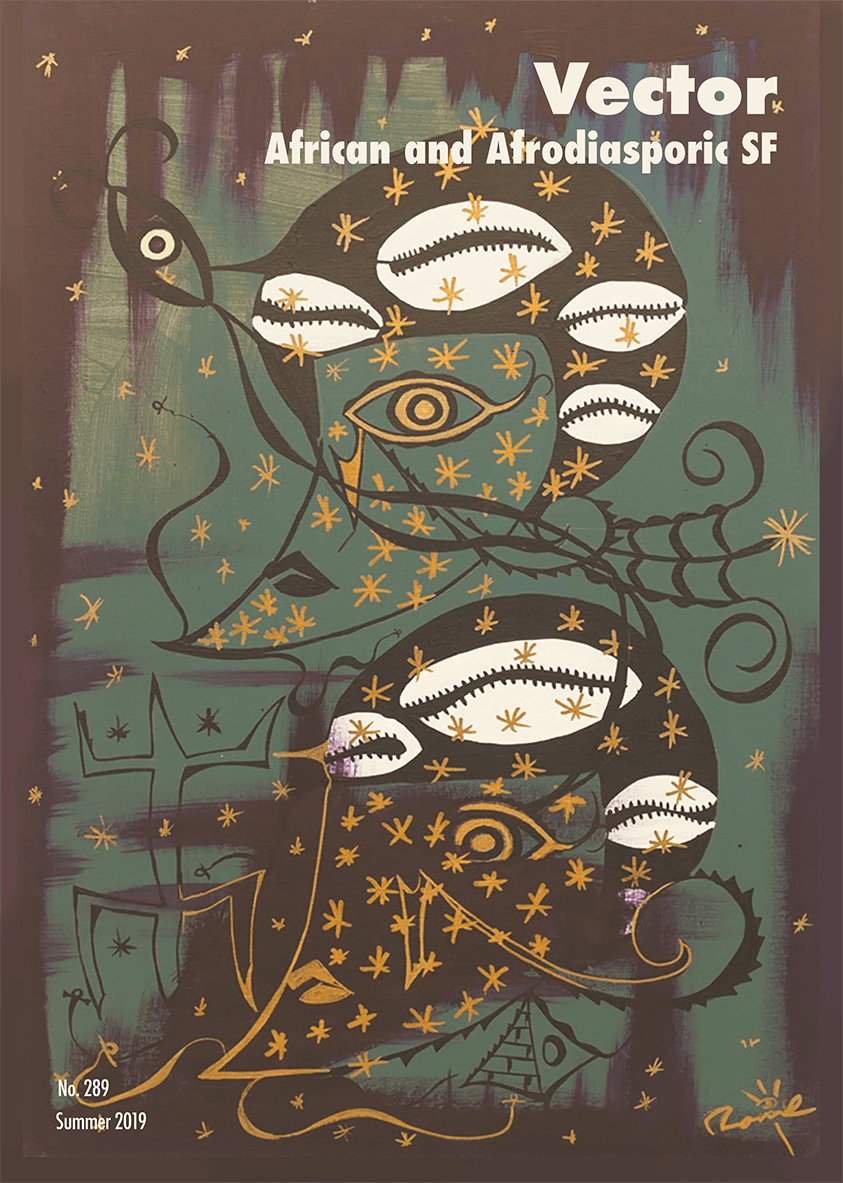
Cover art by Ronnie McGrath

Vector #289 (August 2019) is a special issue on African and Afrodiasporic SF, guest edited by Michelle Louise Clarke. It includes articles by Michelle Louise Clarke, Anwuli Okeke, and Chinelo Onwualu on the state of contemporary SFF across Africa and the African diaspora; Jonathan Hay on clipping.’s Splendor & Misery; Kate Harlin on Afrofuturism and Afro-Pessimism in Black Panther and the short fiction of T.J. Benson; Päivi Väätänen on Nnedi Okorafor’s short fiction; Lidia Kniaź on African SFF cinema by Miguel Llansó and Wanuri Kahiu; Andy Sawyer on AfroSF Vol. 3 ed. Ivor W. Hartmann; Gemma Field on Nnedi Okorafor and ecological crisis, Nick Wood on South African comics; Masimba Musodza on the experience of writing SFF in ChiShona; plus Polina Levontin interviewing Dilman Dila, Louisa Egbunike interviewing Wole Talabi, and Joan Grandjean interviewing Mounir Ayache.

Cover: Ronnie McGrath

You can order a print copy here.

From our archive: An interview with Saul Williams by Richard Howard

slamSaul Williams is a poet, hip-hop M.C., producer and actor who first came to prominence through his victory at the poetry Grand Slam at the Nuyorican Poets Café in 1996. This event kick-started an acting career for Williams with the lead role in the feature film Slam in 1998, and a music career in which Williams began to blend his poetry with his love of hip-hop. What makes Williams’ work interesting from a science fiction standpoint is the obvious affinity he has with the genre, evident in his lyrics and the soundscapes that he chooses to rhyme over. From the outset, Williams wrote and produced with a speculative bent. In the song ‘Ohm’ from 1998’s Lyricist Lounge compilation, Williams announced ‘I am no Earthling, I drink moonshine on Mars/And mistake meteors for stars ‘cause I can’t hold my liquor/But I can hold my breath and ascend like wind to the black hole/And play galaxaphones on the fire escapes of your soul’. The glimmering production on ‘Ohm’ is no less science fictional, especially as it accelerates at around the three-minute mark.

Continue reading “From our archive: An interview with Saul Williams by Richard Howard”

From Our Archive: Nisi Shawl

This article first appeared in Vector 247.

Colourful Stories

Fantastic Fiction by African Descended Authors, by Nisi Shawl

Everfair coverSo rich a sea, so broad the currents … in exploring fantastic literature by African-descended authors, where do we start?

“Begin at the beginning” is standard advice for writers. “Begin where you are” is more my style. Where I am at the moment, where I’ve been most of my life, is North America. Though I know there are many other schools of African-descended writers out there, myriad fabulists swimming in gorgeous array, I’m at my best talking about those with whom I’ve had the most contact, those about whom I have something substantial to say: those who inhabit the Western Hemisphere. In the course of this essay, then, I’ll focus on “New World” writers of fantastic fiction whose ancestors came from Africa. I’ll talk about specific works by them and also touch a bit on what I see as a commonly shared theme.
Just as important as my location in the three dimensions of physical space is my location in a fourth, time. When I am is one week out from learning of the death of my friend Octavia Estelle Butler. So despite the fact that her fiction’s far better known than that of some of her colleagues, it’s to her work I’ll turn first.

Octavia, as almost anyone who knew her will tell you, was not quite a recluse, but fledglingsomeone who valued her loneliness very highly. Yet a major concern of the heroine of Fledgling, her last complete book, is building a community. Shori belongs to a sentient species known as the ‘Ina’, and must consume human blood to live. In other words, she’s a vampire–but a scientifically plausible one. At its best, the Ina/human relationship is symbiotic, and Shori, survivor of a vicious, lethal attack on her original family, instinctively seeks to reconstruct what she has lost: a feminist-oriented blending of species and sexual preferences that might be the envy of a Utopianist visionary.

Shori’s other quest, of course, is to bring to justice those who murdered her mother, her sisters, and the humans they had gathered into their extended family. The killings may have been “racially” motivated; that is, though Shori’s not human, she has been genetically altered so that her skin is as dark as most blacks, and the tactics her enemies use are those of the Klan and other racist lynchers.

While it’s these last points that will probably impress most readers as drawing on African American culture, the book’s concern with social and familial structure shares the same roots, I would argue. Historically, most New World descendents of Africans came to this hemisphere as victims of the slave trade. This means that a large percentage of the cultural artifacts that survived that trauma are non-material. And even these were difficult to retain, subject to enormous stresses under the system of chattel slavery. Language, genealogy, occupational associations: all vanished or were transformed beyond easy recognition. It seems to me that a longing for these lost inheritances underpins the frequent tendency of New World African descendents to write what’s known as “third order” stories.
Continue reading “From Our Archive: Nisi Shawl”

Afrofuturism

I knew we’d miss something when we put together issue 245 of Vector on movements and manifestos. And miss something we did: Afrofuturism.

Afrofuturism started out as a mailing list (owned by Alondra Nelson) with the following remit:

The AfroFuturism listserv will explore futurist themes in black cultural production and the ways in which technological innovation is changing the face of black art and culture.

Discussions on the mailing list developed into a series of manifestos and people – in particular the author Mark A. Rockeymoore in his article on the subject – started to ask the question ‘What is Afrofuturism?’:

Afrofuturism is not science-fiction. It is not a mechanical, technology driven vision of the future because an afro ain’t never been about anything constricting or orderly, in the hierarchical sense. Rather, an afro is free-flowing, loving the wind. Changing, shifting and drifting on the breeze, bending this way, puffing out or just plain swaying gently from side to side, following the whimsical inclinations of the melanated person upon who’s head it is perched. An afro can be taken from, it can be added to, yet it still retains its own natural structure, its own spiral and bouncy nature. It is flexible, yet patterned. It is about synthesis and holism. It is about accepting the kitchens and working the waves on the crown. It is about dreading, locking and following the patterns of nature where they lead, yet following a laterally delineated order. It is about the interplay between dominant and recessive genes. It is about diversity. It is about knowing purposes and determining the placement of diverse variables within their proper context.

Then author Nalo Hopkinson questioned the wisdom and accuracy of referring to Afrofuturism as a movement:

[T]here’s definitely useful perspective to be gained from looking at the complex of society, culture, science, technology and the future through an Afrofuturist lens; I was sure thrilled to find other people who were doing so, and to have an online community where we could palaver. I just fear that the “there” is being mislabelled. Calling Afrofuturism a “movement” at this point feels imposed from the outside, and implies a different kind of project than what I witnessed.

My objection does in part hinge on how I understand the word “movement,” and I’m aware that some uses of the phrase “Afrofuturist movement” seem perfectly fine to me. I only start to kick when it’s used to imply a codification of practice that I don’t think exists, or a unified direction and intent that do not jibe with my experience of the discussions of Afrofuturism that I’ve witnessed or in which I have participated.

I think she’s got a point. A lot of the science fiction movements that were mentioned in issue 245, such as the New Wave and Cyberpunk movements, were all about trying to do something new. They were about getting away from established genre conventions and making their own rules. If the movement then becomes the established convention it loses the whole spirit in which it was started. The problem with most movements is that they’re all about change, and as soon as you pin them down and define them they stop being about change, and so stop being what they are. As soon as movements require you to follow rules rather than break them, they’re dead. Movements are only interesting and useful if they open up the possibilities that are open to genre writers. As soon as they become restrictive they lose their value as movements.