Amirah Muhammad reviews ‘Afro-Centered Futurisms in Our Speculative Fiction’

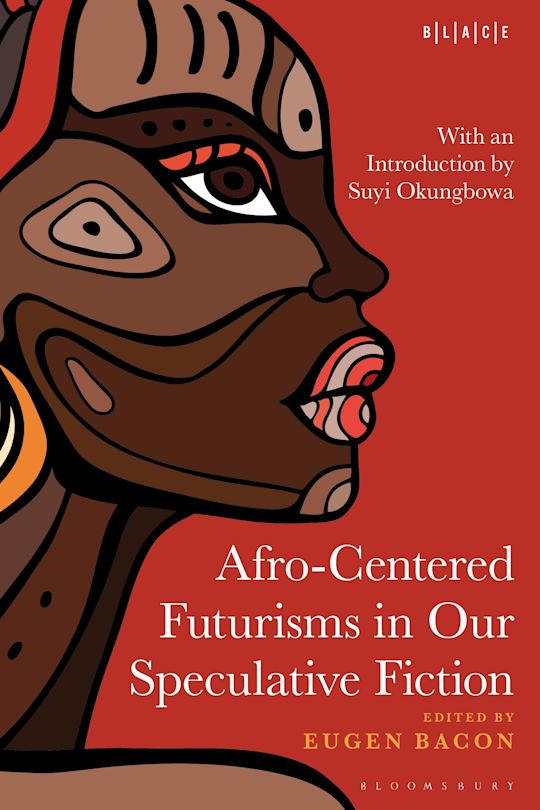
Edited by Eugen Bacon, Afro-Centered Futurisms in Our Speculative Fiction (2024) is an anthology of award-winning African speculative fiction writers, including Suyi Okingbowa, Cheryl S. Ntumy, and Dilman Dila.

The anthology pushes us to question the genre labels we take for granted – namely, Afrofuturism, Africanfuturism, and futurism – alongside introducing us to new terms, fusing specificity with inclusivity. Key to the anthology is the concept of the ‘gaze’: of looking in order to name, and the tension between fixity and fluidity that comes from it. With a blend of fiction and nonfiction, Bloomsbury describes the anthology as offering “excerpts from their work and creative reflections on futurisms with original essays.”

Afrofuturism, Africanfuturism and Afro-centred Futurisms

There are many names for speculative fiction by African writers. The anthology is chiefly concerned with differentiating Afrofuturism, Africanfuturism, and introduces Afro-centred Futurisms. ‘Afrofuturism’ often refers to Black speculative fiction, although the anthology reminds us of its origins in the United States of America through Mark Dery’s coinage. ‘Africanfuturism’ is Nnedi Okorafor’s invention to describe speculative fiction invested in African histories, presents and futures. ‘Afro-centred Futurisms,’ as Suyi Okungbowa defines it, is a plural term with an “active consciousness and open-armed framework — the privileging of the Afrodescendant self, an investment in timelessness, and an embrace of the spirituality-to-science spectrum” (18).

Continue reading “Amirah Muhammad reviews ‘Afro-Centered Futurisms in Our Speculative Fiction’”

David Rix interviews Alexander Zelenyj

Alexander Zelenyj is the author of the books Blacker Against the Deep DarkSongs for the LostExperiments at 3 Billion A.M.Black Sunshine, and others. His most recent book is These Long Teeth of the Night: The Best Short Stories 1999-2019. His books and stories have been translated into several languages, including German, French, Romanian, Italian, Spanish, and Ukrainian. He has a collection of brand new stories forthcoming from Eibonvale Press in Fall 2024.

Zelenyj lives in Windsor, Ontario, Canada with his wife and their growing menagerie of animals. Visit him online at alexanderzelenyj.com.

Alexander Zelenyj
 

David Rix: Thank you for taking the time to talk! How are you finding this new year so far? 

Alexander Zelenyj: My pleasure, thanks! I’m finding the year so far very busy. Busy with mostly good things. We have a new kitten and she’s a handful. She adopted us. Showed up at our back porch door on a cold night, tiny and frail. How could we turn her away? 

DR: I feel we may need some kind of ‘cat tax’ here – that would definitely get all this off to a good start! But anyway – I have been involved with your writing in various ways for quite a long time now and I have published several of your books, so this is a good chance to dig in a bit and explore what is going on – what makes you tick, as it were.

When reading your stories, one gets the feeling of a lot of different threads coming together, from nostalgia for classic forms of writing to the much more surreal and experimental. Can you tell us a bit about the influences that came together to make you? And maybe which ones came first and which were added later?

AZ: My home library tells the story most clearly, I suppose because I’ve always bought a lot of books and rarely get rid of them. This means I still have all the ones I had when I was a young boy, certain of which had the most profound influence on me. I was most drawn to the stranger books, which turned out to be a lot of science fiction, fantasy and horror. Those genres and many key works from each became foundational influences for me. Especially authors like Robert E. Howard, who has stood the test of time, still has a primal power and weaves a very strong spell. I remember reading Howard’s story, “The Tower of the Elephant” as a boy and having a true moment of clarity—one of just three such moments I’ve ever had in my life—and understanding that I’d just discovered something magical and very powerful, something that called to me in such a strong way that I knew I had to write stories, too.

Authors like Arthur Machen, Ray Bradbury, Edgar Allan Poe, Richard Matheson, and James Tiptree Jr. also had a huge impact on me, and continue to do so. Harlan Ellison as well. His The Beast That Shouted Love at the Heart of the World was a revelation for me. All of his collections are amazing but this one has a huge amount of variety between its covers that I’m not sure he matched anywhere else, and it’s some of his most original work. The novella “A Boy and his Dog” does a wonderful job of establishing the lead character’s amoral motivations within a post-apocalyptic wasteland, which turns out to be the most disturbing aspect to the story because it asks (and answers) the question with a kind of unerring logic: how far away are we from being this boy, in this world?

Going back even further, I have an early memory of my mother reading to me from a book of Czech fairy tales by Karel Jaromír Erben. One story in particular, called “Otesánek”, really frightened me—it was about a couple who cares for a baby that has come to life from an inanimate piece of wood. 

DR: Yes, people might be more familiar with this story from the film by Jan Švankmajer – Little Otik. That had quite an effect on me as well.

Jan Švankmajer – Little Otik

AZ: Yes, that’s the one. The baby’s appetite soon becomes much more voracious than its adoptive parents could have foreseen. Looking back on it, I see a deep pathos to this story about a childless couple wanting so desperately to have a baby that, through some magical means, the universe seemingly grants them their wish, only to have their dreams turn into this deeply disturbing, nightmarish scenario. I still have my childhood copy of the book, and it has a special place on my shelves. This might have been one of my earliest exposures to the supernatural, or the unknowable.

Continue reading “David Rix interviews Alexander Zelenyj”

Interview with Samantha Mills

by Jean-Paul L. Garnier

Samantha Mills is a Nebula, Locus, and Theodore Sturgeon Memorial Award winning author living in Southern California, USA. You can find her short fiction in Uncanny Magazine, Beneath Ceaseless Skies, Strange Horizons, and others, as well as the best-of anthologies The New Voices of Science Fiction and The Year’s Best Science Fiction & Fantasy 2023. Her debut science fantasy novel, The Wings Upon Her Back, is out now. You can find more at www.samtasticbooks.com

JPG – The culture in The Wings Upon Her Back is a theocracy where labor and religion are intertwined, can you tell us about using this as a worldbuilding device? 

SM – When developing The Wings Upon Her Back, I wanted a claustrophobic, monocultural setting to reflect the isolation of the main character and the fraught history of her city. Everything had to revolve around the five gods that are sleeping overhead. 

In the book, the division of labor is a core tenet of their religious and social framework because they are emulating the gods, who arrived with very clearly defined roles. I ended up with five sects: the workers and farmers are the biggest groups, who keep the city running; the scholars and engineers are documenting and implementing the teachings of the gods; and the warriors keep the city isolated from outside forces. The primary conflict of the book comes from the unbalancing of these factions, as the warriors take more power over the others. 

One of my favorite worldbuilding techniques is to build out social expectations – what everyone is supposed to believe, what everyone is supposed to do – and then to imagine the characters who do not fit the mold. I set a limit at five sects because it automatically creates tension: you can’t actually sort the breadth of humanity or the tasks needed to keep society running into such a small number of categories!  

This tension permeates the book. There are jobs, such as medicine, that rely on teachings from multiple gods, and therefore arouse some unease. And there are many individuals who don’t fit neatly into their sect. My main character, Zemolai, was born into a family of scholars, but left them to be a warrior. The hodgepodge group of rebels she falls in with later in life have all either changed sects, or are revolting against the expectations placed on workers specifically. The right to question the division of labor (and therefore, the teachings of the gods) is central to the story. 

Continue reading “Interview with Samantha Mills”

Issue 300, ‘Community’— Call for proposals

Solaris (1972), Andrei Tarkovsky

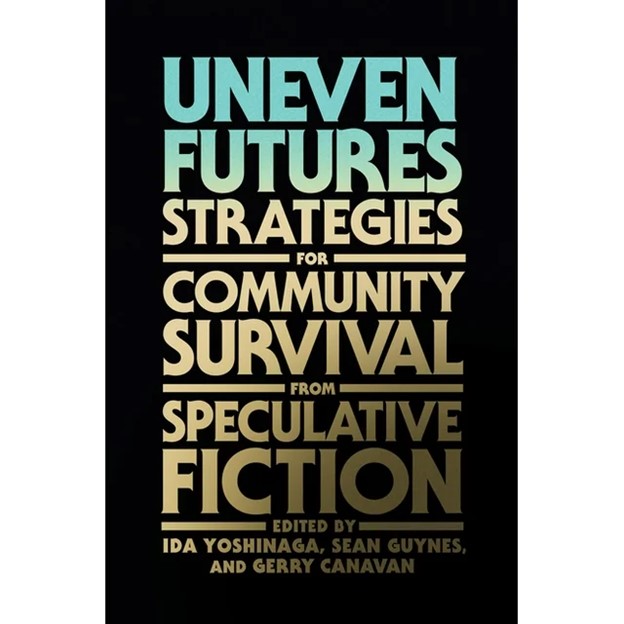
Science fiction, for all it encompasses strange new worlds and fantastical creatures, is a literary genre that is built and sustained by human communities. Writers, artists, and creators have imagined new social formations, technologies, economic, ecological, and sociopolitical systems for centuries; indeed, science fiction may be the most nakedly political of all literary genres, as thought-provoking as it is beguiling. Who is present in narratives of futurity? What kinds of technologies enable—or stymie—human connection? How can inter-species communities develop and flourish? 

Pre-internet, fanzines and conventions were the spaces where editors, authors, and fans met, shaping the genre in new and exciting ways. Praise and critique and conflict and collaboration were equally already common before social media. Some landmark dates include: the first WorldCon (1939), the first British science fiction convention, Eastercon (1937), the Maleyevka seminars, Nihon SF Taikai (from 1962), and many others, around the globe.

In 2024, the ideologies of ‘community’ are under pressure and scrutiny. Violent geopolitical events shadowplay on smartphone screens, small enough to fit in the palm of our hands, fulfilling the most dystopian dreams of the genre; we venture to fight and commiserate and celebrate with people from all over the world, instantly. Where wealthy industrialists were (and are) once praised as saviors of humanity with the glittering promise of their space programs, now SF tends to show how the relentless logics of capitalism undermine any notions of transcendence. The challenge of space travel was supposed to unite us. What would the pioneers of SF make of the now-straining politics around the International Space Station, scheduled for dismantling by 2030? 

In light of these challenges, the Vector team—for the journal’s milestone 300th issue—invites contributions that reify the notion of ‘community’ as it manifests in speculative cultures. What tools can SF offer us to construct better tomorrows, together? How can we innovate new ways of collaborating, such as the world-building projects of Syllble? What does ‘community’ look like in fiction, non-fiction, conventions, awards, conferences, collaborations, online spaces, and other literary and paraliterary formations?

Suggested questions / topics

  • history of fandom/conventions 
  • the practice of writing: zines, magazines, letters 
  • science fiction publishing: editors and collaborators on the printed page 
  • utopias and dystopias 
  • terraforming
  • defining personhood 
  • future societies 
  • sex and sexuality 
  • navigating conflict 
  • political divides, past and present 
  • interspecies alliances
  • the posthuman 
  • the future of communication 
  • translating SF 

Please submit your proposal by June 15th, 2024 to vector.submissions@gmail.com, including:

  • a 150-500 word proposal, including estimated length;
  • something about yourself, either a 50-100 word bio or a CV.

Articles should be between 1,000 and 8,000 words. Please let us know your estimated word count. We seek articles that are carefully grounded in scholarly research, while also being clear, engaging, and suitable for a broad audience (including non-academics). Articles will be due by July 31st, 2024.

Please also feel free to make queries about other formats, e.g. reviews, interviews, curated reading lists, roundtable discussions, unusual / innovative formats. 

Flights of fantasy

By Janet Philp

Fantasy tales are littered with beings that can fly, whether in video games like The Legend of Zelda1 and Skyrim2, classic films such as Prince Vultan’s hawk men in Flash Gordon3, dozens of Marvel and DC heroes, TV series, blockbusters like the Harry Potter4 series and the classic Dungeons and Dragons5. The fantasy creatures of China Mieville provide us with a multitude of winged and armed creatures whilst Le Guin provides us with winged entities of a more recognisable feline form (Le Guin, 1999).

Characters who can fly capture our imagination.  They are seen as having the ability to rise above and they often have power and God-like appearances. In this article we will be looking at the anatomy of flight and whether it can help us understand how these beings can fly, or whether it is best left to special effects. 

As we are looking at self-propelled flight, we will ignore characters who fly by some means of alternative propulsion such as Ironman6, Thor7 and Mary Poppins8.  We shall ignore those that fly using a cape such as Dr Strange9 and potentially Superman10 and we will limit our exploration to those creatures who present with anatomical wings that propel flight as opposed to fins or flaps that allow for gliding.

In the history of life on Earth there have only been four classes of creatures who have possessed the ability to truly fly.  These are the pterosaurs, insects, birds, and bats. 

Pterosaurs have been extinct for millions of years and so how they flew can only be speculated upon. Insects, due to their exoskeletons have a different anatomy and flight patterns which are not often represented in fantasy literature, although accurately depicted in the new Dune movie11.  This article will concentrate on bats and birds and how they can inform our understanding  (Evans 2020) of the flight of fantasy creatures.

Wings of Desire (1987)
Continue reading “Flights of fantasy”

Viking Fever – Vikings in Fantastika

By Kevan Manwaring

Ink: when Viking Fever goes viral

The Northman (2022) – Director: Robert Eggers; Writer: Sjón/Eggers.

Vikings are very much in vogue again, with a slew of releases in recent years reaching fever pitch in 2021-2022, many of which draw laterally, rather than literally, upon Viking culture: MCU’s Loki and Thor: Love and Thunder; Vikings: Valhalla; The Last Kingdom; The Northman; The Lord of the Rings: The Rings of Power... Readers and viewers are perhaps more adept at perceiving the loose historicity of such retellings than scholars credit them; and are drawn to the new tales largely because of the storytelling, the characters, and the aesthetic. For some, such texts are a ‘gateway drug’ to the hit of history, the fix of the source material, the Gothic allure of the archive. 

Yet for many, it is perhaps something more visceral. Martin Amis said novels come from the ‘base of the spine’, but maybe the appeal of narrative flights of fancy do also. 

It is perhaps not surprising that tales of warriors and their warrior gods are in favour in such tumultuous times (it could be argued we live in a new Viking Age, where the mask of civility has been forsaken and the strong take what they wish from the weak, or at least try), but Viking culture and Norse mythology has had an especial appeal to writers of Fantasy for a long time. Mike Ashley defines ‘Nordic Fantasy’ as ‘That body of FANTASY which draws its heart from the MYTHOLOGY of the Scandinavian and Teutonic races and incorporates the stories retold in the SAGAS.’ (1999: 691) 

In this article (from an author and academic who has written two Viking-inspired novels of his own), I explore this phenomenon. What is Viking Fever? When and how did it go viral? And is this latest ‘wave’ just a variant of a long-running cultural mutation that originates in the birth of Scandinavian and English literature, and perhaps even in the very foundations of storytelling?

Continue reading Viking Fever – Vikings in Fantastika

“More politics, more magic, and more queer”: An interview with Juliet Kemp

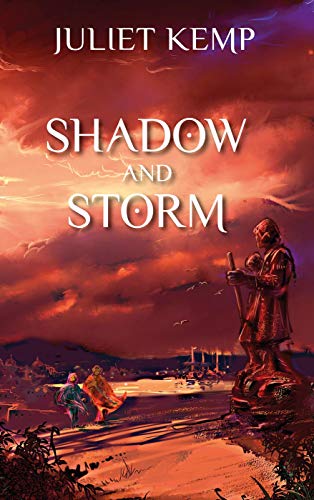
book cover of Shadow and Storm

Juliet Kemp’s second novel Shadow and Storm is hot off the presses. Rivers Solomon calls it “the literary equivalent of sinking into the embrace of a dear friend.” Ali Baker caught up with them to chat all things writing and reading …

Let’s start with your new book! How would you describe it?

Shadow and Storm takes place a couple of months after the events of The Deep and Shining Dark. My protagonist Marcia is dealing with the aftermath of the first book, and the other political problems that inevitably appear. Then a sorcerer on the run from Teren arrives in Marek hoping they’ll be safe there, which might have worked, until a demon comes looking for them. And the demon may be more involved with the politics than everyone would prefer. So there’s more politics, more magic, and more queer, basically.

That sounds amazing! 

I like writing politics — I have a background in it — but it’s hard to make it convincing. On the other hand, recent real-world events have demonstrated that sometimes people really do make very short-sighted political decisions for reasons that might not be the smartest, so …

Some might say that epic fantasy has very problematic roots, politically. Is that ever something you find yourself encountering when you write –that the material you’re working with tries to tug you in directions you don’t want to go?

That’s a really interesting question, and the answer is yes, definitely. I am consciously trying, in the Marek series, to write characters from multiple backgrounds, but there’s definitely a tendency in epic fantasy to focus on the people at the top of the pile, and one of my main characters is in that position. I also find that I’m drawn towards various forms of violence both as problem and as solution, simply I think because that’s one of the approaches I’m used to reading. The stories we tell shape how we think about both stories and the world in general. So I do try to push back against that — I want people to solve problems in other ways — but I have noticed the pressure in what
I expect a story to look like and have to consciously stop and rethink. With greater or lesser success…

Can you talk a bit more about queer representation in both books? Continue reading ““More politics, more magic, and more queer”: An interview with Juliet Kemp”

Vector #268

No, I think it’s more about the way to do it. With Tolkien, as I said in the book, it was “Gosh, you can write a whole three-volume fantasy – this is marvellous, let’s do this thing.” With other influences like C.S. Lewis, the “how to do it” thing that grabbed me was that he was always so completely clear about what was happening. You are never in any doubt who is where, and doing what – and much more complicated things than that.

Diane Wynne Jones

Bold as Love: Recap

So that was 2001.

Bold as Love is a high-paced meander through several years of England’s potential future after the dissolution of the UK, as shaped by rock n’ roll. It’s not quite quest, and it’s not quite romance. It’s a thought experiment, it’s a tour of England, it’s about the messiness of change. It’s not a book which put me in the main characters’ heads: they might have known how the rest of the world was getting on, but they only shared in the ways it impinged directly on them. It’s not nearly as much Arthuriana as I feared, based on reading reviews. (It’s not that I dislike Arthuriana per se. It’s that I’m a medievalist, so it makes me picky.)

Gwyneth Jones’ Bold as Love was the first of the poll-topping best science fiction novels written by women in the last ten years that we’ll be discussing here at Torque Control over the course of this year. It was the only one of them published in 2001.

Niall hosted the discussion February discussion, and, speaking of 2001, he noted that the book could not really have been written any later than it likely was. After 9/11 that year, “terrorism” could no longer be conceived of the way it is in this book. But that’s not much of a distraction in the scope of such rich, intense, focused world-building. Much of the intensity it has is in the music, the festivals, the performances. Music is a central focus because, in this book, “what’s significant is the potential of music to be a vehicle for belief, at a moment when belief in all other systems of the world has been shattered by catastrophic cynicism.” Ax Preston, the guitarist/leader of the book and cultural icon, curates concerts as a means to his end of making the best of a difficult political situation. I can’t quite bring myself to call him Counter-Cultural, as the movement within the book is called because, cynical as the book is, it knows full well that this is just a label, and that the Counter-Culture are mainstream cultural avatars, in effect.

My thanks to Niall for hosting the discussion, and to all the commenters who joined in reading (or re-reading) the book.

Niall’s Discussion: Part I: Context, Part II: Characters, Part III: Music, Part IV: Utopia
Overview of Bold as Love and some of its reviews from December
Abigail Nussbaum on Bold as Love and other of Jones’ books.

Bold as Love: IV

Bold as Love cover

(Previously.)

A confession: I actually came to the Bold as Love series backwards. As part of my Clarke judge duties I had to read the final volume, Rainbow Bridge (2006), and at the time I had no experience of its predecessors. Truth to tell I don’t remember all that much about it, and that which I do remember I should not speak of, but what does seem worth mentioning here is the lingering elegiac impression the book left, crystallised in a self-description by one of the triumverate, that they are “veterans of utopia.”

And so I came to Bold as Love on the lookout for the possibility of utopia, and was a little surprised by the novel’s darkness. Not the darkness in the stories of its characters — I’d read “The Salt Box” in Interzone — but in its ambience and events. Bold as Love opens in a period of near-crisis, with the authorities struggling to maintain an orderly dissolution against a backdrop of economic and ecological collapse, and the trials don’t let up: an influx of migrants, a failing electronic infrastructure, a small war in Yorkshire. It seems astonishing that this world will ever progress far enough to look back on utopia.

But there is a utopian desire present in Bold as Love, refracted by the triumverate, and in particular by Ax and Fiorinda. The latter is profoundly pessimistic — the combination of youth and experience, perhaps — and sees no good in the way the world is turning. More than once she comments that everything is going up in smoke, that it’s the end of the world. And on the role of Ax himself, when pestered, she says:

“I think he’s the Lord’s anointed. I think he has the mandate of heaven. I think he is rightwise king born over all England. But still–”
“But still you are the cat who walks by herself, green-eyed Fiorinda–”
“But still nothing’s changed.”

What does that “nothing” denote? Manifestly things are changing through the novel, dramatically so. But we know what Fiorinda means, of course, we kow she means that there are still winners and losers and — in the novel’s terms — suits with power. Sage, similarly, is a sceptic. For him, the cross-demographic appeal of the triumverate, as evidenced by the diversity of their gig audiences, does not seem like a compliment; it seems “like a deeply, deeply mistaken confidence” (243).

It’s left to Ax to lead: the only character to deliberately articulate any vision of utopia. In the aftermath of the coup, he rallies his countercultural comrades to that vision, speaking of the potential for something new in history, “a genuine human civilisation. For everyone”, enabled by technology. His goal is “To make this turning point the beginning of civilisation, instead of a fall into the dark ages”; but it’s tempered with pragmatism:

And yeah, before anyone says it, I know it won’t work. If I succeed beyond my wildest dreams, it’ll be partial, fucked-up and temporary. Partial, fucked-up and temporary will be fine. If we can get that going, for just a few years, just here in England, we’ll have made our mark. Something will survive. (82)

The grandest of visions an the most modest of terms: that’s the tension that defines Ax, seen later as dedicated to the art of the possible over the good, and seen from inside his head as one who endures. In the warzone, he recognises “a reason for Fiorinda’s mourning, the end of a world, an unbearable loss”, but “he had to bear it. Accept” (118); or, later, more than once, he thinks, “If we can just get through this part …” (I started to think of the catchphrase of Kim Stanley Robinson’s much sunnier Phil Chase: “I’ll see what I can do!”) The fragility of it all, the provisionality, is exhausting for Ax, and we sometimes feel that exhaustion. But between the three leads we also scent the elusive spirit of change, the muscular belief that things can get better, slowly.

All of which leads to the curious ending note. Superficially Bold as Love closes on a not entirely unexpected moment of grace, a pause that sees the triumverate together and comfortable. Stubborn stuff, this world; hard not to retreat from it sometimes. At the same time, Ax’s thoughts, on the final page — “I was not perfectly happy, but now I am, and if I had the power this is where I would make time stop, this is where I’d stay forever. This is it, this moment. This, now” (307-8) — make it seem coldly plausible that this is the utopia of which they become veterans: a limited, individual utopia, an impression of the world around them shaped entirely by their personal emotional circumstances. But on reflection, it’s hard to imagine another ending for this quixotic, thorny book.