Sick of Myself: a Manic Satire on Spectatorship, Vomiting Blood, and the Icarian Limits of Identity Politics

A film review by Maz Jardon
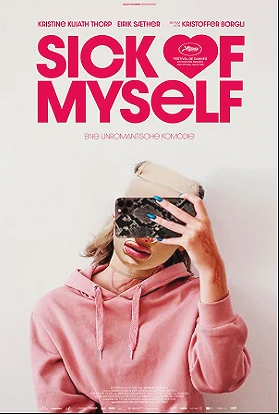
“Beautiful tragedy” might seem like an oxymoronic statement, but one that holds multitudes of truth for Western aesthetics, from the inclusion of Little Nell’s malady in Charles Dickens’s The Old Curiosity Shop as synonymous with her beauty and purity, to the recent trend of “Sick-Lit” Young Adult novels that blend medical drama narratives with teen romance themes. What emerges from these depictions is a distorted mirror image of the reader both seeking and being subjected to, the social power of being a medical spectacle. Kristoffer Borgli’s debut feature film Sick of Myself comments on the trend of reflexive voyeurism-exhibitionism by countering the notion of a Romantic affliction with grotesqueness and a liberal dose of body horror. Scathing in commentary and relentless in gore, Sick of Myself (2022) provides a riotous narrative layered with a critique on postmodern loneliness, the economy of sympathy, and the mirage of corporate inclusivity.  

Sick… follows 20-something Signe (Kristine Kujath Thorp) and her tragi-comedic attempts to eclipse her boyfriend’s artistic success by attracting sympathy through medically induced self-harm. Sick premiered on May 22nd, 2022 at the 75th Annual Cannes Film Festival but would not receive a global release until 2023, to largely positive, albeit polarising, reviews. 
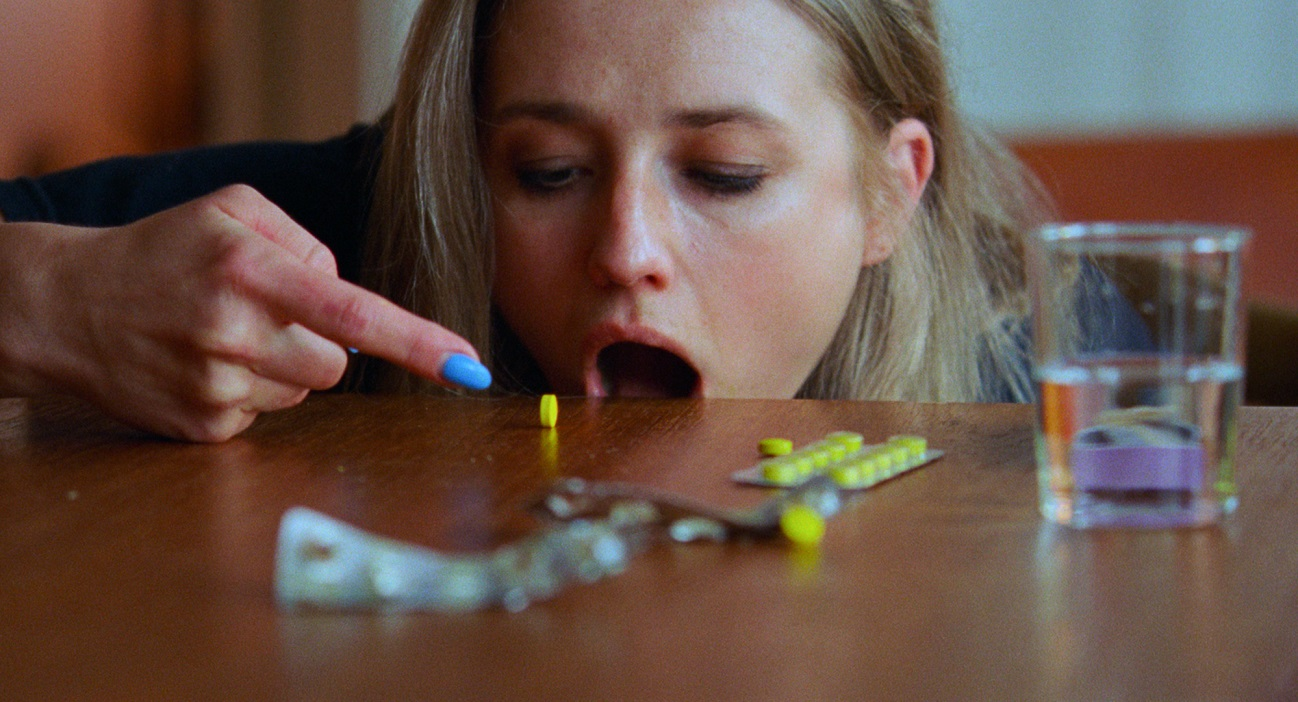
Signe consuming Lidexol

Opening with a scene of Signe and her boyfriend Thomas (Eirik Sæther) at an upscale restaurant competing for attention with their respective techniques – Signe, pretending it is her birthday, and Thomas, pretending he is rich and successful – the film’s premise is set. The up-the-stakes dynamics of the plot is affirmed when Thomas flees the restaurant, with a stolen $1000 bottle of wine in hand, and is chased by their waiter. Later, Signe witnesses a near-fatal dog attack and overcomes the Bystander Effect to call an ambulance and care for the woman’s wounds until the ambulance arrives. During her walk home, when onlookers see her covered in blood and assume she is the victim, she realises she can receive far more attention from sympathy than gratitude. The narrative escalates, much like how an untreated dog bite festers.

Continue reading “Sick of Myself: a Manic Satire on Spectatorship, Vomiting Blood, and the Icarian Limits of Identity Politics”

Into The Spider-Verse and (Side)Setting the Scene for Social Change

By Christy Dena

This piece contains mild spoilers and mild mind scrambling if you haven’t seen the 2018 film Spider-Man: Into the Spider-Verse.

Margaret Thatcher had something to say about Miles Morales, so too did narrative theorist Seymour Chatman, as well as those fighting the idea of a “half-black, half-Hispanic” Spider-Man (Rose, 2018). It wouldn’t be a stretch of my tingly senses to say these folks share the belief that there is no alternative, there is a single, right, way. Thankfully, the opening sequence of the film Spider-Man: Into the Spider-Verse (screenplay by Phil Lord and Rodney Rothman, story by Phil Lord), sets the scene for social change with some cool emancipatory narrative devices.

It’s the kind of interventionist work that needs to be done because audiences have been trained to approach their story experiences, and much of life, with closed thinking. As part of his work on The Psychology of Closed Mindedness, social psychologist Arie Kruglanski explains that ‘the need for closure is the desire to have certainty, to have a definite answer to a question and avoid ambiguity’ (Kruglanski, 2021). A consequence of this is we can ‘jump to conclusions about others, and to form impressions based on limited and incomplete evidence’ (Kruglanski, 2004, 2). That character is the killer! Capitalism is the answer!

Former British Prime Minister Margaret Thatcher found it hard to imagine alternatives, and encouraged everyone else to find it hard. Thatcher is associated with the slogan ‘There is No Alternative’ — which refers to the neoliberal logic she popularised. In a speech, Thatcher not only said ‘there’s no real alternative,’ but also said ‘What’s the alternative? To go on as we were before?’ (Thatcher, 1980). As if the future is a long, single, inevitable, line of progression and the only choice is to stick with what isn’t working or proceed in the only available direction. Do nothing and crumble, or do the only change available. 

In Capitalist Realism, Mark Fisher connected the belief that there is no alternative to capitalism with dystopian films and novels that don’t imagine ‘different ways of living’ (Fisher, 2009, 2). Instead of representing or prefiguring different ways of living together, many works of fiction depict the destruction of the world by unbridled capitalism. Even our fiction jumps to conclusions.

Continue reading “Into The Spider-Verse and (Side)Setting the Scene for Social Change”