The Evidence by Christopher Priest

Reviewed by Nick Hubble. This review first appeared in The BSFA Review.
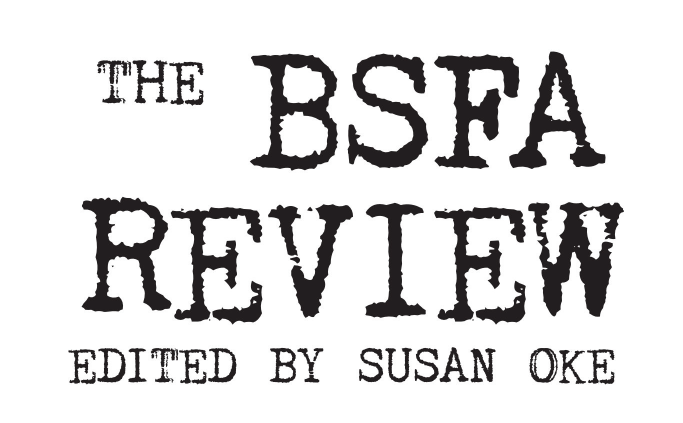
Christopher Priest’s sixteenth novel, his fifth in the last decade, returns to the uneasy setting of the Dream Archipelago, most recently traversed in 2016’s The Gradual. On the one hand, The Evidence is classic Priest with the full panoply of twins, stage magicians and the endless war between Glaund and Faiandland trundling on in the background. But, on the other, it’s a crime novel with several variants on the locked-room mystery and a particularly violent murder scene. Has Priest sold out to the demands of commercial genre writing or is he sarcastically deconstructing the format?

The Evidence

The novel begins with crime writer, Todd Fremde, on a train on Dearth Island heading to Dearth City, where he will be staying in the Dearth Plaza Hotel, in order to give a keynote lecture, to a conference organised by the University of Dearth Literary and Historical Society, on ‘The Role of the Modern Crime Novel in a Crime-Free Society’. Fremde has accepted the invitation against his better judgment, swayed by the promise of top cuisine, a suite at the hotel, and being driven around in a university car. Therefore, he makes it clear he only has time to give the lecture and then leave the next day. While it would no doubt be a mistake to conflate Fremde with Priest himself, the following fear seems heartfelt: ‘The prospect of prolonged and detailed academic discourse from theoreticians who knew little of the art and craft of writing filled me with dread’. Ouch! Suitably chastened, I shall try and rein in my well-known proclivities to quote large chunks of Derrida, Lacan or Agamben for the duration of this review.

Needless to say, the amenities on Dearth fail to match up to their billing but the real trouble arises from Fremde’s inability to adhere to the ‘Seignioral mutability regulations’ with the consequences that his watch stops, the electrical equipment in his room (not suite) takes on a life of his own, letters disappear from his emails and texts, and he incurs hefty fines for ‘electrical mutability abuse’ and a ‘Seignioral surcharge’ for ‘unauthorized horizontal prejudice’. Fortunately, he is able to offset some of the cost of these by cashing in the return half of his rail ticket and accepting the offer of a lift back across the island from a woman, Frejah Harsent, who attended his talk. But even this has its consequences as Harsent, who drives a gullwing roadster with a barely-concealed automatic weapon in the boot, turns out to be a semi-retired detective in the ‘Transgression Investigation Department, Dearth Seignioral Police’. Not only does she insist on telling him extensive details of a cold case that she was involved in because it will give him material for his writing but it also transpires that she is incredibly prejudiced against serfs leading to his blunt admission that he is a ‘citizen serf’, which provokes the following exchange:

‘I’m embarrassed – I assumed you were a professional, a vassal.’

‘That’s just your assumption,’ I said. ‘Don’t feel sorry for me. I’m a writer. All writers are serfs.’

Subsequently, Fremde gets back to his home island of Salay Raba and over the following days all seems back to normal apart from the fact that there is no sign of his expenses and fee from the University of Dearth. But then, once more against his better judgement, he finds himself slowly dragged into the ongoing fallout of the cold case that Harsent insisted on describing to him and the attendant complications of twins, magicians and illusory perfect crimes. None of which is helped by the financial collapse and run on the banks, which threatens to destabilise the economy of the entire Archipelago that Fremde may have inadvertently triggered through his mutability transgressions. All of this is great fun, narrated with deadpan irony to characteristic understated comic effect; but with a marked political charge. 

The feudal class system of the Dream Archipelago has never been laid out so starkly as in the drop-down list of ‘social level’ options that Fremde accesses at one point in the proceedings: ‘Serf, Citizen Serf, Villein, Squire, Vassal, Corvée Provider, Cartage Provider, Demesne Landed, Knight, Manorial Landed, Baron, Seignior.’ Although, amusingly, magicians are categorised as a separate category of ‘Mountebank’. In The Evidence, this outdated class system is linked with finance as a manifestation of mutability, which is both a real and unreal process that happens or is thought to happen: ‘best understood as existing somewhere between quantum physics and psychology’. 

The unexpected appearance of the medieval term ‘Vassal’ in contemporary British usage presents an example of this kind of simultaneously real and unreal existence. It is used to express the concern of Brexiteers, such as the Prime Minister of the United Kingdom, not to be reduced to the status of vassals of the European Union regardless of the fact that this is neither a likely outcome nor necessarily an undesirable one. That this kind of absurdity now constitutes the political reality of the UK is a reflection of the state of affairs described in a recent book, This is Not Normal: The Collapse of Liberal Britain (2020), by William Davies, Professor of Political Economy at Goldsmiths, University of London. Davies posits that the mismatch between ever-expanding digital data and timebound analogue frames of meaning is generating ‘escalating opportunities for conflict over the nature of reality’. This strikes me as essentially the same phenomenon that Priest describes as mutability. Fremde might have been tasked with the seemingly paradoxical task of talking about the role of the modern crime novel in a crime-free society but Priest sets himself the even more difficult problem of writing about the relationship between illusion and reality in a world in which the distinction between them has collapsed. Somehow, by sleight of genre and time-honed skill, he achieves this, and order is restored at the end of The Evidence with revels ended as all is mended. The dream still works even as all falls apart around us.

Copyright Nick Hubble. All rights reserved.
The Left Hand of Darkness by Ursula K. Le Guin

Reviewed by Nick Hubble. This review first appeared in The BSFA Review.

The Left Hand of Darkness is set on the planet Gethin, also known as Winter where there is no sexual difference between people apart from a monthly period of kemmer. When the androgynous Gethenians meet in kemmer, hormonal secretions increase so that either male or female dominance is established in one and the partner takes on the other sexual role: 

Normal individuals have no predisposition to either sexual role in kemmer; they do not know whether they will be the male or the female and have no choice in the matter. (Otie Nim wrote that in the Orgoreyn region the use of hormone derivatives to establish a preferred sexuality is quite common; I haven’t seen this done in rural Karhide.). Once the sex is determined it cannot change … If the individual was in the female role and was impregnated, hormonal activity of course continues, and for the 8.4 month gestation period and the 6 to 8 month lactation period this individual remains female. … With the cessation of lactation the female … becomes once more a perfect androgyne. No physiological habit is established, and the mother of several children may be the father of several more. (91)

Thus read the field notes of Ong Tot Oppong of the Hainish Ekumen on her initial observations concerning the sexual life of the Gethenians. These notes are in the possession of Genly Ai, who has openly come to Gethen as an ambassador from the Ekumen with the purpose of inviting the Gethenians to join the wider interstellar community. ‘The Question of Sex’ – as the chapter in which Ong’s notes appear is titled – is the aspect of The Left Hand of Darkness which has attracted most attention over the near half century since its original publication.

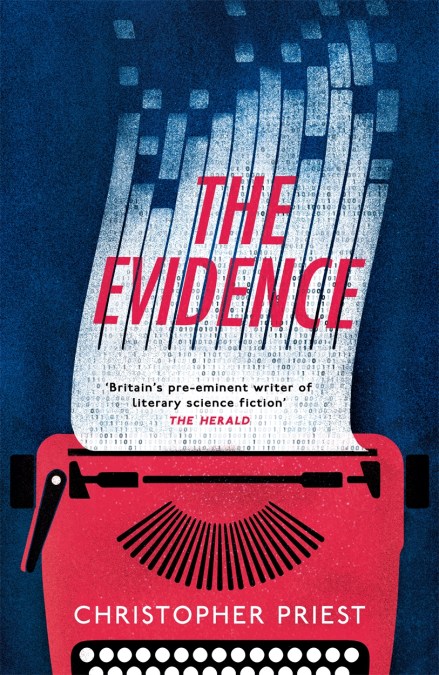
Front cover of the first edition, with art by the Dillons. Cover depicts two faces against an abstract background.

I was going to begin this review by arguing that ‘if Heinlein’s line “the door dilated” is often presented as an example of the cognitive estrangement of 1940s Golden Age SF, then Le Guin’s “The king was pregnant” is representative of a more profound late 1960s countercultural and feminist defamiliarisation’. But then I read China Miéville’s introduction to this new edition of Le Guin’s 1969 classic and discovered to my horror that not only does he make the exact same comparison, he also sums up its significance more effectively: ‘Heinlein renders one corridor strange: Le Guin reconfigures society’. For Miéville, the novel’s defamiliarisation of gender makes it unquestionably a precursor of the gender queerness and sexual fluidity of our twenty-first-century present. 

However, as he acknowledges, it was not always seen in such a radical light. Le Guin’s use of universal male pronouns to denote a society without a permanent sexual divide and therefore without a gender division, led to Joanna Russ, among others, criticising The Left Hand of Darkness for only containing men in practice. In In the Chinks of the World Machine (1988), Sarah Lefanu argues that the lack of sexual difference means that there is no historical dialectic and that the novel’s popularity is due to it simultaneously offering women a retreat from conflict back to the pre-Oedipal imaginary order while offering men the opportunity to roam freely unconstrained by the difficulties that arise from sexual difference. Adam Roberts went as far as to say, in Science Fiction (2000), that The Left Hand of Darkness is remarkably non-binary as a novel, with an appealing spirituality but an unengaging storyline, and mainly dependent on the quality of its world-building to attract readers’ imaginative and emotional investment.

In fact, The Left Hand of Darkness has long had all the hallmarks of one of those novels which one feels guiltily ashamed of uninhibitedly enjoying in private while publicly pretending indifference in order to fit in with the apparent critical consensus. There is something about all that apparently non-existent narrative tension concerning the fate of Genly’s mission and his relationship with the mysterious and enigmatic King’s Ear, Estraven, that makes one need to keep turning the pages even on the umpteenth rereading. The plot is not negligible by any means. The central irony that the rather backward kingdom of Karhide does eventually turn out to be more important to Genly than the apparently more modern and democratic Orgoreyn, is the inspiration for Iain M. Banks’s Culture-related planetary romance, Inversions (1998). And, of course, the Culture is also a society in which it is possible for the mother of several children to become the father of several more.

Continue reading “The Left Hand of Darkness by Ursula K. Le Guin”

Vector #291

BSFA members can access the full Vector archives, including the most recent issues, by logging into the main BSFA site.

Vector291 - 22 June
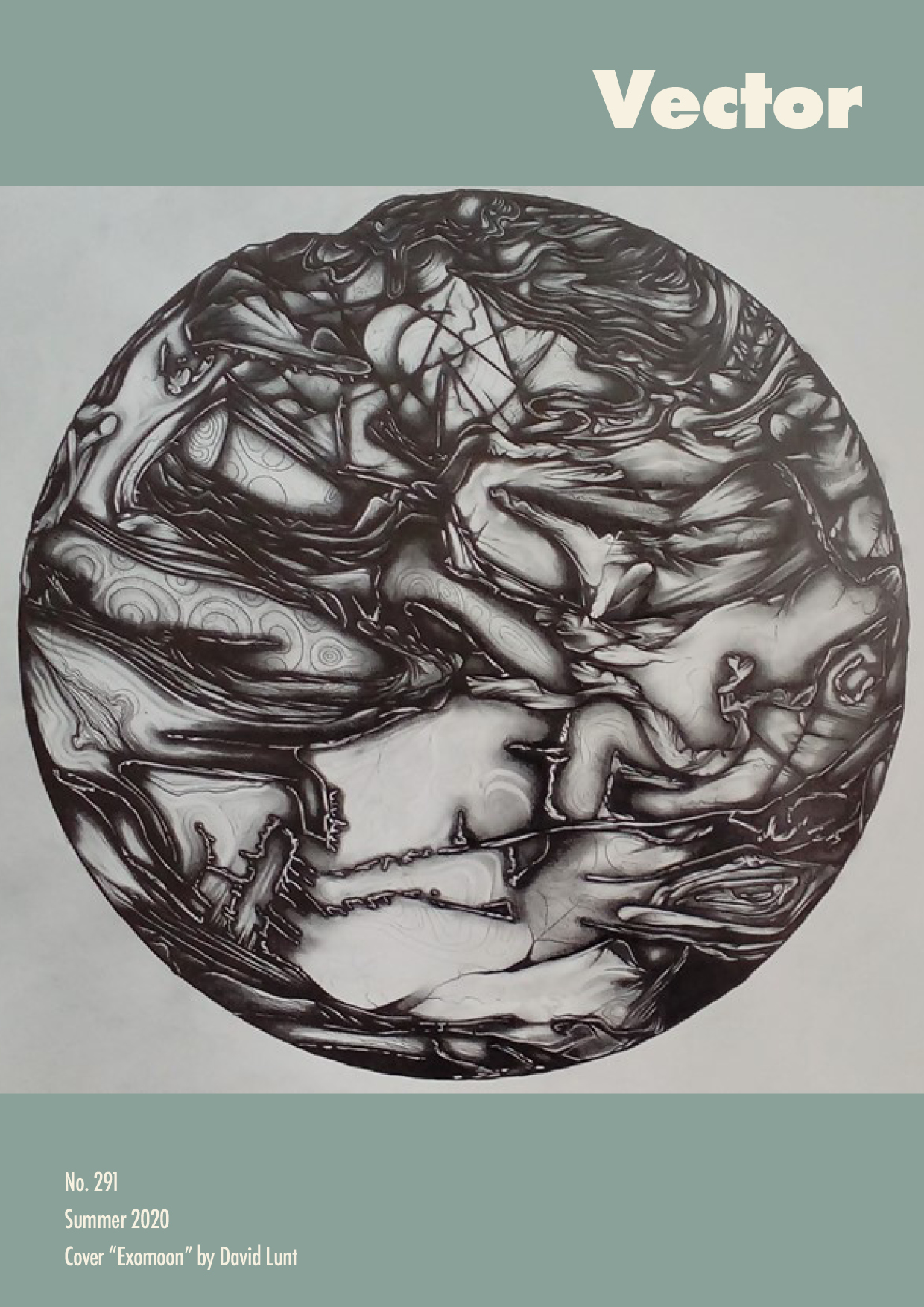
Cover art by David Lunt

In this issue you’ll find several insightful articles: “The Dystopian Narrative: an Analysis of Texts that Portray Nightmarish Futures” by Giovanna Chinellato; “The Needle and the Wedge: Digital Games as a Medium for Science Fiction” by Monica Evans; and “Amazofuturism and Indigenous Futurism in Brazilian Science Fiction” by Gama and Garcia.

There’s also an exciting array of interviews, including “This Is How You Produce The Time War”: Powder Scofield interviews Amal El-Mohtar and Max Gladstone; “Another Kind of Party”: Vector interviews Catherynne M. Valente; “The Science and the Politics”: Vector interviews Nancy Kress; “Actions and Reactions and Ripple Effects”: Liz Lutgendorff interviews Valerie Valdes; “Living among the Leviathans”: Robert S. Malan interviews Stewart Hotston; and “More Politics, More Magic, and More Queer”: Alison Baker interviews Juliet Kemp.

Paul Kincaid‘s regular column, “Kincaid in Short,” is devoted in Vector 291 to a short story by Brian Aldiss, “The Girl and the Robot with Flowers”. There are three highlighted book reviews from The BSFA Review by Andy Sawyer,  Maureen Kincaid Speller and Kate Onyett, as well as a special review-essay by Nick Hubble about Sideways in Time: Critical Essays on Alternate History Fiction, edited by Glyn Morgan and C. Palmer-Patel. Finally, this issue features a review-essay by Dev Agarwal “Us: A film about ‘Them’?”, a conference report by Jasmine Sharma on “Productive Futures: The Political Economy of Science Fiction,” and several artworks by the artist David Lunt.

Sideways in Time: A review

Sideways in Time: Critical Essays on Alternate History Fiction, edited by Glyn Morgan and C. Palmer-Patel

Reviewed by Nick Hubble

On Friday 19 February 2016, Boris Johnson, wrote two drafts of an article intended for publication in the following Monday’s Daily Telegraph. The first argued in favour of Britain leaving the European Union; the second argued in favour of Britain remaining in the European Union (see Shipman 2016: 170-3, 609-18). As we know, Johnson opted to publish a redrafted version of the original, went on to become the figurehead of the successful Leave campaign and, in 2019, became Prime Minister of the United Kingdom and then won a General Election by a landslide. But what if he’d published a polished version of the second article instead and decided to support Remain in the European referendum?

Continue reading “Sideways in Time: A review”