Bittersweet Utopias: An interview with Kellynn Wee

We were lucky enough to chat with Kellynn Wee, researcher and designer of tabletop roleplaying games, about solarpunk, utopia, memory, narrative and chance, the TTRPG scene in Singapore, and much more.

Hi Kellynn. Why don’t you start by introducing yourself?

Sure, my name is Kellynn Wee, and I’m currently a PhD candidate at UCL. I’ve been looking at play communities in Singapore, and how players relate to fantasy and speculative worldbuilding in tabletop roleplaying games. I have a background in anthropology, so I’m interested in the social relationships and meanings that emerge from these play communities – in how games can become sites to explore different relationships and identities, and how games allow us to deal with different forms of value, different approaches to uncertainty, or new ways of imagining the self. I’ve also been working on a climate futures game, Move Quietly and Tend Things, which I describe as a bittersweet utopia. 

This research involves a lot of playing games, right?

Oh for sure. I’ve never played so many games in my life! I recently calculated and it was nearly 250 games in about twenty months of ethnography, which should kill my passion for games, but somehow hasn’t. And I think that’s a good sign.

Wow! Has the play sometimes felt like work?

It’s a good question. There are always interesting tensions between play and work, right? Have you read Play Money by Julian Dibbell? It’s about quitting his day job and becoming a full-time loot farmer …

No, but that sounds kind of up my street.

Well, there were definitely games that felt like drudgery. I think it’s because of the volume of games I played. Some games just didn’t spark. It might be the dynamics of the players at the table, the kind of energy people are bringing to it. Roleplaying games are so dependent on the particular constellation of individuals at that point in time. 

Right.

But even when they don’t quite spark, it’s not exactly like work. I mean, I still had fun!

That’s good! I guess ‘work’ and ‘play’ is one wobbly binary, and then ‘work’ and ‘fun’ is another wobbly binary? There is some interesting writing by Bo Ruberg about the variety of emotions associated with play — fun is an important one, but it’s not the only one.

Sure.

You are researching the games and the players and the communities. But can I ask about games themselves as research tools? I’m wondering how games and play have been used in anthropological research historically, and whether you see potential for using them in new ways in the future.

Well, it’s pretty common for games to be pedagogical tools, right? They’re ways to place students into an anthropological frame of mind. I know that games have been successfully used to reframe research findings beyond textual outputs. For instance, I recently attended a talk by Andrea Pia, who designed a game for students to explore the topic of Chinese rural migration. They transformed their research into an interactive digital narrative where you’d make choices for a migrant character to proceed through the world, and it used photos, videos, quotes and characters that derived from Pia’s fieldwork. 

That sounds interesting.

Yes, it was really interesting. Using games as research methodologies though? Maybe that’s something that hasn’t been explored all that much, or at least it’s something I’ve yet to fully grasp myself. I wonder why not though, right? Playing, especially role-playing, and ethnography share many principles. The first thing that comes to mind is the art of asking questions well. There’s this act of iteration, of only understanding whether a method works by doing it, and then coming back to ask what sort of tools or approaches you need to get to an understanding that you want. There’s the act of making the implicit explicit, of paying attention to what is unsaid as much as what is said. There’s the consideration of different relationships, different identities, how people are going to come together and interact in the same space. There’s this element of sharing sensorial or bodily space. 

These are all aspects that anthropologists pay attention to. And so do tabletop roleplayers. A roleplaying game can also make aspects of relationships and elements of social currency visible. I also think games can act almost like a kind of meta-reality tool. While anthropologists and other social scientists often act on the principle of making the familiar strange when thinking about their work, I think games can often carry out the opposite act of making the strange familiar–exploring peculiar worlds and peculiar viewpoints by using everyday tools that help us frame our capacity for action regardless of the circumstances. So yes, many game practices resemble ethnographic practices and ethnographic thinking. It’s exciting to think what might be done with that, but it’s still a question I’m exploring. 

Your answer is making me think of this interview as a very rules-lite roleplaying game.

Should I roll some dice?

Continue reading “Bittersweet Utopias: An interview with Kellynn Wee”

Ambitopia: Futures Beyond the Binary

By Redfern Jon Barrett

We live in a golden age for speculative fiction. Futurist novels, shows, and movies have achieved a cultural saturation which would have been difficult to foresee just a couple decades ago, largely thanks to our increasingly unpredictable and perilous world. But rather than simply doling out temporary escapist relief, speculative stories help us comprehend our own cultures and their problems. Often, contemporary issues are approached via one side of a binary: either they’re exaggerated, showing us their destructive potential via a dystopia, or else they’re understood via their solution, producing a utopia.

So far, so obvious. But why are utopia and dystopia the genres we use to exaggerate and comprehend our own societies? Human communities are not structured according to a simplistic binary, instead being dependent on ever-changing laws, ideas, and social conventions. We know that truth ultimately lies in shades of grey, so why do black and white narratives still predominate in speculative fiction? Is this binary still useful as we wade deeper into the 21st century? What alternatives are out there?

Binary Problems

A few years ago the speculative writer Laurie Penny and I were interviewed on the subject of utopia. Penny, who is also a prominent journalist, posited a serious problem with utopias: namely, that the desire to create an idealised society has been used to justify numerous atrocities throughout our own history. Considering the many massacres committed in the name of a perfect world – theocratic, eugenicist, nationalist, agrarian, or Communist – it’s a difficult point to argue with. In Penny’s words, “true utopia is fascism”, underscored by a rigid set of idealised rules, unable to ever truly change or adapt; at best stagnant, and at worst, totalitarian.

Continue reading “Ambitopia: Futures Beyond the Binary”

Black Utopias: Speculative Life and the Music of Other Worlds

Reviewed by Rebecca Hankins

Black Utopias: Speculative Life and the Music of Other Worlds by Jayna Brown. Duke University Press, 2021. Paperback 212 pg. $24.95. ISBN: 978-1478010548

Brown’s Black Utopias is one of the most scholarly and comprehensive works exploring Black Utopian futures. Very apt for a Covid-19 pandemic period that has seen the initial overwhelming loss of Black and Brown lives. In light of this mass death, Brown’s study asks — and through this work, answers — “What might Black futures mean, and how might we challenge our imaginations to create futures that are not only different to what we know and what we expect, but even allows us to evolve beyond our physical existence? Packed into these pages is a narrative that encompasses Afro-futurism, death, theology, spirituality, music, philosophers, science fiction, fantasy, and gender, stories that had to be absorbed, analyzed, and contemplated before beginning the review. There were layers after layers of new ideas packed into a narrative that also centered the stories of Black women’s religious and cultural beings in which they constantly sought a physical and metaphysical utopia within an Afro-futurist and Afro-centric framework. 

Cultural critic Mark Dery is credited with coining the term Afro-futurism as “techno cultural aesthetic that blends science fictional imagery, technology, philosophy, and the imagery, languages, and cultures of Africa and the worldwide African diaspora.” Scholar Yusuf Nuruddin also notes that Afrofuturism “includes black science fiction or Afrocentric science fiction, more broadly defined as African American signification about culture, technology and things to come” (or, in the case of alternative histories, “things that might have come” from a reconfigured past). Brown’s adds to our understanding of Afro-futurism that undergirds her work: Brown defines Afro-futurism as “a program for recovering the histories of counter-futures […] most notable for resisting disciplinary boundaries” (p17). Moreover, combined with this Afro-centric, interdisciplinary attitude toward futures and counter-futures, the genre of Afro-futurism centers works of science fiction, fantasy, and other speculative fiction created by African Americans, Africans and the African diaspora. Afro-centricity embodies works that are often critical writings that focus on race, the institution of slavery, class, gender, oppression, inequality, and sexuality, all woven throughout Brown’s book. 

Continue reading Black Utopias: Speculative Life and the Music of Other Worlds

Finding Utopia in the Failures and Lost Languages of Dialect

By Ben Platt

It seems that the utopian imagination is trapped, like capitalism and industrialism and the human population, in a one-way future consisting only of growth. All I’m trying to do is figure out how to put a pig on the tracks.

Ursula K. Le Guin, “A Non-Euclidean View of California as a Cold Place to Be”

What happens when we combine TTRPGs, an artistic medium that often depends on the productive forces of failure, with utopianism, a ‘philosophy of hope’[1]that expresses the ‘desire for a better way of being’[2] but which has been undermined by its ties to the social and political failures of the 20th century?

TTRPGs often build their mechanical foundations on the bedrock tension between success and failure through action-resolution systems that some game studies scholars identify as one of ‘three key design areas […] relevant for all types of RPGs.’[3] Failure, for many players, makes the eventual successes that emerge through these improvisational stories all the sweeter. As Sarah Lynne Bowman remarks, ‘even players who enjoy various types of games for entertainment… locate their pleasure as rooted in the mental challenges necessary for success and the competitive gratification inherent to outwitting an opponent.’[4]

Utopianism, on the other hand, seems to have been undermined in the popular imagination due to its association with failure. In our current socio-political climate, ‘to call a political ideology or project “utopian” in this context was not only to signal that it was unrealistic or unrealizable,’ but also that utopianism as a whole is ‘irresponsibly and actively dangerous, an effort to exert political control over whole societies, freeze history, deny social complexity, and treat human beings as so much raw material for the fulfillment of grand philosophical visions.’[5] These visions were more often than not ‘the emanation of a single, individual will, a fantasy of total control.’[6] Remnants of a utopian desire persist, but have to contend with the bleak socio-political landscapes where they are often drowned out by the ‘empty din of globalized neoliberal capitalism’ and the general consensus within ‘mature capitalist liberal democracies’ that the ‘prospect of gradual progress under consensual, relatively depoliticized, liberal or social-democratic governance’ is the best path forward.[7] Because of its perceived failures, utopianism as a method of representing and bringing about concrete ‘replacement ideologies’[8] and ‘full-fledged alternative communities ready to supplant existing institutions’[9] has lost much of its foothold in the contemporary imagination, despite the urgent feeling that we need a better world now more than ever.

Continue reading “Finding Utopia in the Failures and Lost Languages of Dialect

Utopian Drama: An interview with Siân Adiseshiah

In your book Utopian Drama: In Search of a Genre, you distinguish two wellsprings of utopian thought. There is the early prose tradition, which includes texts like Christine de Pizan’s The Book of the City of Ladies, Thomas More’s Utopia, and perhaps also Plato’s Republic. Your research focuses on the second tradition — the theatrical tradition. This is something you trace back to the Old Comedy of Ancient Greece, and something that has been comparatively less studied. How do you think that the priority on prose has shaped Utopian Studies?

The frameworks of Utopian Studies, as they have developed over recent decades, have typically assumed the object of study to be prose fiction. So features of this early prose tradition have of course informed how interpretation has operated within Utopian Studies. Utopia, at least by default, is something described. It also generally gets constructed by a gaze that is located outside of that utopia. Thomas More’s Utopia, for example, needs to be set within the context of early modern travel narratives, and the whole range of colonial encounters which these describe. 

Right, the traveller who visits a far away place or time, sees strange things, and learns just to rethink the institutions back home. Presumably that has played into the high regard with which defamiliarization is held, certainly within adjacent fields like Science Fiction Studies?  But then, does it need to be that way? Couldn’t we get to know utopia through the experiences of characters who have always lived there and are deeply familiar with different aspects of utopia?

Another feature of the early prose tradition is that assumption of anonymity. More’s Utopia is again a good example. There’s a striking shift between Book One, where there is a conversation of sorts among various real and fictional people, and what happens in Book Two. In Book Two, Raphael recounts his travels on the island of Utopia, and suddenly all sense of character disappears! 

So I think that’s very much a feature of the early prose fictional examples of utopia, and absolutely not in the case of dramas. In More’s Utopia, you don’t get to know individual Utopians. In later prose utopias, that does change, partly due to the emergence and development of the novel, but also as a response to accusations of the genre being boring — but even in the later utopias, there isn’t very much character interiority, or much of  a sense of agency, et cetera

You do sometimes get defences of a utopian rhetoric of generality, abstraction, anonymity. Like the idea that a wide range of readers will identify with an Everyman narrator. But of course, every ‘Everyman’ is really an ‘Actually Pretty Specificman.’ He is a particular subject position, elevated in a way that rejects the reality of other subject positions, or suggests that such differences are negligible. On stage, I suppose that Everyman myth might be even harder to sustain? Simply because there is always a very specific voice, face, body, occupying that role?

Yes, absolutely. The particularity. But also just the fact of a body on stage at all!— people on stage, humans, rather than a kind of distant description, a kind of external gaze. Another feature of the early prose fiction tradition is using setting as foreground. So in More’s Utopia you have long descriptions of the number of districts and the way that towns are laid out, housing, agriculture, et cetera. What’s usually registered as background setting in the novel becomes part of the foregrounded narrative in utopian prose. Character, if it figures at all, is there as background. So again, this is something that’s immediately reversed when you’re looking at a play, when you’re looking at stage drama. 

Continue reading “Utopian Drama: An interview with Siân Adiseshiah”

Telling the Acrobats which way to Jump: Irrigation Gaming and Utopian Thinking

Maurits W. Ertsen

“I mean I can book the acts, but I can’t tell the acrobats which way to jump!”

James George Hacker (portrayed by Paul Eddington)—Yes Minister, Series 2, Episode 2: ‘Official Secrets

Utopia and Irrigation

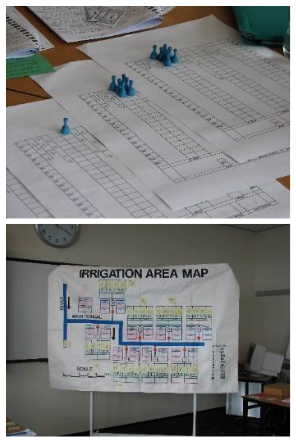
This is an article about The Irrigation Management Game (IMG), reflecting on my own use of the game in educational settings, and drawing some links with utopian and dystopian thought. The relationship between water and human wellbeing has been extensively studied and debated. Perhaps the most famous overarching theory is that of Karl Wittfogel. Wittfogel argued that certain climates imply certain forms of irrigation, which in turn imply certain political and social institutions.[1] In particular, Wittfogel thought that ancient Egypt and Mesopotamia, Hellenistic Greece, Imperial Rome, the Abbasid Caliphate, Imperial China, the Moghul Empire, and Incan Peru, were all ‘hydraulic societies,’ whose despotic character arose from the need to manage complex irrigation infrastructures. Although Wittfogel’s environmental determinism has since been discredited, his work remains a great reminder that water management is seldom simply a set of technical problems. Instead, water management is intimately linked with power, labor, knowledge, discipline, control, and utopian and dystopian possibilities. Anyone who has read George Orwell’s 1984 or Aldous Huxley’s Brave New World—or is a fan of Michel Foucault—will surely recognize such themes.[2] Irrigation is one of many domains where governments have attempted to improve collective welfare without undue interference in individual freedoms.

Irrigation was on many development agendas, in states as diverse as the Neo-Assyrian empire[3], colonial states in the 19th and 20th centuries[4] and modern settings[5]. In these developmental settings, irrigation—including its aspects of control—was often associated with utopian futures, at least within state propaganda and planning discourse. In colonial Africa, for example, European powers imposed irrigation regimes on communities they treated as ‘historyless’, while perceiving themselves as creating an ideal, rational order.[6] After the Second World War, with many colonized countries gaining independence, irrigation systems that had been constructed and/or planned became part of post-colonial international development.[7] Former colonial experts became international experts, and new experts were trained within irrigation approaches developed in colonial times.

In the first decades of post-WWII development, the main focus was on building new and rehabilitating existing irrigation infrastructure. From the 1970s onwards, more attention was paid to issues of managing these infrastructures—including relationships between managers, farmers, and other water users. These discussions intensified in the 1980s, if only because results lagged behind the expectations (sometimes too optimistic—utopian!—expectations) of governments and engineers. New methods of design and management began to emerge, and slowly began to adopt more participatory processes, to accommodate stakeholders’ knowledge and wishes. The main topic of this article, the Irrigation Management Game (IMG), is a result of these intensified efforts.

The IMG was initially developed to support discussions among irrigation managers on farmer strategies and water delivery problems, especially in the larger systems in South and South-East Asia.[8] After positioning the IMG within a gaming context, I will examine how the game reflects the realities that I study—both in practical and theoretical terms. I will conclude by suggesting that the IMG allows us to explore how utopia and dystopia are in the making, and not fixed in advance by a given environmental setting and management system. Especially in irrigation, I will suggest, the margin between utopia and dystopia can be thin.

Continue reading “Telling the Acrobats which way to Jump: Irrigation Gaming and Utopian Thinking”

The Rules of Utopia: The Procedural Rhetoric of The Book of Cairn

By Tyler Brunette

In ‘Back to the Future: Wells, Sociology, Utopia, and Method,’ Ruth Levitas argues:

[…] we would be better served both as sociologists and as citizens by a more utopian method, one which embraces the Imaginary Reconstruction of Society (IROS) as an active device in reflexive and collective deliberations about possible and desirable futures.[1]

Few activities dovetail better with Levitas’ proposal, one of collective deliberation and active imagination, than tabletop roleplaying. Indeed, both utopianism and tabletop roleplaying are often derided by their detractors as mere frivolity, and unworthy of serious consideration. However, as an interactive medium based on cooperative imagination of the possible, tabletop roleplaying games (TTRPGs) offer a unique opportunity for analysis of the practice of the IROS.

Cover of The Book of Cairn. A hooded anthropomorphic mouse gazes over the hilt of a sword, which they are holding by the top of the blade.

In this article, I analyze one such game: SoulJAR Games’ The Book of Cairn (Cairn). While at first glance, Cairn appears to be little more than yet another ‘fantasy heartbreaker,’ I argue that Cairn’s combination of unique rules and use of a pastoralist utopian setting function as a method of critique, of both contemporary social conditions, and of the themes embraced by the TTRPG industry more broadly.[2] Specifically, I argue, two interlocking rhetorics are built into the rules of Cairn, producing through play of the game both a sense of what would be necessary to maintain (albeit imperfectly and abstractly) a small pastoralist utopian society, and also an enactment of those activities around the gaming table. Before turning to my analysis of Cairn and the implications of its rules, I first address the theoretical underpinnings of my approach. After my analysis, I conclude by discussing the limits of Cairn’s IROS.

Continue reading “The Rules of Utopia: The Procedural Rhetoric of The Book of Cairn

Post-it Utopia: The Promises and Pitfalls of Arium’s Lean Worldbuilding

By Nicholas L. Stefanski 

Arium: Create

The worldbuilding TTRPG Arium: Create by Adept Icarus promises a utopian procedure for creating gameworlds that are generative, safe, and liberating environments for roleplayers, an undertaking animated by recent debates over the prevalence of harmful, stereotypical, or simply repetitive tropes throughout the TTRPG industry. While the shift away from these problematic tropes is admirable and perhaps overdue within the industry, Arium’s approach to addressing this issue is also notable for its enthusiastic endorsement of creativity techniques stemming from the world of corporate management and innovation consulting. Specifically, Arium’s Lean Worldbuilding approach shares many commonalities with the Lean management philosophy that emerged in the 1990s, largely inspired by Toyota’s operating model. Both Arium’s Lean, and Lean as it is now understood in business, are associated with the pervasive use of Post-it notes for ideation and collaboration.

Image Credit: Shutterstock

This article explores how Arium’s utopian solutionism and endorsement of a signature technique of post-Fordist management presents both pitfalls and opportunities for inventive, utopian roleplay. Beginning in the critical mode, I suggest that by adopting techniques that reduce the art of imaginative worldbuilding to a ritualized formula, Arium: Create risks building worlds that are creative merely for the sake of creativity, and consensual mainly in their appeal to the lowest common denominator. Inspired by Adorno and Horkheimer’s critiques of jazz and the culture industry, and following Eitan Wilf’s ethnography of Post-its and critiques of the innovation and creativity industry, the first movement of the article asks whether such strategies of routinized, commodified creativity can only ever produce the ‘freedom to choose what is always the same.’[i] Nevertheless, while this danger should not be ignored, I argue that it would be wrong to dismiss Arium or to label it as utopian in only the pejorative sense. Taking cues from theorists responding to Adorno’s pessimistic stance toward popular culture, notably Adorno’s Frankfurt School colleague and interlocutor Walter Benjamin, the second movement of the article suggests that despite its embrace of corporate solutionism, Arium’s collaborative worldbuilding contains a generative kernel, revealing an additional movement in the dialectic between oppressive technologies of control and the utopian impulse.

Continue reading “Post-it Utopia: The Promises and Pitfalls of Arium’s Lean Worldbuilding”

Automation and Utopia: Human Flourishing in a World without Work by John Danaher

Reviewed by Michael Pitts.

Danaher, John. Automation and Utopia: Human Flourishing in a World without Work. Harvard UP, 2019. Hardcover. 248 pg. $99.95. ISBN 9780674984240.

Automation and Utopia: Human Flourishing in a World without Work is crafted as a response to fears over an automated future in which humans are made obsolete by technological developments. Written by John Danaher, senior lecturer of law at the National University of Ireland, Galway, the text consists of two main sections, which cover automation and the possibility of a utopian future, respectively.

After outlining the scope and purpose of his research, in the first chapter Danaher forecasts the obsolescence of humankind in an automated world. But this is not as catastrophic as it may sound since, for Danaher, “Obsolescence is the process or condition of being no longer useful or used; it is not a state of nonexistence or death” (2). In the rest of the automation section, Danaher responds to two propositions: that automation in the workplace is both possible and desirable, and that automation outside of the workplace is potentially dangerous and its threats must therefore be mitigated.

After making his case for why automation should be conditionally embraced, in the second section Danaher turns to two possible, ‘improved’ societies with automation fundamental to their economies, the cyborg and virtual utopias. While the cyborg utopia enables humankind to remain valuable members of the economy, occupying the cognitive niche that has historically provided an initial evolutionary advantage to the species, Danaher posits that such a future will likely maintain the degradations of employment, enhance our dependency upon machines, and disrupt humanist values while, due to the technological advancements it requires, ensuring no worthy improvements to human wellbeing in the near future.

Following up this analysis of the cyborg polity, Automation and Utopia concludes with a presentation of what Danaher views as the ideal, improved society, the virtual utopia. This improved society, in which humankind ventures into the virtual world to enhance its flourishing, is presented by Danaher as an ideal goal towards which humankind may aim since, as the author posits, it will ensure human agency, pluralism, stability, a myriad of alternative utopias, and a meaningful connection to the non-virtual, real world. 

Pivotal to Danaher’s assessment of automation, and a possibly utopian future, are his views on labor and the avenue he identifies as optimal for human flourishing, the virtual utopia. For the purposes of his argument, he adopts a definition of work which he acknowledges as unusual and likely controversial, since it excludes “most domestic work (cleaning, cooking, childcare)” as well as “things like subsistence farming or slavery” (29). Defining work as “any activity (physical, cognitive, emotional etc.) performed in exchange for an economic reward, or in the ultimate hope of receiving an economic reward,” Danaher builds the case that obsolescence is almost certain and could result in as low as 10% or as high as 40% of the future population remaining employed (28). Such a development is framed as a positive result since work, he emphasizes, has a negative effect upon employees and improving it in the current economic milieu is, according to him, a more difficult route to take than shifting towards a virtual utopia. Specifically, Danaher argues that improving work, which often involves fissuring, precarity, colonization, classic collective action, domination, and distributive injustice is unlikely in our current system since it “would require reform of the basic rules of capitalism, some suppression or ban of widely used technologies as well as reform of the legal and social norms that apply to work” (83). Though this dismissal of the possibility of improving working conditions is short-sighted and ignores the likelihood that labor organizing will prove necessary as technological advances continue, this weakness of the text stands on its periphery. More important to Danaher’s vision of the future is his adoption of an approach that is interestingly more radical than such efforts to protect workers: the introduction of a universal basic income and the normalization of technological unemployment in current economic systems. 

Danaher envisions this radically different distribution of economic power as a salient feature unique to the virtual utopia. Danaher rejects the cyborg utopia, believing it will threaten the prospect of universal basic income and technological unemployment and ensure the continuation of work and the injustices endemic to capitalistic systems. In considering the virtual utopia, Danaher’s audience must consider the ethics and consequences of a nation in which utopian games and escape become a salient feature of its culture. This ideal society is marked by its focus upon virtual worlds as the mechanism by which human flourishing may take place. By venturing into simulations that are shaped to satisfy the desires and needs of individual users, it avoids the problems of a single utopian ideal that must be enforced upon all citizens. It can therefore, as Danaher explains, “allow for the highest expressions of human agency, virtue, and talent… and the most stable and pluralistic understanding of the ideal society” (270). 

Yet as with the cyborg utopia, the virtual utopia is plagued with ethical complications. The question of what actions are permissible in such a simulated environment is closely related to the ethical considerations surrounding cyborgs and artificial intelligence. In very briefly confronting this topic, Danaher asserts that the same moral constraints that shape human interactions in daily life will impact those occupying the virtual world. He supports this argument by pointing out that some of the characters inhabiting the simulation will be operated by human players and that interactions with such players will have ethical dimensions. In addition, he asserts that other actions may be deemed intrinsically immoral even without a corresponding ‘real-life’ consequence.  Danaher asserts that, though there will be some moral frameworks unique to the virtual utopia, there will be no major alteration to human ethics. The virtual utopia, he claims, is therefore a reasonable goal for the post-work society since it enables human flourishing and protects values such as individualism and humanism.

Danaher is also keen to emphasize that “the distinction between the virtual and the real is fluid” (229). He rejects the “stereotypical” science fictional view of virtual reality, as something that is only produced within immersive technological simulations, like the Matrix or Star Trek’s Holodeck. On the other hand, he also rejects the “counterintuitive” view that everything humans experience is virtual reality in that our reality is constructed through language and culture. Instead, Danaher offers a middle position. Some things may be more virtual than others, but nothing is wholly virtual or wholly real. He sees virtual utopia as being filled with emotionally and morally meaningful interactions, but in the context of relatively inconsequential stakes (rather than survival, or struggle for hegemony). A Holodeck-style simulation is only one of many ways this could be accomplished. 

Automation and Utopia delves significantly into the topic of possible futures at the intersection of ethics, technology, and humanism. It is a valuable resource for scholars, students, and laypeople engaged with conversations surrounding the advancement of automation in the 21st-century, its impact upon economics and workers, and optimal approaches to accommodating such new technologies through the advent of a post-work society. The work continues discussions at the intersection of technology and labor, but necessitates broader considerations related to the virtual utopia Danaher proposes. Namely, it does not convincingly explain how virtual utopia will avoid the ethical pitfalls outlined in relation to the cyborg utopia. It also does not thoroughly discuss how such simulations may be safeguarded from economic exploitation at the hands of those owning or operating these systems, or address the potential for intersectional inequalities. Finally, Danaher does not comprehensively discuss how such escapism and the further minimization of human interaction in the natural world may impact climate and the environment. Though it is difficult to accurately predict, estimations of both the ecological and psychological effects of a society in which the main mechanism of human interaction is not within nature but instead within a virtual world are vital to identifying optimal utopian aims.

Overall, Automation and Utopia productively dives into the topics of technological advancement and labor policy, proposes thought-provoking socioeconomic policies related to the challenges of automation, and necessitates further discussions concerning ‘the ideal society,’ its connection to technology, and the impact it may have upon human psychology and the environment. 

Creative Commons License
This work is licensed under a Creative Commons Attribution-NonCommercial-NoDerivatives 4.0 International License

Political pragmatism and utopian anticipation: A review of Fully Automated Luxury Communism

Thomas Connolly reviews Aaron Bastani, Fully Automated Luxury Communism (London: Verso, 2019), x + 278 pp, ISBN 978-1-78663-262-3.

9781786632623The term “fully automated luxury communism” (or FALC) first began circulating among far-left internet commentators in the mid-2010s as a name given to one potential form of post-scarcity economy. Alongside a number of variations (such as “fully automated luxury gay space communism”, or FALGSC, which inflects the term with post-gender and post-sexuality connotations),

FALC gained wider recognition following a Guardian write-up in March 2015 that discussed the origins and significance of the term. Aaron Bastani—a British political commentator and co-founder of Novaro Media, an independent left-wing media outlet—was interviewed as part of that article, and has since become the key intellectual figure associated with FALC. The current work is Bastani’s attempt to unpack the meaning and implications of FALC.

Continue reading “Political pragmatism and utopian anticipation: A review of Fully Automated Luxury Communism”