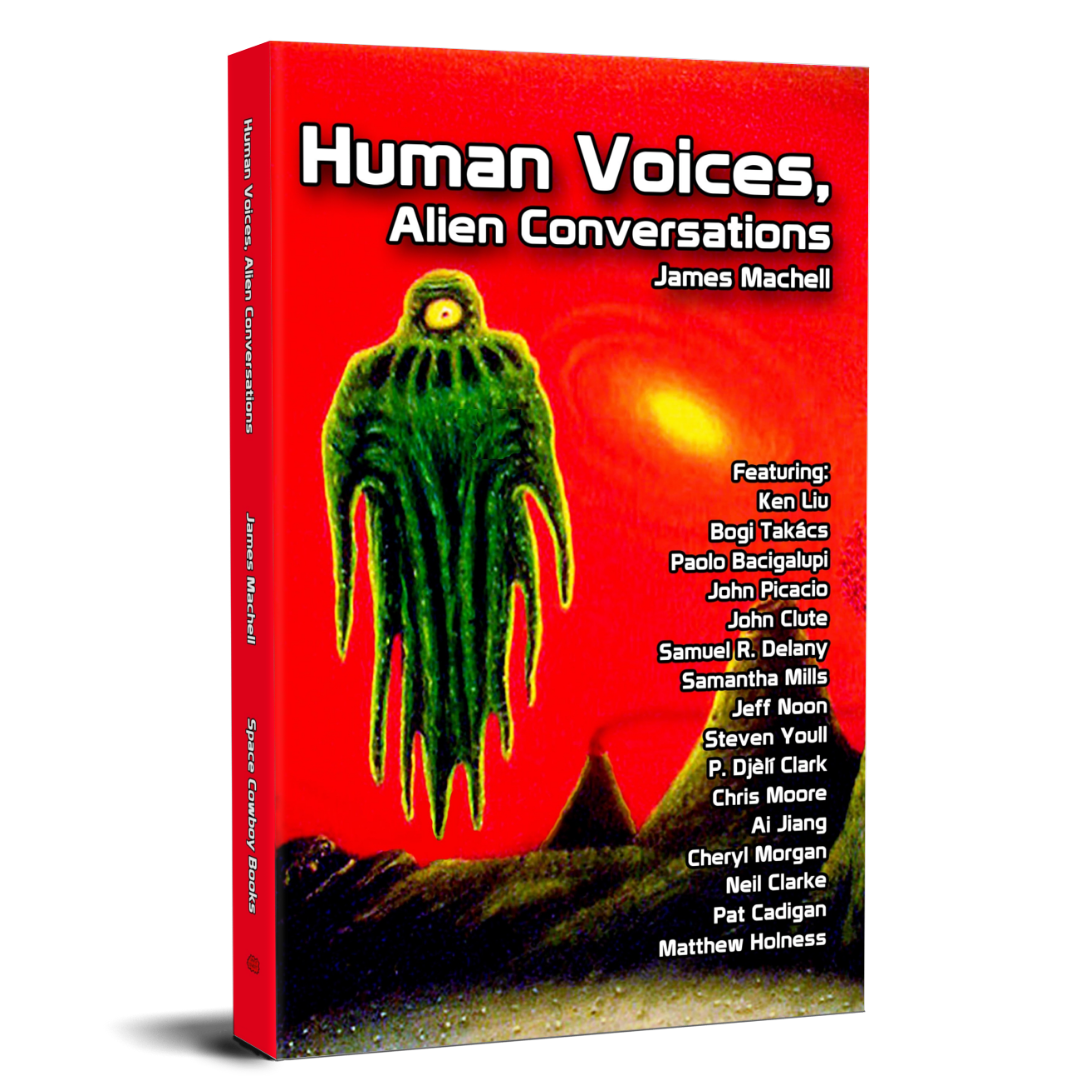
Jean-Paul L. Garnier interviews James Machell

Jean-Paul L. Garnier: What inspired you to conduct the series of interviews in Human Voices, Alien Conversations, and how do you go about selecting interviewees?

James Machell: Several of the interviews had appeared in Utopia Science Fiction Magazine and Electronic Brain. What I wanted to do with Human Voices, Alien Conversations was pull them together into one narrative, and additional interviews were conducted to fill what I perceived to be the gaps in the collection as an overview of SF in the 21st Century. In order to show this with a bird’s eye, I couldn’t just focus on writing when there’s art, editing, performance, and adaptation. I also wanted to explore understated significance. Samuel R. Delany, for example, is nowhere near as well known as Andy Weir, but his influence, even at the time of composing his major works, has been much more profound. Similarly, Chris Moore, with his prog-rock styled art for the SF Masterworks Series, created some of the most recognisable images in the history of SF but did so quietly, never chasing awards or drawing attention to himself: he let his art speak. Cyberpunk, almost exclusively associated with William Gibson, was developed by a “team” of writers in the ‘80s: I thought it would be much more interesting to speak with Pat Cadigan, who is frequently dubbed the “queen” of the subgenre. But I couldn’t just focus on the legends when their contributions to SF are constantly evolving through their influence on younger writers. Interviewees, therefore, vary greatly in age, juxtaposing the perspectives of those blossoming into the SF landscape with those who loosened the soil. Bogi Takács, Samantha Mills, and Ai Jiang, also included in Human Voices, Alien Conversations, are writers we should be looking out for. The final interview is with Matthew Holness, co-writer, co-director, and star of Garth Marenghi’s Darkplace, which gets my vote as the most underappreciated use of SF in visual media. As Holness is now working on the third in a series of spin-off novels, he was ideal to pull everything together. 

JPG: How do you go about researching your subjects in preparation for interviews?

JM: Most of the interviewees were selected because I’d been enjoying their work for years. The questions came easily. The Internet Speculative Fiction Database and The Encyclopedia of Science Fiction, however, were excellent resources for pinning down dates and discovering aspects of their careers which may have eluded even the most die-hard fan.  

JPG: What do you see as some of the main concerns and themes in early 21st Century science fiction?

Continue reading “Jean-Paul L. Garnier interviews James Machell”

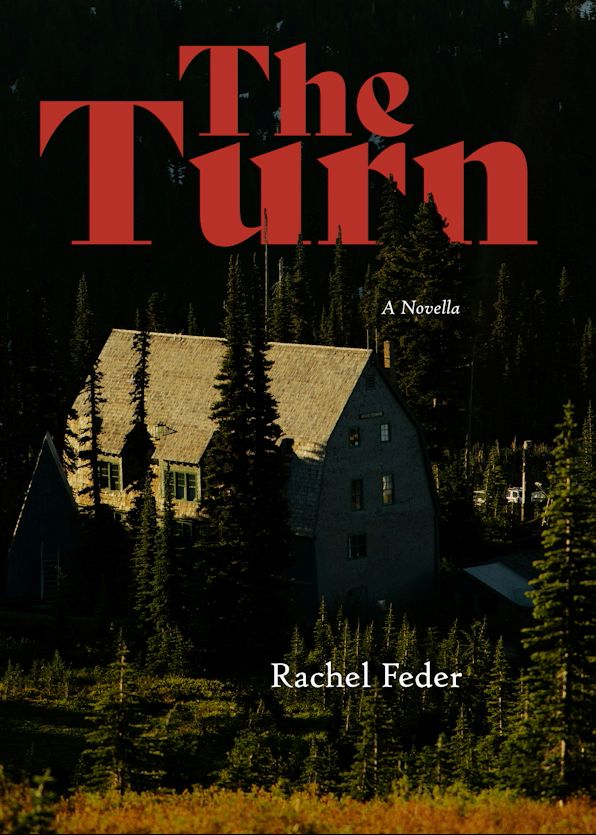
Vector interviews Rachel Feder

Vector (ed. Polina Levontin): As a literary scholar, you have written both about motherhood in Frankenstein and theorised the gothic genre in Dracula, a book you edited. How does writing and ‘research as practice’ intersect in The Turn?

Rachel Feder: One of my mentors in graduate school, Yopie Prins, once described herself as “promiscuous” in her scholarly interests. This stuck with me, and I like to say that I’m a slut for genre. I’m interested in genre as a form of experiment, one that calls a certain imagined readership into being. I’m interested in how genre hopping might allow me to imagine and, hopefully, connect with different communities of readers.

The Gothic is a really interesting test case, here. A text I think about a lot is Mary Wollstonecraft’s unfinished Gothic novel, The Wrongs of Woman, or Maria, which is, in my opinion, her most radically proto-feminist work. When Wollstonecraft enters political-theoretical discussions—which it’s actually incredible that she was able to do so effectively, given both her gender and her class and family background—she writes to the readership that was already established for that discourse field. She offers almost chiropractic adjustments to patriarchy. But then we get this raw, unfinished Gothic novel (edited and mediated by Godwin, who burned her drafts, sure), and suddenly we’re talking directly about abuse, assault, abortion, and suicide, in highly political ways. The femme-coded nature of the Gothic—which has always been a trade, or even pulp, genre—lets Wollstonecraft imagine talking directly to the victims of patriarchy. One of the most invested readers of that text was Mary Shelley—it really haunts her work—so Wollstonecraft’s feminist intervention in the Gothic informs the history of science fiction, too.

Personally, I’m interested in how the Gothic reveals totalities. When I want to understand forces that feel invisible, totally oppressive, or inevitable in our world, playing with fiction lets me take a hard look at my subject. When someone runs out of a haunted house, you get to see the house, if only for a moment.

And the follow-up question is the converse: writing from experience rather than theory, about motherhood, academic life, academic life as a mother… To me, who is also both, The Turn spoke directly. Genre fiction is precisely the mode to talk about the politics of care, both childcare and care as a creator more generally. Was reaching for the Gothic motivated by the desire to convey the real problems in the most visceral way?

RF: Across genres, I would say that my writing mind and my parental mind are inseparable. I like to joke that I made my kids strange baby books—I began working in earnest on my monograph, Harvester of Hearts: Motherhood Under the Sign of Frankenstein, almost immediately postpartum with my older child, and started writing The Turn while home with a new baby during the pandemic. One argument I make in Harvester is that there is no such thing as writing from theory rather than experience. Our experiences—including our familial and embodied experiences, and our experiences of giving and receiving care—are always going to inform how we understand theory.

And then of course, there are external events. The pandemic. Did it really happen? Apparently, forgetting – a global amnesia – seems to be one of our responses. The memory gaps, of course, play a key part in the plot. Is this a random connection? When, in relation to the pandemic, did you begin writing this novella? Did you have to overcome forgetting?

RF: In the summer of 2020, my husband and kids and I were staying at my childhood home in Boulder. (The house in The Turn is not based on my childhood home, but rather on the home of my friend, the writer, scholar, and lawyer Natalie Brown.) I awoke one morning to a strange dream, the dream Baxter has at the beginning of the novella. In the dream, I walked out into my childhood living room and looked out the window to find the house was a ship floating on the sea. 

My first attempt at this project was a story serialized in the online literary journal Luna Luna Magazine. The editors there were so generously willing to take a chance on something I had yet to write, and very kind to me when, for various reasons, I was unable to keep going. But Baxter stayed with me, and, with some distance, I was finally able to come back to her story, and bring her home.

It’s interesting to me that you bring up forgetting. I’m a very inductive writer, so I didn’t imagine the memory gaps in the story as such when I was first drafting—I was just learning things at the same time Baxter did. But forgetting is such a crucial component of the way, for example, Mary Shelley imagines motherhood in relation to the Gothic. In terms of The Turn, I think the question for me has more to do with the fraught connection between cognitive and embodied knowledge.

One of the horror/realism aspects in The Turn is how gendered parental roles are. Fathers seem superfluous, while the biological bond between a mother and a child is rendered fantastical and supernatural. Is the gender of the child significant? In this way, we find a protagonist torn between two male figures with unnatural power over her body. 

RF: It’s really important to me, as a cis hetero person who often writes about parenthood—and who writes, inherently, from my own experience of the world, my own identity—not to ever imply that I think about biological motherhood as somehow better or “more than” any other type of parenthood. I feel the need to tread lightly to avoid spoilers here, so I will just mention that the monstrous forces at the margins of Baxter’s world are both paternal and maternal in nature—a hallmark of the Gothic.

Regardless of whether this pertains to gender, the fantastical, supernatural bonds in the book have to do with loving a child unconditionally and caring for that child no matter what. That’s the real magic, I think, that makes a parent. 

In terms of the kids, Thebes and Quinn just kind of came to me whole cloth. You’d need to ask them any questions you have about their genders.

Power is often narrativised as magic. The imagery of vampirism has been used in critiques of capitalism and deployed to represent sexual power. Situating consent within the ambivalent framing of the gothic genre seemed especially difficult. What were the parts that gave you the most trouble?

RF: When I teach the history of vampire literature, I invite students to consider how stories can be subversive, but not necessarily progressive. Monster stories often open up pockets of possibility—for queerness and polyamory in Dracula, for example—but then punish these desires and reassert the status quo.

One of the Gothic novellas that inspired this project is Henry James’s The Turn of the Screw. I’ll never forget reading that text in class for the first time. The professor, the great James scholar William Veeder, paid particular attention to the end of the book. I remember him saying something along the lines of, sometimes the Gothic opens Pandora’s box, and what comes out is too powerful. You can’t close the box. You can’t reassert the frame. You can’t put things back in their “proper” place. I’m committed to this Gothic potential. The greatest challenge of this project—and the most rewarding—was letting Baxter fully embrace her own power, even as the world around her continued to spin into disorder.

Will there be a sequence? What are you working on now?

RF: The form of the Gothic governess novella is an integral part of The Turn’s deep engagement with literary history. Someday I’d love to try my hand at some kind of serialized adaptation of the story to a different medium, extending past the current ending, maybe even in collaboration with other writers.

I’m working on a few projects now, in different genres: a literary horroromance novel; a libretto for a musical; a collaborative scholarly project. Like all my creative endeavors, these examine how literary history informs our shared cultural mythologies, and our sense of what we owe ourselves and each other.

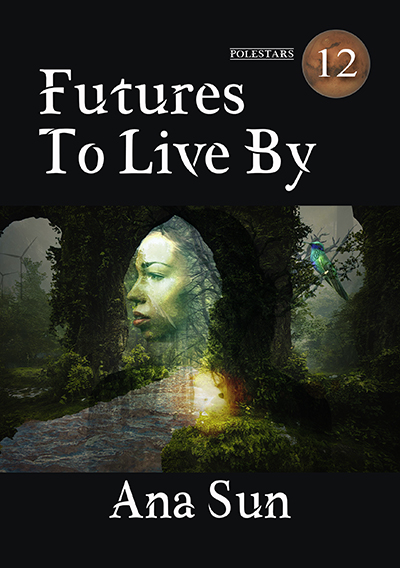
Towards Kindred Futures

By Ana Sun

Ever wonder why we tend to refer to the future in its singular form in everyday speech? Why ‘the future’, and not simply ‘futures’? Considering that we can probably agree that a myriad of futures is possible before one of them falls into the present, this seems to be a mundane but overlooked mystery. 

In Futurevision: scenarios for the world in 2040, Richard Watson and Oliver Freeman observed [1]:  

There is a problem with most books about the future – and indeed, there is a fatal flaw with almost all of our thinking about what will happen next. This is because of a simple point. The fact is, there is no single future, regardless of our deepest desire that it be so, and there is no heavenly salvation in sight.

As someone who often explores progressive, positive futures within the context of climate change and social justice through science fiction, in particular Solarpunk [2], I’m intrigued: does the common view of a singular future mean we are more likely to believe that climate collapse is inevitable? Do we therefore find it difficult to imagine – and enact – alternatives? Have we inadvertently accepted a destiny described by cyberpunk, a future rocket-boosted by uncaring technology, systems of oppression and power concentrated in the hands of a few? In Zoefuturistic terms, have we simply accepted the ‘being’ and forfeited the ‘becoming’?

There’s some evidence that language can influence how we perceive time and our relationship with the future… or, rather, futures [3]. Our bodies are limited in conscious capacity, our brains constrained by how our memories are formed [4] [5] [6].

Unlike futurists and futurologists, thinking about the long-term future in its simultaneous multiplicities, especially when it comes to a complex issue such as climate change, is not something that most of us are able to conceptualise easily [7]. Sure, we may deal well enough with the immediate future, such as considering different possible routes we might take between two locations, or how we might fill the hours between morning and night on a given day. Beyond a certain timeframe, the future can resemble a different place; this afternoon, tonight, or tomorrow can easily seem like disembodied worlds beyond our reach [27]. And yet, the next second appears on the near horizon in the shadow of the following minute, then the hour thereafter – all rapidly pouring into the now, one liquid moment flowing into the next.

Perhaps there are deeper reasons for why we struggle with notions of futures in our everyday lives, and that’s worth examining. 

Continue reading “Towards Kindred Futures”