
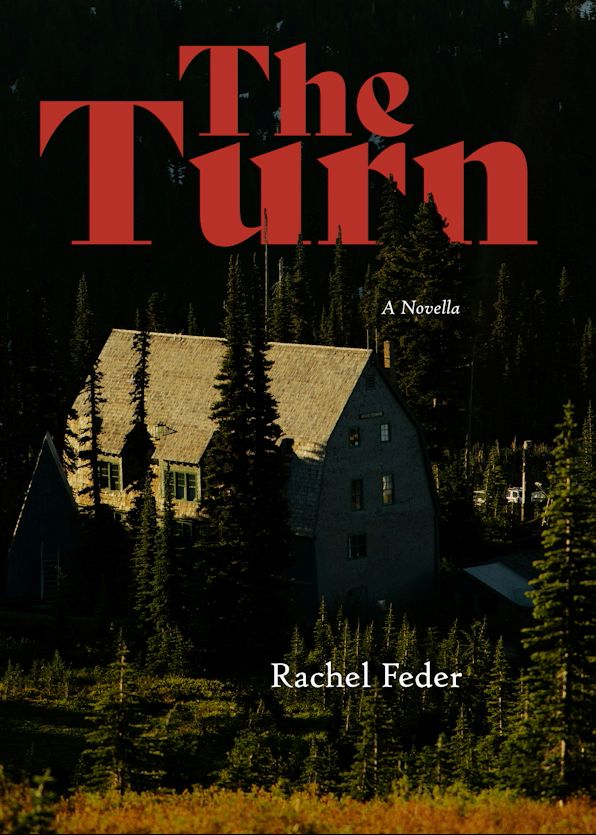
Vector (ed. Polina Levontin): As a literary scholar, you have written both about motherhood in Frankenstein and theorised the gothic genre in Dracula, a book you edited. How does writing and ‘research as practice’ intersect in The Turn?
Rachel Feder: One of my mentors in graduate school, Yopie Prins, once described herself as “promiscuous” in her scholarly interests. This stuck with me, and I like to say that I’m a slut for genre. I’m interested in genre as a form of experiment, one that calls a certain imagined readership into being. I’m interested in how genre hopping might allow me to imagine and, hopefully, connect with different communities of readers.
The Gothic is a really interesting test case, here. A text I think about a lot is Mary Wollstonecraft’s unfinished Gothic novel, The Wrongs of Woman, or Maria, which is, in my opinion, her most radically proto-feminist work. When Wollstonecraft enters political-theoretical discussions—which it’s actually incredible that she was able to do so effectively, given both her gender and her class and family background—she writes to the readership that was already established for that discourse field. She offers almost chiropractic adjustments to patriarchy. But then we get this raw, unfinished Gothic novel (edited and mediated by Godwin, who burned her drafts, sure), and suddenly we’re talking directly about abuse, assault, abortion, and suicide, in highly political ways. The femme-coded nature of the Gothic—which has always been a trade, or even pulp, genre—lets Wollstonecraft imagine talking directly to the victims of patriarchy. One of the most invested readers of that text was Mary Shelley—it really haunts her work—so Wollstonecraft’s feminist intervention in the Gothic informs the history of science fiction, too.
Personally, I’m interested in how the Gothic reveals totalities. When I want to understand forces that feel invisible, totally oppressive, or inevitable in our world, playing with fiction lets me take a hard look at my subject. When someone runs out of a haunted house, you get to see the house, if only for a moment.
And the follow-up question is the converse: writing from experience rather than theory, about motherhood, academic life, academic life as a mother… To me, who is also both, The Turn spoke directly. Genre fiction is precisely the mode to talk about the politics of care, both childcare and care as a creator more generally. Was reaching for the Gothic motivated by the desire to convey the real problems in the most visceral way?
RF: Across genres, I would say that my writing mind and my parental mind are inseparable. I like to joke that I made my kids strange baby books—I began working in earnest on my monograph, Harvester of Hearts: Motherhood Under the Sign of Frankenstein, almost immediately postpartum with my older child, and started writing The Turn while home with a new baby during the pandemic. One argument I make in Harvester is that there is no such thing as writing from theory rather than experience. Our experiences—including our familial and embodied experiences, and our experiences of giving and receiving care—are always going to inform how we understand theory.
And then of course, there are external events. The pandemic. Did it really happen? Apparently, forgetting – a global amnesia – seems to be one of our responses. The memory gaps, of course, play a key part in the plot. Is this a random connection? When, in relation to the pandemic, did you begin writing this novella? Did you have to overcome forgetting?
RF: In the summer of 2020, my husband and kids and I were staying at my childhood home in Boulder. (The house in The Turn is not based on my childhood home, but rather on the home of my friend, the writer, scholar, and lawyer Natalie Brown.) I awoke one morning to a strange dream, the dream Baxter has at the beginning of the novella. In the dream, I walked out into my childhood living room and looked out the window to find the house was a ship floating on the sea.
My first attempt at this project was a story serialized in the online literary journal Luna Luna Magazine. The editors there were so generously willing to take a chance on something I had yet to write, and very kind to me when, for various reasons, I was unable to keep going. But Baxter stayed with me, and, with some distance, I was finally able to come back to her story, and bring her home.
It’s interesting to me that you bring up forgetting. I’m a very inductive writer, so I didn’t imagine the memory gaps in the story as such when I was first drafting—I was just learning things at the same time Baxter did. But forgetting is such a crucial component of the way, for example, Mary Shelley imagines motherhood in relation to the Gothic. In terms of The Turn, I think the question for me has more to do with the fraught connection between cognitive and embodied knowledge.
One of the horror/realism aspects in The Turn is how gendered parental roles are. Fathers seem superfluous, while the biological bond between a mother and a child is rendered fantastical and supernatural. Is the gender of the child significant? In this way, we find a protagonist torn between two male figures with unnatural power over her body.
RF: It’s really important to me, as a cis hetero person who often writes about parenthood—and who writes, inherently, from my own experience of the world, my own identity—not to ever imply that I think about biological motherhood as somehow better or “more than” any other type of parenthood. I feel the need to tread lightly to avoid spoilers here, so I will just mention that the monstrous forces at the margins of Baxter’s world are both paternal and maternal in nature—a hallmark of the Gothic.
Regardless of whether this pertains to gender, the fantastical, supernatural bonds in the book have to do with loving a child unconditionally and caring for that child no matter what. That’s the real magic, I think, that makes a parent.
In terms of the kids, Thebes and Quinn just kind of came to me whole cloth. You’d need to ask them any questions you have about their genders.
Power is often narrativised as magic. The imagery of vampirism has been used in critiques of capitalism and deployed to represent sexual power. Situating consent within the ambivalent framing of the gothic genre seemed especially difficult. What were the parts that gave you the most trouble?
RF: When I teach the history of vampire literature, I invite students to consider how stories can be subversive, but not necessarily progressive. Monster stories often open up pockets of possibility—for queerness and polyamory in Dracula, for example—but then punish these desires and reassert the status quo.
One of the Gothic novellas that inspired this project is Henry James’s The Turn of the Screw. I’ll never forget reading that text in class for the first time. The professor, the great James scholar William Veeder, paid particular attention to the end of the book. I remember him saying something along the lines of, sometimes the Gothic opens Pandora’s box, and what comes out is too powerful. You can’t close the box. You can’t reassert the frame. You can’t put things back in their “proper” place. I’m committed to this Gothic potential. The greatest challenge of this project—and the most rewarding—was letting Baxter fully embrace her own power, even as the world around her continued to spin into disorder.
Will there be a sequence? What are you working on now?
RF: The form of the Gothic governess novella is an integral part of The Turn’s deep engagement with literary history. Someday I’d love to try my hand at some kind of serialized adaptation of the story to a different medium, extending past the current ending, maybe even in collaboration with other writers.
I’m working on a few projects now, in different genres: a literary horroromance novel; a libretto for a musical; a collaborative scholarly project. Like all my creative endeavors, these examine how literary history informs our shared cultural mythologies, and our sense of what we owe ourselves and each other.
 vector-bsfa.com