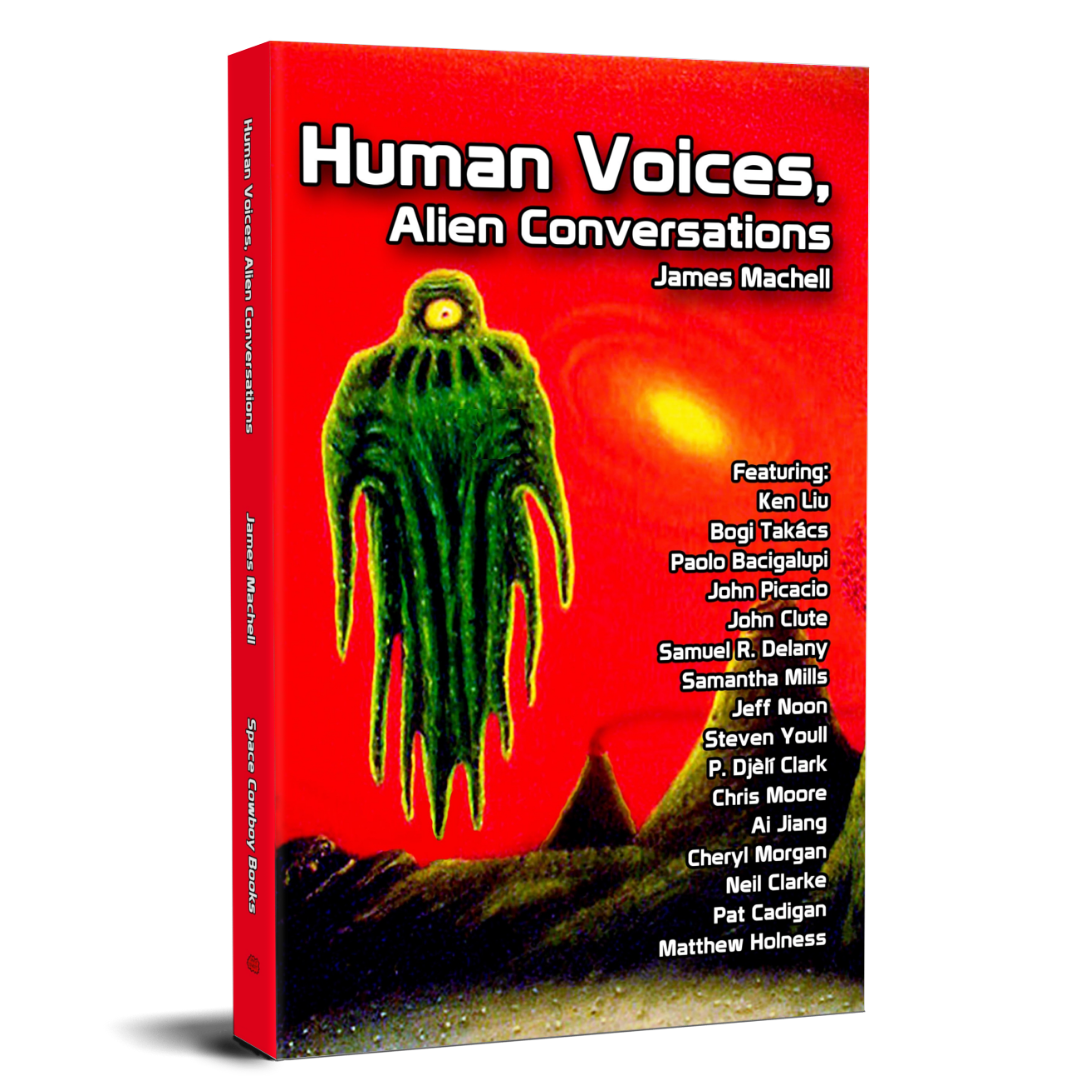
Jean-Paul L. Garnier: What inspired you to conduct the series of interviews in Human Voices, Alien Conversations, and how do you go about selecting interviewees?
James Machell: Several of the interviews had appeared in Utopia Science Fiction Magazine and Electronic Brain. What I wanted to do with Human Voices, Alien Conversations was pull them together into one narrative, and additional interviews were conducted to fill what I perceived to be the gaps in the collection as an overview of SF in the 21st Century. In order to show this with a bird’s eye, I couldn’t just focus on writing when there’s art, editing, performance, and adaptation. I also wanted to explore understated significance. Samuel R. Delany, for example, is nowhere near as well known as Andy Weir, but his influence, even at the time of composing his major works, has been much more profound. Similarly, Chris Moore, with his prog-rock styled art for the SF Masterworks Series, created some of the most recognisable images in the history of SF but did so quietly, never chasing awards or drawing attention to himself: he let his art speak. Cyberpunk, almost exclusively associated with William Gibson, was developed by a “team” of writers in the ‘80s: I thought it would be much more interesting to speak with Pat Cadigan, who is frequently dubbed the “queen” of the subgenre. But I couldn’t just focus on the legends when their contributions to SF are constantly evolving through their influence on younger writers. Interviewees, therefore, vary greatly in age, juxtaposing the perspectives of those blossoming into the SF landscape with those who loosened the soil. Bogi Takács, Samantha Mills, and Ai Jiang, also included in Human Voices, Alien Conversations, are writers we should be looking out for. The final interview is with Matthew Holness, co-writer, co-director, and star of Garth Marenghi’s Darkplace, which gets my vote as the most underappreciated use of SF in visual media. As Holness is now working on the third in a series of spin-off novels, he was ideal to pull everything together.
JPG: How do you go about researching your subjects in preparation for interviews?
JM: Most of the interviewees were selected because I’d been enjoying their work for years. The questions came easily. The Internet Speculative Fiction Database and The Encyclopedia of Science Fiction, however, were excellent resources for pinning down dates and discovering aspects of their careers which may have eluded even the most die-hard fan.
JPG: What do you see as some of the main concerns and themes in early 21st Century science fiction?
JM: I might cheat here and offer two answers because I think the answer differs based on whether we’re talking about long or short form SF. With novels, the main concerns are harder to pinpoint, in major Western ones of this century, including M. John Harrison’s Light, China Mieville’s Perdido Street Station, Paolo Bacigalupi’s The Windup Girl, Ann Leckie’s Ancillary Justice, N. K. Jemisin’s The Fifth Season, Arkady Martine’s A Memory Called Empire, and Jeff VanderMeer’s Annihilation. These books deal with the climate, colonisation, technology (developing with unprecedented strangeness), and the uncanny, but none of this is new. I think concerns may have shifted but the passions of the writer and tastes of the reader have roughly been continuous since the ‘60s. There’s a reason the Modernist period lasted all of forty years and the postmodern sees no sign of ending. Naturally, we live on a different planet now, but I don’t believe the cognitive shift from Donald Trump’s presidency or the rise of AI has been as profound as the First World War or Civil Rights Movement, at least among readers. Characters were having conversations with their automatic computers in the ‘50s and we can go all the way back to Sinclair Lewis’s 1935 dystopia, It Can’t Happen Here, for premonitions of Trumpism.
The underlying revolution in 21st century SF is the shift in emphasis from sexuality to gender. Ellen Datlow waved goodbye to the 20th with her anthologies, Alien Sex and Off Limits: Tales of Alien Sex, perhaps the last time to shock an audience who would become mentally hardened by the internet. Some of the most striking stories to emerge during the last five years include Blue Neustifter’s “Unknown Number” which is told through a series of texts between a transgender woman and an alternate universe version of herself in which she didn’t physically transition, and Samantha Mills’ “Rabbit Test,” which contrasts the future of invasive procedures on women’s bodies with the history of abortion and pregnancy tests. In both cases, the author is examining the self of their protagonists in correlation to the world around them. This is a far cry from H. P. Lovecraft, Harlan Ellison, or Clive Barker menacing their readers with abominations. The notion of the self is evolving and magazines, with a small but dedicated audience, provide a space for writers to explore this in different settings. Enormous strides have been made in the last 26 years regarding the understanding of gender fluidity and trans* identity. “What does it mean to be a woman?” is a question posed and answered since at least Simone de Beauvoir. My prediction for the next quarter of this century is that we’ll see further examinations of masculinity. Louis Theroux’s recent documentary on the “manosphere” has highlighted the prevalence of toxic manhood being marketed to young people. SF writers from the targeted age group will no doubt reflect on the so-called “red pill” philosophy and what it means to be a man in the mid-21st century.
JPG: In your introductions and interviews, authors such as J. G. Ballard and Thomas Pynchon are regularly referenced. What is your attraction to these difficult, genre-defying works?
JM: My attraction stems largely from seeing myself in their work. As much as I enjoy Leo Tolstoy’s Anna Karenina, I am less passionate about aristocrats discovering the joy of “simple living” as characters feeling anxious and being right to do so. J. G. Ballard’s Crash is a photorealistic portrait of evil. Here, he examines a dystopian gang of car crash fetishists. Now, I’ve never been turned on by a car (I can’t even drive) but this aligns with my experience of real-world villains. They are weird, which is also to say, unpredictable. (One of the themes I’d like to explore more in my own writing is the exhaustion of constantly having to figure out the thought process and motivations of those who’d cut off their own finger to rob a stranger of their hand.) With Pynchon, this applies as well, but he delves deeper (partly because his works tend to be much longer) into the propulsion that stems from threat. His characters are rarely still; they search for peace, but their loud worlds have been shaken. At the risk of sounding gloomy here, I’ll add that I also find myself in Charles Dickens and D. H. Lawrence, but there’s even less to be said about these authors in 2026.
Part of the reason for Ballard and Pynchon coming up in Human Voices, Alien Conversations is that the interviewees tend to share a passion for them. Several list a Ballard novel among their favourite works of SF. This isn’t a coincidence. The likes of Jeff Noon will have found the same things to enjoy in Ballard as I have in his Vurt Series. The other writers that come up most frequently in my writing include Alfred Bester, Theodore Sturgeon, and Samuel R. Delany. In Human Voices, Alien Conversations, Delany lists Bester and Sturgeon as the writers of his favourite SF novels. You can find his key mainstream influences in there as well.
JPG: What do you think are some of today’s biggest differences in science fiction coming from the UK and US?
JM: The central difference, to my mind, between British and American writers, is their self-consciousness as writers of genre fiction. This, in the UK, goes back to Olaf Stapledon, David Lindsay, C. S. Lewis, and G. K. Chesterton, who were writing novels about other planets and the future, but I doubt “science fiction” was a term often used. They were writing allegories and warnings. Edgar Rice Burroughs and E. E. “Doc” Smith, however, were firmly aware of their roots in pulp, brazenly (and gloriously) escapist. This trend extends beyond the Golden Age. Compare J. G. Ballard’s grey dystopias with Philip K. Dick’s plastic realities. One seems to follow Kafka’s route into the speculative, while the other invigorates SF canon tropes. Kazuo Ishiguro’s Never Let Me Go, China Mieville’s The City & The City, and David Mitchell’s Cloud Atlas are among the most loved contemporary works of British SF, but none of these revel in their speculative setting. John Scalzi’s Old Man’s War, however, is a novel that could only be written by an American. (There are, of course, exceptions to this rule, Michael Moorcock being a prime example of a writer who managed to fuse a British and American way of thinking.)
JPG: You are also a writer for The Encyclopedia of Science Fiction. How did that come about, and how has writing for the encyclopedia affected your approach to interviewing SF writers, editors, and artists?
JM: This actually came about after an interview.
I had been reading The Encyclopedia of Science Fiction since I was a student and as someone who now writes about SF, the SFE is an inescapable reference work. It’s not just useful as a source of information, but opinion. You’ll see in Pat Cadigan’s Human Voices, Alien Conversations interview that she has a very interesting response to the SFE’s take on her career. As John Clute (its co-editor with David Langford) has supplied a Brobdingnagian number of entries, I thought he would be an interesting person to interview for Utopia Science Fiction Magazine. We carried on talking and following some of my own entries, we met in person. The one featured in Human Voices, Alien Conversations was our second, and was conducted at his dining table while I anxiously ensured that my phone was still recording. I’m still impressed by the speed with which he was able to formulate opinions, and it explains how he came to publish more words than perhaps any other critic. We’ve since started an SFE Substack, which currently features essays by John, me, and Gary Westfahl, but we’re open to new contributors. Topics thus far have included Brexit, The Wind and the Willows, Gormenghast, and autism as a product of human evolution.
In terms of influencing my interviewing technique, it’s shown me that non-fiction can be both informative and challenging. Dr. Simon Malpas, who is a senior lecturer at The University of Edinburgh, said quite a few nice things about Human Voices, Alien Conversations, but the one I most appreciated was that it is “occasionally provocative.” I think the same could be said of the SFE in that it gives a balanced view of quality and in contrast to Wikipedia, isn’t afraid to make debatable assertions about SF history. It does, however, get some disgruntled emails, predominantly from insecure authors, which I see as a sign of doing something right.
JPG: Can you share your thoughts on the interview as an artform and its role in genre fiction?
JM: Alfred Bester (better known for The Demolished Man and The Stars My Destination) is a great example of an interviewer who turned conversations into art. “Woody [Allen] isn’t a funny man in real life,” he writes in an introduction. He makes his own presence felt so that the reader doesn’t perceive questions as appearing from dark corners, nor is the interviewee professing their responses like an influencer with a smartphone. I particularly enjoyed his exchange with Isaac Asimov because, although the focus was on the Foundation author, there was a real sense of being in a room with two characters. The best interviews tell a story. Of course, they’re opportunities for interviewees to promote their work, but they’re also vehicles of discovery as to how they got there. And you make that discovery through the lens of the interviewer. This is why Human Voices, Alien Conversations opens autobiographically, giving the reader a sense of who I am and how I came to be posing questions. In terms of the role it plays in genre fiction, I think it serves the same role as it does in the literary sphere: consumers of art want to feel a connection with the artist. I wonder if The Beatles would have achieved half their success if they recorded anonymously, never appeared on an album cover, and never advertised the personality in their music.
JPG: Do you have any advice for interviewers and non-fiction genre adjacent writers?
JM: The big thing I learned from Human Voices, Alien Conversations is to think of SF as something that’s happening now rather than the current period as a link in a chain that goes back to Mary Shelley. When thinking of SF editors, the first ones that come to mind are Hugo Gernsback, August Derleth, John W. Campbell, Isaac Asimov, Robert Silverberg, and Michael Moorcock, all prolific authors themselves. When I asked Neil Clarke about why his focus was on editing rather than writing, his response was that it wasn’t unusual, giving Ellen Datlow and Jonathan Strahan as examples. Had I been thinking more in 21st Century terms, Clarke would not have struck me as unique, as while there are many contemporary editors who write their own fiction, I can think of about as many who don’t. It is a question, however, that I chose to keep in, anticipating that many readers of the collection may also approach SF with a similar mindset.
Secondly, I’d advise newer non-fiction writers to diversify. I began interviewing for Utopia Science Fiction Magazine because I’d previously published prose, poetry, and an article there (I was at the time and may still be the first to do all three). There are lots of people who want people to read what they write, but there are many gaps in the fence.
Keep trying to squeeze through the same one: you may get through, or you may get stuck.
###
Bios:
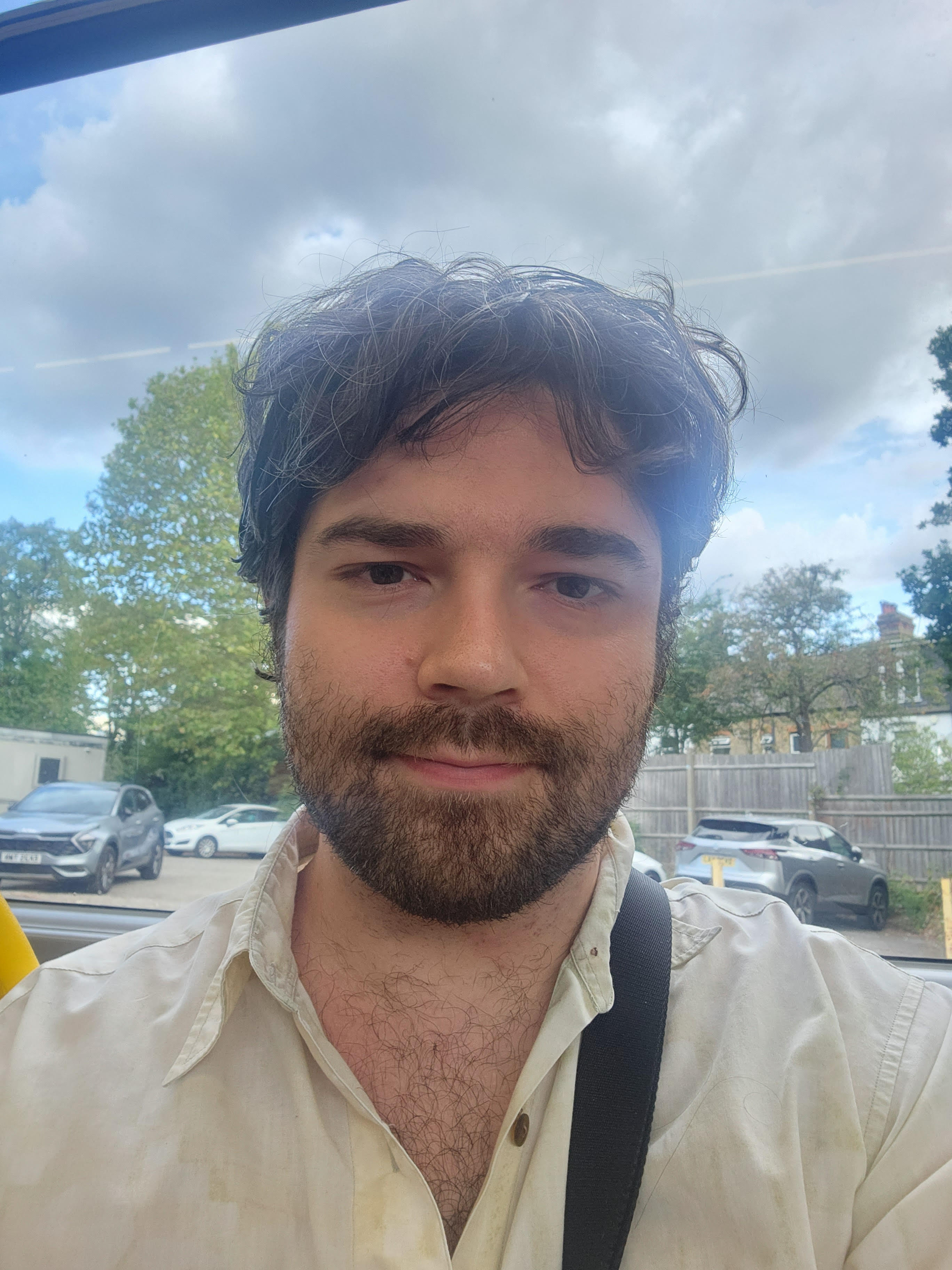
James Machell is a British writer. He contributes to The Encyclopedia of Science Fiction and curates its Substack. He also serves as Outreach Manager for Utopia Science Fiction Magazine and was the 2025 Contest Chair for the Science Fiction and Fantasy Poetry Association. Find him on Bluesky @jamesmachell.bsky.social or YouTube @Fell-Purpose. https://jamesmachell.com/
#
Jean-Paul L. Garnier is the owner of Space Cowboy Books bookstore and publishing house, producer of Simultaneous Times Podcast (2023/25 Laureate Award Winner, 2024 BSFA, Ignyte, and British Fantasy Award Finalist), and was the editor of the SFPA’s Star*Line magazine from 2021-2025. He is also Editor-in-Chief of Electronic Brain magazine. In 2024 he won the Laureate Award for Best Editor. He has written many books of poetry and science fiction. https://spacecowboybooks.com/

