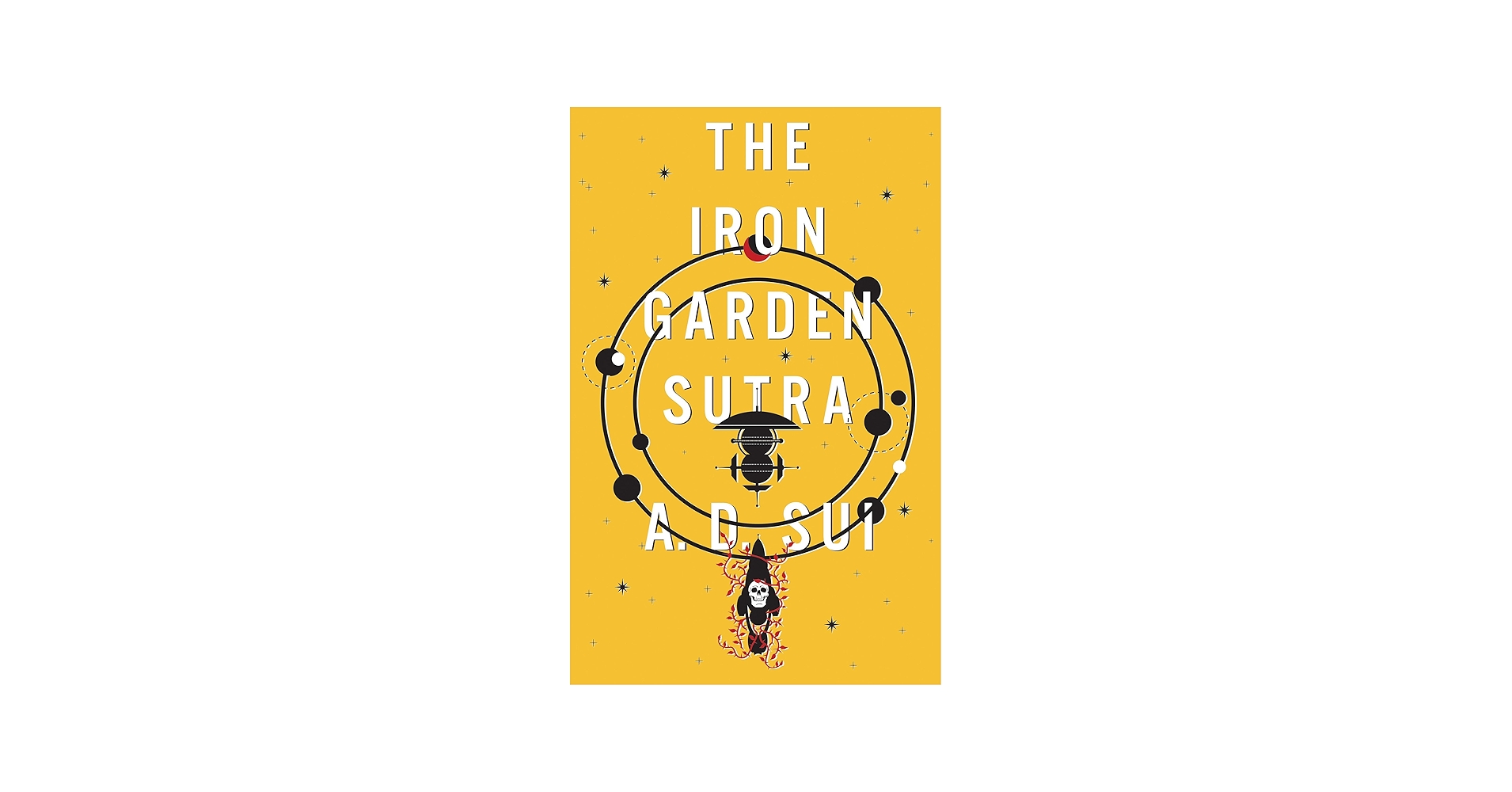
Jean-Paul L. Garnier: One theme of The Iron Garden Sutra concerns failed generation ships and the existential troubles they face during their journeys. I have read several books recently with similar takes on generation ships. Do you feel that this kind of story reflects a growing tension between generations in the real world and youth feeling that they have been dealt a bad hand by previous generations?
A.D. Sui: Generation ships are a long-standing tradition in sci-fi. What’s not alluring about packing up ourselves into a tin can and running off into the universe in search of greener pastures? But in my opinion, it’s also a very naïve take. Space is hostile. Space is hard. But there is a romanticism in cutting and running. Staying is, arguably, far more difficult.
I think every generation feels that pull of running away from their reality. Every generation can say that they have been dealt a bad hand. Millennials are economically disadvantaged because of policies enacted by Gen X and Boomers (and yes, have lived through three recessions now, but who’s counting?). Gen Xers felt they’ve been invisible all their lives. Boomers, I’m sure, felt disadvantaged in some way as well. Hard to imagine now, but one might. The generation before probably felt that they were unfairly thrust into a war that was only possible because of what the previous generation had done. And this is just the North American perspective. There are many more global conflicts, recessions, and other strains on each generation. We all want to run away, thinking that it will be better. To where? No one knows for sure, but somewhere that isn’t here.
Part of The Iron Garden Sutra’s theme is deciding when to stand your ground and fight for the things we believe in. Even if we are one person. Even if the outcome doesn’t look hopeful. Millennials are of the age when our financial decisions and our voting have the most impact. Some of us are even in positions of influence. Some are making decisions on scales that will impact the next generation (hi, Gen Z, and sorry). We can continue to bemoan the hand we’ve been dealt, or we can also work towards leaving things better for those who are coming after us. I, personally, am a huge fan of complaining while doing the thing.
It’s going to suck and it’s going to be a lot of work, sure, but we can leave a better world for those after us.
You’ve also created a religion in this novel, The Starlit. What did the process of creating a theology look like for you, and please tell us about the introduction of cosmology into the religion of peoples who have colonized the stars?
The Starlit is loosely based on Zen Buddhism. I have a very strong preference for non-monotheistic religions and like pondering where they can end up in thousands of years. What is the natural progression of something like Zen if it was supported into the future? What would its practitioners decide to keep and what would they discard? Because religion does change! Doctrine does change! It changes very slowly since religious institutions are massive and can’t afford to throw their entire weight around every other week, but it does change.
I think the introduction of cosmology is the natural transition, given how we commonly incorporate elements from our immediate environments into religious texts. Parting the Red Sea, trudging through deserts, and all that. If people are traversing between stars frequently, then star-like language would begin bleeding into texts.
The Iron Garden Sutra has multiple AI characters. Would you have written these characters differently had you written this book today?
I’ve been doing a lot of laughing/crying since the book has come out. You can guess why.
A very niche fury that I’m experiencing about GenAI is that it has taken a very well-established trope in sci-fi and made it into a real-life abomination. I’ve been hearing some discussions in the genre that we need a new name for this concept now because any time we even drop the term “AI,” readers begin to think that we support the existence of Grok.
In The Iron Garden Sutra, I have tried to move from the term “AI” and sometimes use “synthetic consciousness” because that’s really what I’m describing here. This is a fully-fledged individual that can act (mostly) autonomously, who has agency and drive, but isn’t born from organics. This isn’t Claude writing an email. This is something that is as much of a person as other characters in the novel.
If I were to write this book again, I’d change nothing. I think I would lean into the AI ethics component of the book even harder to hammer the point home that these characters are sentient and deserving of individual rights. The caveat is that if I were to rewrite it, it would take several years for the book to get published and by that point we’d all be fighting Boston Robotics dogs for access to fresh water, and no one would be reading anymore.
Two of the characters in this book share a body. What complications arose during writing characters that do not have complete bodily autonomy and must occupy the same internal space?
Two characters/one body is becoming a very popular trope in spec fiction!
This was, arguably, my favorite dynamic to write and explore. What kind of relationship can you have when one of you cannot act on the physical world without the other’s permission? How does a relationship develop when you have complete access to someone’s deepest, darkest thoughts?
There’s a balance of power between Iris and VIFAI (Iris’s AI companion/helper) and I think this allows them to have a true relationship and friendship, even if Iris doesn’t believe it at first. It’s the closest and most meaningful relationship Iris has had in his entire life, but it cannot stay pure from the fact that he *is* the container for VIFAI and the one supposedly “in charge”. Without spoiling anything, this does budge a bit throughout the book and Iris does come to a deeper understanding that VIFAI is not as helpless as Iris had believed it to be.
The name of the main spaceship in the story is the Counsel of Nicaea, which suggests a Christian theological bent, and is a great contrast to the Starlit and their worldview reminiscent of Buddhism and Hinduism. What were your aims in creating such a stark, yet subtle, contrast?
The contrast does exist, but it was not intentional!
The Buddhist worldview is the one I am most familiar with and preferred writing from that vantage point, and I must admit that the Christian theological bent was inspired by the generation ship in the ‘Expanse’ series, and the Nauvoo, which was commissioned by a group of Mormons who wanted to travel far past the Solar System. It made sense to me that a group of people united by intense faith would do well in long-term space travel. Although, as we see with the Nicaea, that might not always be the case.
Without spoilers, the main character has revelatory experiences leading him to contemplate the meaning of the void and the space between the stars. Can you elaborate on how you used spiritual growth and crisis of faith in your character arcs?
Oh, poor Iris.
I wanted him to be a reluctant monk. I wanted him to look right, wear the right clothing, say the right things, but I wanted him to think all the wrong ones. Well, what he believes to be wrong. I think there is a stereotype of monks being happy and peaceful at all times, but in reality, they are just people, experiencing the same existence we are, who also hold a specific job. Being a monk is a job, above all else, and people come to it for very different and personal reasons.
And I wanted Iris to grapple with how he related to the doctrine and his role as a monk. I wanted to push him towards an understanding of what holding the role of a Vessel meant to him. There is a term in Buddhism called a koan. It’s kind of like a riddle used to impart a teaching of some sort and it’s often posed by a teacher to their pupil. The goal is for the pupil to have a revelation, to “get” the koan. There is no single answer to a koan, but rather a feeling that comes when one understands it. It’s like that feeling you get when you’re learning to ride a bike and after stumbling and falling, and trying over and over again, suddenly, you catch your balance. Hard to describe, but once you have it, you have it.
The entire experience aboard the Nicaea is a koan for Iris, a question of his relationship with faith that only he can answer, and only towards the end.
There’s a sequel coming, The Starlight Samsara.. Can you tell us about when and what we can expect from the continued adventure?
The sequel should be coming sometime near the summer of 2027! You can expect some new faces in the cast, but also some favorites returning. While The Iron Garden Sutra touched on the notion of AI ethics, The Starlight Samsara takes a deeper dive into the topic. And finally, things do get better for Iris, but not before they get significantly worse.
A.D. SUI is a Ukrainian-born, internationally raised speculative writer, Nebula winner, and Aurora, and Theodore Sturgeon Memorial Award finalist. They are the author of The Dragonfly Gambit (2024), The Iron Garden Sutra (2026), and more than two dozen short stories. A failed academic and retired fencer, they spend most days wrangling their two dogs and tending to their myriads of tropical plants.
You can find them on most social media platforms as @thesuiway and https://thesuiway.ca/
Jean-Paul L. Garnier is the owner of Space Cowboy Books bookstore and publishing house, producer of Simultaneous Times Podcast (2023/25 Laureate Award Winner, 2024 BSFA, Ignyte, and British Fantasy Award Finalist), and was the editor of the SFPA’s Star*Line magazine from 2021-2025. He is also Editor-in-Chief of Electronic Brain magazine. In 2024 he won the Laureate Award for Best Editor. He has written many books of poetry and science fiction. https://spacecowboybooks.com/

