By Cyril Simsa

Eva Hauserová promoting her non-fiction title Na koštěti se dá i lítat [Broomsticks can also be used for flying], 1995
Of the many contemporary subgenres of sf that can claim they originated as a reaction to the cyberpunk revolution of the 1980s, one of the oldest is certainly “biopunk”, especially if one counts the mini-genre of “ribofunk” – shouted into existence by the American writer Paul Di Filippo (1954-) in 1990, and just as quickly extinguished – as a legitimate precursor (Di Filippo 1990). Probably only “steampunk”, coined by K.W. Jeter (1950-) in 1987, is older (Nicholls and Langford 2025).
“Biopunk”, as it is used today, refers to a subgenre of sf that adopts many of the stylistic and narrative tropes of cyberpunk – a focus on stories built around an ensemble cast of petty criminals, (gene) hackers and chancers, urban subcultures, and a “revolt into style” (if the reader will pardon the throwback to the cultural criticism of an earlier era) (Melly 1970) – while sourcing its McGuffins from biotechnology, rather than cybernetics. In this contemporary sense, biopunk has its origins in the American genre writing of the 1990s, with the first documented use (from two different, and almost certainly unconnected sources) in 1992, and the subsequent attempt to identify precursors in earlier genre history.1
Di Filippo takes this as far back as H.G. Wells’ The Island of Doctor Moreau (1896); of more recent antecedents, Greg Bear’s Blood Music (1985) and Bruce Sterling’s Schismatrix (1985) are frequently cited (Di Filippo 1990; Schmeink 2014b, 32). From these American genre roots, biopunk has spread around the world and into other media, film and TV in particular. The hit TV show, Orphan Black (2013-2017), with its saga of a shadowy organisation trying to direct the future of human evolution through gene hacking and the complications that arise when some of its human clones escape, would be a good example. All of which makes a neat teleological narrative of exactly the kind that, in theory, every self-respecting punk of whatever persuasion is supposed to abhor; and none of which quite holds together when examined in a broader framework.
Because there is a catch – of course, there is – and in a European context, this neat timeline is disrupted by the Czech writer Eva Hauserová (1954-2023), also known as Eva Hauser, who in 1988 independently came up with a literary intervention she called “biopunk,” and her coinage pre-dates the American one. This sits uncomfortably with the official chronicle, making her something later critics have had to explain away, though there are also those who have simply ignored her. (For the former, see Schmeink, who will be discussed below; for the latter, a simple Google search will reveal any number of biopunk, or biopunk-adjacent websites that have no idea of Eva’s existence.)
Eva was living behind the Iron Curtain at the time she came up with the notion of “biopunk,” with limited access to American sources and no contact with her American contemporaries. However, like the American writers who later dreamt up their version of biopunk in the 1990s, her ideas were formed in reaction to cyberpunk – or rather, her vague impression of what she imagined cyberpunk to be, in the absence of any direct experience of the foundational texts – but with a change of focus to genetics and biology, rather than information technology and computer programming. (No doubt her educational background as a microbiologist played a role in that.) There are, then, some parallels between Eva’s initial impulse towards biopunk and that of the writers who later adopted the same term in America, though there are also significant differences.
In the 1980s, there was a common consensus in Czechoslovak fandom that cyberpunk was not really a viable literary genre in the conditions of latter-day Communism. As the Czech writer Ondřej Neff (1945-) argued in a classic lecture at Parcon, the Czechoslovak national sf convention, in June 1987: “It’s difficult to develop cyberpunk in a country, where one can’t even find a working telephone box.” (Neff 1987, cited from Hauser 1993, 15)
In devising her concept of biopunk, Eva took this insight one step further, arguing that the differences between East and West in relation to cyberpunk were not just a question of technology, but also of social conditioning:
The heroes of cyberpunk, in spite of all the novelty and colour of cyberpunk narrative, are at heart the same, familiar American boys – optimistic, active, greedy for money and longing for success. The heroes of biopunk, similarly to the people that I saw each day in my surroundings, couldn’t be nearly so straightforward.
When the disintegration and paralysis of society reaches a certain level, people lose their motivation to do anything at all. This is what we experienced in Czechoslovakia in the 1980s: people became extremely sceptical and passive as they realised, time and time again, that no matter what they tried, they couldn’t bring about any results, that no revolt, no expression of anger was capable of changing anything… (Hauser 1993, 15)
Worse, in Eva’s view, people living under totalitarianism become so accustomed to the limitations imposed on them that they come to consider them normal:
For example, the heroes of my stories often consider their situation to be marvellous and pleasant, even though by any rational analysis it is in actual fact frightening or utterly repulsive: this reflects totalitarian society with its grotesque voluntarism, its newspapers which continually declared that we, the people, were extremely happy, that we were living in a highly developed society, and that if we still had a few problems, they weren’t really so serious… (Hauser 1993, 15)2
Biopunk, then, was a literary device that allowed Eva to express the inner deformations of life under totalitarianism by externalising them into speculative biological traits. Her societies become the playground of “mutants, genetic diseases and deformations, chimaeric organisms,” (Hauser 1993, 15), and her protagonists are unable to imagine another state of being. Under the pressures of totalitarianism, her protagonists literally become monsters.
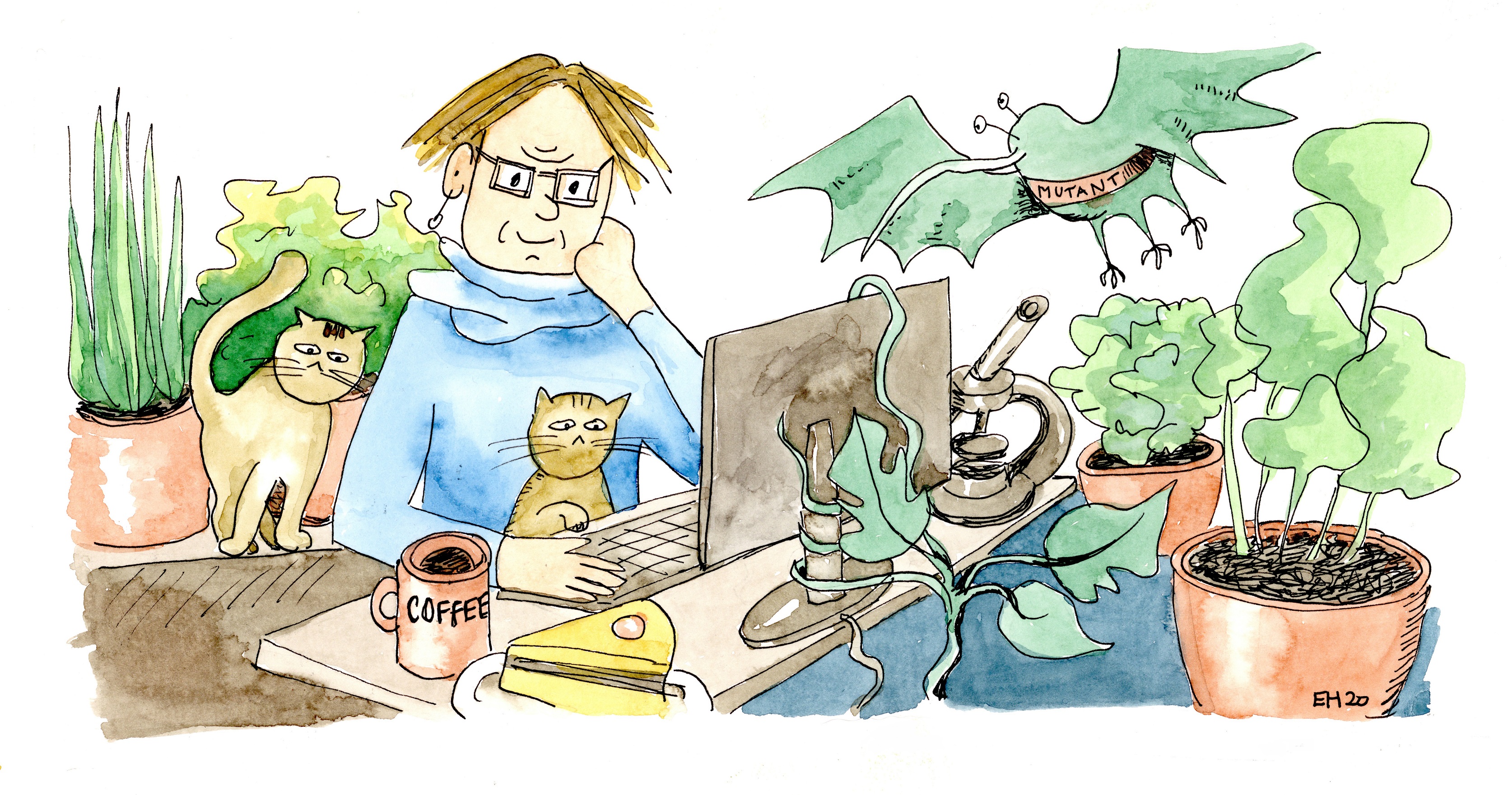
Eva Hauserová: Self-portrait (2020)
American biopunk clearly comes from a very different impulse: the exploration of how biotechnology is going to impact society in the framework of a more-or-less corporate future. Its extrapolated biotechnology is based on real science, not metaphor.3 Its social assumptions are those of capitalism, not the sunset years of Soviet-style Communism and the collapsing economy of a failed experiment in centrally-planned socialism, based on nineteenth-century notions of industrial development and twentieth-century surveillance technology.
There is no question that the “biopunk” of contemporary film and fiction is not the same animal as Eva’s, and that her coinage of an earlier Central-East European homonym is an inconvenience to the people who take the contemporary, “Western” variant seriously. It therefore makes perfect sense that they should seek to sideline Eva’s rogue intervention, though the ways they do so are sometimes quite problematic.
The most detailed attempt I have found to date is that of Lars Schmeink (1975-) in his article “Biopunk 101,” which was published in two slightly different versions in 2014 (Schmeink 2014a; Schmeink 2014b). Schmeink is today a respected independent scholar, based in Hamburg, with an impressive CV and a long publications list, but in 2014 he was just finishing his Ph.D. at Humboldt University Berlin , which two years later yielded his monograph Biopunk Dystopias: Genetic Engineering, Society and Science Fiction, published by Liverpool University Press (Schmeink 2016). The monograph itself makes no mention of Eva or her Czech biopunk – justifiably so, as it has no relevance to his argument – but one assumes that one of the reasons for his earlier essay was to tidy away this awkward forerunner, so as to avoid cluttering up his later book.
As far as I have been able to reconstruct the publishing history, the two versions of “Biopunk 101” appeared within a couple of months of each other. The first, longer version appeared on Schmeink’s personal blog in May 2014 and is now accessible only on the Wayback Machine; the second, more formal (and shorter) variant appeared as an essay in SFRA Review in Summer 2014 (Schmeink 2014a; Schmeink 2014b). The discussion of Eva’s work in both versions is based on a mini-feature about biopunk, which appeared in the BSFA’s critical journal Vector in 1993, and which was curated by the present author.
This comprised of three items:
1. A slightly edited and polished version of Eva’s English-language essay, “Biopunk: A New Literary Movement for Post-Totalitarian Regimes”, first published under a slightly variant title in her personal fanzine, Wild Sharkaah, in 1990 (Hauser 1990; Hauser 1993).
2. An English translation of “A Few Notes About Biopunk”, by Miroslav Fišer (1965-), first published in Czech in 1991, to illustrate how Eva’s biopunk had been received in Czech critical circles (Fišer 1993).
3. An introduction by myself to set the context (Simsa 1993).
Given the relatively late date of these publications (1991 for the first Czech appearance of Fišer, 1993 for Vector), both Fišer and I make the point that biopunk – which Eva herself declared to be a response to the experience of living under totalitarianism (see above) – was no longer a going concern by the time Vector appeared, because the fall of Communism had done away with the conditions that gave rise to it. This in turn leads Schmeink, whose account of Eva’s biopunk seems mostly intended to demonstrate its discontinuity from his own research, to base his discussion almost entirely on Fišer’s essay. We thus have the paradoxical situation, where Schmeink talks about biopunk as if it was some kind of impersonal movement from Eastern Europe, with Fišer as its spokesman, rather than the personal project of one individual (Eva Hauserová), supported by a couple of her acolytes (Simsa, Fišer), who essentially contributed nothing, except as a kind of all-singing, all-dancing team of bespoke fanboy cheer leaders.
Eva is cited by Schmeink only in support of Fišer’s arguments: “Eva Hauser, another writer of Czech biopunk, in a manifest[o] from 1990 […] translated into English in Vector, underlines some of Fišer’s statements and adds to the definition” (Schmeink 2014a, a passage that is found only in the web version of the article; it has been deleted from the abridged version published as Schmeink 2014b). In the longer version of the essay on his blog, Schmeink does at least quote a few words from Eva herself, but in the shorter (and more official) version in SFRA Review, he quotes only Fišer and myself. Eva is named, but not allowed to speak, and one can only conclude that Schmeink has completely misunderstood the distribution of roles between Eva, Fišer and the present author; and in particular, the fact that biopunk was Eva’s invention, not ours.
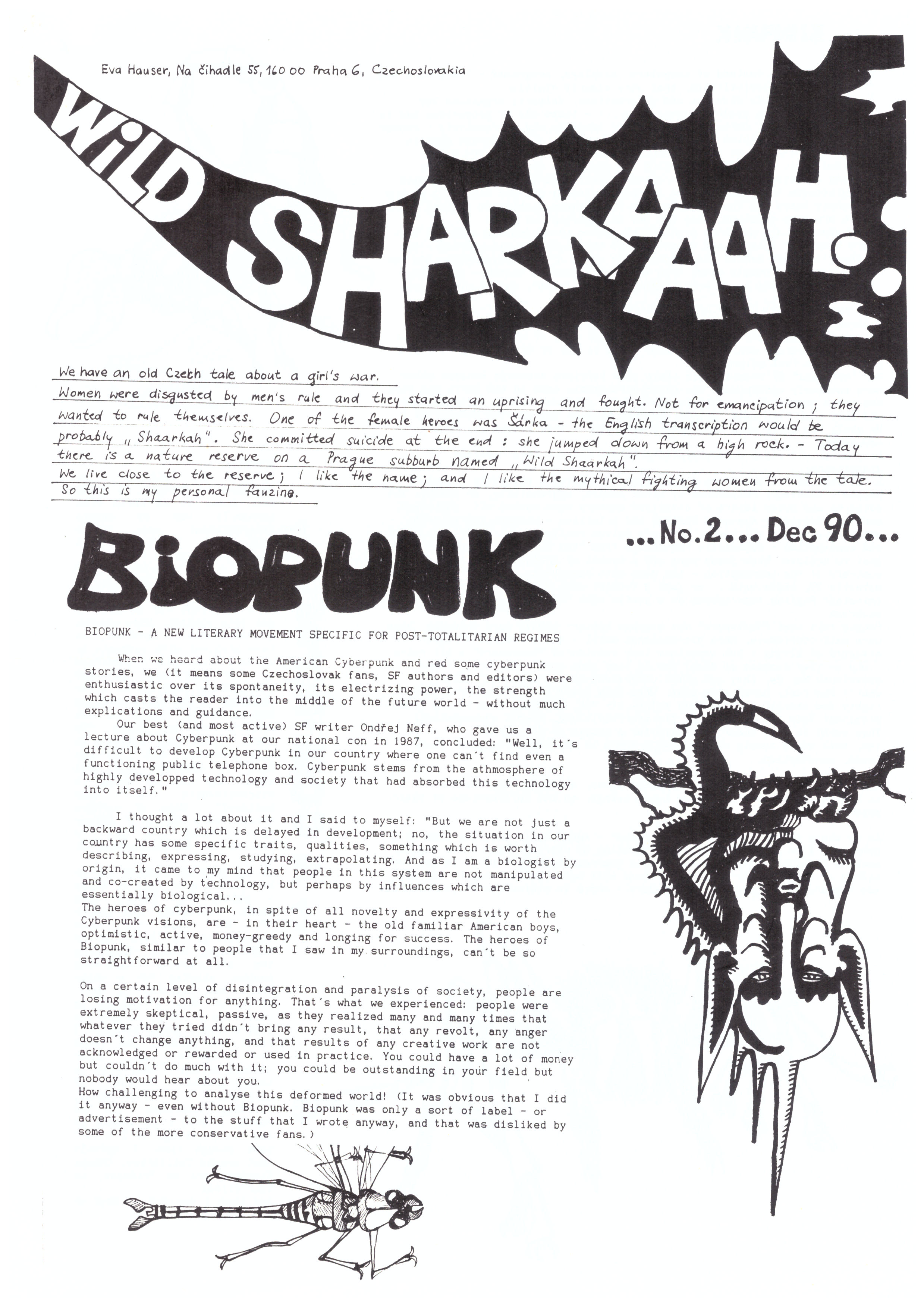
The original fanzine publication of “Biopunk: A New Literary Movement Specific for Post-Totalitarian Regimes”. Wild Sharkaaah, No.2, December 1990.
In fairness to Schmeink, Eva’s Wild Sharkaah was not available online at the time he was writing (it was not posted on efanzines.com till 2018), and paper copies would have been hard to find in 2014. It is therefore likely he had had no opportunity to verify the provenance of Eva’s article for himself, which might have helped clarify the pivotal nature of Eva’s contribution. The handwritten heading, the hand-drawn illustrations, and the way the article is integrated into the free-flowing text of Eva’s personal fanzine can leave little doubt about how individual this project was for her. Certainly, anyone who has read the original fanzine version of “Biopunk: A New Literary Movement for Post-Totalitarian Regimes” would find it hard to claim that “it remains unclear who originally coined the term,” as Schmeink does in both versions of his text (Schmeink 2014a; Schmeink 2014b, 33). That being said, I did include details of the article’s earlier publication in the bibliographic notes in Vector and a simple comparison of Eva’s author bio to Fišer’s should have been enough to show which of the two was the more significant writer. (By the time the Vector feature appeared, Eva had professionally published one novel and a short story collection, had been working as a professional editor for three years and her bio listed multiple publication credits. Fišer had gafiated. This is stated explicitly. Simsa 1993, 18.) One, therefore, cannot help wondering whether gender bias may also have played a role.
Another factor may have been how much time had elapsed since Eva first published her biopunk manifesto. In the early 1990s, immediately after the fall of Communism, the world was swept by a wave of interest in the post-Communist societies that had newly reopened to direct contacts with “the West,” and this was no less true of sf and sf fandom than it was of the rest of society. Eva was a known quantity in English-speaking fandom in the 1990s: she had worked as a professional editor at Ikárie magazine in Prague, which was newly publishing so many British and American writers, and had contributed stories and articles to a range of English-language publications, including a previous issue of Vector (Hauser 1992b). (Other English-language genre publications in which she appeared around this time included Matrix, BBR, Shards of Babel and Science-Fiction Studies: see Hauser 1991a, Hauser 1992a, Hauser 1992d, and Hauser 1994.) She was also publishing her own English-language fanzine; attending multiple international conventions, including the Chicago Worldcon in 1991, and Syncon 92 in Australia as the official European GUFF delegate, the first fan from post-Communist Central Europe to be selected for one of the major international fan funds (convention reports available in Hauser 1991b for Chicago and Hauser 1992c for Australia); and she had become one of the regular ports of call for Western writers visiting Prague, including Bruce Sterling, who wrote about her in a travelogue for Wired (Sterling 1995, 155-156 plus photo on 103).
In other words, at the time the Vector feature was published, anyone with at least a passing interest in European sf would have had an idea of who Eva was, and the editors did not see any need to emphasise this; but twenty years later, when Schmeink came to write his piece, this was evidently no longer the case and his discussion misses the context.
In his focus on contemporary forms of biopunk, Schmeink does his best to locate Eva’s Central-East European biopunk in the past, to contain it in a bubble of late-totalitarian DIY punk subculture that has long ceased to be of anything but historical interest. In essence, he tries to present it as something like a dead language, leaving her mutants and chimaeric organisms to wander the margins of the post-Communist genre landscape, like hopeful monsters – another species of the weird zombies of Communism that are still endemic to the culture over here…
The problem with all this is that contemporary genre scholarship is not the only possible frame of reference for studying Eva’s oeuvre, and if one takes a step back to look at her work in the framework of Gender Studies or Slavic Studies, she is still considered an appropriate topic of research. Indeed, there has been a marked upswing of interest in her work in recent years. University theses have been written about her sf of the 1980s and her involvement in fandom (Praženková 2007; Czechaczek 2015); essays have been published about the overlap between her science fiction and her involvement in the Czech women’s movement of the 1990s (Blažková 2025); at least one conference paper has been devoted specifically to her version of biopunk (Czechaczek 2018); and the Polish Scholar Joanna Czaplińska has drawn heavily on Eva’s stories in her recent study of gender aspects of Czech science fiction (Czaplińska 2022). The donation of Eva’s literary archive to the Czech Literature Museum (Muzeum literatury–Památník národního písemnictví), after her untimely death in 2023, has also opened up new opportunities for study, as detailed by her son in an upcoming essay for the journal, Literární archiv (Hauser J. 2026).
In short, Eva’s work is not going away and there are fields of scholarship in which it is her version of biopunk that is seen as the genuine article and the global version is the distraction. In fact, to be slightly provocative about this, from a Central European perspective, the globalised biopunk that has dominated cultural discourse for the last thirty-odd years looks increasingly like the vision of a dying corporate Utopia – a “localized referent” for a historically specific, culturally limited moment, to paraphrase Schmeink (Schmeink 2014b, 33) – while it is Eva’s biopunk and its raw engagement with the structures of totalitarianism that is once again becoming alarmingly relevant in the face of the new, post-democratic social order that seems to be sweeping our way from Airstrip Two, on the far side of the water.
“Dystopia is already here, it’s just unevenly distributed.”
~
FULL DISCLOSURE: Eva Hauserová was my partner. We lived together from 1994 until her death in 2023. We were not yet partners in 1991, at the time I prepared the biopunk feature that was eventually published in Vector.
Eva Hauserová (1954-2023)
Eva Hauserová was born in Prague and originally planned to become a research scientist, receiving a Master’s degree in microbiology in 1978 and later starting an unfinished doctorate. However, in parallel to her scientific activities, she had always had an interest in creative writing and in the 1980s this began to dominate.
She discovered fandom in 1985 and rapidly began to produce the stories that became the basis of her idea of biopunk and her first short story collection, Hostina mutagenů [A Feast of Mutagens, 1992]. In 1988, she also won the prestigious Karel Čapek Award for her story “U nás v Agónii” [“Here, in Agony”, where Agony is the name of a planet].
She narrowly missed becoming one of the founding editors of the premier Czech sf magazine, Ikárie, in 1990, joining the editorial staff from the second issue. She went on to work as an editor for a range of Prague publishers, as well as a freelance translator, eventually producing somewhere in the region of a hundred book-length translations from English (she herself lost count), starting with The Vampire Tapestry by Suzy McKee Charnas in 1993. Her other translations included genre-adjacent work by Fay Weldon, Ruth Ozeki and Eve Ensler, and a host of Harlequin romances under various pseudonyms. Her last translation, Clive King’s classic children’s fantasy, Stig of the Dump, is being published in 2026.
In her own writing, she published an sf novel, Cvokyně [The Madwoman] in 1992, and continued to write genre-inflected stories throughout her career, such as those collected in Když se sudičky spletou [When the Fates Make a Mistake, 2000]. However, her later novels moved into the mainstream. She also wrote several volumes of non-fiction, initially in relation to her voluntary work at the Prague Gender Studies Center, perhaps most notably Na koštěti se dá i lítát aneb Nemožné ženy dokažou i nemožné [Broomsticks can also be Used for Flying, or Impossible Women can Achieve the Impossible, 1995], one of the very first attempts to provide an overview of what would today be called second-wave feminism for Czech readers. The book was an unexpected hit.
It was also around this time that she was most active internationally, attending multiple sf conventions, contributing to English-language publications (both within the genre and in Gender Studies), and publishing her own fanzine. Much of her English-language work from this period is signed Eva Hauser.
Later in life, her focus shifted to environmental issues. She was chair of the Czech Permaculture Association for several years and her last major publication was the gigantic three-volume Encyklopedie soběstačnosti pro 21. století [Encylopedia of Self-sufficiency for the 21st Century, 2016-2022], which she edited and co-wrote.
She died in 2023. Her final, posthumous novel, based on her experiences in the environmental movement, is forthcoming.
Cyril Simsa
Cyril Simsa is an Anglo-Czech writer (born in London to Czech parents, but now living in Prague), with stories and articles in a range of genre publications. His short story collection is Lost Cartographies: Tales of Another Europe (Invocations Press, 2014). A second collection, Starspawn and Other Stories, is forthcoming.
~
SOURCES
Blažková, Hana. 2025. “Pozapomenutá sci-fi tradice českého feminismu. Emancipace Evy Hauserové a Caroly Biedermannové v 80. a 90. letech 20. století”. Gender a výzkum/Gender and Research online: https://doi.org/10.13060/gav.2025.004 [accessed 29 Mar 2026].
Czaplińska, Joanna. 2022. “Does Czech Science Fiction Have a (Feminine) Gender?” Revista Hélice, 8 (1), whole no. 32, 9-20. Translated by Carleton Bulkin. Online at https://w ww.revistahelice.com/en/book/helice-32-2/ [accessed 29 Mar 2026]. Previously published in Czech in 2015.
Czechaczek, Jan. 2015. “Cena Karla Čapka ve fanzinech.” Master’s thesis, Masaryk University, Brno.
Czechaczek, Jan. 2018. “Biopunk Evy Hauserové.” Paper presented at the conference Fantasy and Myth in the Anthropocene/Fantastika a mýtus v antropocénu, Masaryk University, Brno, October 5, 2018. One-page abstract available at: https://ceska-literatura.phil.muni.cz/fantastika/en/fantasy-and-myth-in-the-anthropocene/conference-program [accessed 29 Mar 2026]
Di Filippo, Paul. 1990. “Ribofunk.” Boing-Boing, Winter 1990, 24. Republished online as “Ribofunk: the Manifesto”, currently at https://www.streettech.com/bcp/BCPtext/Manifestos/Ribofunk.html [accessed 29 Mar 2026]. Print version not seen.
Fišer, Miroslav. 1993. “A Few Notes about Biopunk.” Vector, 174, 17-18. Translated by Cyril Simsa. Online at https://fanac.org/fanzines/Vector/Vector174.pdf [accessed 29 Mar 2026]. Previously published in Czech in 1991.
Hauser, Eva. 1990. “Biopunk: A New Literary Movement Specific for Post-Totalitarian Regimes.” Wild Sharkaaah, 2, 1-2. Online at https://efanzines.com/WildSharkaah/WildSharkaah-02.pdf [accessed 29 Mar 2026]. The spelling of the fanzine title is inconsistent.
Hauser Eva. 1991a. “The Changing Face of Europe.” Matrix, 94, 23-24. Online at: https://www.fanac.org/fanzines/Matrix/Matrix94.pdf [accessed 29 Mar 2026].
Hauser, Eva. 1991b. “A Czech Fan in America: Chicago WorldCon Impressions.” Shards of Babel, 34, 6-7. Online at https://fanac.org/fanzines/Shards_of_Babel/Shards_of_Babel34-06.html [accessed 29 Mar 2026].
Hauser, Eva. 1992a. “Will People in Czechoslovakia Read SF in the Future?” Shards of Babel, 35, 7. Online at https://fanac.org/fanzines/Shards_of_Babel/Shards_of_Babel35-07.html [accessed 29 Mar 2026].
Hauser, Eva. 1992b. “The View from Olympus.” Vector, 166, 14-16. Translated by Cyril Simsa. Online at: https://fanac.org/fanzines/Vector/Vector166.pdf [accessed 29 Mar 2026]. Previously published in Czech in 1991.
Hauser, Eva. 1992c. “My Australian Diary: Syncon ’92 – and Something More.” Wild Shaarkah, 8, 1-12 [whole issue]. Online at https://efanzines.com/WildSharkaah/WildSharkaah-08.pdf [accessed 29 Mar 2026]. Reprinted with corrections in GUFF: The Incomplete Chronicles, edited by David Langford. Ansible Editions, 2025. Online at https://taff.org.uk/ebooks.php?x=guffanth [accessed 29 Mar 2026]. The spelling of the fanzine title is inconsistent.
Hauser, Eva. 1992d. “A Toothsome Smile, an Artificial Death.” Back Brain Recluse, 21, 21-23. Translated by Cyril Simsa. Online at: https://archive.org/details/back-brain-recluse-no.-21-1992 [accessed 29 Mar 2026]. Previously published in Czech in 1991.
Hauser, Eva, 1993. “Biopunk: A New Literary Movement for Post-Totalitarian Regimes.” Vector, 174, 15-16. Online at https://fanac.org/fanzines/Vector/Vector174.pdf [accessed 29 Mar 2026]. Slightly revised version of Hauser 1990.
Hauser, Eva. 1994. “Science Fiction in the Czech Republic and the Former Czechoslovakia: The Pleasures and the Disappointments of the New Cosmopolitanism.” Science-Fiction Studies 21 (2), whole no. 63, 133-140. https://doi.org/10.1525/sfs.21.2.0133
Hauser, Jakub. [2026]. “‘Svůj ženský úděl ponesu mužně.’ Zpráva o literární pozůstalosti Evy Hauserové (1954–2023) v Literárním archivu PNP.” Literární archiv, 58, 2026 [in press].
McHale, Brian. 1992. Constructing Postmodernism. Routledge. Cited from Schmeink 2014b. Original not seen.
Melly, George. 1970. Revolt into Style: the Pop Arts in Britain. Allen Lane. Cited from the Kindle edition: Faber, 2012.
Neff, Ondřej. 1987. “Nová vlná v SF a kyberpunk.” Lecture delivered at Parcon, the Czechoslovak national sf convention, June 13, 1987. Noted in the convention programme in Interkom, 6/1987 [online at https://interkom.vecnost.cz/1987/19870654.htm; accessed 29 Mar 2026], and commonly referenced by other writers of the period, but I have not been able to find a published text of the lecture itself.
Nicholls, Peter, and David Langford. [2025]. “Steampunk.” In The Encyclopedia of Science Fiction. 4th edn., edited by John Clute, David Langford et al. https://sf-encyclopedia.com/entry/steampunk [accessed 4 Apr 2026]. Entry last updated 7 Apr 2025.
Orwell, George. 1949. Nineteen Eighty-Four. Secker & Warburg. Cited from pdf e-book at https://www.fadedpage.com/showbook.php?pid=20120511 [accessed 4 Apr 2026].
Praženková, Monika. 2007. “Světy feministické fikce v díle Evy Hauserové.” Bachelor thesis, Masaryk University, Brno.
Prucher, Jeff, ed. 2007. Brave New Words: The Oxford Dictionary of Science Fiction. Oxford University Press.
Schmeink, Lars. 2014a. “Biopunk 101” [blog post], May 1, 2014, http://larsschmeink.de/?p=2548 [accessed 10 Nov 2016]. No longer available at this address but cached at https://web.archive.org/web/20150214054235/http:/larsschmeink.de/?p=2548 [accessed 29 Mar 2026].
Schmeink, Lars. 2014b. “Biopunk 101”, SFRA Review, 309, 31-36. Web version not accessible as of 29 Mar 2026.
Schmeink, Lars. 2016. Biopunk Dystopias: Genetic Engineering, Society and Science Fiction. (Liverpool Science Fiction Texts and Studies.) Liverpool University Press. Online at https://www.liverpooluniversitypress.co.uk/doi/book/10.3828/9781781383766 [accessed 29 Mar 2026].
Simsa, Cyril. 1993. “Two Short Articles about Biopunk.” Vector, 174, 12-14, 18. Online at https://fanac.org/fanzines/Vector/Vector174.pdf [accessed 29 Mar 2026].
Sterling, Bruce. 1995. “Triumph of the Plastic People”. Wired, 3.01, 100-107, 154-158. Plain text (minus photos) archived at https://www.wired.com/1995/01/prague/ [partially pay-walled] [accessed 29 Mar 2026].
- Prucher 2007, 16, attributes the first appearance to a Usenet post relating to the role-playing game GURPS on 17 May 1992; Schmeink 2014b, 33, cites the literary theorist Brian McHale (1952-2025), who uses the term in his monograph, Constructing Postmodernism (McHale 1992), 255. The two sources appeared in rapid succession, and the chances of them being related seem close to zero. ↩︎
- Cf. Winston Smith’s declaration at the end of Nineteen Eighty-Four: “[T]he struggle was finished. He had won the victory over himself. He loved Big Brother”. Orwell 1949, 361. ↩︎
- Cf. Di Filippo 1990: “Ribofunk is speculative fiction which acknowledges, is informed by and illustrates the tenet that the next revolution – the only one that really matters – will be in the field of biology.” ↩︎

