The following is an edited transcript, abridged from the original conversation that closed the BSFA/SFF AGM on 14 June 2026. The event was held online on Zoom.
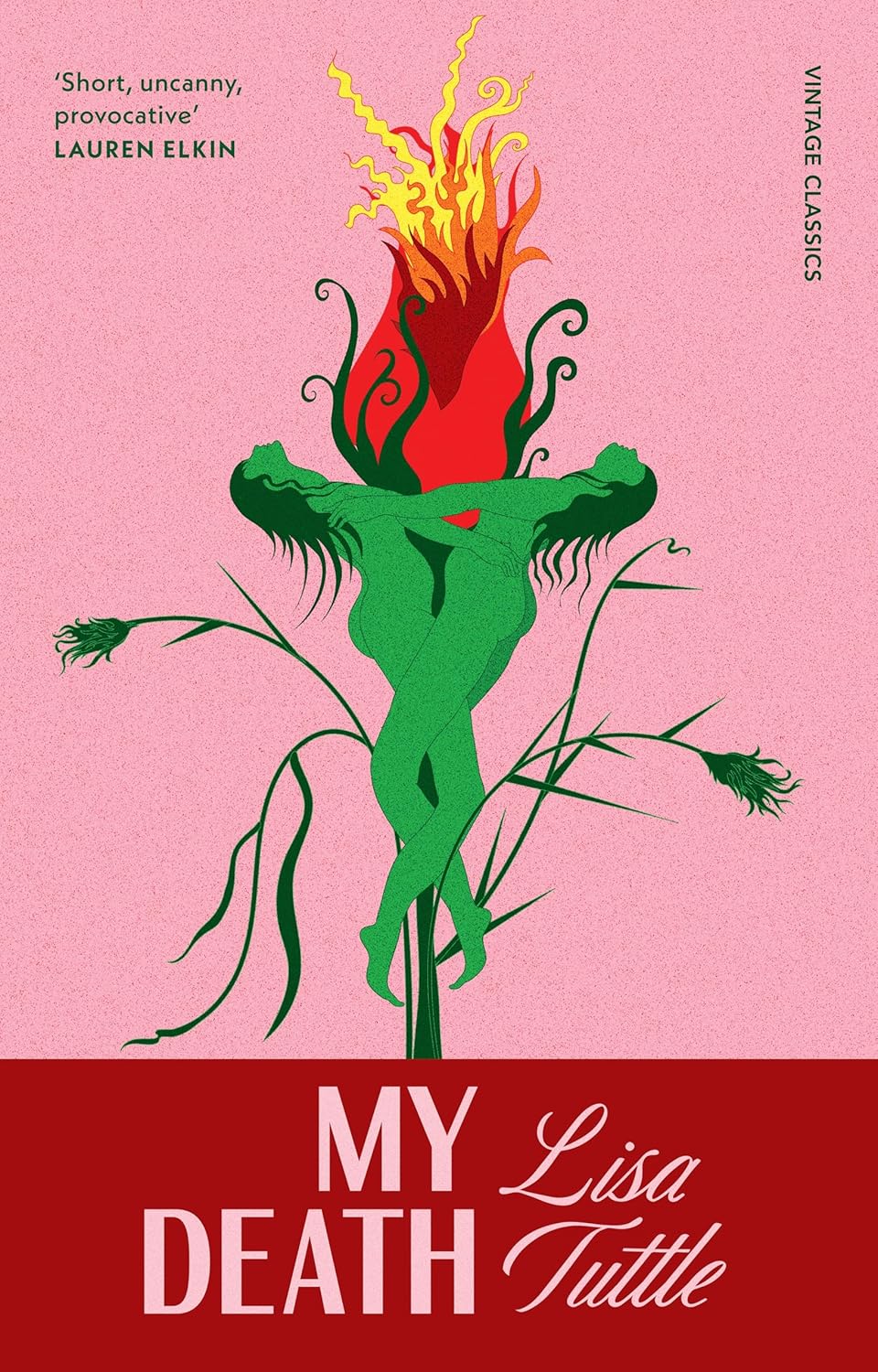
Paul March-Russell: I’m honoured to have Lisa Tuttle here to discuss her novella My Death, which was originally published by P.S. Publishing in 2004, reprinted by NYRB Classics, and is now available in a beautiful edition from Vintage. A number of Lisa’s other works are also being reprinted by Valancourt – A Nest of Nightmares and later this year Lost Futures, which was shortlisted for the Arthur C. Clarke Award in 1993. Lisa, it’s a delight to have you here. My Death is a wonderfully intricate work, so I’m going to be very careful to not give anything away. But what was it that first inspired you to write the novella?
Lisa Tuttle: It was a few things that came together. One is that I’ve always been interested in women writers, women artists, particularly women who’ve been sort of forgotten. I can’t think who it was, someone like Gail Godwin, who was recently talking about when she was at college, she always felt slightly embarrassed being particularly interested in women writers. It didn’t seem right. You were supposed to look at the great writers, and they were all men. Well, I’m from a slightly younger generation, and I think that by the time I got to college, there were women – women’s writing, women’s work, women’s history. The courses were just starting. This was back in 1970. So, I didn’t feel this wasn’t proper. It was like, no, now is the time to find out about all these forgotten women or the women who haven’t been celebrated.
I also read a lot of biographies and autobiographies by women and about women. And at one point, years ago, I thought I might write a biography, but it all seemed a bit too daunting. What suited me better was to write an imaginary biography of an imaginary writer or artist or muse. That was another subject that interested me: women playing the role of muse to a male artist or writer. I’d recently read a memoir of Robert Graves, can’t remember by whom (we’ve just moved house so my books are everywhere!). But one of the things was that the author and his wife went to live in Mallorca, and he had a letter of introduction to Graves, who was at that time living with the American poet and critic, Laura Riding, and the stories that he told about her just fascinated me. I was interested in writing about someone who’d been connected to a more famous male, but had her own talents, more than just being a muse. So, I took elements of Laura Riding’s life for my imaginary writer, and I began in a kind of semi-autobiographical fashion to write about a woman writer, who would have been around my age at the time.
The writer was widowed which I was not, and am still not, I’m very happy to say. But she had some of my own characteristics. That was a kind of a tease, in a way, because some of the things were true. I made her be from Texas, going to college in New York, and then coming over to Britain, winding up in Scotland. And the writer that she is interested in is someone she first encountered as a painted female figure, a kind of mythical person. Because that was another element. I’ve recently been going through my old notebooks, and some of the same names were in there from this story I’ve never written. It was called ‘The Fountain’, and there was a Willie Logan and a Hermione, I think, or Hermine. It was a sort of Circe story with a magical fountain and men being turned into animals. But anyway, I never wrote that, but it was something I was thinking about at the same time. And then Pete Crowther invited me to write a novella, and so suddenly I had a reason to write this, because I couldn’t really see it as a novel and it was way too complicated for a short story. And, in fact, I didn’t even know how it was going to end. When I began writing it, it was really just a character a bit like me researching someone who turns out to still be alive, so she can actually go and interview her, and then finding these rather odd connections or echoes of her life.
Continue reading “A Deeper Magic: Paul March-Russell in conversation with Lisa Tuttle”