SF fans sought as interview subjects

UPDATE: Nick now has received enough offers for the first round of research, and would like to thank all those who have volunteered. There may be a further call for volunteers in the future.

Nick Goddard is a doctoral researcher at the University of Buckingham, exploring SF fandom. If you’d like to help out, get in touch.

Exploration of Science Fiction Fandom

Are you a science fiction fan? Would you like to talk about your experience of science fiction fandom? My name is Nick and I am a PhD student at the University of Buckingham. I am looking to interview participants about their experience of science fiction fandom. I’m particularly interested in your experience of fan activities, the benefits and disadvantages of fandom and your experience of other fans and fan groups.

Interviews will take place over Skype and are expected to take 45-60 minutes. For more information, and to register your interest, please email the researcher, Nick Goddard, 1807057@buckingham.ac.uk.

In order to participate, you must:

  • Have self-identified as a science fiction fan for at least two years
  • Be 21 years old or older

Thank you, your participation is appreciated.
From Infinite Detail

Screenshot 2020-06-03 at 11.02.04

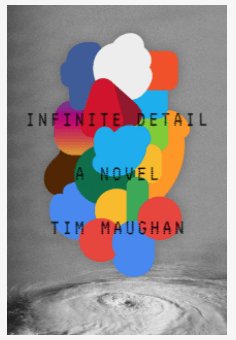
A snippet from Tim Maughan‘s Infinite Detail (2019):

Immediately the protesters’ drones start to drop lower, arrows scrolling across their screens to shift the march’s route, and new cues rattling from speakers to realign the chanting.

WHY ARE YOU IN RIOT GEAR?
WE DON’T SEE NO RIOT HERE!
WHY ARE YOU IN RIOT GEAR?
WE DON’T SEE NO RIOT HERE!

Rush spots a couple of cops behind the main line not wearing headgear, senior officers or strategic management agents, and blinks to grab images of them, storing them away to run through image-search algorithms later. Until you can dismantle them, he tells himself, always use the oppressors’ tools against them.


Early Vector now open access (& a note on Judy Watson)

The BSFA have partnered with FANAC.org to make sixty years’ worth of back issues available free online. This collection includes for the first time scans of all of the first seven issues (editors inclue E.C. Tubb, Terry Jeeves, Roberta Gray, and Michael Moorcock).

Among the earlier issues, there are still one or two gaps, so if in the course of your spring cleaning you find a #12, #33, #46, #47, or #49 perfectly preserved in amber, or a  #50, #51, #53, #54, #62, #63 or #184 released by glacial melt, get in touch.

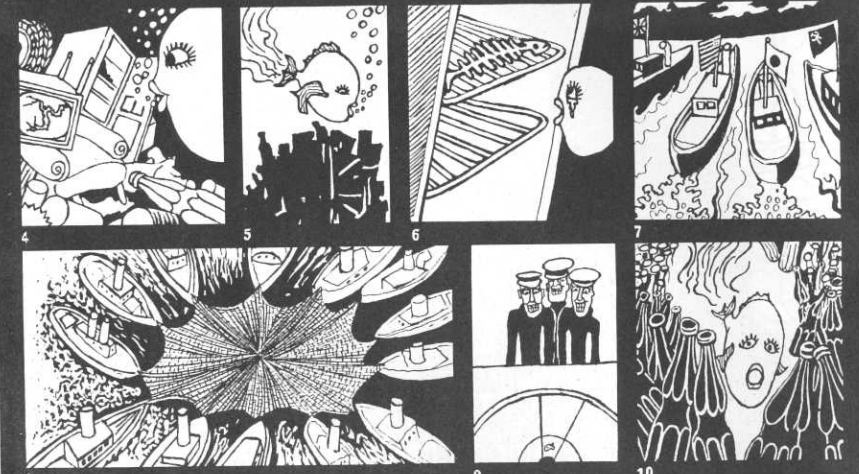
The archive is an absolutely fascinating place to swim around in. In Vector #79 (1977) I stumbled on two striking comic strips by Judy Watson. There are no words. In one comic, titled ‘The Last Fish,’ a fabulous high femme fish is exploring a desolate, junk-crammed ocean. Grinning fishers, evidently in competition with one another, track her on sonar, surround her, and all together cast their vast nets, sized for catches in the thousands or millions, snagging her in a monstrous tangled web. The final panel is remniscent of da Vinci’s Last Supper, except with a vast host of indistinct gatecrashers (5,000 at least) standing in observance. All attention is focused on the little fish on her platter. A single figure at the centre is poised with knife and fork. The seated ‘diners’ — crude national stereotypes — all point and reach, their faces fixed in eerie rictuses remniscent of fish-bones. One figure, skeletal from hunger, does not reach toward the last fish, but instead cowers from her.

Screenshot 2020-02-28 at 13.29.13

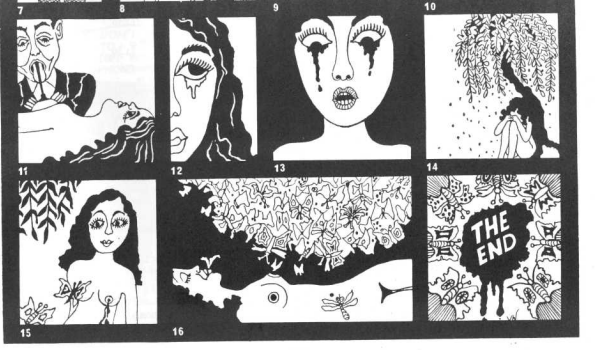
In another comic, ‘If,’ blood flows freely from the protagonist’s breasts. She tapes them up, and blood pours from her navel. She tapes this up too, and visits a Dr [Somebody] — or perhaps Dracula, the edge of the sign is obscured — a balding fanged man, who drinks the blood from her breasts. She weeps, her tears turn to blood, she sits weeping under a tree. Then there is an ambiguous ecological epiphany: she smiles, she finds herself covered with — perhaps she generates? — flocks of dragonflies and butterflies.

Screenshot 2020-02-28 at 13.17.57


Science Fiction’s big digital pivot

Over the past month or so, the British Science Fiction Association (BSFA) has been hosting a series of livestream readings from SFF authors in the UK and beyond. We’re calling them the Lockdown Solidarity Salons or, if you prefer, Very Extremely Casual Tales of Optimism and Resilience (VECTOR). Authors, you are all such charmers!

You can find out more about the series on the Facebook page or YouTube channel. We hope you’ll join us this Thursday (8.15pm UK time) for Chinelo Onwualu, Fiona Moore, and on later dates for Naomi Foyle, Lauren Beukes, Temi Oh, Ian R. MacLeod, and more. Here’s Adam Roberts:

See below for Foz Meadows, Stew Hotston, Valerie Valdes, Adrian Tchaikovsky, Malka Older, Tiffani Angus, Stephen Oram, Geoff Ryman, Wole Talabi, and Andrew Wallace. This Sunday, the BSFA will be holding our annual BSFA Awards ceremony (usually held at Eastercon, the UK’s annual national SF convention) on YouTube at 7pm BST.

And of course, we’re not the only ones.

Continue reading “Science Fiction’s big digital pivot”

“The big idea”: An interview with Wole Talabi

Back in August, Louisa Egbunike caught up with award-winning SFF author Wole Talabi to chat about his work. This interview was first published in Vector 289.

Earlier you mentioned feeling like you were outside of literary circles, and being dragged in. By who? Who’s dragging you?

I don’t know. For a long time, my writing was just about blogging, writing stories from random ideas, and selling to these obscure science fiction magazines. Well, not obscure … but still, I never had any sense of belonging to a generation of writers, you know? The “it” people, or should I say “lit” people right now, are all people I hadn’t met before, hadn’t heard of, and probably hadn’t read much of. Until maybe last year, when I started meeting them after the whole Caine Prize nomination.

So I guess maybe the Caine Prize dragged me into the whole literary circle thing. Before that, I was just like, “I have an interesting idea, there’s some cool robots, and what if the world was like this? Okay, that’s it.” Now, it’s like I have actual fans, and other writers are saying, “There’s all these layers, meanings, and themes in your work.” I was like, “Okay, cool. I mostly thought the robot was cool, but that’s it.”

They see things in your work you didn’t see yourself?

It’s not like I ignore themes or whatever. It’s just, for me, they’re kind of secondary – which is almost the opposite of most writers I know. Most writers I know focus on character and theme. But for me, the idea comes first, and everything else is secondary. A lot of my stories come from just studying things. I see some interesting science thing, and I’m like, “Oh, OK. How would that really work?”

Like what? Continue reading ““The big idea”: An interview with Wole Talabi”

The Time Machine

Reviewed by Jo Lindsay Walton

Time travel plus pandemic: the elevator pitch might simply be, “Dr WHO.”

Written by Jonathan Holloway and directed by Natasha Rickman, The Time Machine is a free and freewheeling response to H.G. Wells’s classic text, which is celebrating its 125th anniversary this year.

Like previous work by Creation Theatre, The Time Machine is an immersive, site-specific production. You prowl around the London Library in a little gaggle, led by your Time Traveller guide, occasionally chased by a spooky Morlock, and now and then bumping into other characters. Continue reading “The Time Machine”

Ten Literary Plagues

Ten literary plagues (and plenty of honourable mentions).

Screenshot 2020-06-05 at 12.41.05
Michel Foucault, Abnormal: Lectures at the College de France 1974-1975

This list has spread here from its original posting at All That Is Solid Melts Into Argh.

Image result for thackery t lambshead diseases

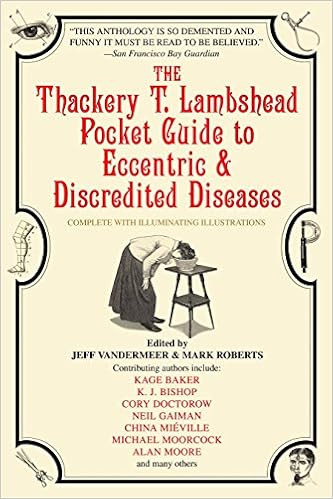
10) Hsing’s Spontaneous Self-Flaying Sarcoma, documented by Liz Williams in The Thackery T. Lambshead Pocket Guide to Eccentric and Discredited Diseases, ed. Jeff VanderMeer and Mark Roberts.

A day or so later, the outer layer of the epidermis splits at the temple into a series of lotus-like petals, apparently causing the victim to force his/her head into the nearest narrow gap (such as a window frame) rather in the manner of a snake attempting to aid the shedding of its skin. Rejecting all offers of help and attempts at restraint, the victim bloodlessly sloughs the skin, ‘scrolling it down the torso and limbs in the manner of a tantalizingly unrolled silk stocking’ (Mudthumper, p.1168).

OK, we’re starting with one that’s not really contagious (as far as I know). So it only manages to scraape its way onto the top ten. But it can also be considered a calling card for Thackery’s, which is a good source of plagues generally. But is whimsy what we need now? I’m not sure. Continue reading “Ten Literary Plagues”

2019 in TV and Cinema

By Gary Couzens.

As I’ve done in past years, this won’t be a comprehensive overview of genre films and television of 2019. Instead, this is a selection of titles which are worth your attention. All were commercially released or reissued in the UK last year.

If in Groundhog Day it was Sonny and Cher’s “I Got You Babe” which heralded its protagonist’s recurring day ahead, in Russian Doll (on Netflix, eight episodes of just under a half-hour each) it was Harry Nilsson’s “Gotta Get Up”. It’s Nadia (Natasha Lyonne), again and again in the bathroom of her friend’s apartment while her own birthday party goes on. A cynical, New York thirtysomething, Nadia certainly has her share of damage, manifesting itself in casual drug use and equally casual sex. At the end of today, Nadia will die, she finds out … and then she’s back in that bathroom with Nilsson on the soundtrack. After several go-rounds she finds Alan (Charlie Barnett) in the same predicament. 

Image result for russian doll
Russian Doll

Although she was one of three creators (along with Leslye Headland and Amy Poehler), Lyonne dominates the show. She wrote and directed the final episode and co-wrote another. Her chartacterisation inevitably brings resonances of her own personal history, including publicly-known issues with substance abuse. It’s a commanding performance in a miniseries which works out its premise in several interesting ways. The music works perfectly, from Nilsson at the outset to Love’s “Alone Again Or” in the final scene. A second season is on its way. Continue reading “2019 in TV and Cinema”