Vector 269

What a welcome sight! The post just arrived, and with it, the latest BSFA mailing.  In addition to Vector, there’s an issue of Quantum, the BSFA’s occasional newsletter; and a paper copy of the ballot for the BSFA Awards (also available online).

There’s also a NewCon Press sampler which includes excerpts from The Outcast and the Little One by Andy West and Kim Lakin-Smith’s BSFA best novel-nominated Cyber Circus. Ian Whates assures me that the booklet went to press well before the BSFA Award nominations for best novel were known and announced.

Lest the prompt arrival of the paper copy of the ballot worry anyone, we’re still planning to do a short story booklet of stories nominated for the BSFA award for the best short story of 2011; but the logistics of that take just long enough that it’ll be coming in the mailing after this one.

This issue of Vector is partially a followup to the poll which Niall ran last year, on the best sf novels by women written in the previous decade. It also has Adam Roberts’ reflections on writing music entries for the Science Fiction Encyclopedia, and Andrew M Butler’s review of the three versions of the John Martin: Apocalypse show which recently closed at the Tate Britain. (The review was printed here on Torque Control in late December to make sure it would  be read before the show closed!)

Vector 269 is labeled the Spring 2012 issue, which means we seem to have skipped winter entirely, despite what today’s chilly weather seems to imply.

Vector 269 contains…

Women SF Writers: An Endangered Species? – Cheryl Morgan
Death and Transcendence in the “Forged” Novels of Justina Robson – Tony Keen
Telling the World: The Exodus Trilogy by Julie Bertagna – Niall Harrison
Single-Gendered Worlds In Science- Fiction – Better For Whom? – Victor Grech with Clare Thake-Vassallo, and Ivan Callus
On Science Fiction Music – Adam Roberts
John Martin: Apocalypse – A Review – Andrew M Butler

Kincaid in Short – Paul Kincaid
Resonances – Stephen Baxter
Foundation Favourites – Andy Sawyer
Picture This – Terry Martin

The BSFA Review – edited by Martin Lewis

Tonight’s BSFA London Meeting – New Venue

This is just a reminder that tonight’s BSFA London meeting will NOT be happening at the Antelope at Sloane Square, where the meetings have been for the last several years.

We’re decamping to a new venue, the basement of the Melton Mowbray on Holborn, near Chancery Lane underground station. It’s still at 7 pm, you’ll still have the pleasure of hearing Christopher Priest interviewed by Paul Kincaid – but do show up at the new venue if you’d like to attend!

The BSFA 2011 Shortlists!

The BSFA is delighted to announce the shortlisted nominees for the 2011 BSFA Awards.

The nominees are:

Best Novel
Cyber Circus by Kim Lakin-Smith (Newcon Press)
Embassytown by China Miéville (Macmillan)
The Islanders by Christopher Priest (Gollancz)
By Light Alone by Adam Roberts (Gollancz)
Osama by Lavie Tidhar (PS Publishing)

Best Short Fiction
The Silver Wind by Nina Allan (Interzone 233, TTA Press)
The Copenhagen Interpretation by Paul Cornell (Asimov’s, July)
Afterbirth by Kameron Hurley (Kameron Hurley’s own website)
Covehithe by China Mieville (The Guardian)
Of Dawn by Al Robertson (Interzone 235, TTA Press)

Best Non-Fiction
Out of This World: Science Fiction but not as we Know it by Mike Ashley (British Library)
The SF Encyclopedia, 3rd Edition ed. John Clute, Peter Nicholls and David Langford (website)
Review of Arslan by M J Engh, Abigail Nussbaum (Asking the Wrong Questions blog)
SF Mistressworks, ed. Ian Sales (website)
Pornokitsch, ed. Jared Shurin and Anne Perry (website)
The Unsilent Library: Essays on the Russell T. Davies Era of the New Doctor Who (Foundation Studies in Science Fiction), ed. Graham Sleight, Tony Keen and Simon Bradshaw (Science Fiction Foundation)

Best Art
Cover of Ian Whates’s The Noise Revealed by Dominic Harman (Solaris)
Cover and illustrations of Patrick Ness’s A Monster Calls by Jim Kay (Walker)
Cover of Lavie Tidhar’s Osama by Pedro Marques (PS Publishing)
Cover of Liz Williams’s A Glass of Shadow by Anne Sudworth (Newcon Press)

This year a number of members nominated the British Library’s Out of This World exhibition for the Non-Fiction Award. The Committee has decided that this does not meet the eligiblity criteria for the award. However, in recognition of the support it has received and its success in encouraging people to explore and enjoy science fiction (one of the primary purposes of the BSFA Awards) will be giving it the status of Specially Commended. In addition, the accompanying book by Mike Ashley made the shortlist and can still be voted on, along with the other nominees.

***

Members of the BSFA and Eastercon will now have the opportunity to vote on the shortlists.

Advance voting forms will be posted out to BSFA members, who will have until 2nd April 2012 to get their nominations in. They can do that by post, email or online form, ranking each of the nominees according to their personal preference: 1 for favourite, 2 for second favourite etc. They don’t have to rank all nominees and they don’t have to vote in every category. The awards ballot is available online here. After 2nd April, the only way to get your voice heard will be to attend the Eastercon and grab a ballot form from your pack or the BSFA desk. Deadline for voting at Eastercon will be 12 noon on the day of the ceremony, the date of which will be confirmed shortly.

Congratulations to the nominees!

Extra opportunity to nominate for the BSFA Awards!

I have a guilty admission to share with you.  For all the times I posted about the BSFA Awards in the last year, encouraging you to share your recommendations of the best UK-published sf novel, the best sf short story, the best work of sf non-fiction, and the best sf artwork from 2011… I never actually got around to putting in a nomination myself last week by the deadline.

I didn’t nominate because I didn’t feel I’d read a wide enough selection of 2011 works. And that may be the same reason why number of people nominating were down somewhat from last year. I still read – and saw – a number of works which were worthy of nomination and which I certainly wouldn’t mind seeing on the ballot.

But! I – and you – have a chance to make up for this.

Starting right now, until Thursday January 19th at 10 pm, the BSFA is accepting additional nominations, especially – particularly – from those BSFA members who haven’t already nominated.

Join me, and nominate! The more people who do, the more representative of the BSFA the resulting shortlists will be.

Lavinia, Part 2: Audience

Lavinia is one of the most recent installations in a long history of what is, in effect, Aeneid-related fan fiction. It was a particularly popular topic for authors in the seventeenth and eighteen century, when the well-educated were quite likely to have read it in Latin as part of their education. The ancient Latin work spawned a slew of elaborators and continuations, best know of which is Purcell’s opera, written about Dido and Aeneas.

Indeed, one of my own extremely rare forays into fan art was when a friend at university asked me to draw a series of small images of Aeneas and his escape from Troy. The images were quite tiny and in watercolour pencil, so barely more than stick figures at that scale. Further, I hadn’t read the Aeneid yet, so relied entirely on my friend’s description of each of eight or nine scenes. That’s how I first met Ascanius and Aeneas and their household Lares, the house gods they saved from Troy, and which find their home, ultimately, with Lavinia in Le Guin’s novel. In Lavinia, Aeneas’ first point of personal commitment to the title character is in entrusting her with their care; and one of the few moments proposed as potentially-supernatural intervention occurs when the Lares move themselves back to her custody.

I’m sure other Aeneid-related works are still being produced, if not so many as in their heyday. Certainly Troy-related works have been going strong lately, if more focused on the Trojan War itself than its aftermath. Equally certain is how well known the stories of Troy are, from their related epics to the ongoing archeological investigations into the history of a city long-since defunct. It’s as inspiring as Atlantis.* Just the other day in Paris, I saw a Trojan dog in the window of some upscale mass-market clothing store, big enough for at least three people.

So the stories generally are known. But how well is the Aeneid in particular known these days among those who haven’t studied Latin? I wonder, not in terms of judging whatever count as “reading the classics”, but in term of who the target audience for Lavinia might be. And does knowing the source material even matter?

My copy of the book is printed in a nice, clear, big font, which leaves me wondering if it was marketed – as many of Le Guin’s books have been – as that relatively-recent classification, Young Adult fiction. The story does deal with a young woman coming of age. How accessible would this book be to someone with no background in Aeneid, whether or not they were a teenager? The story itself provides a summary, in effect, of the last three books of the Aeneid, plus quite a big of its contextual background, but equally the book is written in conscious dialogue with the poem and its poet, who himself appears as an influential character in the book. Lavinia herself tells the reader that her very existence is contingent on his having told of her having been.

Le Guin’s books often deal with historically-rich civilizations, burdened from and benefitting from their layers of past. Might that mean her books would intrinsically appeal to readers with a greater historical consciousness and interest? Or perhaps it is largely through partially-derivative works like this that audiences are most familiar with the Aeneid these days, if at all?

I first read Lavinia specifically because it had been nominated for the BSFA Award for best novel of 2009. Le Guin is, of course, one of the most important authors of science fiction and fantasy; but is this book even targeted at readers of those genres? (I’ll consider the degree to which it even is science fiction in my next post.)

It’s a Le Guin book, and a good and well-reviewed book, so of course it sold at least moderately well. It’s been published at least in the US, the UK, and Japan, and had both hardback and paperback editions; but who is the book’s audience?

* I was recently looking through a brochure of things to do while in Dubai. It includes a theme park devoted to how the residents of Atlantis might have lived.

Lavinia, Part 1: Voice and Identity

Ursula Le Guin’s novel Lavinia is the story of an identity, and of permutations of “I”.

The book begins with the word “I”, and, as throughout, the reader sees this world through the eyes of the titular Lavinia:

I went to the salt beds by the mouth of the river, in the May of my nineteenth year, to get salt for the sacred meal.

Lavinia was a minor figure in Vergil’s Aeneid, a voiceless treaty-bride to his hero Aeneas once he finally settles in Italy and metaphorically plants the seeds which will grow into the city and empire of Rome. Vergil had little enough to say about the young woman, and, as Le Guin’s Lavinia tells us, much of what little he said was cliché rather than accurately descriptive.

The Lavinia of the novel is a voice of several parts. The primary story is that of her more distant past, growing up in Latium, learning the rituals of worship which structure her experience of time, and encountering Aeneas, first through prophecy, then from afar, later through treaties, and finally as his bride. Interludes tell us of a later past, her time happily married with Aeneas, in the three brief years they have together – as she knows and he does not. The framing narrative is the mystery of her voice, that she has one at all, for Vergil, her poet, did not give her one in his poem.

Vergil narrated her into existence, she tells us, in turn recursively narrating his existence in to her story. He appears in her story as a time-traveler in the dreams of his death bed. He meets her that way for the first time, when it is far too late to include her properly in the poem he has already written in his own time; Lavinia, and how badly he misrepresented her that poem, become sone of his dying regrets.

Their conversations cast a long shadow over the playing out of the book’s events; his descriptions of what will happen to Aeneas and what is shown on his shield shape Lavinia’s life for the next three years, and, ultimately, leave her with the difficulty of going on after his effectively-prophetic tellings have concluded. Vergil can tell her of the future glories of Rome, but not of what might happen to her once Aeneas has died. She tells us she is contingent, existing only because of Vergil’s telling of her; and yet, she must find most of her life and the degrees of her existence for herself, because he did not know them. When the contents of the poem have finished working themselves out in her life, she tells her readers that she “has lost my guide, my Vergil.” That “I must go on by myself through all that is left after the end, all the rest of the immense, pathless, unreadable world”. (p. 183)

The end of the Aeneid is not the end of Lavinia, since the whole point, the whole argument, of the book is that she has her own life; by inference, so too does any tertiary character, especially any given woman in a story of antiquity. The rest of the book is a meditation on finding identity amongst political and social conflict.

By the end, the “I”s have multiplied from what seemed to be the simple voice of telling with which the book began; in the the “I”s of the ending, there is the English word for first-person nominative identity but in them too is also the last externally-structuring words Lavinia has – the Latin command to “go”. To go on.

And so, in her own way, she does.

Last chance to nominate for the 2011 BSFA awards!

BSFA members have just one day left now to nominate what they consider to have been the best science fiction novel, short story, work of art, and/or work of non-fiction from 2011. Nominations close at midnight on Friday, 13 January. That is, as of when I’m posting this tomorrow.

It’s worth making a nomination if there are any eligible works which you would like to see on the shortlist. Just because someone else nominated it already, doesn’t mean it has enough nominations yet to make the shortlist in its category.

Email nominations, along with your name (and, ideally, BSFA membership number) to awards@bsfa.co.uk. Currently, there are no limits on the number of nominations you can make, but you should not nominate your own work.

The Last Days of John Martin

John Martin may have died around 158 years ago, but his paintings and other works are still well worth seeing! John Martin: Apocalypse, the show of his work at the Tate Britain in London, the third-and-last venue for the show, is only on until THIS Sunday.

Go see it while you still can!

And, in case you missed it, Andrew M Butler’s review of the show, forthcoming in the next Vector, was posted here on Torque Control a few weeks ago. He explains – if you didn’t already know – just why this show is so worth seeing.

BSFA Award Nominations: One week to go!

BSFA members have just one week left in which to nominate what they consider to have been the best science fiction novel, short story, work of art, and/or work of non-fiction from 2011. Nominations close at midnight on Friday, 13 January.

Email nominations, along with your name (and, ideally, BSFA membership number) to awards@bsfa.co.uk. Currently, there are no limits on the number of nominations you can make, but you should not nominate your own work.

John Martin: Apocalypse – Reviewed by Andrew M Butler

This review will appear in Vector 269. I encourage you, if you’re able, to go see the show before it closes in mid-January!

John Martin: Apocalypse

Tate Britain 21 September 2011  –  15 January 2012

Reviewed by Andrew M. Butler

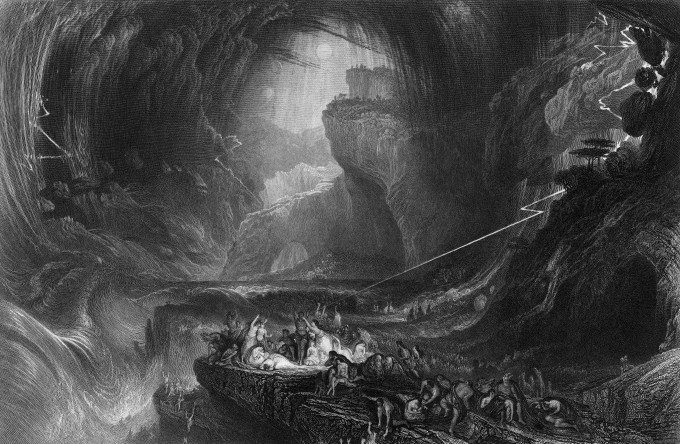
The Deluge, engraving by William Miller after the painting by John Martin

There is a moment in a mid-1820s etching by John Martin when Biblical narrative collides with archaeology, and with market economics — in The Expulsion of Adam and Eve From Paradise the couple are running out of the Garden of Eden through a rocky landscape, a tongue of lightning in the background. Down to their right is some sort of prehistoric creature, almost certainly depicted with the latest theories of what dinosaurs would have looked like, at a time when such palaeontology was in its infancy — the word dinosaur being coined by Richard Owen in 1842. In Martin’s earlier oil painting of the same title, dated about 1813, the image is broadly similar, but lacks the creature. The addition would help him sell the print. This was no one-off — he illustrated for Gideon Mantell’s The Wonders of Geology (1838), in the form of The Country of the Iguanodon, and Thomas Hawkins’s The Book of the Great Sea-Dragons (1840) [PDF], as well producing other images of antediluvian fauna. Such depictions suggest that Martin is one of the first science-fiction artists, and his paintings of Biblical, historical and mythological scenes, often featuring disasters and tumultuous landscapes, reinforce this sense. His uneasy status as a provincial outsider having to earn a living from a metropolitan élite also anticipates the struggles for mainstream respect of genre writers.

Martin was born in 1789 in Haydon Bridge, Hexham, Northumbria, the youngest of four sons. Apprenticed to a coachmaker, he intended to learn heraldic painting, but after a dispute about terms his indenture was cancelled and instead he went to work with Italian artist Boniface Musso. Musso had already given him lessons in drawing and oil techniques in Newcastle; now Martin learnt to paint plates and glass as part of a commercial operation. In 1806, he moved to London, where he supplemented his income by producing watercolours and, in time, became a professional artist. The key place to be exhibited was the annual Royal Academy of Arts summer show, then held at Somerset House, although his first painting was rejected in 1810. The same painting, retitled, hung the following year; the breakthrough came when a member of the board of governors of the Bank of England, William Manning MP, offered fifty guineas to buy Sadak in Search of the Waters of Oblivion (1812). This painting had been inspired by James Ridley’s Oriental fantasy Tales of the Genii (1764), where the hero Sadak crawls across a mountainous landscape toward amnesia-causing waters. Further large canvases followed over the next forty years, with Martin in search of wealthy and influential patrons. But Martin also found popular acclaim, with the Biblical painting Joshua Commanding the Sun to Stand Still upon Gibeon (1816), and was to both show his work in London exhibitions and to tour them around the world — it is thought that two million people saw his Day of Judgement triptych (1849-53) in the UK, the USA and Australia.

Martin’s paintings typically invoked a sense of the sublime. Longinus, writing about rhetoric in the first century, argued that “the true sublime uplifts our souls; we are filled with a proud exaltation and a sense of vaunting joy”, whereas the eighteenth-century Edmund Burke argued that “delightful horror […] is the truest test of the sublime”. In Martin’s case, the feeling is invoked by vast landscapes containing tiny figures in the fore- to midground to give a sense of scale — and his canvases tend to be portrait in orientation, allowing for the composition to tower above the viewer. The terrain is often bowl-shaped, with cliffs and trees taking up the left and right sides of the frame, and then, further back, rivers, lakes, seas and classical cities in the haze of the background. Sometimes the sky forms an answering semicircle, perhaps with clouds of fire, and in some canvases the patina of the painting is cracked in concentric circles. Frequently, the sky is scarred with lightning, scratches across the canvas. In The Deluge (1826), the sea curves around the bottom of the canvas, sweeping the boat clockwise, with storm clouds completing a circuit around the top of the composition, an oval of fairer weather and a glimpse of cities in the distance between them.

The Deluge is one of several paintings Martin made of the Biblical flood, alongside The Eve of the Deluge (1840) and The Assuaging of the Waters (1840); the painting of The Expulsion of Adam and Eve From Paradise, alongside The Garden of Eden (1821), The Fall of Babylon (1819), Belshazzer’s Feast (1820), Adam and Eve Entertaining the Angel Raphael (1823) and The Destruction of Sodom and Gomorrah (1852), suggests an Old Testament theme running through his work, especially the sense of a powerful, destructive, vengeful God. The success of Belshazzer’s Feast, which was reproduced in several versions, clearly suggested that there was a market for such apocalyptic thrills, in a Britain which in the process of being changed forever by the industrial revolution and a network of railways threading its way between mines and factories and ports, and between London and the provinces. The aristocracy and the upper middle classes could go on Grand Tours across Europe, to the Matterhorn, the Alps, Venice, Sicily and beyond, but Martin had been on no such journey and locates such landscapes within England. It is tempting to see the valley of the Tyne with Newcastle perched above it as one inspiration for his topography.

It was apparently a journey through the industrialised Black Country which pointed him to the New Testament subject of The Great Day of His Wrath, a book of Revelation style destruction of Babylon in which volcanic powers rip open a landscape, and vast boulders — on which ruined cities can be glimpsed — are thrown through the air. A second painting, The Last Judgement (1849-53), has a landscape riven in two, beneath Christ and the Angels sitting in court at the top of the picture against a more heavenly sky. On the left of the canvas are the saved, including a range of politicians, poets and artists from antiquity to the present day, on the right, across a chasm filling with corpses, are the damned. Before the painting was damaged, there was a train being driven towards the abyss. The trilogy is completed by The Plains of Heaven (1851-3), a gentler pastoral of the era after the Second Coming, the green of grass and trees surrounding a rich azure of sky and sea. But Martin also looked to Pompeii and Herculaneum for his subjects, and its destruction by volcano (1822, 1822-6), and a classical story of Marcus Curtius being swallowed up by a chasm in a city street.

From the 1820s onwards he was developing plans for canals across London to provide a water supply for London and Westminster, for a sewage system to improve London’s hygiene (and to provide fertiliser for farms) and for a network of railways circling central London and along the banks of the Thames. In this work he anticipated Joseph Bazalgette’s improvements to the London drains and the Embankment and the piecemeal engineering of the London Underground network and overground lines, then in its infancy. Funds were never quite available to translate Martin’s plans into practice. He was also friends with Isambard Kingdom Brunel, Michael Faraday, Charles Babbage and other scientists such as Georges Cuvier, a French palaeontologist. In the painting Arthur and Aegle in the Happy Valley (1841), inspired by a Sir Edward Bulwer-Lytton poem, Martin insists that the background constellations are accurate in astronomical terms, even if the topic was fictional. He drew on the latest science and engineering.

Martin also knew Charles Barry, who won the competition to design the neo-gothic yet classical new Houses of Parliament, and it is likely this architecture also fed into his work. One could scale his painting of Balshazzer’s Feast to discover how many miles long his palace interior was — or so Martin argued — and contemporary archaeology was another source of inspiration and publicity. Pamphlets and handbills listed details of the people painted in crowd scenes and drew attention to details. All of this contributes to the showmanship which Martin clearly possessed in spades — but also, perhaps, to the sense of insecurity from being an outsider, a working-class artist with little training. Conspicuous testimony to his sense of pride is a piece of furniture, shown in Apocalypse: a bureau with drawers labelled for Martin’s various projects and honours. At the 1851 Great Exhibition, he presented himself as an engineer rather than as an artist.

Salespitches remained necessary, as the art market ebbed and flowed in the era of J.M.W. Turner and John Constable, the former artist stopping at nothing to gain advantage and positioning in the Royal Academy summer exhibitions. Whilst it was possible to sell similar paintings in several sizes, this undercut their exclusiveness, so Martin made a virtue of copying through the comparatively mass medium of the mezzotint. But the mezzotints enabled Martin to revise his earlier compositions — hence the appearance of a prehistoric creature alongside Adam and Eve. Martin employed other engravers to make plates of his images, although he was not always happy with their work and would sometimes reject it. Other times he would do his own engraving, and for a period set up a state of the art press in his own home where he supervised the production of mezzotints by professional printers.

One series of mezzotints were commissioned in 1824 by Septimus Prowett as illustrations to John Milton’s Paradise Lost (1667), returning to Old Testament scenes, but also paving the way for scenes from Revelation and the New Testament in general. The most striking of these depict Satan, especially Satan in Council, whose composition seems to anticipate the council chamber in the Star Wars prequel trilogy (and Lucas apparently was inspired by Martin’s work; the empty landscape of Solitude (1843) is echoed in the climax of THX 1138 (1971) or the deserts of Tatooine). Martin went on to work on illustrations of the Bible, a less successful project than he had hoped, as was his attempt to sell direct to customers, bypassing the established English network of print emporia. Worse, he undercut himself by designing cheaper plates to be printed by Edward Churton. Nevertheless Martin still made more money from his mezzotints than his paintings — Michael Campbell, a Martin collector and scholar, suggests up to £25,000 — although the market declined through the 1830s.

Perhaps such mentions of money are vulgar — but I see in Martin a kindred spirit of today’s science-fiction writers. He might not have quite been competing for the reader’s beer money, but he knew how to exploit a successful image in more than one format, and he knew how to bring showmanship to his exhibitions. In the lack of official recognition from membership of the Royal Academy nor was he knighted — although the Belgians honoured him — we might also think of the anxieties over the injustices of the Booker Prize or snootiness about the Granta Best of Young Novelists lists. But mostly it is in his fusion of science and art, his use of the sublime, and his creation of apocalyptic imagery that never quite feels reducible to allegory or political parable. (His painting The Last Man (1833) is inspired by an 1823 Thomas Campbell poem rather than Mary Shelley’s 1826 novel, but his accommodation of Jane Loudon as a house guest might put him somewhere in the genesis of The Mummy! Or A Tale of the Twenty-Second Century (1827).)

His work remains sublimely astounding. If you want to see the inspiration for a hundred ends of the world, or be inspired yourself, immerse yourself in Martin’s art, which is, in the words of curator Martin Myrone, “suspended or caught between mass production and the unique, the popular and the rarefied, the industrialised and the artistic, the sensationalist and the scholastic.” And that, after all, is the place where we often find sf.

Reading List

Adams, Max (2010) The Prometheans: John Martin and the Generation That Stole the Future, London: Quercus.

Aristotle/Horace/Longinus (1965) Classical Literary Criticism, trans. T.S. Dorsch, Harmondsworth: Penguin.

Burke, Edmund (2008) A Philosophical Enquiry into the Origin of Our Ideas of the Sublime and Beautiful, Oxford: Oxford World’s Classics.

Feaver, William (1975) The Art of John Martin. Oxford: Clarendon Press.

Martin, John (2011) Sketches of My Life, ed. Martin Myrone, London: Tate.

Myrone, Martin (ed.) (2011) John Martin: Apocalypse, London: Tate.