The Pause That Makes You Human
Tade Thompson interviewed by Liz Williams
Write-up by Andrew Wallace

Tade Thompson is the author of acclaimed SF novel Rosewater, which won the 2017 Nommo Awards for African speculative fiction. His short story The Apologists was nominated for a BSFA Award in 2017, and his novel Making Wolf won the Kitschies Golden Tentacle. Liz Williams is a novelist whose Philip K Dick Award-nominated novels include The Ghost Sister and Empire of Bones, while Banner of Souls was shortlisted for the Arthur C Clarke Award.
As a child in Nigeria, Tade Thompson read whatever he could find. Often, the texts were mashups of American comics like the Fantastic Four, or British reprints made of cheap newspaper. He quickly graduated from comics to novels, although his genre tastes were not restricted to SFF – at one point his sister convinced him to get into romance, after which Tade read forty Mills & Boon novels. After that he read Ian Fleming, the Saint and tried War and Peace when he was about ten, although part-way through he fled back to the fantastical, devouring works by Frank Herbert and Lewis Carroll. Tade also wrote his own versions of these stories, many of which featured the Mock Turtle in a kind of Alice-inspired Extended Universe. He got back to Russian literature in his teenage years, starting with Dostoevsky.
At times, his mother would only allow him to buy two books at a time, which was a problem if you were reading a trilogy. Tade solved the problem by purchasing book two and three while writing book one himself, and the imaginative discipline required to keep such long narratives in mind was a valuable introduction to story structure. It enabled him to make choices regarding linear narrative, which he believes is over-rated, preferring thematic or other structural links to hold a story together.
During the BSFA interview, Tade explained that this approach extends to the belief that science fiction is best when people work harder to understand a book. He disagrees with editors who want him to be kind to the reader, because he has faith in the reader’s intelligence. Tade wants his books to stay in the reader’s mind, as books do when people put maximum thought into understanding them. In his novel Rosewater, for example, the protagonist is presented as two separate characters: one young and the other old. The story looks at similarities found in each life stage, and the inevitable bleed-over.
Rosewater has an authority figure in the person of the Section Head, who is female.The Section Head’s gender is of interest. During the interview, Tade said he felt women had more of a grasp of what is going on: a capacity to perceive and understand the bigger picture. He grew up in a house of women. The women around Tade were competent at a lot more things, from the social relationships that keep a family together to the responsibilities men are conventionally associated with, such as the time Tade’s mother put out a fire in the house before the fire brigade got there. When creating such female characters, Tade says: ‘I am writing what I know.’
This concept of diffused but effective power finds another expression in the alien entity of Rosewater, which was inspired in part by The Andromeda Strain. Michael Crichton’s novel describes how an extra-terrestrial virus is collected by accident by an orbital probe and then released on Earth with devastating results. Tade liked the idea of aliens who don’t arrive by spaceship, ascribing agency to the alien spores, and considering what kind of bugs they would be. Rosewater depicts a biological invasion: a cellular preparing of the way. It is delivered with a scattershot approach to include as many worlds as possible, rather than choosing Earth specifically; indeed, the aliens might not even know Earth exists.
At the BSFA, Tade explained he was not interested in traditional ‘fight the invading aliens’ narratives. He believes war stories reflect earthly rather than alien concerns, particularly the failure to imagine a scenario involving a meeting of cultures that does not end in fighting. Perhaps the idea of the devastating alien invasion comes from history, because our first contact narratives have always been evil; in Nigeria for example, the British wiped out entire villages. The War of the Worlds scenario is an expression of guilt as much as paranoia.
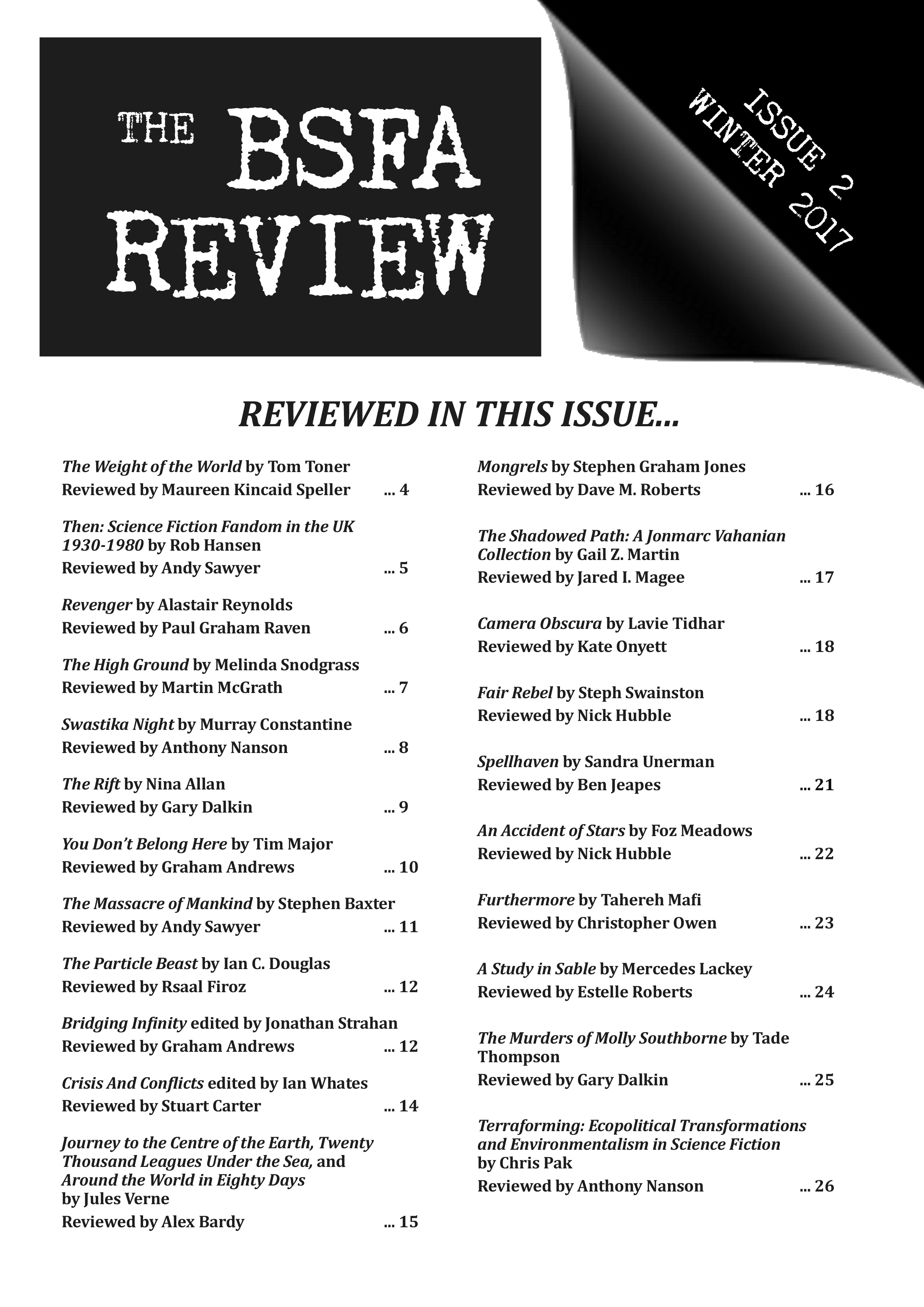
Tade also explores the subject of a territory as defined by porous boundaries in his novella The Murders of Molly Southbourne. Instead of projecting problems psychologically, which everyone does all the time, the book is about what happens when these metaphors come to life and try to kill us. The story concerns our daily mental battles, and an unwillingness to confront difficult psychological truths.
These ways of defining individuality relate to Tade’s views on world building. At the BSFA, he explained how he thinks the SFF community fetishizes world building because of the success of JRR Tolkien’s Lord of the Rings, despite the book’s problematic depiction of subjects like race. In his own work, Tade prefers to focus on character, building each person’s subjective world around them instead of imposing a single over-arching realm.
He believes the ways we are treated by society change how we see that society, and his experience bears this view out. In Nigeria, he is not part of an ethnic minority; in London, he is the same person, but needs to be careful where he goes, particularly on match days. There is a shift in perspective that is not a choice he makes, but which is imposed upon him. In America, these conditions are even harsher; Tade describes merely existing there as a black person is an ‘extreme sport’.
The next Rosewater book deals with the US, or rather the lack of it given that in a previous volume the country was wiped out. Tade describes the difficulty of reaching an audience that cannot conceive of a situation where it is not the centre of everything. Even negating America is talking about America, not least because the book features American refugees.
He plans to write a novel set in a future Africa – a contemporary fantasy based on Yoruba creation myths, whose Earth Magic-inspired stories have not yet been represented in genre fiction.
In the interview, he said that selling any kind of fiction is about educating the audience, and the audience is better educated now than in 2001. He recalls the cringeable scene in Independence Day with the alien spaceship in flames behind some Africans who were carrying spears, as if they’d used those instead of nukes to bring the invader down. We are less likely to get that kind of scene now, so there has been some progress, and SF readers are happier to look at genre stories inspired by different Earth cultures.
There is inevitable pushback due to what Tade said is a result of the old conservative guard feeling threatened; that old atavistic behaviour will spike before it changes. He feels this process is quite normal, and is not worried about it. He explained how the opinion that black people don’t read and write SF was prevalent as recently as 2009, even though writers like Nnedi Okorafor had already published a significant body of work.
Attitudes like these seem to Tade to be part of the same ‘there can be only one’ narrative. In 2008 Tade was told that although his submission was good, the editor already had work by eight black people and, by implication, that was enough. This experience stopped Tade writing for a while; fortunately, Lavie Tidhar contacted Tade and requested the inclusion of a story in the World Science Fiction Blog. It is significant that Tade’s way back was a blog, because technology has democratised publishing and enabled a wider variety of voices, rather than the tokenistic inclusion of a small number of ‘representatives’.
Challenges remain, however, not all of them in the West. At the BSFA, Tade described how the publishing industry in Nigeria can be neither fair nor supportive of new writers. A friend sent him a contract and asked for advice; the contract was atrocious, with the publisher retaining all rights including subsidiary rights in perpetuity for a tiny advance. The decision was not straightforward, however, because Tade could not think where else the work could be sent. If you write professionally, then whoever is selling your book dictates what you write, so the West still influences what African authors write simply by controlling a large share of the market through its more established publishing system.