From Our Archive: Nisi Shawl

This article first appeared in Vector 247.

Colourful Stories

Fantastic Fiction by African Descended Authors, by Nisi Shawl
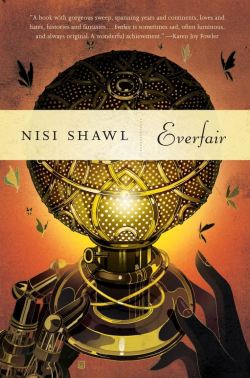
Everfair coverSo rich a sea, so broad the currents … in exploring fantastic literature by African-descended authors, where do we start?

“Begin at the beginning” is standard advice for writers. “Begin where you are” is more my style. Where I am at the moment, where I’ve been most of my life, is North America. Though I know there are many other schools of African-descended writers out there, myriad fabulists swimming in gorgeous array, I’m at my best talking about those with whom I’ve had the most contact, those about whom I have something substantial to say: those who inhabit the Western Hemisphere. In the course of this essay, then, I’ll focus on “New World” writers of fantastic fiction whose ancestors came from Africa. I’ll talk about specific works by them and also touch a bit on what I see as a commonly shared theme.
Just as important as my location in the three dimensions of physical space is my location in a fourth, time. When I am is one week out from learning of the death of my friend Octavia Estelle Butler. So despite the fact that her fiction’s far better known than that of some of her colleagues, it’s to her work I’ll turn first.

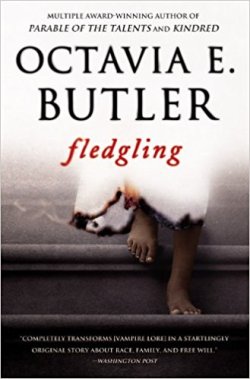
Octavia, as almost anyone who knew her will tell you, was not quite a recluse, but fledglingsomeone who valued her loneliness very highly. Yet a major concern of the heroine of Fledgling, her last complete book, is building a community. Shori belongs to a sentient species known as the ‘Ina’, and must consume human blood to live. In other words, she’s a vampire–but a scientifically plausible one. At its best, the Ina/human relationship is symbiotic, and Shori, survivor of a vicious, lethal attack on her original family, instinctively seeks to reconstruct what she has lost: a feminist-oriented blending of species and sexual preferences that might be the envy of a Utopianist visionary.
Shori’s other quest, of course, is to bring to justice those who murdered her mother, her sisters, and the humans they had gathered into their extended family. The killings may have been “racially” motivated; that is, though Shori’s not human, she has been genetically altered so that her skin is as dark as most blacks, and the tactics her enemies use are those of the Klan and other racist lynchers.

While it’s these last points that will probably impress most readers as drawing on African American culture, the book’s concern with social and familial structure shares the same roots, I would argue. Historically, most New World descendents of Africans came to this hemisphere as victims of the slave trade. This means that a large percentage of the cultural artifacts that survived that trauma are non-material. And even these were difficult to retain, subject to enormous stresses under the system of chattel slavery. Language, genealogy, occupational associations: all vanished or were transformed beyond easy recognition. It seems to me that a longing for these lost inheritances underpins the frequent tendency of New World African descendents to write what’s known as “third order” stories.
Continue reading “From Our Archive: Nisi Shawl”
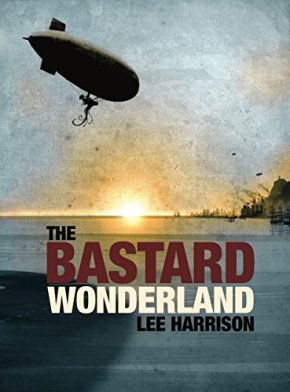
From the BSFA Review: That Bastard Wonderland by Lee Harrison

That Bastard Wonderland by Lee Harrison (Wrecking Ball Press, 2016)

Reviewed by Arike Oke

bastar

You can take the lads out of Hull, but you can’t take Hull out of the lads. That’s okay, I’m a daughter of Hull myself. That means I appreciate the dourness, sarcasm and bittersweet melancholy of my home, all of which come through beautifully in this love letter of a fantasy debut from Lee Harrison. I mean: mushy peas get an origin story.

There’s a backlash right now against maps in fantasy books. Utter tosh say I. A novel with this geographic ambition, outlining a startlingly well realised alternative world, could only benefit from a map. I kept flicking to the frontmatter and the endpapers to find only blank pages, beautiful blank pages though. Wrecking Ball Press, a small press operating out of Hull (see, some kind of theme emerging!), has made a gorgeous edition of this book, cover, paper and font all working together to make a quality volume. Is the image chosen for the cover a small spoiler of a one of the story’s treats? Perhaps, but it looks well on’t.

The protagonist, and main point of view character, is Warboys. No relation to the tragic lost boys of Mad Max Fury Road, this Warboys is as laddish and uncouth as they come. He reluctantly teams up with his dad on a begrudging journey across their world. They are caught up in the expansionist ambitions of a Napoleon–like figure, but soon come up against the old belief systems of the territories they are forced to invade. It seems that there might be some truth in the old myths, but who can Warboys and his dad trust? Is anyone looking out for the underdogs in this war that on the surface is about a conflict of cultures, but underneath is as much about broken dreams and sickening ego as any real-world conflict throughout our own history.

Harrison shows us the other side of the conflict through the eyes of Nouzi Aaranya, a young man groomed from childhood in more ways than one to be a soldier and martyr for a cause he barely grasps. Whereas Warboys is solidly placed within the world of pubs, back streets, sailors, drinking and swearing, Nouzi is altogether more delicate. He’s led a life of direct indoctrination, rather than the societal conditioning of Warboys’ context. Nouzi’s own identity gradually surfaces as the plot unfolds. This forms an enlightening counterpoint to Warboys’ growing sense of responsibility to others. By the end of the book both men find themselves changed.

Harrison handles the dual point-of-view third person narration deftly. Each character is well drawn and distinctive. The plot, once past an avoidably slow and dialogue heavy first act, trips along happily building towards a satisfying, touching and cinematic denouement that still somehow manages to retain the ‘call a spade a spade’ Northern tone. Female characters are few and far between in this boys’ own tale, but as this story can be read as intrinsically about male relationships this paucity of female representation is hardly unexpected.

The world that Harrison has created for this story is startling in its clarity and depth. The technology, the big reveal, the language, religion, even the descriptions of landscape, sea and street are deft and convincing. It is a nice touch that Harrison prefaces sections of the book with quotations from archival texts from within the universe he’s created. Harrison has set up a world that could contain many more stories. We are not left with a cliff hanger so much as an open window looking out across a vista of real humans living real lives in which Harrison will find rich pickings for many more stories. I’ll be in line to read them, pattie buttie and chips in hand and wearing my ‘It’s Never Dull in Hull’ t-shirt. One request though, forget what the internet forums say: next time let’s have a map, eh lad?


From Our Archive: Judith Berman on Cultural Appropriation

Bears, Bombs and Popcorn

Some considerations when mining other cultures for source materials, by Judith Berman

Bear_Daughter[The cover] painting is a made-up decoration merely done in Pacific Northwest style … meant to say to a reader “This novel is based on the mythology of the Pacific Northwest,” just as covers for other kinds of fantasy use images from Celtic, Norse, or Japanese mythologies to signal “pick me up” to the right kind of reader. ([Name withheld], p.c. Feb. 9, 2005)

In the background of the cover for my novel Bear Daughter sits an object that resembles a piece of Native American art. It looks, in fact, quite a bit like a painted wooden screen made by a Tlingit Indian artist in the early 19th century to represent the hereditary Bear crest of the Tlingit Naanyaa.aayí clan. That screen, now in the collections of the Denver Art Museum, formerly embellished the Ground Shark House in what is today Wrangell, Alaska.

Having worked for a number of years with traditional Tlingit art, I immediately recognized the resemblance of the cover image to the Naanyaa.aayí Bear screen. It also resembles, to a lesser degree, two other screens. The first of these, likely a copy of the Naanyaa.aayí screen, was made for the Killer Whale House of the Kaagwaantaan clan of Klukwan, probably in commemoration of the genealogical links between that house and Ground Shark House. The second, which the Naanyaa.aayí screen likely copied, is known only from a fragment preserved at the Burke Museum in Seattle.

Upon seeing the cover, my first concern was that the background object might be another related Bear screen, one I didn’t know about. Tlingit clan heirlooms like these screens are the focus, today as formerly, of deep emotions about one’s connections to past and future generations. The right to display such heraldic designs is a hereditary prerogative often acquired–“paid for,” as it is sometimes said–through the blood of one’s ancestors. In earlier times wars were fought over misuse of crest objects. A validated Tlingit crest object, as I wrote to my publisher, is

like a national flag, a trademarked product logo, a memorial to dead relatives and ancestors, and a family heirloom with strong emotional associations, all rolled into one. There is variation across the [northwest coast] region in what these objects mean and how they are used, but the notion that they are in some fashion property and “copyrighted” is near-universal.

Some crest heirlooms remain in Native custody, like the Klukwan Bear screen. Many others, however, have found their way into museums and private collections. The means by which they have done so are frequently not pretty, and the objects have been the subject of repatriation claims and other legal actions. Given that the cover artist had likely used photographs as the source for the cover image, US copyright law, which extends to so-called “derivative” images of copyright materials, might also have been called into play. In short, using an image of genuine crest art on my book cover could have been problematic.

Continue reading “From Our Archive: Judith Berman on Cultural Appropriation”

Visions of Space: An Interview with David A. Hardy

By Alex Storer.

Any science fiction or space art aficionado should instantly recognise the name David A. Hardy – perhaps from the early part of his career working with Sir Patrick Moore on The Sky at Night and their award-winning books, including Challenge of the Stars and Futures / 50 Years in Space, or perhaps from his film and television credits, which include Blake’s Seven and The Neverending Story. Maybe you’ve got books in your SF collection adorned with David’s stunning cover art (maybe you’ve even read his own SF book, Aurora), or have encountered his work on the convention circuit. At the very least, if you’ve ever bought Cadbury’s chocolate, you’ll recognise the logo that Hardy originally designed during his time working at their Bournville factory, Birmingham, in the 1960s!

First published in 1952, David A. Hardy is the longest-established living space artist. Hardy started out as an astronomical artist, and the inevitable expansion into science fiction did not come for some years. Hardy’s work can transport you to the remotest corners of the Solar System, or into remote alien worlds and future times. What’s more, Hardy is still working and in as much demand as ever, regularly supplying cover art for the likes of Analog and The Magazine of Fantasy & Science Fiction, and countless science fiction paperback and e-book titles.

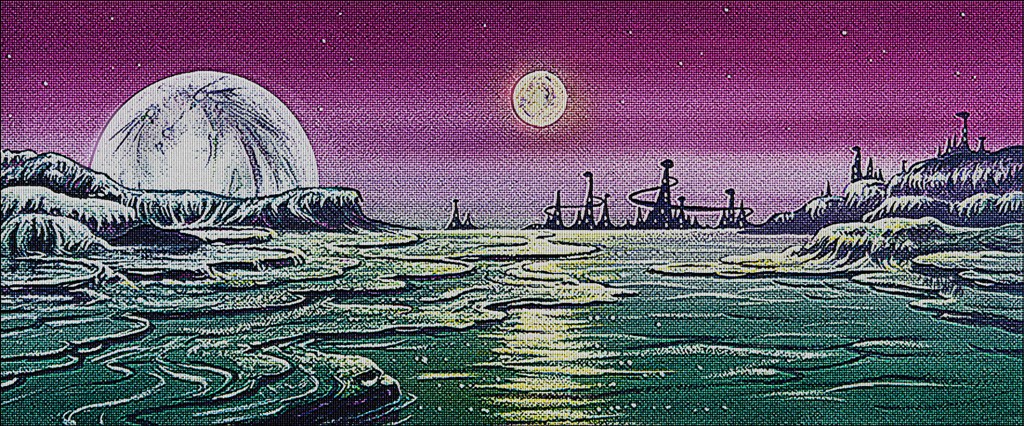
Initiation of Akasa_F&SF

F&SF: Initiation of Asaka

Hardy’s artwork continues to move with the times – in tandem with spaceflight technology and our ever-expanding scientific knowledge about the planets in our Solar System, and advancing with the advent of computer technology and digital art.

I grew up in awe of Hardy’s work, courtesy of its inclusion in the most marvellous book, Space Worlds, Wars & Weapons (published in 1977 by the sadly defunct Paper Tiger imprint), and an art print that hung on the wall at home, entitled Stellar Radiance. This artwork my young imagination; it was like having a window into space. It sparked my obsession with science fiction art and ultimately led to me working as a science fiction artist myself, years later.

Stellar Radiance

Stellar Radiance

When I rediscovered my love of science fiction and space art in 2007, I realised it was time to start creating my own – and David A. Hardy’s work was my first port of call.

However, at the time, I did not know the name of that wonderful painting that I used to lose myself in, nor the artist’s full name – though the carefully scribed signature of “Hardy” in the bottom corner of the painting had always stuck in my mind. Thanks to a quick Google search, in no time at all I was in touch with the man himself, and soon found myself discovering his decade-spanning portfolio, starting with the books, Hardyware and Futures / 50 Years In Space. David’s enthusiasm and encouragement were invaluable and enough for me to know that I simply had to give it a shot.

One of the things which appeals to me about Hardy’s art is that whether it is paint or pixels, the work is still distinctly Hardy. When it comes to digital art in particular, I’ve always found it crucial to still have the touch of the artist’s hand, which I feel adds soul and personality to a digitally piece, eliciting just the same kind of emotional response one gets from looking at a canvas painting – and Hardy achieves this masterfully.

Despite being in the age of photographic imagery and photorealistic 3D graphics, hand-rendered art has remained important in science fiction circles, as it is another medium in which we can escape into other times or worlds – and more often than not, the art goes hand in hand with the SF literature we read; either adorning the covers of the books we love or simply inspired by them.

A ‘Hardy’ is immediately identifiable, not only by that kind of vibrant colour palette (regardless of medium), but by a consistent style and approach. Decades of experience and expertise all go into making each and every piece a work of wonder that one never tires of viewing.

I caught up with David to chat about all aspects of his work and career …

The first time I encountered computer-aided artwork in the early 1990s, it felt like a life-changing moment; a glimpse of the future. Do you remember the first time you saw computer art and did you realise it was going to be a significant way forward, especially in terms of science fiction art?

DAH: I had a similar “Eureka!” moment when I discovered the airbrush in 1957! Here was a way to paint atmospheres, glows, nebulae in a way that was realistic yet wouldn’t take hours of painstaking blending of paints. I have always kept up with new technology, and started using photography, especially ‘derivative’ (manipulated) images, in my work. In the 1980s I did all my own darkroom work and even became a LRPS. I also bought a large-format camera and started taking photos of my work to send to publishers as transparencies (slides) rather than entrusting valuable artwork to the tender mercies of the Post Office! I became aware of the intrusion of computer art in publishing, and it was exciting, but I couldn’t afford any of the equipment. Then when the Atari ST came along in 1986 I got a 520, then a 1040 and finally a Falcon before getting my first PowerMac in 1991. But it was still some time before I felt able to use this professionally. (I did however produce graphics for an Atari/Amiga game, Kristal, which won an industry award.)

Kristal

Kristal

Many SF artists have continued to work with paint while others have moved to digital or only work digitally – yet you have maintained a healthy balance of both. What do you feel you can achieve with digital art that you can’t with traditional media – and vice-versa?

Continue reading “Visions of Space: An Interview with David A. Hardy”

The Geography of Fear: Dave Hutchinson interviewed by Tom Hunter

The BSFA holds regular events in London, usually on the last Wednesday of the month, at the Artillery Arms near Old Street. These events are free, and open to members and non-members alike. Keep an eye on the BSFA website for news of future events. In June 2017, Tom Hunter rendezvoused with Dave Hutchinson, author of the acclaimed near-future spy series, Fractured Europe. Our asset Andrew Wallace returns safely to HQ with the following intelligence …

Any writing career has its highs and lows, and in Dave Hutchinson’s case, quite literally. One of the jobs he applied for after leaving university (he graduated from Nottingham with a degree in American Studies), before beginning a career in journalism, was air traffic controller. Dave credits the absence of planes falling from sky to the fact that he didn’t get the job. Still, it’s intriguing to think of Dave Hutchinson, author of the award-winning near-future Fractured Europe series, as an air traffic controller in a parallel universe … managing the borders between nations, between earth and sky …

Continue reading “The Geography of Fear: Dave Hutchinson interviewed by Tom Hunter”

From Our Archive: Biographical Fantastic

Framing the Unframeable

What does the fantastic bring to the storying of lives? By Gary K. Wolfe

441px-Novalis2

“Unser Leben ist kein Traum, aber es soll und wird viellicht einer werden”.
(“Our life is no dream; but it ought to become one, and perhaps will.”)

– Novalis (Friedrich von Hardenburg), as quoted in George MacDonald’s Phantastes (1859)

“And do not rely on the fact that in your life, circumscribed, regulated, and prosaic, there are no such spectacular and terrifying things.”
– C. P. Cavafy, “Theodotus,” as quoted in Elizabeth Hand’s Last Summer at Mars Hill (1998)

When one looks at the published memoirs and autobiographical sketches written by science fiction and fantasy authors, mostly for the benefit of their fans – the sort of thing collected in Brian Aldiss and Harry Harrison’s Hell’s Cartographers (1975) or Martin Greenberg’s Fantastic Lives: Autobiographical Essays by Notable Science Fiction Writers (1981) – one is initially struck by the relative thinness and lack of genuine introspection of many of the essays. Typically, such pieces read as a variety of Augustinian conversion tales, depicting a precocious childhood, often solitary and bookish, sometimes sickly, sometimes featuring battles with parents to get into the adult sections of the library, and characteristically leading toward a moment of revelation: “And then came Hugo Gernsback” (Alfred Bester) [1] “Then I saw and bought an issue of something called Amazing Stories” (Damon Knight) [2] “So science fiction entered into and began warping my life from an early age” (Brian Aldiss) [3] etc. In one of the still-comparatively rare autobiographies of SF writers, Wonder’s Child: My Life in Science Fiction, Jack Williamson ends a chapter with the following cliffhanger:

Something else happened, however, in the spring of 1926, the first year I was out of high school. Something that changed my life. Hugo Gernsback launched a new pulp magazine, filled with reprinted stories by Jules Verne and H.G. Wells and A. Merritt and Edgar Rice Burroughs, stories he called “scientifiction.”

The magazine was Amazing Stories. [4]

Following these road-to-Damascus moments, however, these memoirs and autobiographies seldom become genuine testaments, instead amounting to not much more than narrative resumés, filled with anecdotes of encounters with fellow writers and editors and often with almost obsessively detailed accounts of sales figures and payments; one comes away with the sense that (a) science fiction writers all clearly remember the first SF story they read, and (b) they keep really good tax records.
Continue reading “From Our Archive: Biographical Fantastic”

Superhero_ines: Rebooted Comics and Trans* Identity

By Christina Scholz

Centre for Intermediality Studies, University of Graz, Austria

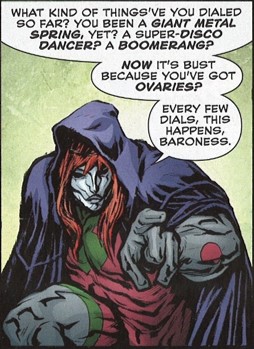
Manteau: Seriously? Bust? – What kind of things’ve you dialed so far? You been a giant metal spring, yet? A super-disco dancer? A boomerang? Now it’s bust because you’ve got ovaries? Every few dials, this happens, Baroness.
(Miéville & Santolouco, Dial H #3, 2012)

In this academic article, Christina Scholz explores trans* identity within comic books. Gender is a discursive and performative construct, and mass media such as comic books play a role in how it is constructed. Problems arise from discrepancies between prescriptive models of gender and individuals’ actual lived experience. Now, in the era of the reboot, comic book writers have the opportunity to change the identity politics inherent within well-known series, reaching a wide audience through iconic figures, and contributing to changing cisnormative perceptions of gender. Comic books are particularly crucially placed in this regard, since superheroes, as established metaphors of otherness, may in some sense already be ‘queer’ figures. However, although important and exciting steps have been taken toward better representation of trans* identities within superhero comics, we still have a long way to go. Drawing in particular on the theory of Judith Butler and Antke Engel, as well as lived experience, this article explores the past and present representation of trans* identities in comic books, and looks with hope toward the future.

Continue reading “Superhero_ines: Rebooted Comics and Trans* Identity”

From the BSFA Review: Lagos_2060

Lagos_2060 curated by Ayodele Arigbadu (DADA books, 2013)

Reviewed by Polina Levontin

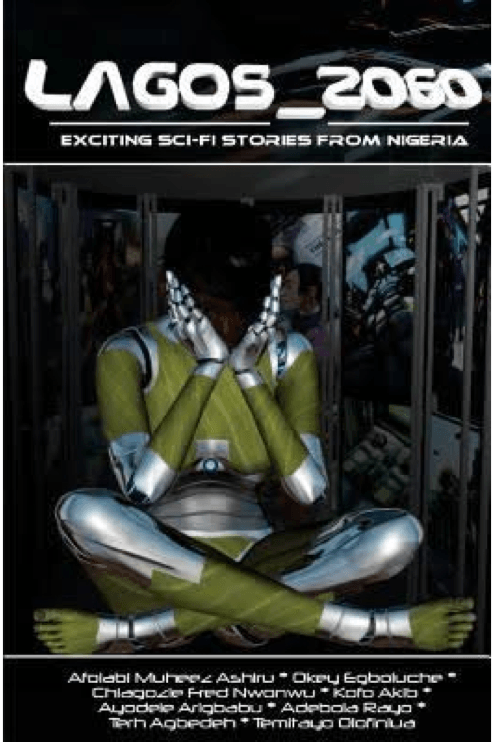
Lagos_2060

Writing about present day Lagos, Rem Koolhaas warns that already ‘the city itself has mutated into something’ quite unrecognizable to Westerners who think of cities in terms of European or North American models.  ‘What will the city be like in 2060?’  This was the question posed to 8 Nigerian science fiction writers during a workshop that yielded an anthology: Lagos_2060. The resulting eight stories, three of which are written by women, represent a diverse range of imaginaries all set in Lagos, the year 2060.  These stories engage with science and governance, city infrastructure and climate change, co-evolution of technology and social norms, urbanization and the future of global capitalism. Yet these scholarly themes emerge from stories that are first and foremost exciting, often romance-filled adventures.  There are man-eating frogs and time-travel inducing herbs, girls with luminous tattoos and zero-gravity bedrooms, albeit in separate stories…

Individual writers approached the remit to imagine the future of one of the world’s greatest cities each with their own genre pallette and a remix of intellectual priorities.  But what these stories share is a sense of dynamic liveliness that can only be a feature of a work in progress, their various literary forms reflective of the chaotic process by which the city itself is shaped. Their gift is the recklessness of trying out new things. These are pioneering works, regardless of how one decides to date science fiction in Nigeria.

What interested me in particular were the discourses on science.  The first story of the anthology, ‘Amphibian Attack’ by Afolabi Muheez Ashiru presents the dangers of leaving the sciences in the hands of the private sector.  The private company ‘Bright Life Group’ is so efficient in curing diseases and supplying energy that it has to use science also to undo the progress, secretly engineering catastrophes, so that it can keep itself profitable and powerful by fixing its own ‘accidents’.   The discourse in the second story ‘Animals on the Run’ by Okey Egboluche is that of conflict between technological progress on one hand and society and environment on the other.  The value of robotics in particular is questioned because it reduces employment in conditions where large numbers of people need jobs.  Robotics is critiqued on an intimately personal scale in another story in the collection, ‘Metal Feet’ by Temitayo Olofinlua.

Technological advances such as land reclamation to expand Lagos are questioned as risky and as a violation of ‘natural order.’  In ‘Mango Republic’ by Terh Agbedeh scientific rationalism is instituted in Lagos, making it ‘the most beautiful prison in the world ever conceived by man’ (p. 197).  But even supreme scientific achievements are shown to be powerless against the forces of nature unhinged by climate change. Floods and rising sea levels threaten Lagos, while environmental destruction elsewhere in Nigeria swells the city’s population beyond capacity. In ‘Mango Republic’ the discourse of science is survivalist – science is our last hope to adapt to a perilous future.  Yet, exemplifying the complexity of the narratives in Lagos_2060, other stories demonstrate the political danger of seemingly desirable scientific solutions.  On the extreme opposite spectrum from ‘Amphibian Attack’, scientific knowledge becomes highly guarded government property in ‘Cold Fusion’.  A new way to produce cheap renewable electricity reinforces the government’s control over the people of Lagos and stirs political ambitions to secede from the rest of Nigeria.   Science promising energy independence actually does enable the politicians who rule Lagos to secede from Nigeria in another story – ‘Coming Home’ by Rayo Falade.

The collection is full of ideas pertinent not only to the future of Lagos but the future of humanity in general. The writers don’t envision Lagos in isolation but as an integral part of the global economic and natural system. Their visions and hopes for Lagos, their individual philosophies and fears are expressed with humor and showmanship. Their ability to ask urgent questions about the direction we are heading is made invaluable by their skills to entertain.

CfP July 2018: Economics and SF

Cfp Economics in SF_colour

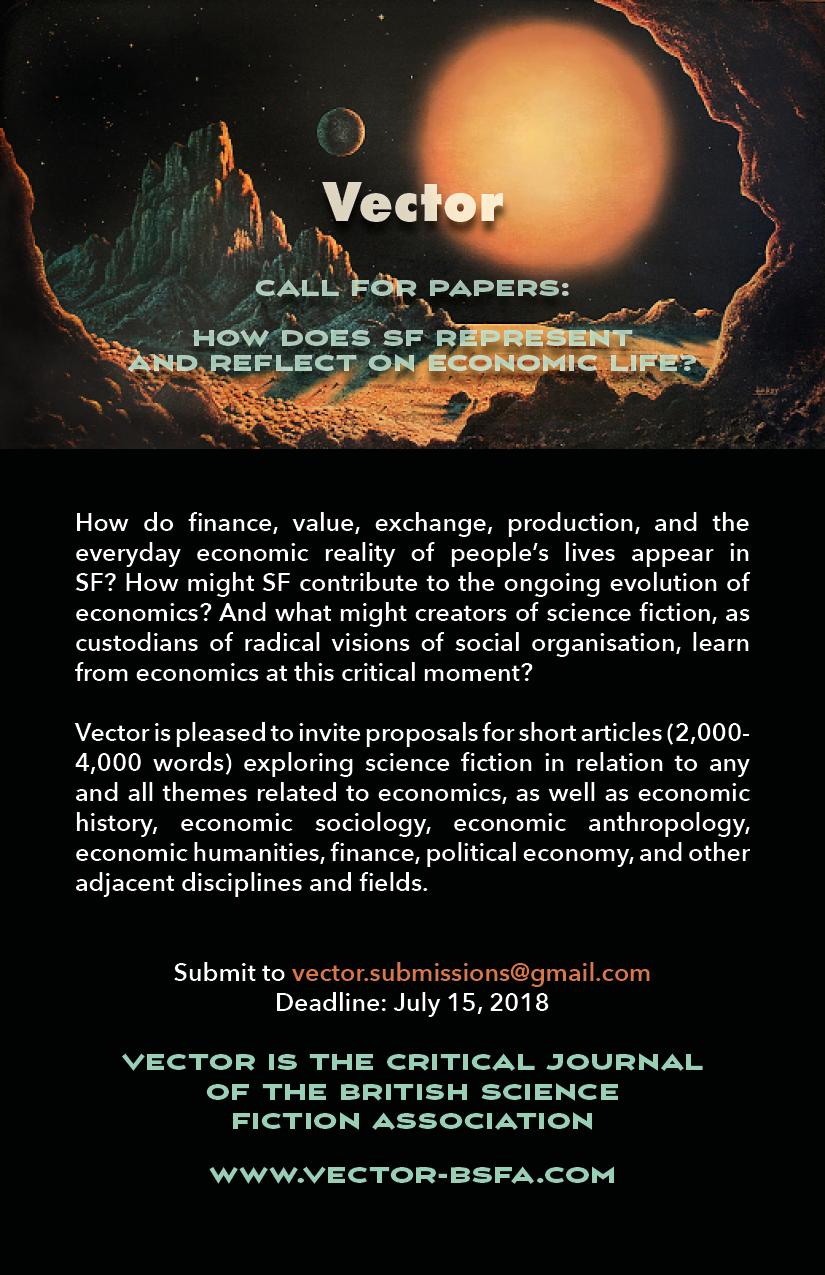
Our next themed issue, scheduled for late 2018, will address economics in science fiction and fantasy. How do economic themes appear in SFF? What can SFF writers learn from economists, and vice-versa? Can SFF help us to develop alternatives to capitalism? The full CfP can be read here.

Please submit abstracts of 200-400 words to vector.submissions@gmail.com. The deadline for articles is July 15, 2018. In the meanwhile, informal queries very welcome. Some resources from Jo’s blog that you may find inspiring or helpful: a list of suggested topics and ideas, a list of suggested secondary reading, and the Economic SFF database.