

Helping to kick off Vector’s 2018 Round-Up, Nina Allan takes a look back at the year …
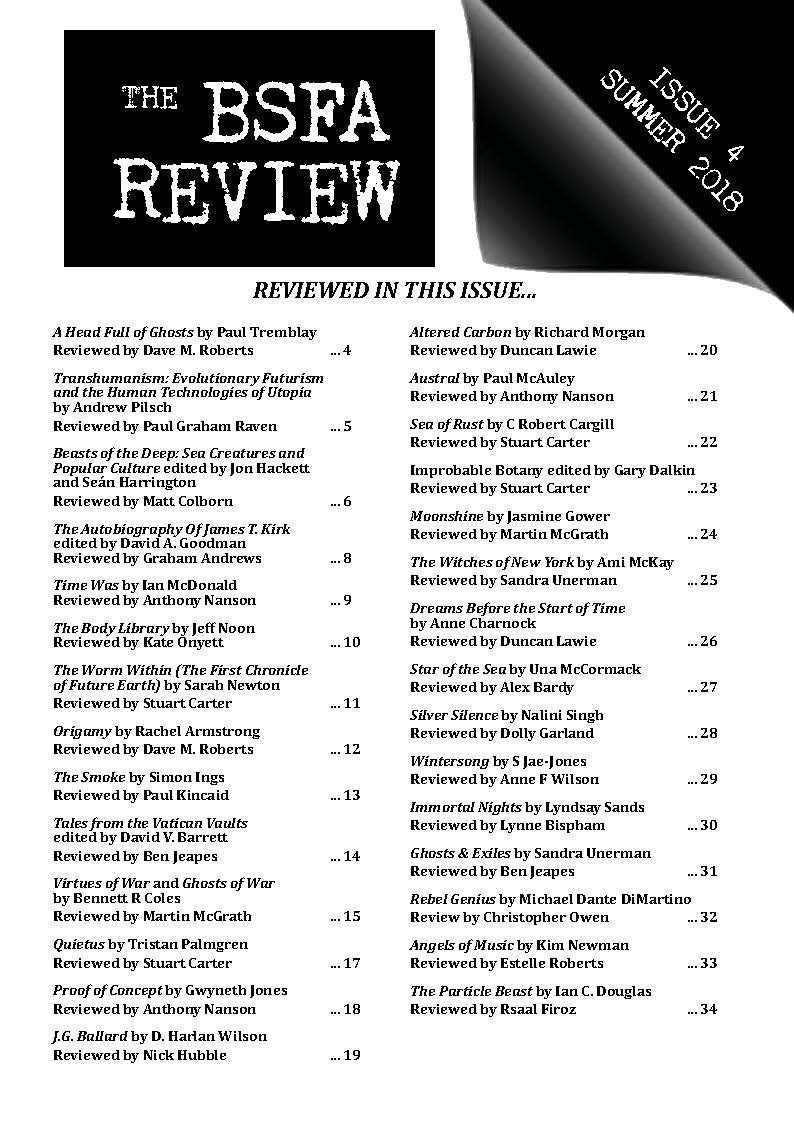
As genre imprints become ever more conservatively focused upon tried-and-tested formulas, so the more interesting speculative fiction gets pushed increasingly towards mainstream imprints. 2018 saw no diminution in this trend, and with Sophie Mackintosh’s The Water Cure, Lidia Yuknavich’s The Book of Joan, Ahmed Saadawi’s Frankenstein in Baghdad, Sam Byers’s Perfidious Albion, Kate Mascerenhas’s The Psychology of Time Travel, Patrick Langley’s Arkady and Ling Ma’s Severence to name but a scattering all being published by literary presses, if anything it is the opposite. Some hardy souls do continue to soldier on in the genre heartlands though, and my vote for best science fiction novel of the year would have to go to The Smoke, by Simon Ings, published by Gollancz. I’m a huge Ings fan in any case – both his 2014 Wolves and his 2011 Dead Water were egregious omissions from the Clarke Award shortlist – but The Smoke hits a new high water mark of excellence and should be read by everyone with an interest in what British science fiction is still capable of.

In a change from recent custom, this year Vector will be holding our annual round-up right here online. So keep your eyes peeled, your noses twitching, and your statoliths shoogling for a series of posts throughout December and January. They’re going to be packed with all the highlights (and maybe a few lowlights) of 2018 in science fiction. We’ll kick off next week with Nina Allan‘s pick of 2018.
And — while we’re talking about SF that amazed and inspired in 2018 — don’t forget that nominations are now open for the BSFA Awards! As usual, there are four categories: novel, short fiction, non-fiction, and artwork. Anyone can suggest works on this eligibility spreadsheet. To nominate and vote in the awards you must be a BSFA member (join here). If you’ve recently joined and don’t yet have a membership number, don’t worry! You’re still eligible to nominate and to vote.
This article originally appeared in Vector #288.
Fantasies are things that can’t happen, and science fiction is about things that can happen.
— Ray Bradbury, interview with Joshua Klein for The Onion (1999)
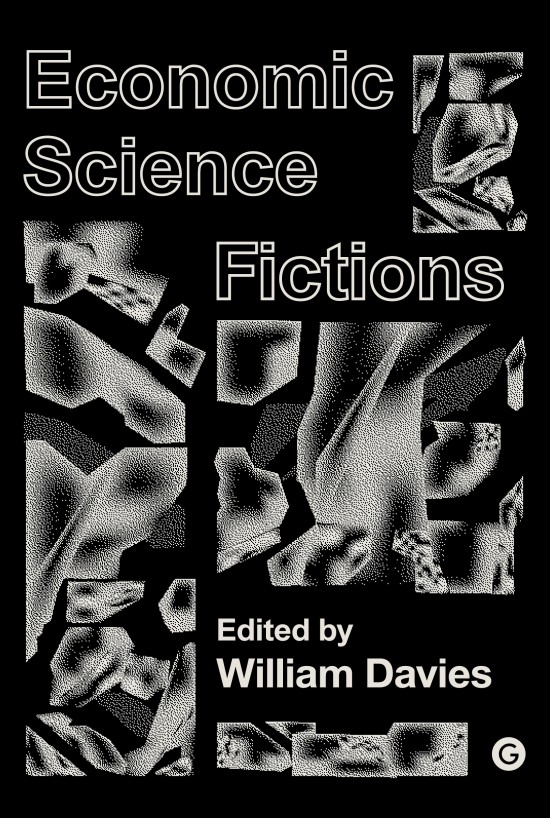
If self-proclaimed ‘not a science fiction writer’ Ray Bradbury ever needed an academic publication to bolster his sprightly quip, then Economic Science Fictions is it. In this bold and exciting collection, William Davies and his contributors offer us an unapologetic manifesto for the power of ‘can’, pushing Bradbury’s statement to its limit to issue a call to arms: economic science fictions are not just ‘about things’, they do things – and so can we.
Taking a firm stance amid the contemporary swirl of fake news and financial, political, and ecological hyperobjects, this major interdisciplinary contribution confronts the porosity between fiction and reality head-on, to interrogate the rigid boundaries we often impose, the assumptions we make, and the mental and social habits we forget to question.
As such, Davies’s collection is a welcome addition to a growing canon of post-2008 crash literature which seeks to combine critique and clear political statements with intellectual rigour, reconnecting academia with ‘the real world’. It takes its place alongside such titles as the late Mark Fisher’s Capitalist Realism (2009) and Nick Srnicek and Alex Williams’s Inventing the Future (2015). From Fisher’s luminous foreword, in which he posits economic science fictions as ‘effective virtualities’ (xiii), onwards, this collection aims to counter the fiction that is capitalism. It invites readers to turn from speculative finance and its logic of accumulation (with the permanent risk of catastrophe), to speculative fiction and its potential to write – and set right – the world.
This title forms part of Goldsmiths’s PERC (Political Economy Research Centre) series, which defines itself as a ‘pluralist and critical approach to the study of capitalism’. This commitment to interdisciplinarity and dialogue between the academic and non-academic spheres is made absolutely manifest in the collection’s diversity. It has an echo of the democratic ecumenism of the underground 1990s zines, as theory-fictions intermingle with more canonical forms of academic writing. Indeed, the title of Judy Thorne’s ‘Speculative Hyperstition at a Northern Further Education College’ raises the spectre of that mid-1990s phenomenon, the Cybernetic Culture Research Unit. Today, in 2018, writers, artists, architects and musicians mingle polyphonically with founders of think tanks and consultancies, as well as journalists, early career researchers, and established academics.
William Davies’s shrewd editing allows these very different contributions to speak to one another and shine. His opening ‘Introduction to Economic Science Fictions’ grounds the discussion in classic liberal economic theories of value. Taking as his sparring partners Ludwig von Mises and Friedrich Hayek, Davies teases out how capitalism is constructed around the flexible ‘division between “real” and “imaginary” value”’ which, as he points out, ‘is how financial bubbles occur: when collective imagination starts to become mistaken for an empirical reality’ (23). Lucidly and compellingly, Davies reconfigures this instability as an opportunity, positing politically progressive economic science fictions as a means to engage with capitalism on its own oscillating ground, poised between the fictional and the non-fictional.
The four sections which follow – each with a clear and concise introductory overview – develop this core thesis. The texts within them move fluidly from theory to practice and back again, with examples which will be familiar (or at least not wholly alien) to non-academic and academic readers alike. While it is only possible to pick out highlights here, what consistently impresses is the interweaving of analyses of science fictions, evocations of personal practice, theories of global megastructures, and creative riffs. Interlocking in surprising yet harmonious ways, within and across the various essays, these texts probe disciplinary boundaries in provocative and illuminating ways.
The collection’s first section – ‘The Science and Fictions of the Economy’ – grounds us in the nuts and bolts of the dream-mechanics of economics, with contributions from distinguished academics on the corporate imaginary (Laura Horn), the anthropology of money (Sherryl Vint) and automation (Brian Willems). Alongside these, Ha-Joon Chang’s contribution (‘Economics, Science Fiction, History and Comparative Studies’) stands out – as much for its laudable inclusion in a collection overwhelmingly dominated by ‘non-economists’, as for its content. A second section on ‘Capitalist Dystopias’ gives us a whistlestop tour of different dystopias in which capitalism is pushed to its limits. Here, accelerationist nightmares rub shoulders with the more ambiguous vision of Dan Gavshon Brady and James Pockson’s gloriously-titled ‘Fatberg and the Sinkholes: A Report on the Findings of a Journey into the United Regions of England by PostRational’. Readers wary of discourse about discourse will find the ‘Design for a Different Future’ section refreshing, for its pragmatic yet playful turn towards architecture, urban planning, and design.
But it is perhaps in the final section, ‘Fumbling for Utopia’, that Economic Science Fictions offers the ideal meta-reflection on the collection as a whole. Featuring four economic science (theory-)fictions, it closes with Jo Lindsay Walton’s ‘Public Money and Democracy’ – a fiction with footnotes, which perfectly encapsulates the collection’s aspiration to break down the barriers between the real and the imagined.
This collection makes no secret of its political stance. Readers looking for neutrality, dry objectivity, or dissent from the valorisation of science fiction and its role in building a post capitalist future will not find it here. The voices of economists who – unlike Ha-Joon Chang – are not avowed SF fans, sceptical SF writers, or interviews between converts and sceptics might have helped to redress this balance, and add a new dynamism to what remains an invigorating discussion – but not really a debate. Greater granularity in the definition of capitalism as it manifests itself in different national contexts (including non-European and non-US contexts) would also have added even greater bite to a collection that seeks to cross wires between the abstract and the pragmatic.
Quibbles aside, this collection is stimulating for believers and dreamers, but also provides ample material to dig into and with which to productively disagree for those who are not quite converts. Its return to political and social commitment represents a passionate and urgent response to our contemporary situation, and an astute and convincing argument for – and illustration of – interdisciplinarity and the interweaving of theory and practice, inside and outside the academy. It is a collection which empowers us to speculate – to invest in fiction not just as a means to provoke but as a means to intervene in our confused and confusing world.
By Dev Agarwal. This review first appeared in Vector 287.
Get Out premiered at the Sundance Film Festival in January 2017, and was theatrically released in the United States a month later. The film was well-received by critics and audiences, with particular praise for Jordan Peele’s writing and directing and for Daniel Kaluuya’s performance. Get Out was chosen by the National Board of Review, the American Film Institute, and Time magazine as one of the top 10 films of the year, and received four Oscar nominations.
The film is both its own unique story and part of a canon of socially relevant horror films. It blends social commentary, comedic elements, drama and genuine scares to bring together a coherent narrative about exploitation and the black experience in America today.
Besides being the highest grossing feature debut for an original screenplay, the film made Peele the first black writer-director to reach $100 million on a feature debut. And at $162.8 million, it’s the biggest domestic hit from a black director. It cost $4.5 million dollars but it now grossed $175 million in the USA and 254 million worldwide. It is the third highest ranking for an R rated horror after IT and The Exorcist.
In fannish circles, Get Out arrives at a time when some loud voices are decrying diversity as “virtue signalling” and “message fiction.” Message fiction, they claim, puts politics ahead of all other considerations, especially storytelling and entertainment. As science fiction writer Larry Correia puts it: “Let’s shove more message fiction down their throats! My cause comes before their enjoyment!” This little schism in science fiction reflects a greater schism in western society itself. For the first time in decades, the neoliberal consensus is under serious pressure, both from the left and from the alt right. Long held certainties are in question. Brexit has wobbled the postwar European project. Nuclear Armageddon is being credibly imagined once more. There are actual Nazis everywhere; Marine Le Pen of the Front National brushes against the French presidency while White Nationalists run down protesters in Charlottesville. And, of course, looming over everything is the still remarkable phrase: President Donald Trump.
And none of this is fiction. Not even the most outlandish science fiction. Into this volatile, surreal world comes the movie Get Out.
Get Out posits the story of a black man, Chris, driving from his comfortable middle-class home in Brooklyn to upstate New York. But just before we get to Chris and his story, there is a pre-credit prologue. A black man is lost in a prosperous white suburb … a ‘nice’ part of town. We have, for many years and regardless of our own origins, been invited to follow the story from the default setting of white protagonists navigating white society. Get Out invites us to instead follow black protagonists navigating white society, and horror proves a relevant genre. As this prologue unfolds, the terror mounts, and racial identity become an increasingly urgent matter.
Tanarive Due draws a comparison with ‘The Comet’ by W.E.B. DuBois, observing that DuBois “was writing horror from the heart. And, of course, what he’s trying to counteract with that story is a different horror […] There were moments in the DuBois story where he’s nervous about where he goes and how he’s seen from the outside. It’s similar to the opening of Get Out, being lost in a strange, white neighbourhood. That’s so real.”
Manohla Dargis, reviewing in the New York Times observes that “Peele briskly sets the tone and unsettles the mood. He’s working within a recognizable horror-film framework here (the darkness, the stillness), so it’s not surprising when a car abruptly pulls up and begins tailing the man […] when this man anxiously looks for a way out, the scene grows discordantly disturbing because you may, as I did, flash on Trayvon Martin.”
The film soon introduces our main character, Chris, played by Daniel Kaluuya. A staple of horror is that things begin very “normally.” Chris is a black man in Brooklyn, living a comfortable middle-class life with his white girlfriend, Rose, who is played by Allison Williams. So things may seem normal, even humdrum. Chris has been invited to meet Rose’s family, who live upstate on a huge estate. At the outset, the implication is that Rose’s family are part of the wealthy white middle classes, post-racial, egalitarian, liberal, and welcoming. Chris’s attempts to anticipate any racial awkwardness are met with disarming humour by Rose. This premise could be lifted from Poitier’s Guess Who’s Coming to Dinner from 1967, but then projected through the amplifying lenses of both horror and science fiction.
As we journey closer to Rose’s family, things begin to steadily deviate from anywhere near “normal.” On the drive upstate, Rose and Chris hit a deer – a jump scare and also a distressing and bloody encounter. A white policeman arrives on the scene and his reaction to the traffic accident is to demand Chris’s ID. It’s a moment designed to outrage a liberal audience. But it also reveals how both characters react. Chris is pragmatically compliant, whereas Rose, the one who was actually driving the car, confronts the officer. Following this tense, ambiguous encounter, Chris affirms Rose’s act – “that was some ride or die shit, baby; I like that” – but it’s a remark with many layers, and even below those layers, we sense that there is a lot he isn’t saying. This film doesn’t just talk about race, but also about silence: about all the ways race isn’t talked about.
By the time he arrives on the estate, Chris has been through two unnerving events, the death of an animal and the threat of a police officer. Neither incident is fantastical, and yet they add to the accumulation of tension and discomfort. Now, the family who awaits him ranges from the patronisingly liberal to the loutish and offensive. It’s just the welcome Chris appeared to fear at the outset.
In this sense, the film is experimenting with the use of ‘normality’ in the standard horror arc. As Tananarive Due points out, “Horror is a great way to address this awful, festering wound in the American psyche, the slavery and genocide that was present during our nation’s birth.” The possibility of being arrested or murdered whenever he meets the police is part of Chris’s reality that Rose is shielded from. Likewise, the awkwardness of managing the family’s creepy behaviour is ‘normal’ for Chris.
Nevertheless, at this stage, the story may seem more social drama than horror. However, Peele has already skilfully slipped in cues which will resonate later in the film. The narrative’s details continue to accrete like coral. The black characters on the estate are mostly servants, and they remain distinctly uncommunicative with Chris, or weirdly out of sync in their behaviour. Indeed, it is these few black characters who create the gateway into the horror genre proper. Their uncanny presence, and the reactions of the white characters to their disturbed behaviour, is the chief source of tension in this part of the film. The smallest details imply warnings of the looming terror, as the ‘minor’ characters start to leak their secrets, and bit by bit the skin of the genteel peels back to expose a brutal, fantastically horrific foundation.
I’ll avoid any big spoilers, but this is a film you can run your mind over afterwards, admiring the many small, clever details that reveal its careful construction. Many audiences may be satisfied with the jump scares and plot surprises, while more schooled genre viewers will take the extra pleasure in their anticipation of horror and SF tropes. Peele engages established genre elements – hypnotic suggestion, out-of-body experiences, experiments on human subjects that would fit within David Cronenberg’s body horror films. We even get grainy video footage of the 1980s that looks like the Dharma Project from Lost, or recalls that moment in Quatermass where a major plot development is explained by silent film footage.
At the same time, Peele never resorts to mere pandering allusions or cheap tricks. He asks us to emotionally invest in the characters’ lives, and that means understanding how they feel in specific settings or situations. The film draws on the history of slavery and exploitation, as well as the racist stereotypes about the ‘physical vitality’ of black bodies. The allegory has resonated so widely that a UCLA course in African-American Studies has now been named after a key conceit of the film: ‘Sunken Place: Racism, Survival, and Black Horror Aesthetic.’ The course is now made available to anyone online. The trick that Peele pulls off is to make the message mesh with his story in such a way that they become synergistic and ultimately indivisible.
Get Out cost $4.5 million dollars to make and took $33.3 million on its opening weekend. It’s now surpassed the $175 million mark in the US alone, putting it behind The Exorcist and It for R-rated horror. In financial terms, Get Out is a success.
And, in cultural terms, the film is already earning the sobriquet “revolutionary.” In an interview with Evan Narcisse for io9, Tananarive Due said that, “just recently, we were talking to some network execs about a pilot we were developing […] and they were like, “Oh, like in Get Out.” And it’s not that it’s anything similar to Get Out, it’s just that was now the new framework. That’s what black horror looks like: Get Out. They can now have a reference point and you can continue with the conversation. Because before, you could barely even get that conversation started.”
Any work that is discussed as revolutionary resists pigeon-holing, especially if categorisation itself is symptomatic, as in the case of Get Out being nominated in the “comedy” category at the Golden Globes. Peele himself has said that “[t]he reason for the visceral response to this movie being called a comedy is that we are still living in a time in which African-American cries for justice aren’t being taken seriously. It’s important to acknowledge that though there are funny moments, the systemic racism that the movie is about is very real. More than anything, it shows me that film can be a force for change. At the end of the day, call Get Out horror, comedy, drama, action or documentary, I don’t care. Whatever you call it, just know it’s our truth.’’
The BSFA holds regular events in London, usually on the last Wednesday of the month, at the Artillery Arms near Old Street. These events are free, and open to members and non-members alike. Keep an eye on the BSFA website for news of future events. In November 2017, former Vector editor Glyn Morgan interviewed acclaimed author Anne Charnock, whose first novel A Calculated Life was nominated for a Philip K Dick Award and whose second novel, Sleeping Embers of an Ordinary Mind was listed by The Guardian as one of the Science Fiction Books of the Year in 2016. She also regularly takes part in The Ada Lovelace Conversations, a collaborative project between The Arthur C Clarke Award for science fiction literature and Ada Lovelace Day, an international celebration of the achievements of women in science, technology, engineering and maths. Anne’s latest novel, Dreams Before the Start of Time, is out now.
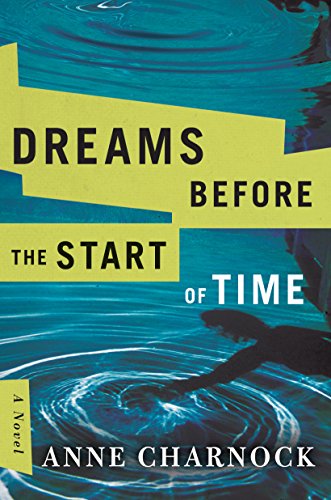 The themes of Anne’s latest novel Dreams Before the Start of Time evolved from ideas about reproductive technologies likely to be with us within the next forty years. The book explores the psychological, ethical, legal and social implications of these technologies by following generations of the same family into the future as they take advantage of these new opportunities and deal with the unexpected consequences. Anne believes that fiction offers the best means of analytically, emotionally and aesthetically engaging with the potential impacts of innovations and trends, from our ‘reproduction’ as digital selves to artificial intelligence, genetic engineering and the emergence of China as both a strategic world player and presence in our future lives.
Continue reading “BSFA events: Anne Charnock interviewed by Glyn Morgan”




 vector-bsfa.com