Station to Station is a fishpunk1 game of building a better world. It is a hybrid card/tabletop role-playing game (TTRPG) in the vein of works such as Avery Alder and Mark Diaz Truman’s The Deep Forest, a favourite of ours. While fishpunk is its truest descriptor, categories like solarpunk and weirdhope2 shed some light on its nature.
“Sometimes when you lose, you win” (Sun Ra, Space Is the Place)
“Whatever you win, you’ve lost” (Lao Tzu, Tao Te Ching, trans. Ursula K. Le Guin)
We designed Station to Station in response to the themes of The Lost Bay discord server’s Build a Better World TTRPG jam and Vector’s Zoefuturism call. Our mechanical starting points were that the game would require tarot cards as physical components, include dynamic use of oracles to bridge rules and storytelling, and its endgame would give meaning to anything players ‘lost’ as they played. Our worlding starting point was that the game would take place in an archipelago, a landscape type that has fascinated us since childhoods spent reading Ursula K. Le Guin and messing around with computer game map editors. As places where land and sea flow across each other, archipelagos are sites of life and relationality, where attempts at imposing rigid boundaries will always fail. Our next realisation was that the game would revolve around travel aboard sentient bio-trains that are huge and ancient, and may only be travelled on if they willingly agree. In our playthroughs, both in testing and following release, we have noticed that players are drawn to explore the nature of their kinship with their group’s train, with these strange entities playing prominent roles in storytelling as agents unto themselves.
The game builds on our longstanding interest in oracular game design. The use of aleatory resolution methods such as dice, cards, or coins in games echoes divinatory practices; tarot historically was used for gameplay before it became a cartomantic tool. Equally, the use of tables of outcomes as storytelling procedures in TTRPGs resonates with manuals for fortune-telling, with indie game designers such as Perplexing Ruins and Alfred Valley foregrounding oracle tables in their work. Station to Station pushes things just a little further, whereby its Coral Oracle blends variance with player choice, at times creating productive tensions between storytelling and mechanically optimal gameplay. A second oracle, The Lost and Found Oracle, gives life to the sacrifices made along the way to building a better world. The game’s rooting in oracularity grounds players in a sense that they are influencing and responding to an ongoing stream of strange encounters, losses, and becomings.
“Heaven and earth aren’t humane” (Lao Tzu, Tao Te Ching, trans. Ursula K. Le Guin)
Underlying the game’s use of oracles and incorporation of tarot are a set of Attitudes – confrontation, manipulation, scarcity, abundance – that pertain equally to the game’s world and its player characters. These Attitudes are not rendered in terms of anthropocentric moralising, which seeks to divide the world into forced binaries, but as neutral approaches that become specific and grounded through context. Story prompts cover a range of possibilities of flourishing and struggle, and repeatedly centre on symbiosis, life, and transformation. This carries over to the endgame, with playthroughs culminating at heterotopian destinations whose communities have their own unresolved contradictions. Player characters will both adjust to these tensions and help change them, with the distinction between group and destination ultimately melting away. As this happens, some of what was lost along the way will come back, be healed, or come to be seen in a more hopeful light. And for groups who do not get to the endgame, all is not lost. The sea gives and takes, and you can always play again.
“We are contaminated by our encounters; they change who we are as we make way for others. As contamination changes world-making projects, mutual worlds—and new directions—may emerge. Everyone carries a history of contamination; purity is not an option. One value of keeping precarity in mind is that it makes us remember that changing with circumstances is the stuff of survival.” (Anna L. Tsing, The Mushroom at the End of the World: On the Possibility of Life in Capitalist Ruins)
We hope you enjoy Station to Station! Stay fishpunk.
– GOBLIN FUTURES
Fishpunk is something we made up, not a pre-existing genre. In other words, Station to Station is fishpunk, and anything else people want to consider fishpunk they can, just as long as it is Approved By Fish. ↩︎
Weirdhope is a term coined by COPY/PASTE CO-OP, which they describe as a form of eco-punk that is stylistically and thematically opposed to grimdark. For more, you can check out their game ECO MOFOS!! or the webpage for the Weird Hope Engines exhibition that ran in the Bonington Gallery in 2025. ↩︎
The Afterlives of Greek Drama in Science Fiction Theatre: A Review on the Occasion of the 10-Year Anniversary of TALOS V
By Yichun Zhang
You are not just watching the fifth Talos Science Fiction Theatre Festival—you are in it. One moment you are a sailor aboard Odysseus’s ship, another you are playing an interactive survival game in a retrofuturistic city. Next, diaries are read alongside ancient Greek monstresses in the midst of a cabaret. With its immersive method, Talos V brings together Greek mythology, speculative futures, and urgent contemporary politics. The festival reaches into many dimensions to present an international group of works that are as evocative as they are unpredictable.
Organised by Artistic Director Christos Callow Jr (of the Greek theatre company Cyborphic & University of Derby) and Associate Producer Colleen Bowes (Central School of Speech & Drama), Talos V took place from 11–13 December 2025 at The Bread & Roses Theatre.
A total of five productions were selected for the 2025 festival: Odysseus, Not Your Hero, Assigned Earth at Birth, Babel Beast, The Failure of the Century (WIP), and Occasionally Gleeful Worms in Hell: PALESTINE BENEFIT EDITION. Each piece creatively incorporates sci-fi elements or engages with speculative ideas. To varying degrees, each piece also reflects on, deconstructs, or subverts established traditions, from ancient Greek myth, to patriarchal cultural structures, to the notion of the classic or Western canon itself.
Is there a better time to talk about a less-warring, more prosperous, empathetic, and humane world than the present moment, where the militaries of powerful countries have taken up arms against each other, dropping bombs on civilians and tearing down cultural heritage that took decades to build?
Sadly, living in such a moment rarely engenders the appetite for dreams and imaginings of a better future. Rather, it makes us envision periods where the worst that could happen to humanity has happened: nuclear bombs have detonated, floods have sunk major cities, or an asteroid has lodged itself in the Earth’s crust. We see the presidents of powerful countries threatening or actually invading less powerful ones and that prompts us to take up pens and weave the most authoritarian panopticons we can imagine. We watch anti-science rhetoric spread in the media about climate change and we’re tempted to paint pictures of doomed, environmentally degraded futures.
The current happenings rarely inspire utopian stories in us. Instead, they often steer us toward the catastrophic.
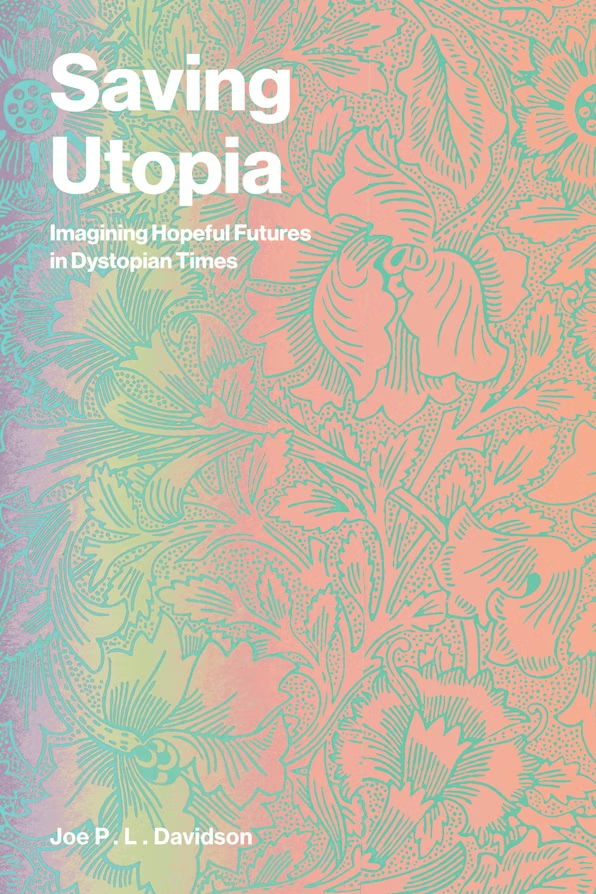
In Joe P. L. Davidson’s Saving Utopia: Imagining Hopeful Futures in Dystopian Times (The MIT Press), we learn that this way of thinking hasn’t always been the case. There has never been a time when there wasn’t some form of global turmoil. However, many writers of the late 19th and early 20th centuries were inclined to look beyond the specific troubles that plagued their era and envisioned possible futures where the problems had been solved. This period saw a blossoming of utopian fiction, coloring the literature of the time with visions of better and hopeful lives. Edward Bellamy’s Looking Backward (1888), William Morris’s News from Nowhere (1890), Sakhawat Hossein’s Sultana’s Dream (1905), Buchi Emecheta’s The Rape of Shavi (1983), and many more, are amongst the books Davidson touches on, in showing how writers of the past treated the situations around them.
Davidson shows us in this book that, even amidst the current horrors and seeming pessimism about the future, utopian stories can still be told and told well. He helps us see that, amidst the seeming dearth of utopian fiction, some writers are still standing up for the genre and putting in the work.
I particularly loved how the modern texts like Claire G Colman’s Enclave (2022), River Solomon’s TheDeep (2019), Kim Stanley Robinson’s The Ministry for the Future (2020), were juxtaposed with older books like Ursula K. Leguin’s TheDispossessed (1974), Edward Bellamy’s LookingBackward (1888), and William Morris’ NewsFromNowhere (1890). This juxtaposition helps readers understand how utopian thinkers of the past viewed the concept, how they related it to their particular society and preoccupations, and how recent writers have engaged with the subject, noting the differences between both modes of approach.
While the older writers wrote utopian futures only as they could envision them, fashioning worlds imbued with whatever politics they liked, more recent authors take a different approach when crafting utopian stories. In Kathleen Hughes’ PhD thesis, Imagining the Future of Work (2024), she mentions that in William Morris’s News from Nowhere, “The past and the present, just as much as the future, are presented by Morris as temporary and transient.” But the more contemporary writers, according to Davidson, employ a method that he has come to call “postdystopian utopia.” This is a mode of writing utopias that doesn’t overlook the horrors of the present or the past, to weave into existence future worlds of abundance and peace. It acknowledges existing injustices and, rather than dismissing them in favor of an imaginary time, incorporates them into the story and uses them to make a point:
“What I call postdystopian utopia,” Davidson writes, “is a precarious balance between liberation and horror, in which the possibility of better worlds becomes apparent only by acknowledging worse worlds. The postdystopian utopia addresses the bad feelings that prevail in contemporary culture.”
The concept of postdystopian utopia is Davidson’s idea of how the genre of utopian fiction can be jump-started and reintroduced into global discourse meaningfully, as exemplified by recent books like Claire G. Coleman’s Enclave (2022), Rivers Solomon’s The Deep (2019), and Claire North’s Notes From A Burning Age (2021). It is not hungry to leap to a time when every problem of the day has been magically resolved. Rather, it approaches genre with the hope of “confronting and overcoming the skepticisms about the possibility of alternative worlds.”
A close reading of Claire G. Coleman’s Enclave (2022) in the book shows us exactly what a postdystopian utopia may look like in writing. Christine, the protagonist in the novel, is exiled from a community called Safetown where she has lived all her life and has been made to believe is the only safe place left in the world. True to her conviction, the outside world is indeed a hellscape. But, by chance, she gets a ticket to a train that takes her to a part of the country that has become a utopia in all practical sense. She is shocked beyond belief that such a place exists and yet she had lived in Safetown all the while with its segregation, discrimination, and 24-hour surveillance. Davidson uses this story to show us what a postdystopian utopian narrative is like, and how this category is distinct from both classic utopias or dystopias. In the novel, dystopian worlds are touched upon within the pages of utopia. Dystopian societies aren’t done away with, but are made to exist side by side with the utopian ones, though the latter is the more dominant force, persisting amidst other negative societies.
In Rivers Solomon’s The Deep, Davidson shows the same genre convention in how a seemingly utopian underwater society exists even though the world above is anything but perfect. “They are undisturbed by the outside world; their watery society is protected from the forces of white supremacy on the land. In fact, such is the happiness of the wajinru that they can almost forget the Middle Passage.”
Davidson succeeds at drawing parallels between the past and alternate futures, connecting one with the other through discussing nostalgia, apocalypse, and trauma. With a scholarly lens and strong research, the book, through the concept of postdystopian utopia, advocates for a way of approaching utopian fiction that could once again breathe life into the genre and, perhaps, give it its day in the sun once again. He shines a light on texts that have used this method in different ways, and shows that it is quite effective in our present time.
At the end of this book, I came away somewhat hopeful for new forms of utopian fiction. Before now, I had rarely encountered it in recent books amidst (relative to utopian fiction) the large numbers of dystopian works in the markets like Suzanne Collins’ Hunger Games (2008) and its many spawns, Cherie Dimaline’s The Marrow Thieves (2017), Matt Bell’s Appleseed (2021), and many more. I simply thought it was something people just didn’t engage with anymore. But Davidson’s clear-eyed writing in Saving Utopia has shown me that sometimes, we only need to change our sitting positions to see what has always been there in a new light.
Chisom Umeh is a Nigerian fiction writer and poet. His short stories have been featured in Omenana, Apex, Clarkesworld, Year’s Best African Speculative Fiction 2023, African Ghosts anthology, Isele, Mythaxis, Scifi Shorts, and elsewhere. His short story, “Ancestor’s Gift”, won the 2024 Tractor Beam short story contest. He was a finalist for the Seattle Worldcon Short Story Contest and is the winner of the 2025 Nommo Award for Best African Speculative Fiction Short Story.
Tristan Evarts is the editor of Utopia Science Fiction Magazine, and since 2019 he has overseen the publication of optimistic prose, poetry, non-fiction, and art. The magazine operates with a reverence for the classics of the SF canon while pushing to explore new ways of living, technology as a friend rather than enemy, and humanity adapting to present crossroads. Themes push writers to examine the different manifestations of utopia, ranging from language to disability to weird SF. Contributors include Beth Cato, Jean-Paul L. Garnier, and Bogi Takács. Cover artists range from Donato Giancola to Stephen Youll to Alyssa Winans. Every December, Utopia SF publishes an art special, showcasing a broad range of talent, with a portion of the profits donated to charity.
Tristan gave me my start as an SF interviewer when he took me on as outreach manager in 2023, so it’s a real pleasure to be sharing this interview with him now.
James Machell
JM: What do you think makes a really great utopian story?
TE: I think a great utopian story realizes that a utopian world isn’t the end game in and of itself, and that it’s really just a launching pad for truly discovering the universe and examining the more subtle but powerful aspects of what makes us human. It doesn’t accomplish this the way most people seem to want, by tearing down the utopia and setting us back to the apocalyptic and imperfect world we live in today, but by saying “Okay, we’ve gotten past our worst, childlike instincts. Not suppressed or ignored them, but actually learned to deal with them in a healthy way. What next?” We can still find conflict, but we get to solving it the right way in the end. We learn, we grow, we discover new mysteries, and when conflict arises, we show how to navigate it in a healthy way, even if it might take a while to get there. I’d point to many classic Star Trek episodes, or James White’s Sector General novels, as some good examples.
JM: Can you take us through how Utopia Science Fiction Magazine has developed since it was founded in 2019?
TE: It’s developed quite a lot. It went from a single-person, token-paying small operation in 2019 to what it is today: a globally staffed, pro-paying magazine. It’s been quite a journey and I owe an awful lot to all the staff and volunteer readers who have joined us over the years to help progress us to where we are today. And we’re not done yet! Our hope, as always, is to increase readership and subscribers, which helps drive up the amount we can pay authors and artists. We’ve come a mighty long way and there’s further still to go!
JM: What drew you to publishing utopian writing?
TE: Chiefly a desire to move away from the (at the time) crushing amount of dystopian fiction out there. You know the phrase: “You are what you eat.” The same is true that “you are what you read.” If all you read is dark, gritty, disparaging, cynical things about the world then that’s how you start to view it and, at least at an unconscious level, how you begin to shape the world around you. It’s a cyclical pattern—people who see the world as apocalyptic are more likely to see the darker things and when those get more attention, they take over our worldview. For a real-life example, just look at the news cycle and see how that affects people’s worldview and mental health. We need to see the good, the hopeful, especially when things are at their darkest. We need to know that we can (and will) overcome this and this is what it’s going to look like at the end. And seeing Utopia as a beginning and not an end is important too. I think, with the arrival of all the cozy books coming out, more people are starting to realize this. I think in the Encyclopedia of Science Fiction, we’re mentioned as part of the solarpunk movement and hearing that is quite an honor.
JM: In addition to publishing science fiction stories, poetry, non-fiction, and art, Utopia Science Fiction Magazine also offers a critique service, helping budding writers to find their feet. You’ve also recently taught an Apex creative writing class. Can you describe your approach to assessing a piece of writing, and some of the suggestions you’re most likely to make?
TE: Let’s start off with assessment. When I look at a story there are a few things I’m really hoping to see before I go on to accept it. The first is: does the story grip me from the first paragraph? If I make it to the end of the first page and am not thoroughly engrossed with a story or character, I’ll usually pass on it. Second is pacing and momentum. If a story starts off strong, does it carry through the rest of the piece? Sometimes, for short pieces, I’ll read through it entirely, but for longer pieces, there’s a trick to use. In the well-written, well-structured story, you can read the first and last sentences in each paragraph without reading anything in the middle and still walk away with all the essential information you need for plot and story. If you do that and stumble or get confused, it means the story has pacing issues and depending on how far from the mark that goes, I may decide it requires more editing than any of us have time to do before the next issue and pass on it. Third is the ending. The last line a person writes is the single most important line they will write. It’s going to decide if the story stays in my memory, awakens that feeling of wonder, or simply fizzles into the frustrating silence of unfinished or underdeveloped potential. So, if it’s got a strong start and consistent pacing, but the ending is flat or leaves us in a rather dismal or dystopian way, I’m liable to pass on it. If I accept it and decide to work with the author to edit it into shape, there are a lot of suggestions I might make depending on what the piece needs. My goal is always to elevate the writer – to get them to perfect their craft a bit more, to push harder and write better by cutting out extraneous words, adding complexity to the themes and ideas, and really project their message out into the world.
JM: Roughly, what is the acceptance rate for stories submitted to Utopia Science Fiction Magazine?
TE: We receive hundreds upon hundreds of submissions in a given year and only publish a total of 15 to 20 stories in a given year. So, like all magazines, there’s a small acceptance rate based largely on limited space. We have to reject a lot of great stories just based on that alone.
JM: Utopia Science Fiction Magazine has recently published its Weird Science Fiction issue. What themes can we be on the lookout for in the future?
TE: We have the cozy issue in June, and August is always an ‘anything goes’ field where we try to publish the best of the best. Every June/July the editors of Utopia meet up and discuss what we want the themes for the next volume to be. There are always a lot of good ideas passed around, but only a few issues we publish. So, what’s on the horizon for next volume’s themes? You’ll just have to stay tuned!
JM: What are some of the books and stories you wish you could travel back in time and publish yourself?
TE: That is a very good question and one I’m not sure I can answer. There are a lot of stories I love, but I’m glad they’ve been published elsewhere. It gives us a chance to read them, to learn from them and push the envelope farther in terms of ideas, technique, etc. We have a part of our magazine called The Vault where every issue I go back and find some amazing, public domain, stories to publish. So, in essence, if there are stories I really love I can go back in time and publish them in this manner (after a very exhausting and extensive search for the public domain and copyright registrations).
JM: When you’re not at the helm of Utopia Science Fiction Magazine, you’re running Castle Books & Tea. Can you tell us a bit about your life as a bookseller and are you offering any good deals on rare books at the moment?
TE: Castle Books and Tea was born out of a bizarre moment when I realized I had free time, and it felt so unnatural I panicked and decided to launch a side project. I’m happy to say I no longer have anything remotely considered free time anymore. But it’s a real passion project— one of our specialities is vintage science fiction books. I’ve been to a lot of places to stock books and bought some amazing collections from people to resell. We’ve had books signed by Isaac Asimov, Kurt Vonnegut Jr., Roger Zelazny, and a lot more. It’s fun to track down some of the harder to find books too, like Soviet Sci-Fi or the novels of Clifford D. Simak. We usually have a big sale in May to celebrate our anniversary (this year is the start of our 5th) and a lot of small sales throughout the year.
JM: What are some of the tropes and subjects that you’d prefer that authors avoid in submissions?
TE: I have read far more books about robots, AI, etc. than I ever hoped could have existed. While we find things about these books to like, it’s an exhausted topic and I find myself preferring more novel ideas. Otherwise, it’s a lot of what other sci-fi magazines hope to avoid seeing. We’re particular in that we really don’t need to see any dystopian, post-apocalyptic, shoot-em-dead stories. As our name suggests, these types of stories really aren’t for us.
JM: Any tips for budding writers who’d like to make Utopia Science Fiction Magazine their first place of publication?
TE: Write every day and read every day. Read the stories you like and read them for technique, not just for story. Read what Utopia has published. A lot of them are available for free through our site, Medium, and Substack. Also don’t get discouraged. You will get rejected. A lot. But that’s all just practice for when you get accepted. And you will. Just keep improving your craft.
Tristan Evarts
Tristan Evarts is the editor-in-chief of Utopia Science Fiction Magazine and has been for the past seven years. He has a Bachelor’s in English and Philosophy with a specialization in creative writing and a Masters in Library and Information Science. When not editing, he is working at the library or at his bookshop, Castle Books and Tea, or growing his eclectic collection of books.
James Machell
James Machell is a British writer. He contributes to The Encyclopedia of Science Fiction and curates its Substack. He also serves as Outreach Manager for Utopia Science Fiction Magazine and was the 2025 Contest Chair for the Science Fiction and Fantasy Poetry Association. Find him on Bluesky @jamesmachell.bsky.social or YouTube @Fell-Purpose.