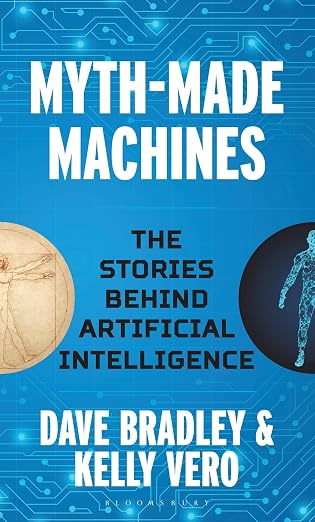
Myth-Made Machines

Kathleen Hughes interviews Dave Bradley and Kelly Vero, the authors behind Myth-Made Machines: The Stories Behind Artificial Intelligence (Bloomsbury Academic)
KH: Tell us a little about how and why you came to write about the stories behind Artificial Intelligence – the background and aims of the project.

KV: There are already many, many books about AI, and it wasn’t our intention to add yet another book about AI to the vast collections that there are in the universe right now. Instead, what we wanted to do was add some clarity to the argument about artificial intelligence, and ask the question why or how did we get here, and what role culture has played in the collective imagination of human beings creating something like artificial intelligence. 

DB: It began with us trying to demystify and explore AI. We were talking a lot about it because “AI” seemed to be completely dominating headlines and, both positively and negatively, engaging people across social media. That was the starting point. “AI” (large language models and the like) were new and creeping into discourse everywhere, and we were talking about how it would affect our professions.

At the same time, we’re both lifelong fans of science fiction and fantasy! And we love storytelling in all its forms. We are readers and cinemagoers. Despite having long careers in the tech and entertainment sectors, we both have a background in the humanities: Kelly studied Classics, and Dave studied medieval language and literature. So, we couldn’t help but see AI through that lens.

Once we started talking regularly about what seemed to be going on in the world, we realised that humanity has been rehearsing this conversation for centuries. Ideas about not just artificial minds as a theoretical concept but also what they would mean in the workplace and at home, about fears of replacement and fears of conflict and the environment, constantly arise in our culture.

I remember that when ChatGPT was released, one of the first comments I saw on Twitter was somebody joking about Skynet coming online, a reference to the Terminator films; it made me think, “This is how we understand technology – through the lens of culture, memes and movies.”

Continue reading “Myth-Made Machines” →
Dangerous Liaisons: A Guide to Robot Symbiosis

By Jesse Rowell

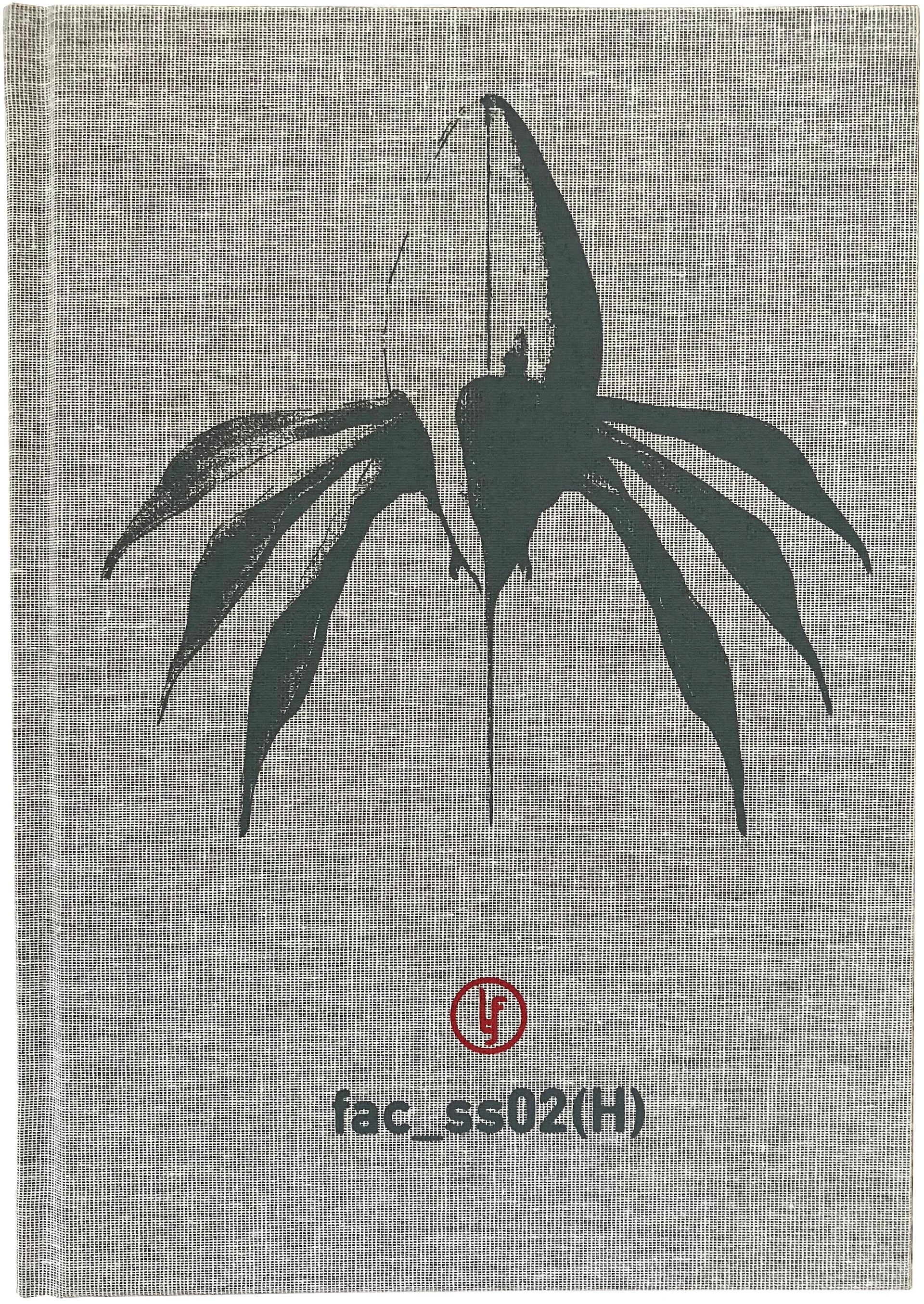
On its face, Brain Fruit is a simple tale of evolution through mutual symbiosis. Being a fan of symbiont sci-fi like Hal Clement’s classic 1950’s novel, Needle, and Peter Watts’s 2010 short story, “The Things,” I eagerly awaited Stephen Oram’s tale of artificial speciation in a hostile world of rock storms and extinction. Mechanical bee symbionts? Count me in. Faceless fungus droids? Even better.

Oram couches his novella in evolution with its first sentence, “The evolutionary crawl continues its upward curve…” (p.5), but the story is anything but a crawl with its cinematic scenes and wry cuts of humor, all standard characteristics of a good Oram story. “I take a dry look at the world and see the irony,”1 he tells me. In person, Oram shows soft-spoken grace with a patience for answering my questions, reminiscent of my secondary school science teacher right down to his casual t-shirt with its wrangled neckline. Meanwhile, Oram’s writing brims with quips like, “Let me fill you full of your heritage,” (p.10) and “This is a new experience, and we hate it,” (p.29).

The humor is sharp, the science is sound, so what more is there to say? Quite a bit, if we are to measure the book’s reviews in public and private forums. This is the type of book that needs to be read more than once. From contributions to zoefuturism (see issues 302 and 303 of BSFA’s Vector), to presenting dangerous ideas tinged with pathos, Brain Fruit contains multitudes.

Danger is delicious. Placing creatures in conflict within ethical predicaments is what science fiction does best. Oram tests the physical and ethical limits of his narrator, an artificial bee that connects with a fruit and insect to become a trioid with a tragically short life, much like the human organoids that haunt his imagination. Oram refers me to the brain-spinal cord models developed in recent studies as he grapples with the agency of organoids, and by extension, his fictional trioid. “How long ethically can they be kept alive? Do they have the same rights as a lab animal? At what point do they become human?”1

Continue reading “Dangerous Liaisons: A Guide to Robot Symbiosis” →

A Lover’s Quarrel with Time: Solvej Balle and the Current Crisis

By Matt Finch

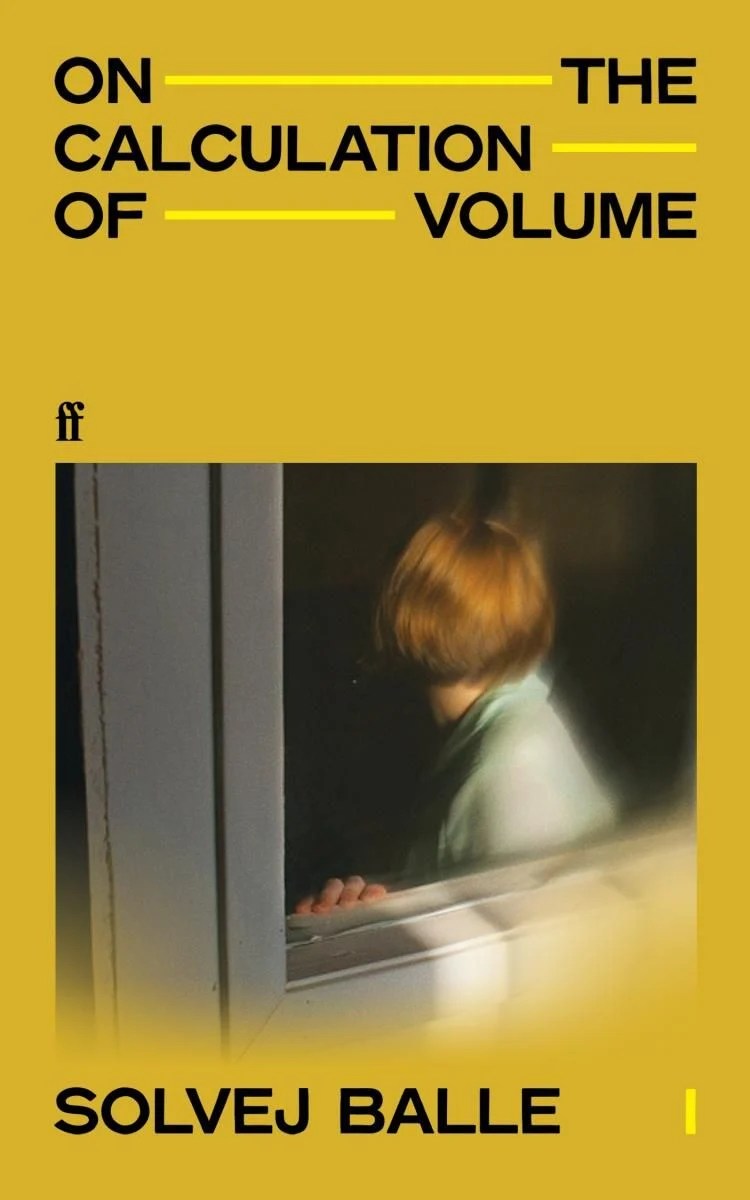
Solvej Balle, On the Calculation of Volume – 1 (Faber, 2025)

What’s gone wrong with time? Once, we might tell ourselves, the lines of travel were straight, clean, and unambiguous, even if they diverged: Doc Brown might have been eccentric, but he was authoritative when he explained the idea of forking parallel universes to Marty McFly – and the cinema audience of 1989 – in Back To the Future II (Gale and Zemeckis).

In doing this, he was bringing a version of many-worlds theory (Gribbin, 2020) to popular audiences on a Hollywood scale, but also building upon prior notions of linear time travel which owed much to the Industrial Revolution, as Adam Roberts (2014) points out in a magisterial essay accompanying the British Film Institute’s season Days of Fear and Wonder. Considering the impact of Wells’ The Time Machine, Roberts notes that what

pre-Wells stories have in common is the arbitrariness of their temporal pretexts: magic, dreams, spirits. There’s no interest there in futurological speculation or historical research, and no sense that time travel could belong to the material world of science and technology […] One reason for this new focus on the machine part is that it makes dirigible something that had, hitherto, been imagined as beyond our capacity to control or steer. Dreams and magic happen to us, inflicting upon us a Scrooge-like passivity. Memory plagues us, or grants us wistful pleasure, but we can do nothing about the events that the memory recalls. A time machine, on the other hand, is something we can control. This, it turns out, is the specific dream that captures the imagination of the 20th century. (p.40)

Noting the arrival of a sophisticated time loop narrative in an episode of a My Little Pony TV show – where every attempt Twilight Sparkle makes to heed a warning from her future self seems to bring disaster closer – David Wittenberg addressed the evolution of Roberts’ dream in the 21st century, arguing that one can “reasonably surmise that the popular appreciation of time travel techniques has arrived at a certain denouement.” (2012, p.207)  On the far side of that denouement in the 2020s, temporal shenanigans are both messier and more familiar than ever before.

Perhaps these narratives have arisen, not just because speculative genres, temporal theorising, and the tropes of the fantastic have so fully permeated mainstream pop culture, but also because of wider experiences which have shaken received notions of time and how we experience it. Pandemic lockdowns at the peak of the Covid-19 outbreak rendered life restricted and repetitive for many, and forced us to confront the fact that during a pandemic, its end – defined only in retrospect – is not clearly in sight (Charters and Heitman, 2021). Digital technologies’ pace of development and spread is faster than any previous innovation in human history, and yet many remain cut off, with connectivity slowing or even reversing in some parts of the world (United Nations, 2020). Climate change and its attendant uncertainties also attack previous understandings of time on multiple fronts, from aspirational long-term Net Zero visions which may also generate opposition (Valenzuela and Lezaun, 2024) to shifting warnings of how much time remains to avoid the worst impacts — as one report put it (McGrath, 2019), “Do you remember the good old days when we had ’12 years to save the planet’?”.

Continue reading “A Lover’s Quarrel with Time: Solvej Balle and the Current Crisis” →