Air by Geoff Ryman
An Extended Review of the 2005 Arthur C. Clarke Award-Winning Novel, by Andy Sawyer
 The success of Air in the latest Clarke award is nothing less than an act of magic.
The shortlist as it stood presented a number of problems which potentially could have wrecked the credibility of the Award at this rather troubled stage of its existence. It consisted of two novels (Geoff Ryman’s Air and Kazuo Ishiguro’s Never Let Me Go) which by anyone’s standards (though see below) should be considered outstanding, and four also-rans of varying quality from excellent to enjoyable-but-forgettable which suffered from being read in the shade of Ryman and Ishiguro but which were on the face of it considerably more science-fiction-ish. “Also-rans” sounds harsh, so I must qualify that by saying that I mean no insult to Ken MacLeod’s Learning the World, Alastair Reynolds’ Pushing Ice, Charles Stross’s Accelerando, and Liz Williams’ Banner of Souls by saying that they did not move and excite me in the way Air and Never Let Me Go did. Were those two not on the shortlist I would have been considerably less disappointed if one of the other four had won, if any of them had — if that makes sense. But with the short-list as it stood a decision to honour any other than Ishiguro or Ryman would have been a travesty.
Air took the award, of course, and this means that the science fiction writer, as opposed to the “mainstream” writer with something which looks like science fiction, was the success. In what follows I am, I hope, going to suggest why I feel uncomfortable writing a sentence like that, but also why it’s good for both the Clarke award and that collection of extremely different texts that we point to and call science fiction that it was Ryman who won the award. This is not to say that Air is the obvious compromise choice, a charge which is laid against just about every juried award at some time or another. I don’t know, or care, what happened in the discussions, but there’s no sense in Air that justifies this. In not giving the award to an outsider-sf text in favour of a book which must be sf because it has also won the BSFA award (as well as a number of other sf awards including the Tiptree), the jury has given first prize to a book that deserves it. As well as being central-sf, Air is also stunningly written; inventive and open, as sympathetic to the human costs of change as, without the darkness and claustrophobia of, Never Let Me Go. But why should I be presenting this as an ideological conflict as much as a simple decision between which of two books is the better?


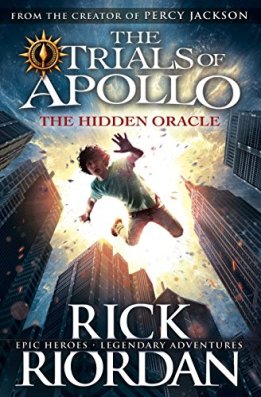 The Hidden Oracle, Book One of The Trials of Apollo series by Rick Riordan (Disney Hyperion, 2016)
 The sequel, The Dark Prophecy, follows Apollo’s quest to save both his friend and all of Indianapolis from the control of the Triumvirate. This book follows a similar structure as The Hidden Oracle. While the characters travel from Long Island Sound to Indianapolis for this novel, and thus there is the potential for a road trip-style structure that the original two series of the Chronicles use, this book begins at the end of the journey, as the characters are arriving in Indianapolis. Within the first few chapters, the heroes are lead to a magical hideout called the Waystation, which functions in the same way as Camp Half-Blood in The Hidden Oracle. The heroes go back and forth between fighting their enemies in Indianapolis, and re-grouping and healing at the Waystation. During these adventures, Apollo and his friends team up with a variety of different species, adding interesting new group dynamics unexplored in previous novels of the Chronicles.
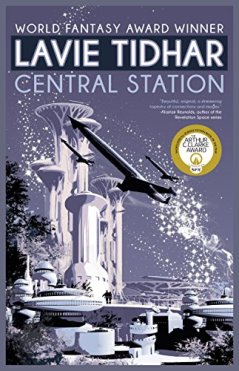 Lavie Tidhar’s style is well-suited to original narrative forms that subvert Western genre fiction tropes, while still engaging with them almost as props. For example, he says this year’s Clarke Award-nominated ‘Central Station’ gave him the opportunity to employ Golden Age imagery, like the action around a spaceport, and then let it fade into the background as if it’s being ignored. However, it’s an approach that can backfire. Another twentieth-century genre that appeals to Lavie is noir detective fiction, and he recalls a synopsis he wrote using the idea of a gumshoe searching for his niece, only for the story’s editor to point out that Lavie had forgotten to include the fate of the girl at any point in the story.
 So rich a sea, so broad the currents … in exploring fantastic literature by African-descended authors, where do we start?
 someone who valued her loneliness very highly. Yet a major concern of the heroine of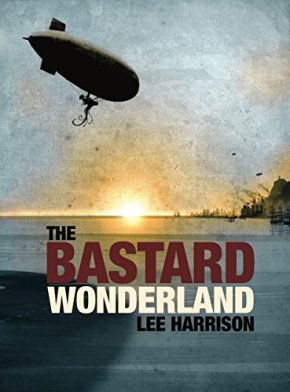
 [The cover] painting is a made-up decoration merely done in Pacific Northwest style … meant to say to a reader “This novel is based on the mythology of the Pacific Northwest,” just as covers for other kinds of fantasy use images from Celtic, Norse, or Japanese mythologies to signal “pick me up” to the right kind of reader. ([Name withheld], p.c. Feb. 9, 2005)