As meaning-seeking beings, we live in alternating cycles of embracing or fearing the natural world. Literature offers a good framework for observing this ancient and ongoing ‘battle’ for the human spirit between the manifestation of our reverence and stewardship of nature and our fear of something that could so easily kill us. As industrialisation moved us further away from nature, and humans started living almost completely dis-attached from the natural world, we saw a resurgence of the need to find belonging in the greater order. The last two hundred years have presented a shift in our attitudes towards our surroundings and an influx of philosophies and literature that try to reconnect humans with nature.
Environmentalism has clearly entered the focus of modern worries, but it often presents shortsighted forms that ignore the bigger picture. By focusing on the more immediate and visible concerns, environmental campaigns often prioritise narrow objectives while overlooking the negative structural downside of some of the green politics (e.g. “green colonialism). The climate crisis and the development of the Anthropocene as a theoretical background for our concerns are lacking in a holistic outlook of reality and often showcase similar dangers as our previous attitudes towards the natural world. While there is a rising concern about the land, it is through an anthropocentric point of view. As long as we keep seeing ourselves as separate to the non-human lifeworld, we will live incomplete existences, and our solutions will be forever lacking. What is needed is “a futurism of connectedness, engagement, and relationality, a futurism of ‘life-becomings’” (Ooi, n.d.). And this reflection on the need for interconnectedness has recently been championed by new subgenres of science fiction.
Storytelling has always been a mirror to the soul of humanity. It focuses the collective emotions and concerns in a metaphorical and philosophical format that offers more than simple escapism. Up until now, science fiction in particular has offered the best platform where the concerns of our present and future are laid out in the format of cautionary tales of how our environmental damage leads to post-apocalyptic scenarios. There are countless examples of stories focused on ecological collapse such as The First and Last Men by Olaf Stapledon that explores humanity’s eventual extinction, the dystopian future of Metro 2033 by Dmitry Glukhovsky where humanity is almost extinct and earth ravaged by radiation, The Road by Cormac McCarthy that is set in a post-apocalyptic setting following a cataclysmic event, the grimdark world of the Warhammer 40K universe where after the AI wars mankind is plummeted into a dark universe of chaos and death. These are just some examples out of a very vast body of literature which express the climate anxiety our society feels.
Enfolding world-building, community-making, and problem solving, the act of play is itself a powerful act of speculation. It can offer entertainment or education. It encourages, or sometimes sidesteps, empathy. It draws attention to the ways that stories are constructed and how we experience them.
In the context of video games, the recent announcement by Sony that it will halt production of physical game discs by 2028—and the attendant backlash from the gaming community—encourages us to think about physical vs. digital media and legacy access, and how economics factors into how we play, and for how long. Some games, like That Dragon, Cancer and The Final Exam, may barely be said to be ‘played’ at all: more experienced, and learned from. Play can inspire joy, flow states, immersion—or desolation.
This special issue of Vector invites contributors to engage with the act of ‘play’ in its most expansive definition, including but not limited to:
Tabletop RPGs
Collectibles
Video games
VR/AR
Physical media
AI and game creation (backlash, adopters)
Educational games
Citizen science games
Gamification of labour
Games in speculative fiction
Games as forms of art or activism
Affect
Materialist/new historicist readings
Please submit your proposal by September 30th to vector.submissions@gmail.com, including:
a 150-500 word proposal, including estimated length;
something about yourself, either a 50-100 word bio or a CV.
Articles should be between 1,000 and 8,000 words. Please let us know your estimated word count. We seek articles that are carefully grounded in scholarly research, while also being clear, engaging, and suitable for a broad audience (including non-academics). Articles will be due by November 30th
Please also feel free to make queries about other formats, e.g. reviews, interviews, curated reading lists, roundtable discussions, unusual / innovative formats.
What do we do when we talk about Zoefuturism? This essay argues that Zoefuturism and CoFuturisms are not merely aesthetic or speculative categories, but infrastructural practices of collective world-making. I propose a framework for understanding how these movements intervene in social imaginaries through genre formation, manifestos, and boundary-making practices, while also examining their material implications for the communities and infrastructures from which they emerge. To that end, I draw on my previous theorization of the role genre mechanics play in the formation of collectivities.
Although they are envisioned here as operationally connected, speculative fiction, CoFuturisms, and Zoefuturism should not be treated as interchangeable categories. Speculative fiction is a broad narrative mode oriented toward hypothetical worlds, alternative temporalities, and estrangement from consensus reality. CoFuturisms, by contrast, designate culturally situated interventions that mobilize speculative methods to contest dominant imaginaries and produce alternative social horizons. Zoefuturism differs from both in that its central organizing principle is relationality itself: an ontological emphasis on “interconnected becoming” across human, nonhuman, ecological, and material forms of life. Where speculative fiction often asks what futures might exist, and CoFuturisms ask who gets to imagine and inhabit those futures, Zoefuturism asks how forms of life become entangled in the production of futurity.
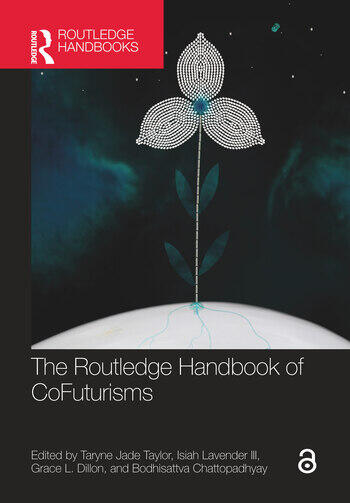
CoFuturisms as a conceptual umbrella emerged with the publication of the Routledge Handbook of CoFuturisms and its survey of speculative works from the world’s periphery, many of which blur the boundaries between art and activism. Like the imaginaries from which they emerge, CoFuturisms are collective constructions shaped by forces operating at both macro and micro levels. As digital media theorist, poet, and software designer Jason Edward Lewis writes, they “create a field of ‘future facts,’ a fully realized reality that exists somewhere down the timeline, waiting for us to catch up to it” (11). More broadly, CoFuturisms often emerge through science fiction (SF) and speculative practices, commonly appropriating their methods, to critique dominant imaginaries and intervene micropolitically in the present. As science fiction scholar Taryne Jade Taylor observes, “CoFuturisms is a movement that is found both within science fiction and fantasy and also reaches past the boundaries of speculative fiction” (2023).
In conversation with the editors of this special issue, I was provided with the following conceptualization of Zoefuturism: “Zoefuturism as a genre is founded upon the understanding that all things are relational—where descriptors, characteristics, or even a sense of ‘being’ depend upon everything around them—and that everything is constantly becoming, much like our DNA. As such, Zoefuturism is not political.”
I interpret Zoefuturism as an attempt to articulate a relational understanding of the world that moves beyond binary frameworks by foregrounding becoming, interdependence, and ecological entanglement. Unlike many futurisms organized around identity, technological acceleration, or emancipatory struggle, Zoefuturism situates relationality itself as the condition of futurity. Its emphasis falls less on representing marginalized futures than on rethinking the ontological assumptions through which futures are imagined in the first place. Yet Zoefuturism cannot escape political implications simply by rejecting explicit political identification. Like CoFuturisms, it shapes how reality is narratively and institutionally organized through language, cultural production, archives, and the social imaginaries that orient collective life. Its politics emerge less through ideological declaration than through interventions into the conceptual and affective infrastructures governing how relations between life forms are understood.
These interventions occur through genre itself. Genres are not merely aesthetic containers but social formations circulating among texts, communities, markets, and institutions. Because genres organize recognition, expectation, and participation, they function as technologies of collective becoming. Speculative fiction provides many of the formal tools that make such interventions narratively intelligible, while CoFuturisms mobilize those tools toward situated cultural and political projects. Zoefuturism, in turn, redirects speculative practice toward relational ontologies that destabilize distinctions between nature and culture, subject and environment, and human and nonhuman life.
Eva Hauserová promoting her non-fiction title Na koštěti se dá i lítat [Broomsticks can also be used for flying], 1995
Of the many contemporary subgenres of sf that can claim they originated as a reaction to the cyberpunk revolution of the 1980s, one of the oldest is certainly “biopunk”, especially if one counts the mini-genre of “ribofunk” – shouted into existence by the American writer Paul Di Filippo (1954-) in 1990, and just as quickly extinguished – as a legitimate precursor (Di Filippo 1990). Probably only “steampunk”, coined by K.W. Jeter (1950-) in 1987, is older (Nicholls and Langford 2025).
“Biopunk”, as it is used today, refers to a subgenre of sf that adopts many of the stylistic and narrative tropes of cyberpunk – a focus on stories built around an ensemble cast of petty criminals, (gene) hackers and chancers, urban subcultures, and a “revolt into style” (if the reader will pardon the throwback to the cultural criticism of an earlier era) (Melly 1970) – while sourcing its McGuffins from biotechnology, rather than cybernetics. In this contemporary sense, biopunk has its origins in the American genre writing of the 1990s, with the first documented use (from two different, and almost certainly unconnected sources) in 1992, and the subsequent attempt to identify precursors in earlier genre history.1
Di Filippo takes this as far back as H.G. Wells’ The Island of Doctor Moreau (1896); of more recent antecedents, Greg Bear’s Blood Music (1985) and Bruce Sterling’s Schismatrix (1985) are frequently cited (Di Filippo 1990; Schmeink 2014b, 32). From these American genre roots, biopunk has spread around the world and into other media, film and TV in particular. The hit TV show, Orphan Black (2013-2017), with its saga of a shadowy organisation trying to direct the future of human evolution through gene hacking and the complications that arise when some of its human clones escape, would be a good example. All of which makes a neat teleological narrative of exactly the kind that, in theory, every self-respecting punk of whatever persuasion is supposed to abhor; and none of which quite holds together when examined in a broader framework.
Because there is a catch – of course, there is – and in a European context, this neat timeline is disrupted by the Czech writer Eva Hauserová (1954-2023), also known as Eva Hauser, who in 1988 independently came up with a literary intervention she called “biopunk,” and her coinage pre-dates the American one. This sits uncomfortably with the official chronicle, making her something later critics have had to explain away, though there are also those who have simply ignored her. (For the former, see Schmeink, who will be discussed below; for the latter, a simple Google search will reveal any number of biopunk, or biopunk-adjacent websites that have no idea of Eva’s existence.)
Aware of other sub-genres that might sit alongside, overlap or appear to be similar to Zoefuturism, we welcomed contributions about them, to help shape our understanding of Zoefuturism relationally.
Below, Manda Scott and Denise Baden set out strong cases for Thrutopia.
This is interesting from a zoefuturist perspective because Thrutopia is about change and the journey; imagining positive futures and the practicalities of getting there has to be a good approach.
However, Zoefuturism does not presuppose an end point or a goal, more that there is a distinct need to fundamentally alter our world-view, of how we interact and fit in with the world in the broadest sense. It also does not delve in binarisms like positivity/negativity inasmuch as binaries are composites of a holistic purview of life.
We need healthy relationships between all of ‘life’ and ‘non-life’ in the now, acknowledging the diversities while engaging in the nuanced relationships that encompass nature, technology, and more. We need to understand that change is constant and how we live is what affects the possible futures that it is becoming.
We hope that celebrating other sub-genres while encouraging a Zoefuturist approach to reading and writing them will make them more impactful.
Yen Ooi and Stephen Oram (guest-editors, Zoefuturism)
“At times, a single fluctuation … may become so powerful … that it shatters the preexisting organization. At this revolutionary moment … it is inherently impossible to determine in advance which direction change will take: whether the system will disintegrate into ‘chaos’ or leap to a new, more differentiated, higher level of ‘order.’” – Alvin Toffler
If we who write can craft clear routes from a recognisable present, mapping towards a future that engages people at the limbic level, we can help tip the balance to a future where a critical mass of us begins to yearn for the outcomes offered, and change will happen.
This is the explicit foundation of the Thrutopian genre: offering route maps—of which there are, self-evidently, an almost infinite number—towards a future we would be proud to leave to the generations that will follow us.
If we can imagine forward seven generations and look into the eyes of a young person living in the world for which we have laid the foundations, if they feel safe, confident, fully connected to all parts of themselves, each other and the Web of Life, then we’re on the road to the emergent edge of inter-becoming from which an entirely new system can potentially arise.
As writers, we can gather the building blocks that are already emerging and make of them stepping stones across the river. Stretching the metaphor to breaking point, the narratives we thereby shape must at least offer a glimpse of a reason to cross (motivation), the means to make the crossing (agency), the route to take (direction) and the freedom to take it (empowerment).
This is the heart of behavioural change: MADE:
Motivation: with all my heart, I yearn for a future I can glimpse but not yet embrace;
Agency: I have the tools to take the first steps towards this future;
Direction: I know the routes away from my present state that will lead me towards the future I yearn for;
Empowerment: I am free of constraint in the present moment enabling me to take the steps and wield the tools in ways that will be effective.
Each of these belongs squarely in the realms of creative imagination. I am not pretending that crafting these is easy; it’s not. One of the many reasons there are so many dystopias and so few genuine Thrutopias is that it’s mind-bendingly hard to find peaceful routes to an equitable world in which humanity flourishes in concert with – even in service to – Life.
But it isn’t impossible and frankly, if the hardest thing we have to do in the next decade is get our heads around the thinking that already exists at the emergent edge of possibility, then we will be supremely lucky.
And this is the single most important point. If you take nothing else away, please believe me that there are people already working at the emergent edge of wide boundary systems thinking, of food and farming systems (we have to abandon industrial agriculture as a matter of urgency), of biomimicry, doughnut/ecological/degrowth economics, distributed governance systems, regenerative use of AI, urban and rural planning based on fully regenerative principles…
Every one of these is actively being pursued, it’s just that our legacy media runs with the old style mindset of ‘if it bleeds, it leads’ and they’re not up to speed (yet) with the idea that the existing system is disintegrating and a new one is already emerging from the ashes.
This is part of the Thrutopian narrative shift of which we are an integral part: building routes through, from a recognisable present towards a future we’d all be proud to leave to the generations that come after us.
Writing a future we’d like to see, the thrutopian approach.
By Denise Baden (April 2026)
Science fiction often envisions not just technological innovations but societal ones. For example, Ursula Le Guin’s The Dispossessed imagines an anarchic/communist society that is broadly utopian in its ideals and has distinctly different arrangements and values surrounding ownership. However, there are few novels that show the process by which we might get from where we are now to such a future. Kevin Kelly coined the term ‘protopia,’ which describes the process of improvement over time. Rupert Read similarly talks about ‘thrutopia’: how we get from where we are now to where we’d like to be, i.e. a flourishing, sustainable society. The idea was so powerful that bestselling author Manda Scott set up a Thrutopia masterclass for writers: “writing our way to a future we’d be proud to leave to the coming generations.” She moved from writing historical fiction to a novel set in the near future, Any Human Power, which adopts the thrutopian approach.
In this article I discuss some of the books published by Habitat Press, an indie publisher with a niche interest in stories that showcase thrutopian or protopian pathways. There are numerous ‘cli-fi’ stories that present dystopian visions of what will happen if we don’t act. These can be unexpectedly problematic, as research has highlighted the dangers of trying to ‘scare people green.’ Dystopian stories run the risk of fear-driven counterproductive responses, such as the blaming of marginalised groups or buying up all the toilet rolls. There are also numerous eco-fiction stories that persuade us to love nature and plant trees but get us no nearer to understanding what the really effective solutions are and, even more importantly, how we might get there from where we are today. This is a gap that I haven’t seen any fiction (other than Ministry for the Future) fulfil.
Steve Willis, a climate engineer and author (Fairhaven, Defying Futility) has allowed me to share his diagram of films, books etc., which plots dystopian/utopian visions of the future against plausibility. It’s clear that there’s little that is both positive and plausible.
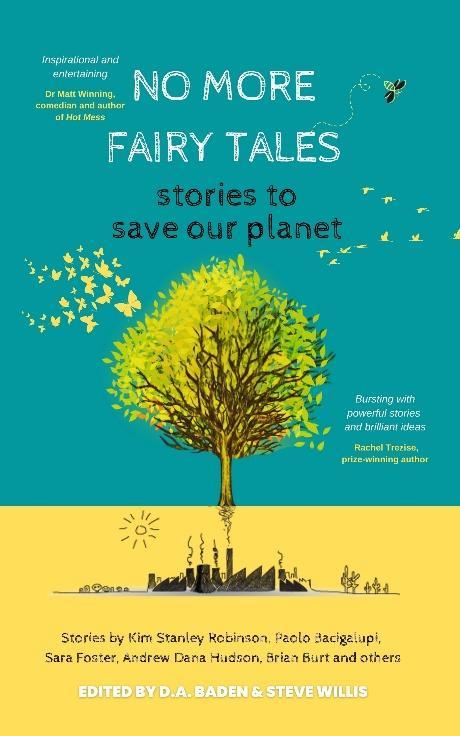
Habitat Press has published several books that write into this space. Many emerged from the Green Stories project which I founded with the goal of embedding climate solutions into mainstream fiction. It has run 21 competitions since 2018, resulting in numerous publications. One of these is the anthology of 24 stories: No More Fairy Tales: Stories to Save Our Planet, where we teamed experienced writers with climate experts to come up with stories that had solutions at their heart.
Stories range from technical solutions relating to carbon dioxide removal projects to more systemic aspects such as switching from GDP to a well-being index, sharing economy, personal carbon allowances, giving citizen assemblies legislative power – all of which would allow for a more sustainable long-term mindset conducive to directing investment towards sustainable technologies, practices, and decisions.
This anthology uses fiction as a testing ground to explore the more radical transformative ideas necessary for a truly sustainable society: ideas that are hard for politicians to talk about for fear of misunderstanding as they can’t easily fit into a soundbite. For example, an essential step is to upgrade our democracy to a form that allows us to think beyond short-term electoral cycles so that we can make more sustainable decisions. Citizens’ Assemblies are a positive step here.
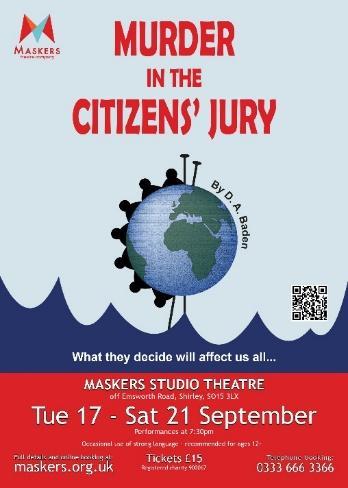
One story from this anthology was adapted as a play called ‘Murder in the Citizens’ Jury.’ It’s a fun whodunit, set in a citizens’ assembly, where eight participants meet to deliberate upon climate solutions—and then there’s a murder!
Caption: flyer for theatre production by amateur theatre group, The Maskers.
The play also has an interactive element. A voting app and pullout voting and comment sheet in the programmes allows the audience to share their views on their favourite policies, so they feel like they are part of the citizen’s jury themselves. You can see a brief video of the first production by a local amateur theatre group here. The play is available to purchase from LazyBee, but if you approach me directly, I’m happy to allow amateur and student theatre groups to stage it royalty free.
The play is also available as a novella and audio book, ‘The Assassin’ of 16,000 words:
Eight people in a citizen’s jury, discussing the most important challenge in the history of humanity – how to save ourselves from the looming climate crisis. Exciting new solutions are proposed, each with their own champions and detractors. What they decide will affect us all. But they all have their own issues to deal with, and one of them has a hidden agenda. Who is the assassin and who are they there to kill?
Such storytelling is a great way to showcase new ideas. Usually in business or government, one would use a stakeholder analysis to see who is benefitted/harmed by any policy and how. These can be dry, and it’s hard to engage with the impacts emotionally as the groups affected seem distant. This story allows stakeholders to become characters and as such we identify with them and their needs more easily. We can then view any climate policy from the perspective of a variety of people, all of whom have a unique relationship to the proposal.
The Assassin also acts as a story within a story in a full-length novel The Philosopher and the Assassin. It’s rather different – think campus novel meets moral philosophy meets whodunnit.
There’s no more important job than educator, and no subject as necessary as moral philosophy. The trick is getting the students to turn up. So, when the Dean proposes the controversial concept of education entertainment, Professor Iris Tate goes all in with a moral philosophy course based on a whodunnit that all assume is hypothetical – a murder in a citizens’ assembly on climate. A variety of characters provide an entertaining source of ethical dilemmas, but what the students don’t know is that the ultimate dilemma is very real, and their conclusions will have far-reaching consequences.
An adaptation for TV won the Writing Climate Pitchfest, 2024. The book lays out in fiction format a roadmap to a sustainable future. It focuses on social science innovations in democratic, economic, financial, and social institutions.
No More Fairy Tales: Stories to Save Our Planet features three short stories that explore the idea of giving the ocean a nation status. One is about the seed of the idea; another is set when the Ocean as Nation has begun and is facing its first challenge, and the final story is set decades in the future outlining what the new Ocean Nation looks like and how it has progressed. It was expanded into a properly thrutopian full-length novel, Fairhaven, written by engineer Steve Willis and writer Jan Lee.
Visco won the 2020 Green Stories novel competition. The story imagines a giant music festival which allows free access to those who need care and their carers too. What emerges is a care-based mini-society. Those who attend love it so much, no one wants to go home when the music stops. So they don’t! This novel adopts the ‘protopian’ approach of imagining a quite plausible scenario whereby a mini community develops in stages. The characters face and overcome various challenges. David Fell brings to this novel all the knowledge he has gained in his years working as a sustainability consultant, using the novel to showcase alternative approaches such as the sharing economy and how a society based on care might work in practice.
Fiction, and science fiction in particular, is a great way to reach audiences beyond the environmental echo chamber, but to finish, I’ll talk about my next book, which is non-fiction but with a twist! It’s tentatively called A Jigsaw to Save the World. The twist – you guessed it – is that I plan to make it available also as a jigsaw.
I like the idea of a jigsaw as on the front cover is a picture which you are trying to get to. I read many books that do an excellent job of pinpointing the many problems society faces, and it’s usually not until the final chapter that any attempt is made at suggesting possible solutions. The news and pundits far and wide are keen to point out the problems we face. But it’s rare we take time to imagine what it might all look like if we did things better.
Rob Hopkins, in his book From What Is to What If, believes that when we take the time to immerse ourselves fully in imagining what kind of future we’d like to see, this creates a longing for it to happen. This in turn can galvanise action to make that dream come true. In his podcast From What Is to What Next, he asked guests to step into a virtual time machine, and to imagine themselves to be several years into the future and that we’ve done everything right and turned our society round. He then asked them to visualise what they see and hear around them. It’s a surprisingly powerful exercise when you do it yourself. Rob is right; it creates a yearning in the heart, a longing that almost makes you cry.
I do a lot of talks and workshops and often use this exercise myself. It’s remarkable that, in my experience, whatever the audience, the society people hunger for is always the same. First is always more nature. A close second is a sense of community, after that it’s more varied, but local food is often part of the picture, being outdoors more, less traffic. Public transport that is cheap, convenient and goes where you want, whenever you want. A more equal society, clean air and water. Access to health care and to feel hope for the future, or our children’s future. This is the picture on the front of the jigsaw. In every chapter, I will remind the reader of the society we are aiming towards.
Another reason I like the jigsaw metaphor is that we can see what pieces we may be part of in our own lives. It’s not just about building castles in the air for fun. The stakes are too high for that. We must work out how we get to our desired society. No one person or element can do it by themselves. We need every part of society to be working together to create this new picture. Whether we be in education, business, politics, members of our community, artists, journalists, or just as employees or voters with a voice, you can see where you fit in. At the end of every chapter, if you like what it’s proposing, I will suggest how you can make a difference.
I have an idea of the many pieces that will make up the jigsaw, and am working on the corners. The criteria for a policy to be a corner piece is that without that, all the other wonderful ideas or policies would not be as effective. Contenders for the corner pieces include citizens assemblies as our current democracy is constitutionally incapable of prioritising existential threats such as climate change over short-term issues. Another might be personal carbon allowances/tradeable energy quotas – also known as personal carbon trading. This would transform the decisions that are made by consumers and by businesses by incentivising us to choose low-carbon alternatives. Business purpose justifies a corner but it’s tricky. The current legal form of corporations makes it impossible for even well-meaning CEOs to prioritise societal welfare when it conflicts with profit maximisation for shareholders. What if all businesses were Benefit Corporations/social enterprises where their aim was sufficient profit to supply necessary goods and services rather than profit maximisation? What would happen to markets and pensions? It’s easy to imagine distant futures but the process of getting there without triggering collapse is harder. Yet the alternative could be human extinction. I’m running events to get people together to puzzle out these sticky problems. Details are available here.
While I’m writing the book I’m releasing abridged chapters as a fortnightly LinkedIn newsletter. Each edition focuses on one piece of the puzzle. Subscribe for free to feedback on the ideas and share your view on what the corner pieces should be. I’d love to know your thoughts!
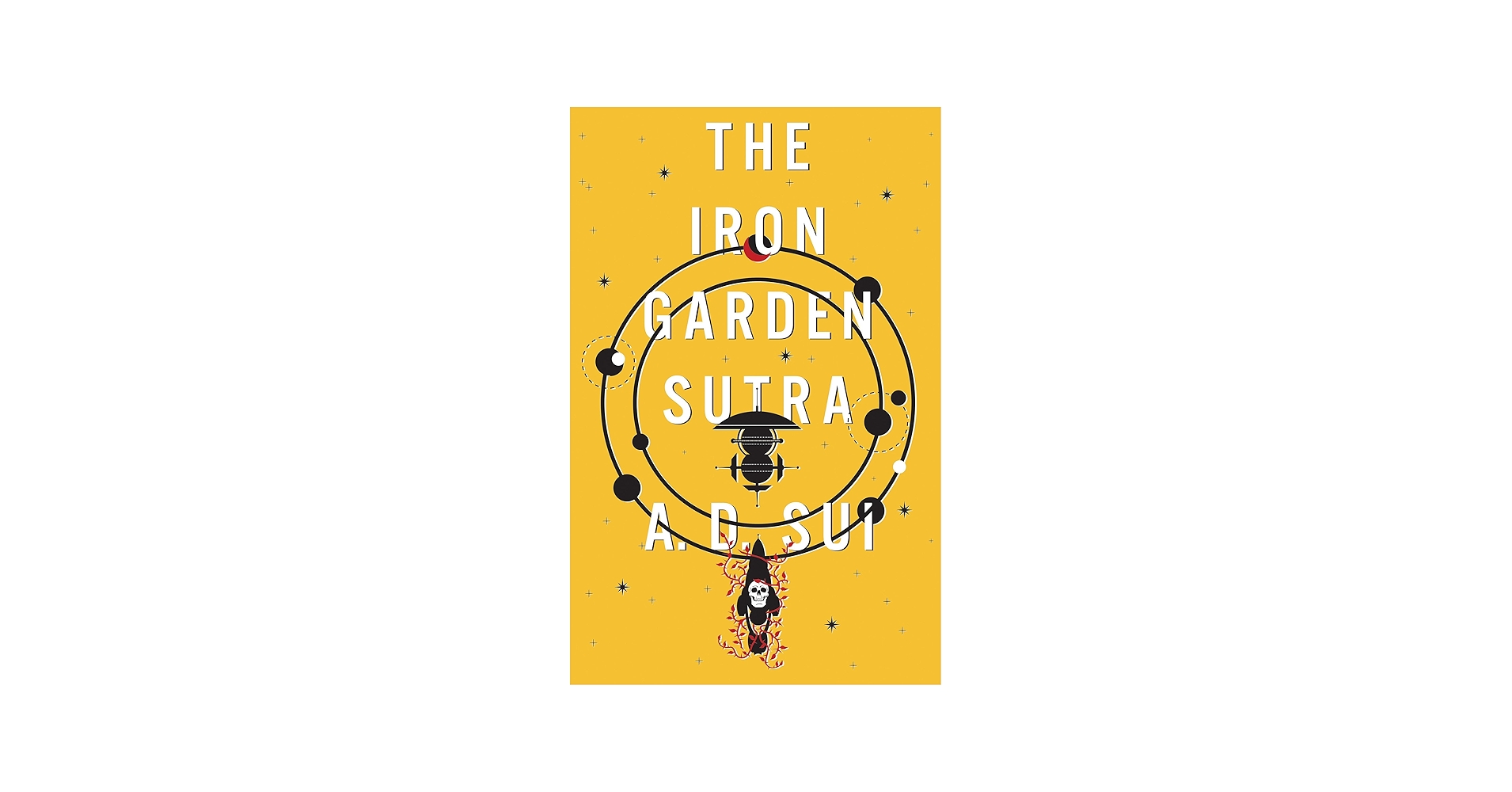
Jean-Paul L. Garnier: One theme of The Iron Garden Sutra concerns failed generation ships and the existential troubles they face during their journeys. I have read several books recently with similar takes on generation ships. Do you feel that this kind of story reflects a growing tension between generations in the real world and youth feeling that they have been dealt a bad hand by previous generations?
A.D. Sui: Generation ships are a long-standing tradition in sci-fi. What’s not alluring about packing up ourselves into a tin can and running off into the universe in search of greener pastures? But in my opinion, it’s also a very naïve take. Space is hostile. Space is hard. But there is a romanticism in cutting and running. Staying is, arguably, far more difficult.
I think every generation feels that pull of running away from their reality. Every generation can say that they have been dealt a bad hand. Millennials are economically disadvantaged because of policies enacted by Gen X and Boomers (and yes, have lived through three recessions now, but who’s counting?). Gen Xers felt they’ve been invisible all their lives. Boomers, I’m sure, felt disadvantaged in some way as well. Hard to imagine now, but one might. The generation before probably felt that they were unfairly thrust into a war that was only possible because of what the previous generation had done. And this is just the North American perspective. There are many more global conflicts, recessions, and other strains on each generation. We all want to run away, thinking that it will be better. To where? No one knows for sure, but somewhere that isn’t here.
Part of The Iron Garden Sutra’s theme is deciding when to stand your ground and fight for the things we believe in. Even if we are one person. Even if the outcome doesn’t look hopeful. Millennials are of the age when our financial decisions and our voting have the most impact. Some of us are even in positions of influence. Some are making decisions on scales that will impact the next generation (hi, Gen Z, and sorry). We can continue to bemoan the hand we’ve been dealt, or we can also work towards leaving things better for those who are coming after us. I, personally, am a huge fan of complaining while doing the thing.
It’s going to suck and it’s going to be a lot of work, sure, but we can leave a better world for those after us.
You’ve also created a religion in this novel, The Starlit. What did the process of creating a theology look like for you, and please tell us about the introduction of cosmology into the religion of peoples who have colonized the stars?
The Starlit is loosely based on Zen Buddhism. I have a very strong preference for non-monotheistic religions and like pondering where they can end up in thousands of years. What is the natural progression of something like Zen if it was supported into the future? What would its practitioners decide to keep and what would they discard? Because religion does change! Doctrine does change! It changes very slowly since religious institutions are massive and can’t afford to throw their entire weight around every other week, but it does change.
I think the introduction of cosmology is the natural transition, given how we commonly incorporate elements from our immediate environments into religious texts. Parting the Red Sea, trudging through deserts, and all that. If people are traversing between stars frequently, then star-like language would begin bleeding into texts.