Productive Futures: A report

Conference Report

Productive Futures: The Political Economy of Science Fiction

12- 14 September 2019

Bloomsbury, London

By Jasmine Sharma 

“The history of science fiction (SF) is the history of unreal economics: from asteroid mining to interstellar trade, from the sex work of replicants to the domestic labour of housewives of galactic suburbia, from the abolition of money and property to techno- capitalist tragedies of the near future.”

The opening statement of the Call for Papers caught the attention of researchers, scholars, artists and authors engaged with the central theme of the conference: science fiction. The connection between science fiction and economics broadened the dynamics of multidisciplinary interaction, encouraging presentations not only from literary studies, but also from architecture, arts and aesthetics, cultural studies, film studies, law, history, politics and international relations, media studies, philosophy, science and technology studies, social anthropology and many more. 

Organized by the London Science Fiction Research Community (LSFRC), and held within the heart of the city, that is the School of Arts Building, Birkbeck, the conference witnessed an exciting exchange of ideas and an orientation to global participation. UK delegates were joined by those from other European countries like Denmark, Germany, Finland and Netherlands, from Canada and the USA, and finally from institutes as distant as The University of Wollongong, Australia, The Chinese University of Hong Kong, and The Indian Institute of Technology, India. It was suggested at the end of the conference, only half-jokingly, that LSFRC now stood for Large Science Fiction Research Community.

Continue reading “Productive Futures: A report”

Sideways in Time: A review

Sideways in Time: Critical Essays on Alternate History Fiction, edited by Glyn Morgan and C. Palmer-Patel

Reviewed by Nick Hubble

On Friday 19 February 2016, Boris Johnson, wrote two drafts of an article intended for publication in the following Monday’s Daily Telegraph. The first argued in favour of Britain leaving the European Union; the second argued in favour of Britain remaining in the European Union (see Shipman 2016: 170-3, 609-18). As we know, Johnson opted to publish a redrafted version of the original, went on to become the figurehead of the successful Leave campaign and, in 2019, became Prime Minister of the United Kingdom and then won a General Election by a landslide. But what if he’d published a polished version of the second article instead and decided to support Remain in the European referendum?

Continue reading “Sideways in Time: A review”

Deconstructing the King of the Katz

By David John Beesley

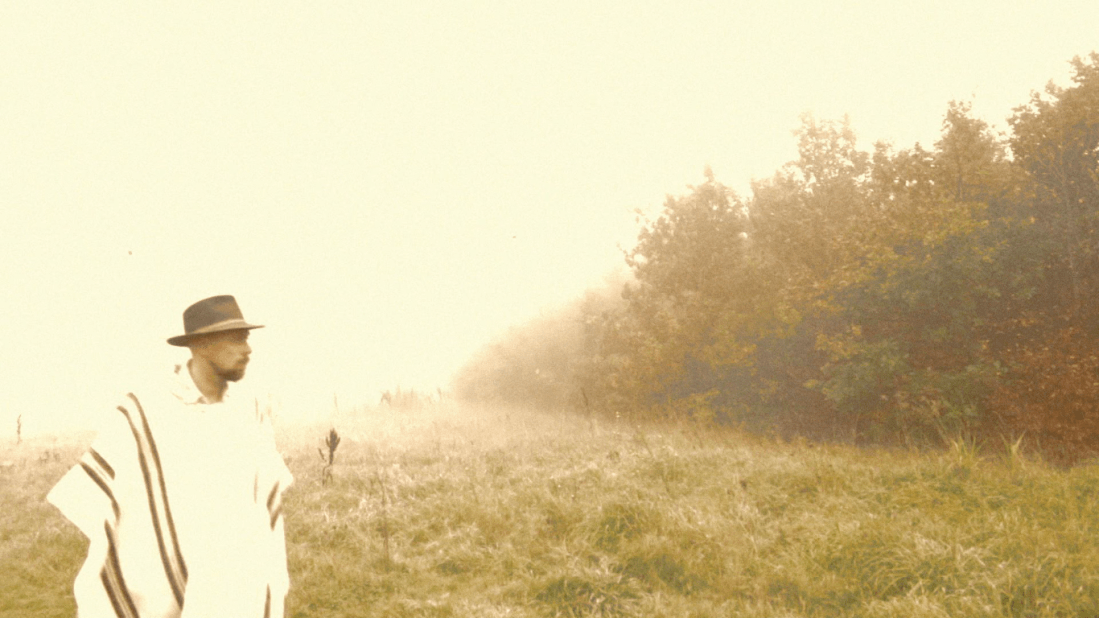
King of the Katz Title shot

Making art can follow many differing paths: allowing the subconscious to do its thing; waiting for inspiration to strike alongside the time to realise craft, developing pleasure in process and deeper understandings of the self. The Neo Liberal market’s force for establishing one’s own name as a brand is a powerful psychological vortex, and for some, it is also imperative to follow the academic establishment’s call for deep research and being precise in defining one’s conceptual intentions. For myself, a commitment to the process of assemblage seems appropriate in an age of polarised economical ideologies; I see this as a way of presenting stratified social critiques –  an ethical choice. 

My favourite indulgence in developing ideas is a long walk or deep soak in the tub – establishing time for reflection. I came up with a draft for my film in about two or three hours… I was twitchingly excited, as I’d conceived an idea to make a Cli Fi Western. 

KOTK1.png

Continue reading “Deconstructing the King of the Katz”

Universal Basic Income in Science Fiction

This is an expanded version of an article that appeared in Vector 288.

UBI SF

Universal Basic Income (UBI) is appearing more and more in near-future (and far-future) science fiction. It’s even becoming a kind of mark of futurity. Not in a “starships and androids” way, exactly: more like something incidental to the plot, a box that SF writers tick, to ensure their stories won’t date too rapidly.

In other words: science fiction writers think it’s happening.

This isn’t surprising: UBI is also prevalent in political discourse. It’s not just campaigners who are talking about it any more, but policymakers and politicians too. Smaller pilots and trials are everywhere. Major economies such as Spain are now rolling out UBI at scale on a temporary basis (presumably) to help cope with the Coronavirus crisis. There is increasing pressure for other countries to do the same. In the UK, one recent policy briefing argues:

Universal Basic Income (UBI) could provide faster and more effective income support during the COVID-19 crisis than that offered under existing UK Government schemes.

Although it also cautions:

More interventionist and state-entrepreneurial approaches – including investments in Universal Basic Services (UBS), place-based industrial strategy, technological innovation and skills training – could deliver much more effectively many of the benefits often claimed for UBI for a similarly significant level of public expenditure.

So what does UBI mean? UBI means that everybody gets some kind regular, guaranteed payment to support basic living expenses. That’s a key thing about Universal Basic Income: it should really go to everybody, not just to “those in need.” This part is controversial, so sometimes other terms like ‘Basic Income’ get used instead. Here we’ll stick with term ‘UBI.’

At first glance, UBI may seem a pretty naturally left-wing idea, and indeed UBI has lots of supporters on the left. But look closer, and things aren’t quite so simple …

Beyond left and right?

The thing is, UBI also has plenty of support on the right. For example, UBI appeals to right libertarians who despise ‘Big Government,’ and want innovative ways of rolling back the state: why not just ensure everybody has cash to spend, and let the market figure out the rest? UBI could even be a step toward a right libertarian utopia / dystopia: first abolish the welfare state in favor of UBI, then abolish UBI. UBI also appeals to some conservatives, who see it as something deserved by all the decent, upright citizens of this proud nation, as a way of tidying up and reinforcing hierarchies, rather than disturbing them.

All in all, UBI has attracted fans as diverse as Martin Luther King Jr. and Milton Friedman. Tech celebs such as Mark Zuckerberg and Elon Musk like it, as do social democrats and progressives like AOC and Ilhan Omar (at least during plague times), as do lefty political theorists like Kathi Weeks, Nick Srnicek and Alex Williams.

UBI-fi

The truth is, there are a huge range of very different possible policies (very different possible societies, even) that get lumped together under the umbrella term “UBI.” Science fiction has a role to play in exploring the variousness of UBI, the many ways it could be implemented, and the many possible second- and third-order ramifications.

By and large, science fiction treats UBI as something whose social and moral significance is yet to be determined. There is good UBI and bad UBI. UBI is witches. Some works of science fiction (or adjacent) that feature UBI (or adjacent) include:

  • Elizabeth Bear, ‘Deriving Life’
  • Adeline Knapp, 1000 Dollars a Day
  • Robert Heinlein’s For Us, The Living: A Comedy of Customs
  • Zoë Fairbairns, Benefits
  • Mack Reynolds, Police Patrol: 2000 AD
  • Philip José Farmer, Riders of the Purple Wage
  • Robert Anton Wilson and L. Wayne Benner’s RICH economy
  • Carl Hoffman, 2037 NZ: One Hell of a Paradise
  • Adam Roberts, By Light Alone
  • Efe Okogu, ‘Proposition 23’
  • Tim Maugan, ‘Flyover Country’
  • William Squirrel, ‘They Built the New Jerusalem on the Ruins of the Old
  • Tade Thompson, ‘Elegba’s Valley’
  • Lee Konstantinou, ‘Burned Over Territory’
  • Matthew Binder, The Absolved
  • E. Lily Yu, ‘The Doing and Undoing of Jacob E. Mwangi’
  • Marshall Brain, Manna
  • Rachel Swirsky, January Fifteenth
  • ‘Basic’ in The Expanse

Please suggest more in the comments below! Continue reading “Universal Basic Income in Science Fiction”

The Value of Science Fiction

By Martin Griffiths, Brecon Beacons Observatory

Science fiction (SF) has many definitions. From the perspective of educators, Joanna Russ’s definition must be one of the best: SF is “a literature that attempts to assimilate imaginatively, scientific knowledge about reality and the scientific method, as distinct from the merely practical changes science has made in our lives.” It is this imaginative approach to science that underlies SF’s broad appeal. The phenomenal success of high-grossing films such as Star Wars, Independence Day, Jurassic Park, ET, Close Encounters, The Day After Tomorrow, Avatar, the Marvel Cinematic Universe movies, and many more, attest to the success of not only SF’s value as entertainment, but its ability to excite, fascinate and encompass human values.

Science fiction and education

The inclusion of SF in the schooling curriculum can promote discriminating faculties with applicability in later life. Some of the greatest scientists of the previous century, figures such as Carl Sagan, Robert Goddard and Richard Feynmann, were inspired by the speculations found in SF. Scientists such as Isaac Asimov, Fred Hoyle, Gregory Benford, David Brin, Paul McAuley, Alastair Reynolds and Kim Stanley Robinson also became award-winning SF writers. 

Continue reading “The Value of Science Fiction”

This Is How You Produce The Time War Part 2: Powder Scofield interviews Amal El-Mohtar and Max Gladstone

PART 2: ‘Odd, unexpected, and serendipitous connections’

This is Part 2 of Powder Scofield’s interview with Amal El-Mohtar and Max Gladstone, authors of This Is How You Lose The Time War (Jo Fletcher, 2019). Part 1 can be read here. Special thanks to Robert Berg for his help with the interview.

Powder: We’ve been talking about your novella This Is How You Lose The Time War, which is an epistolary exploration of time and causality and privacy and intimacy and emotion and all of these things. And we’ve been talking a bit about the internet, and how the changing structures of the internet have maybe revealed different possibilities for solitude and togetherness.

For me, reading Time War also had this extra dimension of excitement because I was like, ‘Amal wrote that! Max wrote that!’ The three of us have odd, unexpected, and serendipitous connections. Max, I met you at university, we’ve known each other for — God! — over eighteen years now. And Amal, I met you online the first time I was living in the UK …

Amal: That was around 2007, through a game of Changeling: The Dreaming.

Powder: But when did you two first meet?

Amal: ReaderCon in 2014. I was vaguely aware of Max, because I had an ARC of Two Serpents Rise, but I hadn’t read it yet. I was on the programming committee, so I was responsible for taking ideas that people sent in and making panel items out of them. One panel was about magic and technology, and I was curious how that would go. So I went to the panel and I was like, ‘Oh, yeah, this is the guy whose book I have on my shelf.’ I sat down and I lasted about ten minutes of taking notes before I actually started vibrating with frustration that I wasn’t just having this conversation with him away from the rest of the panel. He was saying every single thing that I wanted someone to say about the stuff on this panel that I had put together, and it was irritating that I wasn’t on the panel too. So I actually at some point just got up and left! That’s how I actually met Steph first, because I think I ran into her in the hallway as I was leaving, and I was like, ‘Yeah, your husband’s really smart.’

Max: How did you know that she was my wife? Had you seen us together?

Amal: No, someone introduced us. Actually, I think she might have even said, ‘Hi, I’m Max Gladstone’s wife,’ and I was like, ‘WHAT…’

Max: Excellent!

Amal: So later that night we’re both at a party. I was reviewing books for NPR at the time, and there are rules at NPR about reviewing books by friends. My NPR editor was literally in the room. So I walked up to Max, and I think what I said was, ‘Hello! I think if the two of us sat down together for a while we could maybe solve the world’s problems, but I can’t be friends with you because I want to review your books so … yeah.’

Max: Which, as an initial approach line, leaves you without a lot of obvious responses, I will say.

Powder: Do you remember your response? 

Continue reading “This Is How You Produce The Time War Part 2: Powder Scofield interviews Amal El-Mohtar and Max Gladstone”

“More politics, more magic, and more queer”: An interview with Juliet Kemp

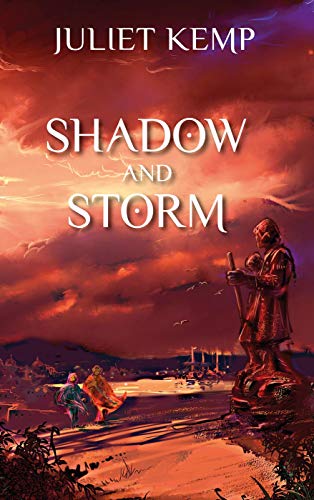
book cover of Shadow and Storm

Juliet Kemp’s second novel Shadow and Storm is hot off the presses. Rivers Solomon calls it “the literary equivalent of sinking into the embrace of a dear friend.” Ali Baker caught up with them to chat all things writing and reading …

Let’s start with your new book! How would you describe it?

Shadow and Storm takes place a couple of months after the events of The Deep and Shining Dark. My protagonist Marcia is dealing with the aftermath of the first book, and the other political problems that inevitably appear. Then a sorcerer on the run from Teren arrives in Marek hoping they’ll be safe there, which might have worked, until a demon comes looking for them. And the demon may be more involved with the politics than everyone would prefer. So there’s more politics, more magic, and more queer, basically.

That sounds amazing! 

I like writing politics — I have a background in it — but it’s hard to make it convincing. On the other hand, recent real-world events have demonstrated that sometimes people really do make very short-sighted political decisions for reasons that might not be the smartest, so …

Some might say that epic fantasy has very problematic roots, politically. Is that ever something you find yourself encountering when you write –that the material you’re working with tries to tug you in directions you don’t want to go?

That’s a really interesting question, and the answer is yes, definitely. I am consciously trying, in the Marek series, to write characters from multiple backgrounds, but there’s definitely a tendency in epic fantasy to focus on the people at the top of the pile, and one of my main characters is in that position. I also find that I’m drawn towards various forms of violence both as problem and as solution, simply I think because that’s one of the approaches I’m used to reading. The stories we tell shape how we think about both stories and the world in general. So I do try to push back against that — I want people to solve problems in other ways — but I have noticed the pressure in what
I expect a story to look like and have to consciously stop and rethink. With greater or lesser success…

Can you talk a bit more about queer representation in both books? Continue reading ““More politics, more magic, and more queer”: An interview with Juliet Kemp”

This Is How You Produce The Time War Part 1: Powder Scofield interviews Amal El-Mohtar and Max Gladstone

Screenshot 2020-03-11 at 22.53.08

Amal El-Mohtar and Max Gladstone’s This Is How You Lose The Time War (Jo Fletcher, 2019) has been gathering a glowing reception. It’s an intense, lyrical, tragicomic novella about two elite warriors, Red and Blue, who strike up a correspondence across the millenia and across enemy lines. Adam Roberts, in his pick of SFF of the year, calls it ‘one of a kind.’ The novella has also made the shortlist for the 2019 BSFA Award. Late in 2019, Powder Scofield joined Amal and Max to shoot the breeze. This interview is a two-parter, with Part 2 dropping next week. Special thanks to Robert Berg for all his help with the interview.

PART I: ‘So we were in this gazebo …’

Powder: You’ve said one of the foundational premises of your friendship was writing physical letters to one another, and obviously that shows up in This Is How You Lose The Time War. Are there other bits of real life embedded in Time War? When you’re working on a project, how much are you intentionally processing past experience? 

Max: Some of it’s intentional, but in my experience, intention is like a raft that’s on an ocean that’s in the middle of a storm. You’re aware of what you can see, but you’re not in control of it as much as you think you are. There’s a little rudder, and you can maybe try to paddle. But if a wave is driving you east, you’re going east. So I think when we sat down to write, we both knew that we were drawing on our experience of writing letters to each other, and of correspondence more generally, and the particular strange kind of time travel that you do when you’re writing a letter, especially a physical letter. But at the same time, there’s the raft, there’s the ocean, and there’s the storm.

Powder: There’s a line in the book, like, “There’s a kind of time travel in letters.” I can see that. The time it takes to write a letter, the time it takes to get there. The way letters can sometimes cross each other in transit.

Max: Exactly. You’re imagining who the other person is that will be receiving this, you’re imagining where you’ll be when they’re receiving the letter in a week or two. You’re wondering sometimes about the many forces that could stand between you dropping the small and very fragile piece of paper into a confusing and vast and twisty basically state system with the hope and trust that the $1.35 stamp will see it across the international border to someone else’s actual house just because you happen to put some words on it. So all of these steps create many different versions of yourself and of the recipient and of your respective spaces. I think that was the intent with Time War. But there are other things that I think were beneath and driving that intent. 

Amal: And to answer really literally, when we were writing the book, we were also in a gazebo with no internet. So we were sitting across from each other and we only had recourse to our own bodies of knowledge. The book is built primarily out of no research, but instead what we both brought to the literal table between us in a literal gazebo as we wrote things! There’s so much in there built out of, for one thing, the surroundings. It was a gorgeous late June, early July in the Midwest. There were trees and birds and plants and things that were finding their ways into the things we were writing, for sure …

Max: Except that I don’t know plants and animals as well as you do. For me: it was green … green was nice … Continue reading “This Is How You Produce The Time War Part 1: Powder Scofield interviews Amal El-Mohtar and Max Gladstone”

Mushrooms: The Art, Design and Future of Fungi

By Seana Gavin

Reviewed by Bethany Garry

Mushrooms: The Art, Design and Future of Fungi, curated by Francesca Gavin, can be seen at Somerset House until the 26th of April. It is part of The Charles Russell Speechlys Terrace Room Series and is free to visit. 

Mushrooms and fungi have a specific place in the imagination as strange and otherworldly, often associated with the fantastical or magical, but Gavin’s exhibition on the “future” of fungi posits them as significantly more science-fictional than fantastical. They are a technology – for use in the future of fashion, biotechnology or ecological industries, or an alien – an unexpected invader via decay or rot, part of the aesthetic that makes a landscape feel truly not of this world. The exhibition achieves this through the mix of mediums, beginning with some of Beatrix Potter’s botanical illustrations of mushrooms and fungi, and progressing through dance (in video form), textile arts, sculpture, collage, fashion, and an extensive display of books. 

IMG_2308

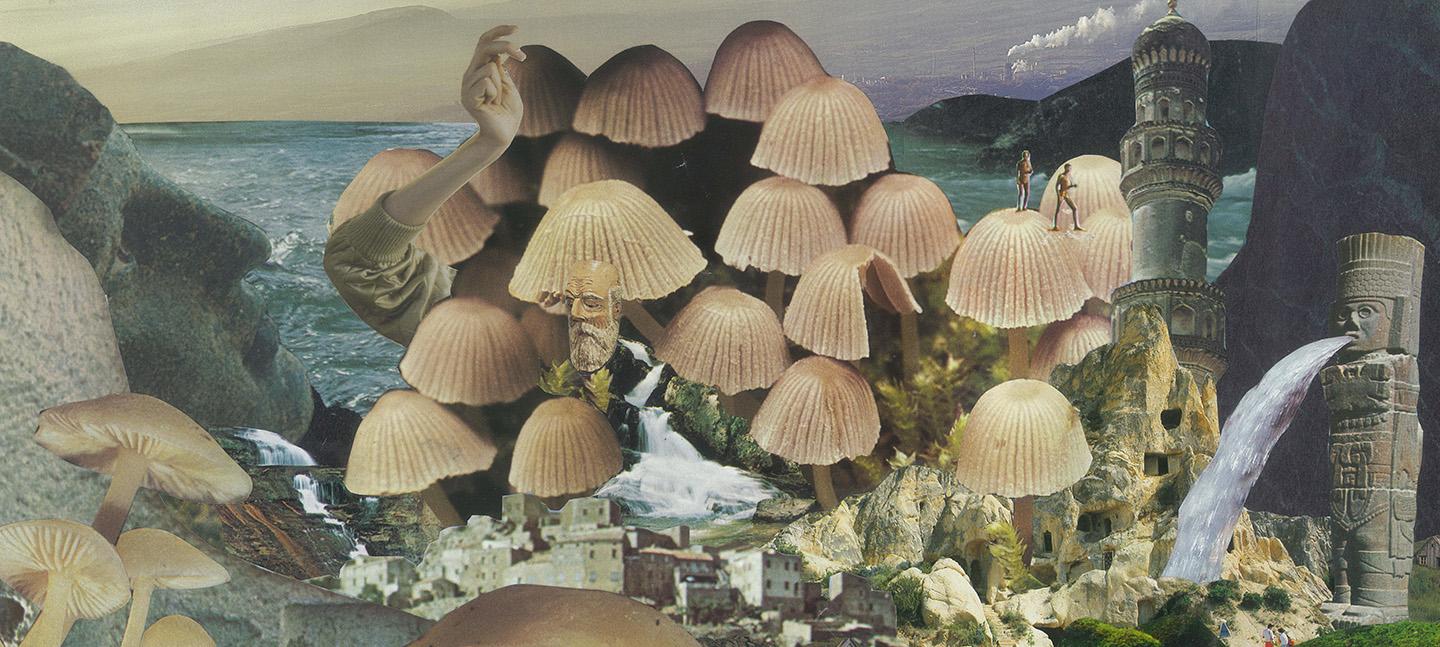
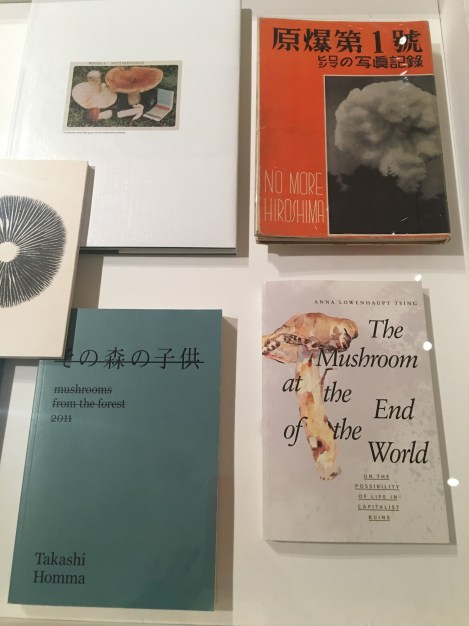
The effect is an exhibition that feels unfinished, if visually engrossing. Amanda Cobbett’s sculptures of mushrooms, perfectly rendered in thread and paper, are an illusion good enough to trick you, and Seana Gavin’s collages are alien worlds where mushrooms form otherworldly buildings, or fungi have unsettling human features. The small setting of the exhibit gives little room for in-depth exploration, and its high goal is undermined a little by the content. A display of mushroom-focused non-fiction literature amounts mostly to a display of book covers, which maybe spark thoughts but ultimately feel superficial. However, for a mushroom lover or for those interested in how the natural world can be positioned in a futurist mindset, it’s a fun way to explore how many different artists have used many different mediums to explore the world of mushrooms and fungi. 

While the first two rooms of the exhibit largely explore mushrooms as an aesthetic or fascination, the final ‘Futures of Fungi’ room positions mushrooms as a future technology, one that humanity has not yet fully exploited, with potentials unexplored, with displays including experimental leather made from mushroom, and a typeface generated to ‘spore’ organically as mushrooms do. The strangeness of mushrooms, their in-betweenness between plant and animal, their interconnectedness, are all ways in which they challenge humanity to experiment with their potential. Not all science-fiction, after all, is an exploration of an alien world. Some are discoveries of the strange in our deep seas or our high peaks. Perhaps the next frontier is neither, but instead will be the forest floor.

IMG_2318

“Actions and reactions and ripple effects”: an interview with Valerie Valdes

Chilling Effect cover

Chilling Effect, Valerie Valdes’s resplendent debut novel, was published last month in the UK by Orbit. It’s an action-packed space opera bursting with wit and wacky hijinks. Liz Lutgendorff caught up with Valerie Valdes to spill the space tea …

Right from the start, Chilling Effect throws you into the deep end. Was that a deliberate choice?

I do usually prefer novels that approach their stories through immersion rather than exposition. I like to create context while something is happening, rather than trying to explain everything up front. That’s how I tend to build my worlds as well: by having things be introduced as the character thinks about them or interacts with them, a very tight POV that can mean some things aren’t immediately clear and some readers will be frustrated by the lack of explicit description. 

It can be a difficult approach to manage because you want the reader to be engaged, and sometimes starting on action or dialogue means the whole thing is occurring in a void and they have no reason to care about what’s happening yet. But also the first chapter, “Save the Cats”, is an allusion to the technique where you get the audience to empathize with your main character by having them do something noble like … save a cat! So I was not only beginning with as much immersion as I could manage, but also joking about the method usually used to get the buy-in from audiences.

That makes sense. Chilling Effect is filled with great worldbuilding, and a lot of action and intrigue, but it’s also very funny and silly! Did you worry about how silly you could be? Or did you leave that your editor if you went too far?

At the point where I started writing this book, I’d spent years trying to write “serious” sci-fi and fantasy and horror stories, because that seemed like the most important thing I could do with my time and energy. The world is a mess, and we need thoughtful fiction to help us find a way to deal with our problems meaningfully, both externally and internally. But as important as catharsis is, as important as it is to engage with contemporary issues, I think it’s also important to imagine a future where humanity has more or less transcended some of those problems. 

Which can be risky too, right? Continue reading ““Actions and reactions and ripple effects”: an interview with Valerie Valdes”