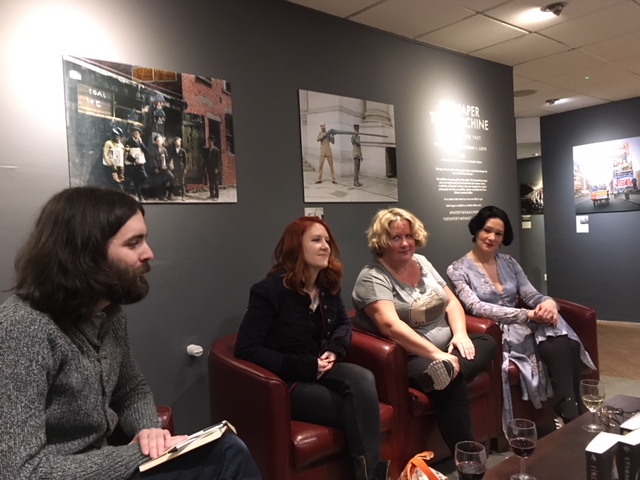
A SciFi Sessions conversation, hosted by Glyn Morgan at Gower Street Waterstones (London). Click here for details of future events, #SciFiSessions return in January 2018 with a special three author event showcasing British fantasy talent.
Weird Fiction for Weird Times by Andrew Wallace
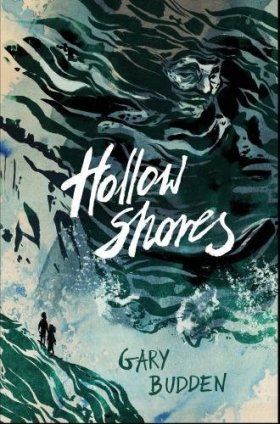 Mike John Harrison, a veteran of the 60s New Wave SF scene, and Gary Budden, an award-nominated short story writer whose first collection Hollow Shores (Dead Ink Press) is out now, discussed how weird fiction is indispensable for processing contemporary political realities.
Mike recounts JG Ballard at a party held by seminal SF magazine New Worlds predicting how the world would become ever more fantastical and psychopathic. At the time, everyone thought Ballard was overstating the case; now, Mike says, his own ferocious, mythic engagement with the culture feels redundant. Indeed, far from our culture inhabiting an exciting new realm of limitless possibility, some reality would be rather welcome. Gary says that the current fractured, nonsensical nature of the world means that weird fiction is resurgent; that the genre is merely reporting on the psychological state of our culture. Indeed, a contemporary writer of ‘realist’ fiction would now need to accommodate the weird simply to reflect what is going on.
Both writers engage with landscape in ways that challenge its conventional certainties. For example, Gary read a short piece about the actor Peter Cushing, who lived in Whitstable. In the story, the actor is referred to via his greatest roles, like ‘the Vampire Hunter’, as he wanders around the seaside town accompanied by his best friend, ‘the Vampire’ (presumably Christopher Lee). They meditate on their great fictional battles, surrounded by the everyday bustle of modern life, and meditate on an uncertain future. This blending of myth and reality has personal note: Gary grew up in Whitstable and the area has a strong folkloric identity. He writes weird fiction because that is the only genre that reflects his understanding of this familiar landscape. One way to reconcile the desire for his home space to be closer to its mythical – but not idealised – identity, and further from its proximity to prime UKIP country, is to use techniques of psychogeography, or as Gary calls it ‘landscape punk’. The Hollow Shores are a real place; the name is drawn from history like some treasure previously submerged that has slowly come to light.
However, the stratification of the English landscape brings political peril. The online Hookland project, which explores a fictional English county using folklore, spent the day of the discussion fighting off an English neo-Nazi who wanted to use the site to justify national/racial purity. Mike says that writers should make their position on landscape politics clear, and maintain awareness that landscape itself has no sentimentality at all. It has its own language, often weird, that should be used with full awareness to avoid the descent into easy nationalism.
Gary is interested in the fringe elements of our island; how its marginal landscapes change over time in a way that seems arbitrary, even absurd. For example, Whitstable would not even have been on the coast when the area now known as Doggerland linked Kent to mainland Europe 10,000 years ago. Doggerland was flooded at the end of the last Ice Age, a prospect we face on the attenuated landmasses of our own time. But for a few degrees’ variation in temperature, the Britain we know would not have existed and neither, in our current form, would we. There is a sense of possibility, only just missed, that folkloric weird fiction reflects so well.
 Creation of a fictional Doggerland-like continent lay behind one of Mike’s projects for New Worlds, in which elements of a series of seemingly unconnected narratives would reveal that a new continent had appeared. Although the book never came to fruition, the stories evolved and formed part of his new collection, You Should Come With Me Now, published by Comma Press. He read a story from the collection called Psychoarcheology. Ostensibly a satire about the unending discovery of royal remains beneath car parks, it also looked at how the royals themselves are as trapped by their DNA into a life of rule they may not want, as their bodies are trapped beneath tarmac. This layering is an example of one of the different narrative techniques Mike uses to draw the reader through stories that do not have conventional narrative plots. Another is ‘reframing’, in which characters are moved through different landscapes as if on a journey, placing them in unfamiliar locations to accentuate the essential quality of strangeness. The weird, then, is as much to do with the way the story is told as its subject matter.
 By Andrew Wallace





 John Boyega as Finn, Daisy Ridley as Rey, and Kelly Marie Tran as Rose Tico in The Last Jedi
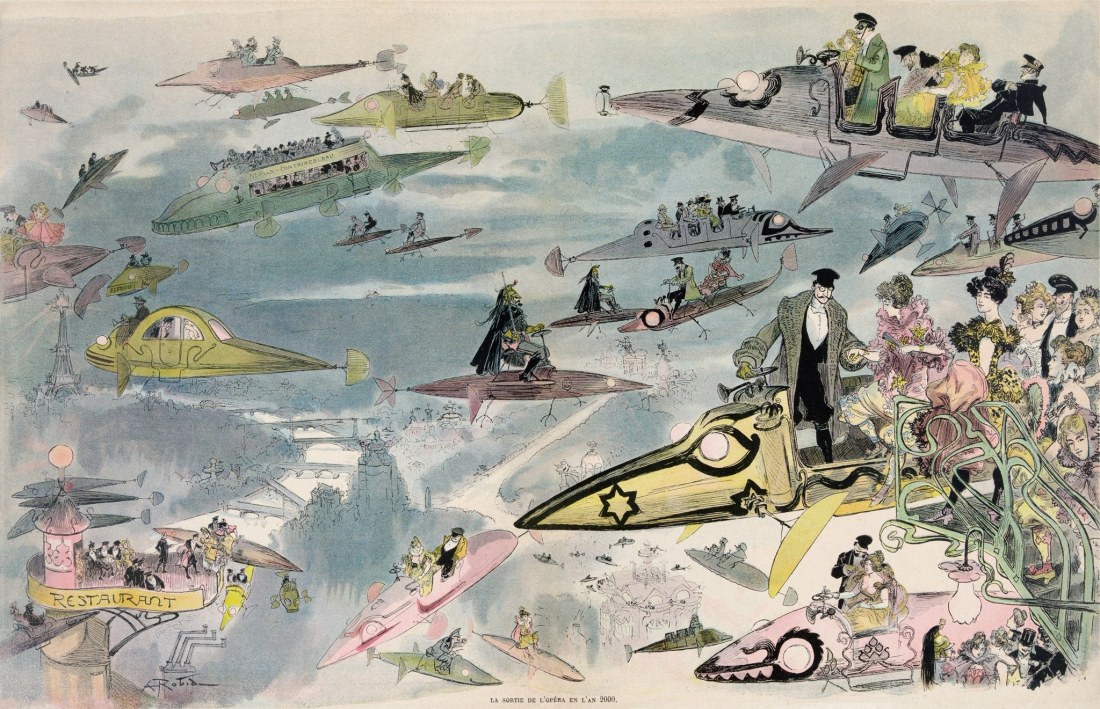 Brian Stableford will be speaking about the evolution of an important early science fiction form, the French roman scientifique, supported by the London Science Fiction Research Community (

