Saul Williams is a poet, hip-hop M.C., producer and actor who first came to prominence through his victory at the poetry Grand Slam at the Nuyorican Poets Café in 1996. This event kick-started an acting career for Williams with the lead role in the feature film Slam in 1998, and a music career in which Williams began to blend his poetry with his love of hip-hop. What makes Williams’ work interesting from a science fiction standpoint is the obvious affinity he has with the genre, evident in his lyrics and the soundscapes that he chooses to rhyme over. From the outset, Williams wrote and produced with a speculative bent. In the song ‘Ohm’ from 1998’s Lyricist Lounge compilation, Williams announced ‘I am no Earthling, I drink moonshine on Mars/And mistake meteors for stars ‘cause I can’t hold my liquor/But I can hold my breath and ascend like wind to the black hole/And play galaxaphones on the fire escapes of your soul’. The glimmering production on ‘Ohm’ is no less science fictional, especially as it accelerates at around the three-minute mark.
The BSFA holds regular events in London, usually on the last Wednesday of the month, at the Artillery Arms near Old Street. These events are free, and open to members and non-members alike. Keep an eye on the BSFA website for news of future events. In November 2017, former Vector editor Glyn Morgan interviewed acclaimed author Anne Charnock, whose first novel A Calculated Life was nominated for a Philip K Dick Award and whose second novel, Sleeping Embers of an Ordinary Mind was listed by The Guardian as one of the Science Fiction Books of the Year in 2016. She also regularly takes part in The Ada Lovelace Conversations, a collaborative project between The Arthur C Clarke Award for science fiction literature and Ada Lovelace Day, an international celebration of the achievements of women in science, technology, engineering and maths. Anne’s latest novel, Dreams Before the Start of Time, is out now.
Andrew Wallace has checked his watch, confirmed he was there and reports as follows…
What will survive of us is love
The themes of Anne’s latest novel Dreams Before the Start of Time evolved from ideas about reproductive technologies likely to be with us within the next forty years. The book explores the psychological, ethical, legal and social implications of these technologies by following generations of the same family into the future as they take advantage of these new opportunities and deal with the unexpected consequences. Anne believes that fiction offers the best means of analytically, emotionally and aesthetically engaging with the potential impacts of innovations and trends, from our ‘reproduction’ as digital selves to artificial intelligence, genetic engineering and the emergence of China as both a strategic world player and presence in our future lives.
The first of Sci-Fi Sessions with Glyn Morgan, at Waterstones (Gower Street, London). Click here for details of future events, #SciFiSessions return in January 2018.
Host Glyn Morgan (a former editor of Vector) was joined by two distinguished science fiction authors: Adam Roberts and Jeff Noon. Adam is a lecturer in nineteenth-century fiction at Royal Holloway and the author of seventeen books, including the British Science Fiction Association Award-winning Jack Glass. Jeff is a former punk, doyen of the 90s Madchester rave scene and author of eleven books, the first of which, Vurt won the Arthur C Clarke Award in 1993. Both have recently published new novels; Jeff’s A Man of Shadows is published by Angry Robot; Adam’s The Real Town Murders by Gollancz.
Both novels blend crime fiction and science fiction, challenging the genre boundaries. A Man of Shadows is the film noir-influenced story of a 1940s-style gumshoe private eye searching for a teenage runaway, while The Real-Town Murders follows another private investigator trying to solve a case that seems impossible. The idea for the murder came from Alfred Hitchock, who posited: what if a dead body was discovered in the boot of a car that had been assembled by an automatic factory with no human intervention? Hitch said that if he could work out how the body got there he would make the film. He couldn’t, so never did and now Adam Roberts has picked up the challenge.
The BSFA holds regular events in London, usually on the last Wednesday of the month, at the Artillery Arms near Old Street. These events are free, and open to members and non-members alike. Keep an eye on the BSFA website for news of future events. In August 2017, Matthew De Abaitua interviewed Jeff Noon, author of speculative fiction and tricky-to-label experimental writing, about his latest work. Andrew Wallace tells the story …
Matthew De Abaitua, Andrew Wallace, and Jeff Noon
Jeff Noon has always been fascinated by borders. His early work was full of characters traversing portals, whether formed by physical structures or drugs. He describes his 1993 debut novel, Vurt, as something brought across the frontier between this world and another.
It’s an obsession that includes his writing process. Many writers listen to music while they work; not Jeff, he has films on as well, a different one every day. He also covers the display screen while he writes to make the narrative less predictable. During this process, part of his mind is carefully planning, while the other enters a crazed state. As well as a negotiated path between dream and reality, Jeff sees composition as being analogous to a chess game between writer and novel: an engagement that seems to give the novel its own agency. Out of this process comes an organic creative vision, well-matched to the visceral SF that established Jeff with his 1994 Clarke Award win for Vurt.
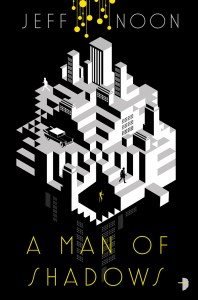
His latest novel, A Man of Shadows (Angry Robot Books), explores a different kind of border: that of dusk. Inspired by Dayzone, part of Tokyo where lights and music are on twenty-four hours a day, seven days a week, three hundred and sixty-five days a year, Jeff science-fictionalised the idea to create a whole city where the lights never go off. If you look up, you don’t see sky: only lamps, flames and neon signs.
The world outside is like our own, although the novel’s main character, private detective John Nyquist, has never left the city.
The novel explores how being constantly exposed to light changes someone. For example, what happens to time when you’re cut off from the seasons? The notion of a twenty-four-hour clock also falls apart, as do traditional commercial structures based upon it. Dayzone is not a time-free zone; it just has a different chronology. People can purchase tailored time standards. For example, families find their own time units, as do lovers, depending on the levels of ardour. Time can be sponsored because it has evolved in its own ways, free of day and night.
People who live in the city love it, so this world is not a dystopia. However, time as a commodity means that there are organisations like ‘the time exchange’, modelled on corn exchanges, as well as the need for time law, and the capacity for time crime.
Although the city exists outside the ordinary rhythm of day and night, it simultaneously acknowledges that people will want darkness. They either visit an area called Nocturna, or go to one of the places where the council’s bulb monkeys haven’t replaced the lamps.
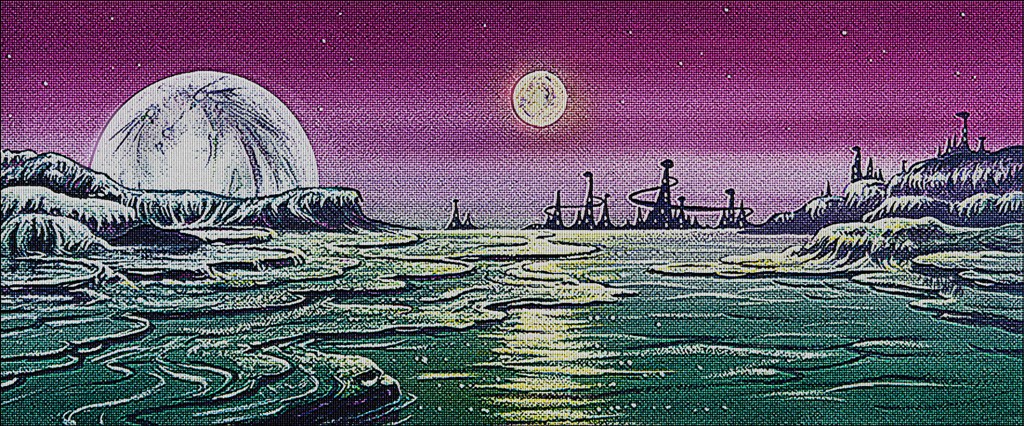
What, then, happens in the spaces between light and dark, in the realm of Dusk? Dusk is mysterious and silvery; there are several moons, while distant lamps become stars and constellations.
Nyquist hates the Dusk. As a reference, Jeff mentioned Chinatown: a self-aware film that is as much about noir as an expression of it. The Dusk in A Man of Shadows feels like Nyquist’s Chinatown, and perhaps it’s Jeff’s too; he says he is uncomfortable on any kind of middle ground.
Because Nyquist is a private eye trying to find a teenage runaway, he must go from light to dark to the mean streets of Dusk. A transitional, liminal zone where things appear to dissolve, it’s also known as the hour between dog and wolf, because in that eerie light you can’t tell which animal it is. More than a dangerous ambiguity, Dusk is like memory; a dreamscape where the dead end up.
It’s interesting how Jeff’s writing has moved from real places, like Manchester in Vurt and Pollen to imaginary ones like Dayzone. Once he left Manchester in his forties, he decided not to invest in a real space so heavily. It’s the kind of decision only an SF writer could make.
The British Science Fiction Association holds regular events in London, usually on the last Wednesday of the month, at the Artillery Arms near Old Street. These events are free, and open to members and non-members alike. Keep an eye on the BSFA website for news of future events. In September, award-winning author Lavie Tidhar was interviewed by critic and editor Konrad Walewski.
Andrew Wallace engages the metadata…
Lavie Tidhar’s style is well-suited to original narrative forms that subvert Western genre fiction tropes, while still engaging with them almost as props. For example, he says this year’s Clarke Award-nominated ‘Central Station’ gave him the opportunity to employ Golden Age imagery, like the action around a spaceport, and then let it fade into the background as if it’s being ignored. However, it’s an approach that can backfire. Another twentieth-century genre that appeals to Lavie is noir detective fiction, and he recalls a synopsis he wrote using the idea of a gumshoe searching for his niece, only for the story’s editor to point out that Lavie had forgotten to include the fate of the girl at any point in the story.
The noir angle could be the reason Lavie has been linked with cyberpunk, although he considers the association inaccurate, describing ‘Neuromancer’ as ‘Chandler with computers’. He decries the ten years between that novel and ‘Snow Crash’, in which people emulated what they thought was a new formula for success. Also, there is nothing hard-boiled about ‘Central Station’. While cyberpunk is about cool, hi-tech cowboys saving the world from a rogue AI, Lavie’s books are about people who get the kids to school and then go to work defeating the AI. Indeed, he sees ‘Central Station’ as a romance novel; its wedding-and-funeral climax more Richard Curtis than William Gibson.
Any science fiction or space art aficionado should instantly recognise the name David A. Hardy – perhaps from the early part of his career working with Sir Patrick Moore on The Sky at Night and their award-winning books, including Challenge of the Stars and Futures / 50 Years in Space, or perhaps from his film and television credits, which include Blake’s Seven and The Neverending Story. Maybe you’ve got books in your SF collection adorned with David’s stunning cover art (maybe you’ve even read his own SF book, Aurora), or have encountered his work on the convention circuit. At the very least, if you’ve ever bought Cadbury’s chocolate, you’ll recognise the logo that Hardy originally designed during his time working at their Bournville factory, Birmingham, in the 1960s!
First published in 1952, David A. Hardy is the longest-established living space artist. Hardy started out as an astronomical artist, and the inevitable expansion into science fiction did not come for some years. Hardy’s work can transport you to the remotest corners of the Solar System, or into remote alien worlds and future times. What’s more, Hardy is still working and in as much demand as ever, regularly supplying cover art for the likes of Analog and The Magazine of Fantasy & Science Fiction, and countless science fiction paperback and e-book titles.
F&SF: Initiation of Asaka
Hardy’s artwork continues to move with the times – in tandem with spaceflight technology and our ever-expanding scientific knowledge about the planets in our Solar System, and advancing with the advent of computer technology and digital art.
I grew up in awe of Hardy’s work, courtesy of its inclusion in the most marvellous book, Space Worlds, Wars & Weapons (published in 1977 by the sadly defunct Paper Tiger imprint), and an art print that hung on the wall at home, entitled Stellar Radiance. This artwork my young imagination; it was like having a window into space. It sparked my obsession with science fiction art and ultimately led to me working as a science fiction artist myself, years later.
Stellar Radiance
When I rediscovered my love of science fiction and space art in 2007, I realised it was time to start creating my own – and David A. Hardy’s work was my first port of call.
However, at the time, I did not know the name of that wonderful painting that I used to lose myself in, nor the artist’s full name – though the carefully scribed signature of “Hardy” in the bottom corner of the painting had always stuck in my mind. Thanks to a quick Google search, in no time at all I was in touch with the man himself, and soon found myself discovering his decade-spanning portfolio, starting with the books, Hardyware and Futures / 50 Years In Space. David’s enthusiasm and encouragement were invaluable and enough for me to know that I simply had to give it a shot.
One of the things which appeals to me about Hardy’s art is that whether it is paint or pixels, the work is still distinctly Hardy. When it comes to digital art in particular, I’ve always found it crucial to still have the touch of the artist’s hand, which I feel adds soul and personality to a digitally piece, eliciting just the same kind of emotional response one gets from looking at a canvas painting – and Hardy achieves this masterfully.
Despite being in the age of photographic imagery and photorealistic 3D graphics, hand-rendered art has remained important in science fiction circles, as it is another medium in which we can escape into other times or worlds – and more often than not, the art goes hand in hand with the SF literature we read; either adorning the covers of the books we love or simply inspired by them.
A ‘Hardy’ is immediately identifiable, not only by that kind of vibrant colour palette (regardless of medium), but by a consistent style and approach. Decades of experience and expertise all go into making each and every piece a work of wonder that one never tires of viewing.
I caught up with David to chat about all aspects of his work and career …
The first time I encountered computer-aided artwork in the early 1990s, it felt like a life-changing moment; a glimpse of the future. Do you remember the first time you saw computer art and did you realise it was going to be a significant way forward, especially in terms of science fiction art?
DAH: I had a similar “Eureka!” moment when I discovered the airbrush in 1957! Here was a way to paint atmospheres, glows, nebulae in a way that was realistic yet wouldn’t take hours of painstaking blending of paints. I have always kept up with new technology, and started using photography, especially ‘derivative’ (manipulated) images, in my work. In the 1980s I did all my own darkroom work and even became a LRPS. I also bought a large-format camera and started taking photos of my work to send to publishers as transparencies (slides) rather than entrusting valuable artwork to the tender mercies of the Post Office! I became aware of the intrusion of computer art in publishing, and it was exciting, but I couldn’t afford any of the equipment. Then when the Atari ST came along in 1986 I got a 520, then a 1040 and finally a Falcon before getting my first PowerMac in 1991. But it was still some time before I felt able to use this professionally. (I did however produce graphics for an Atari/Amiga game, Kristal, which won an industry award.)
Kristal
Many SF artists have continued to work with paint while others have moved to digital or only work digitally – yet you have maintained a healthy balance of both. What do you feel you can achieve with digital art that you can’t with traditional media – and vice-versa?
The BSFA holds regular events in London, usually on the last Wednesday of the month, at the Artillery Arms near Old Street. These events are free, and open to members and non-members alike. Keep an eye on the BSFA website for news of future events. In June 2017, Tom Hunter rendezvoused with Dave Hutchinson, author of the acclaimed near-future spy series, Fractured Europe. Our asset Andrew Wallace returns safely to HQ with the following intelligence …
Tom Hunter
Dave Hutchinson
Any writing career has its highs and lows, and in Dave Hutchinson’s case, quite literally. One of the jobs he applied for after leaving university (he graduated from Nottingham with a degree in American Studies), before beginning a career in journalism, was air traffic controller. Dave credits the absence of planes falling from sky to the fact that he didn’t get the job. Still, it’s intriguing to think of Dave Hutchinson, author of the award-winning near-future Fractured Europe series, as an air traffic controller in a parallel universe … managing the borders between nations, between earth and sky …
The BSFA holds regular events in London, usually on the last Wednesday of the month, at the Artillery Arms near Old Street. These events are free, and open to members and non-members alike. Keep an eye on the BSFA website for news of future events. In February 2017, Ian Whates caught up with SF and fantasy novelist Adrian Tchaikovsky. Andrew Wallace chronicles the encounter …
Adrian Tchaikovsky is known for his ten-volume epic fantasy series, Shadows of the Apt, whose clashing civilisations are based around insect species. More recently, Adrian has been lauded for his science fiction, with his novel Children of Time winning the 2016 Clarke Award. Children of Time starts from the premise of a nano-virus sent across the stars to seed life on a distant world. Unexpectedly, it is the spiders and ants – species meant to play mere bit parts in the glorious epic of mammalian expansion – who get sped towards sentience, and the kind of richly detailed space-faring society that great SF does so well.
So the question we all want to ask Adrian Tchaikovsky is: what’s with the bugs?
As promised, here’s a short interview with Shana Worthen, Vector’s incoming Features Editor, whose first issue, to which I am very much looking forward, should be out shortly after my last. You can find her current online home here. And many thanks to her for taking the time to answer my questions.
How did you get involved with the BSFA?
I started with the London pub meetings. I moved back to London from Toronto in early July of 2005 and my first BSFA pub night was later that month. After a year of attending, I became a member. It was shareware logic: pay for something after I have already had my money’s worth — not that memberships actually subsidize the meetings. How I first heard of the pub nights, I don’t specifically know, but I had been looking for regular fannish meetings here before I moved over. My inbox tells me that I started following Ansible in that May, so that’s a possibility.
What are your interests within sf?
Novels, poetry, and criticism, primarily. i also really like tie-in reference books! I have a small but growing accumulation of science fictionally-related cookbooks, for example. Movies, occasionally. I am very much interested in science fiction-related artwork, especially landscapes and maps, but can’t say I follow it in any systematic way at this point.
I often read through self-imposed projects, whether an award-related list or a friend’s set of recommendations. For the last several years, I’ve been getting to know the subgenre of science fiction romance in particular. I’m currently reading a short list of books recommended by a friend as a way of getting to know some of the more recent American science fiction publications.
Although I have caught at least one episode per season of Doctor Who, I don’t usually remember to watch television series. I grew up without a television and still have poor televisual instincts. iPlayer is useful, but only if I’m reminded in time to catch something. I did have a long spell back in Toronto of watching lots of anime, but most of it had not been broadcast locally in the first place.
And what do you do outside sf?
Professionally, I’m a historian of medieval technology. It still seems improbable that my day job is teaching online for a university on the other side of the ocean, but it’s true.
Food is my major hobby. I love eating good things, and will cook if need be to have them. I love trying new restaurants, and reading food criticism and related essays and blogs. I mostly read cookbooks rather than cook from them. This also explains my science fiction cookbooks, many of which are only partially designed to be cooked with. I’ve been thinking a lot in the last year about why science fiction and fantasy tend to be so conservative in its use of food technologies. I’ve been dabbling in related academic work too: I have an article coming out next year on smoked foods in fantasy literature.
I like seeing new places, whether industrial tourism, museums, or countryside. I like theatrical musicals, drawing with watercolour pencils, and photographing reflections.
What plans do you have for Vector? What can we expect from your first issue?
My plan is to try to live up to the standard set in the last few years! I will be trying for clusters of related articles rather than the entire themed issues, however.
I’m starting off with the usual year-in-review issue, so the majority of the content will be looking back at 2010. I am happy to report that there will also be two new columns appearing in my first issue. Paul Kincaid is writing one which will revisit older short stories. Terry Martin began a column on graphic novels and comics for Matrix which will now be appearing regularly in Vector. Also, Anthony Nanson has an article on an Arthurian trilogy by Stephen Lawhead.
Are you looking for any sort of submission in particular?
Although Vector‘s focus will remain primarily on text, I would love to see interesting and varied submissions which look at science fiction more broadly. For example, I would love to read more critical work on science fiction drama and science fictional art exhibits. I’d be interested in seeing articles on the relationship between original texts and their adaptations, whether to film or graphic novel. I am actively looking for more articles on science fiction poetry.
Any submission I can learn something from is a good one.
The guest at tonight’s BSFA London meeting is Dan Abnett, author of a lot, including the “Gaunt’s Ghosts” series of Warhammer 40,000 novels, and the recent alternate history Triumff. He will be interviewed by Lee Harris.
As usual, the meeting will be head in the upstairs room of The Antelope: 22 Eaton Terrace, London, SW1W 8EZ. The closest tube station is Sloane Square, and a map is here.
There will be people in the bar from 6-ish, with the interview starting at 7. The meeting is free, and open to any and all — not just BSFA members — and there will be a raffle with a selection of sf books as prizes.
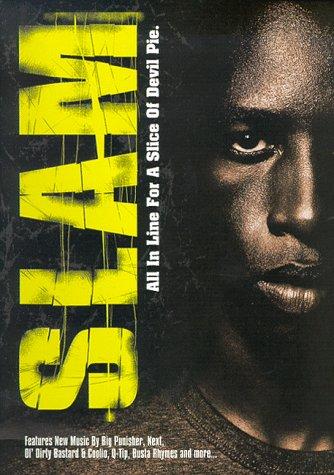 Saul Williams is a poet, hip-hop M.C., producer and actor who first came to prominence through his victory at the poetry Grand Slam at the Nuyorican Poets Café in 1996. This event kick-started an acting career for Williams with the lead role in the feature film Slam in 1998, and a music career in which Williams began to blend his poetry with his love of hip-hop. What makes Williams’ work interesting from a science fiction standpoint is the obvious affinity he has with the genre, evident in his lyrics and the soundscapes that he chooses to rhyme over. From the outset, Williams wrote and produced with a speculative bent. In the song ‘Ohm’ from 1998’s Lyricist Lounge compilation, Williams announced ‘I am no Earthling, I drink moonshine on Mars/And mistake meteors for stars ‘cause I can’t hold my liquor/But I can hold my breath and ascend like wind to the black hole/And play galaxaphones on the fire escapes of your soul’. The glimmering production on ‘Ohm’ is no less science fictional, especially as it accelerates at around the three-minute mark.
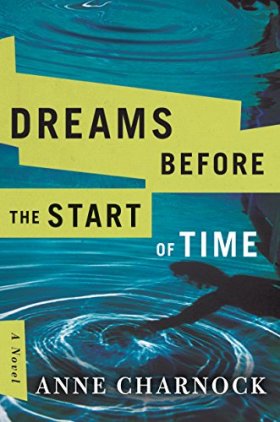 The themes of Anne’s latest novel Dreams Before the Start of Time evolved from ideas about reproductive technologies likely to be with us within the next forty years. The book explores the psychological, ethical, legal and social implications of these technologies by following generations of the same family into the future as they take advantage of these new opportunities and deal with the unexpected consequences. Anne believes that fiction offers the best means of analytically, emotionally and aesthetically engaging with the potential impacts of innovations and trends, from our ‘reproduction’ as digital selves to artificial intelligence, genetic engineering and the emergence of China as both a strategic world player and presence in our future lives.
 Both novels blend crime fiction and science fiction, challenging the genre boundaries. A Man of Shadows is the film noir-influenced story of a 1940s-style gumshoe private eye searching for a teenage runaway, while The Real-Town Murders follows another private investigator trying to solve a case that seems impossible. The idea for the murder came from Alfred Hitchock, who posited: what if a dead body was discovered in the boot of a car that had been assembled by an automatic factory with no human intervention? Hitch said that if he could work out how the body got there he would make the film. He couldn’t, so never did and now Adam Roberts has picked up the challenge.

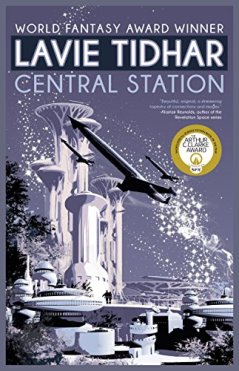 Lavie Tidhar’s style is well-suited to original narrative forms that subvert Western genre fiction tropes, while still engaging with them almost as props. For example, he says this year’s Clarke Award-nominated ‘Central Station’ gave him the opportunity to employ Golden Age imagery, like the action around a spaceport, and then let it fade into the background as if it’s being ignored. However, it’s an approach that can backfire. Another twentieth-century genre that appeals to Lavie is noir detective fiction, and he recalls a synopsis he wrote using the idea of a gumshoe searching for his niece, only for the story’s editor to point out that Lavie had forgotten to include the fate of the girl at any point in the story.



 vector-bsfa.com