Excerpt: How to Suppress Women’s Writing by Joanna Russ

russ

From How to Suppress Women’s Writing, by Joanna Russ

I HAVE A VISION. The streets of midtown Manhattan are filled with all of the professors, professional critics, editors, and judges of award panels. They are all dressed in their ill-fitting suits—they could afford better tailoring but that of course would indicate to their audience that something like beauty is important—but they are tearing them off to replace them with sackcloth. They are on their knees, they are decorating themselves in ashes.

Slowly they crawl out of their blue glass skyscrapers, their suburban commuter rail stations, their off-campus housing to join the mass. It’s not a howl that you hear but a low, unceasing moan. A few, the more dramatic and in need of attention of the group, flog themselves with branches and nylon rope. All of these men, all of these white men, every man who ever told a publishing assistant at a party while pinning her to the wall “you know I am in an open marriage,” every man who ever used the word “histrionic” to describe a woman’s memoir, “articulate” to describe a black man’s performance, or spent two paragraphs speculating about the body of a trans writer in what was supposed to be a review of their work, every professor who used Kanye lyrics in a lecture to show he was with it but taught an all white syllabus, every man who has referred to a Bronte or Emily Dickinson or James Baldwin as a “minor” writer, they are all here.

They have come to atone. They have come to ask for absolution. They have been forced into an encounter with their unconscious, they have finally seen the truth of their bias, the need they have had to believe anyone not of their demographic was a charlatan or a bore, and they have been laid low by this information.The sidewalks are crowded with all they have dismissed and betrayed. Everyone who has been marginalized and written out of the history of literature. They are interested in the spectacle, but skeptical. They have seen this type of performance before, this display of “how could I have been so wrong?”—it was always followed by either a return to previous behavior with slight modifications or an attempt to get laid. But they are transfixed by the image, and they find themselves disappointed that they are still capable of hope, hope that finally they will be seen for their true selves and not through these men’s projections.

When the men finally reach the water, they toss their clothes onto the bonfires that have been burning all night. The stench of burning polyester fills the air. “Forgive us,” they cry, as they hand over their positions to the spectators and write letters of resignation. “We didn’t realize.”

Source: https://thebaffler.com/latest/no-mothers-no-daughters-crispin


Near Future Fictions Salon: Virtual Persons

Extruded Bodies & Phantom Flesh by Andrew Wallace

Virtual Futures’ March 2018 Near Future Fictions Salon explored the theme of Virtual Persons

Virtual Futures grew out of a series of conferences in the mid-90s that sought to develop a new discipline that would confront the technologisation of culture. Its latest incarnation is a regular ‘Salon’, where philosophical, scientific and creative thinkers combine discussion, performance and fiction to explore current and potential technological extensions of the human condition.

The Near Future Fictions Salons place science fiction centre stage, with previous guest participants including Alan Moore, Pat Cadigan, Gwyneth Jones, Hari Kunzru and Geoff Ryman.

Monday’s event explored the theme of ‘Virtual Persons’:

The digital world is a personality playground that offers us an unprecedented ability to curate and create a public persona – but what does this ability mean for the future of personhood? [from http://www.virtualfutures.co.uk]

Opening keynote by performance artist Stelarc

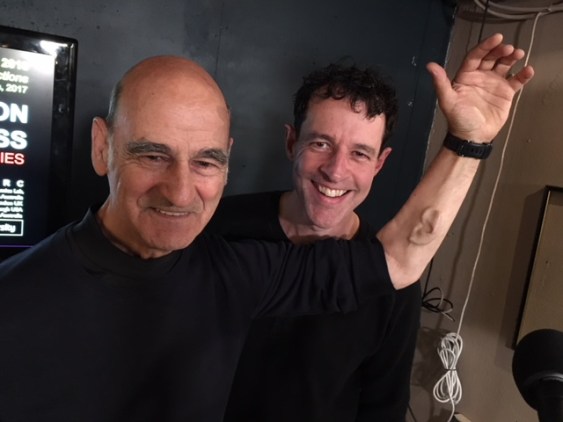
Stelarc took part in the original Virtual Futures conferences at Warwick University in the 90s. His work explores alternative anatomical architectures, interrogating issues of agency, identity and the post-human. He has performed with a mechanical third hand, a stomach sculpture and a six-legged walking robot; while Fractal Flesh, Ping Body and Parasite are internet performances that explore remote and involuntary choreography. Most recently, he has harnessed surgery and stem-cell technology to grow an ear on his arm.

thumbnail_Andrew Wallace & Stelarc
Stelarc and Andrew Wallace

Continue reading “Near Future Fictions Salon: Virtual Persons”

Virtual Futures: Near-Future Fictions Vol. 5 ‘Virtual Persons’

VF NFF 5

Near-Future Fictions Vol. 5 ‘Virtual Persons’ will take place on March 20, 2018, at The LIBRARY London. You can register here

By Stephen Oram

The digital world is a personality playground that offers us an unprecedented ability to curate and create a public persona — but what does this ability mean for the future of personhood? As the digital world expands around us and the Internet of Things combines the physical and virtual do we have a moral obligation to represent ourselves with truth and integrity in the digital realm, or should we view it as an opportunity to explore new and radical ontologies?

Join us for an evening that incorporates original reading, performance and live art as Virtual Futures continues its mission to reassert the significance of science fiction as a tool for navigating the increasing technologization of society and culture.

Keynote Presentation by Laurie Penny, Writer

Laurie Penny is an award-winning journalist, essayist, public speaker, writer, activist, internet nanocelebrity and author of six books, including Unspeakable Things (Bloomsbury 2014), Everything Belongs To The Future (Tor, 2016) and Bitch Doctrine (Bloomsbury, 2017). Laurie writes essays, columns, features and gonzo journalism about politics, social justice, pop culture, feminism, technology and mental health. When she gets time, she also writes creepy political science fiction.

Authors & Contributors

  • A C Tyger: “Aldebaran”
  • Anne McKinnon: “Memory Inc.”
  • Britta Schulte: “iDentity”
  • C R Dudley: “The Test”
  • Jamie Watt: “Conjugal Frape”
  • Jane Norris: “Beautiful Mirror Being”
  • Marc Böhlen: “With a robot on the last day”
  • Sophie Sparham: “Concrete Genocide”
  • Stephen Oram: “From Dust to Digital and Back”

Curators

Britta Schulte is a PhD student by day and a science-fiction writer at night. She thinks about the technologies we have, those we are likely to get and those we might not want. She publishes on wattpad.com as well as in zines online and in print.

Stephen Oram writes science fiction. He’s been a hippie-punk, religious-squatter and a bureaucrat-anarchist; he thrives on contradictions. He has two published novels, Quantum Confessions and Fluence and is in several anthologies. His recent collection, Eating Robots and Other Stories, was described by the Morning Star as one of the top radical works of fiction in 2017.

vf-about

Virtual Futures’ Near-Future Fictions was born after a salon event sometime in early 2017. Although Virtual Futures has embraced science-fiction since its inception, with Pat Cadigan, Alan Moore, Gwyneth Jones, Hari Kunzru and most recently Geoff Ryman all having graced its stage in its near-twenty-five years of existence, this represents the first time that fiction has been the central focus.

The inspiration came from a desire to provide a creative counterbalance to the theoretical and technical discussions of Virtual Futures’ salon events. Our first movement toward this creative fusion was inviting Stephen Oram to be our Author in Residence for a year; presenting a theme-inspired story before audience questions at expert panels discussing near-future issues such as Neurostimulation or Prosthetic Envy. The synthesis was a success. Stephen’s stories grew ever more stimulating, we thought we heard whisperings of something a little larger in the audience’s applause and Stephen has since become the lead-curator of Near-Future Fictions.

The aim of these live reading events are: to assert the significance of fiction as a valid means of navigating the changes instigated by emerging technologies; to find new sci-fi talent in and outside London, with a stress on diverse authors who are atypical of the scene; and to offer science fiction fans speculation on the future in a venue that reflects the vibrancy of the authors and their stories.

File 08-03-2017, 15 33 01

The 2018 series started in February with The (Dis)ease of the i-Mortal and will be closely followed by Virtual Persons on 20 March, Tomorrow’s Battles on 17 April and Post-Brain on 15 May.

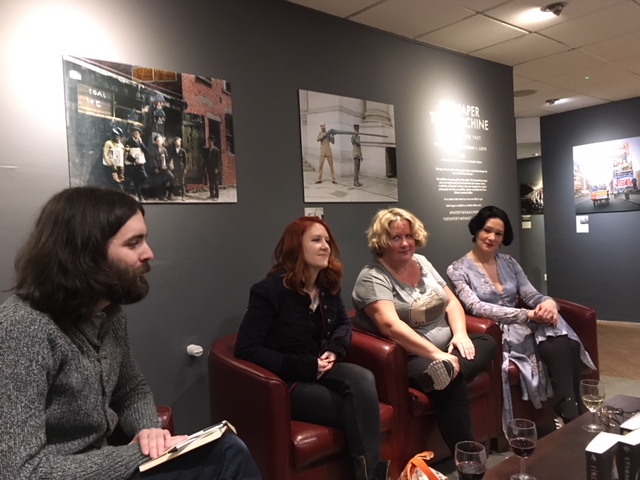
Fantasy Fiction with Vic James, Anna Smith Spark & Lucy Hounsom. A SciFi Sessions conversation, hosted by Glyn Morgan at Gower Street Waterstones in London.

IMG_0283By Andrew Wallace

January’s Sci-Fi Sessions was a conversation between three very different contemporary fantasy authors. Each one has a trilogy in progress. Lucy Hounsom has just released the final book of her acclaimed Worldmaker series (Starborn, Heartland and Firestorm). Tarnished City, the second novel in Vic James’s Dark Gifts trilogy, was published last year. It follows the success of book one, Gilded Cage, as a BBC 2 Book Club Choice. Finally, Anna Smith Spark’s Court of Broken Knives, the opening volume of her Broken Empire sequence, has already been nominated for numerous awards for best fantasy novel of 2017, with second and third volumes yet to follow. Continue reading “Fantasy Fiction with Vic James, Anna Smith Spark & Lucy Hounsom. A SciFi Sessions conversation, hosted by Glyn Morgan at Gower Street Waterstones in London.”

Friday essay: science fiction’s women problem

Image 20160915 4972 gqonsw.png?ixlib=rb 1.1
We need women to participate equally in science fiction’s conversations about humanity’s future.
MsSaraKelly, CC BY-SA

Bronwyn Lovell, Flinders University

Since 1953, the Hugo Awards have been one of science fiction’s most prestigious honours – past winners include Isaac Asimov, Arthur C Clark and Ursula Le Guin. The 2016 results were recently announced, and women and diversity were the clear winners.

However, if you saw the list of titles in contention for the awards, you’d have noticed some oddities, such as Chuck Tingle’s Space Raptor Butt Invasion and My Little Pony’s The Cutie Map. That’s because the awards – nominated and voted on by science fiction writers and readers – have been targeted by two major voting blocs: the Sad Puppies, who started their campaign in 2013, and the Rabid Puppies, who appeared the year after and have been growing stronger ever since.

The Sad Puppies wanted more traditional, mainstream popular science fiction on the ballot. The more extreme Rabid Puppies, who have ties with the Gamergate movement, were about creating chaos. So their bloc included ridiculous-sounding works: both to mock the awards and stack the ballot to prevent more diverse books being nominated.

Both groups’ gripe is with contemporary trends in science fiction toward more literary works with progressive themes. Vox Day, leader of the Rabid Puppies, complains that “publishers have been trying to pass off romance in space and left-wing diversity lectures as science fiction”. Last year’s leader of the Sad Puppies, Brad R. Torgersen, likewise complains about “soft science majors (lit and humanities degrees) using SF/F as a tool to critically examine and vivisect 21st century Western society”. The Hugos, he says, are being used as an “affirmative action award”.

A significant number of those “soft science majors” writing “left-wing diversity lectures” are, of course, women. Female authors have dominated science fiction awards of late.

This year, women (and people of colour) did very well at the awards. Ironically, the Puppies’ activities have now galvanised more progressive members of the World Science Fiction Society to use their voting rights. The best novel was The Fifth Season, a tale of a planet experiencing apocalyptic climate change, written by NK Jemisin – a black, female writer. Best novella was Binti by Nnedi Okorafor. The best short story, Cat Pictures Please, was written by Naomi Kritzer and both best editor gongs went to women.

But the ongoing saga of the Puppies and their attempts to derail the Hugos exemplifies broader conflicts within the realm of science fiction – an enormously popular, lucrative and controversial genre that has major issues with women.

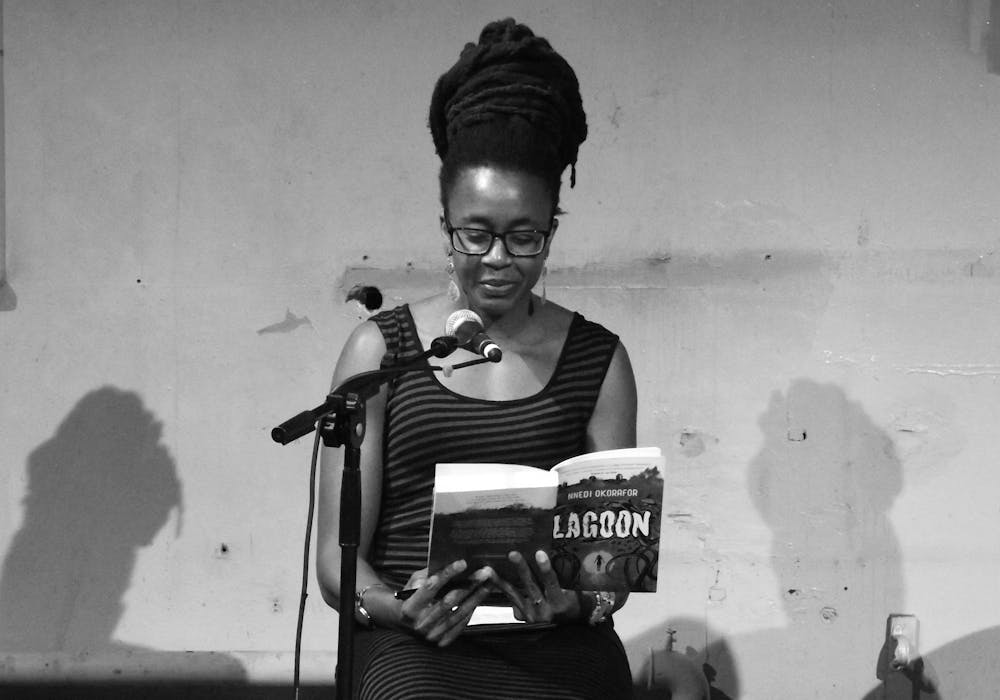
Hugo award winner Nnedi Okorafor at a reading of her work.
byronv2, CC BY-NC

A male dominated genre

Continue reading “Friday essay: science fiction’s women problem”

LSFRC event: Brian Stableford–Le Roman Scientifique

sabBrian Stableford will be speaking about the evolution of an important early science fiction form, the French roman scientifique, supported by the London Science Fiction Research Community (LSFRC).
Monday, February 12th, from 6:30 pm until 8pm, at The Keynes Library, 43 Gordon Square, London.

Brian’s lecture will map its way according to several signposts: Beginning with the origins of the roman scientifique in the illicit “philosophical fiction” of the eighteenth century, he will also discuss the after-effects of the French Revolution on utopian thought and the future impact of technological advancement on society; the development of “travelogue fiction” before and after Jules Verne; the preoccupation with future wars after 1870; the development of “scientific marvel fiction”; and the particular influence of WWI on French writers and their speculative fiction.

In addition to critical studies of science fiction, Stableford has authored more than 70 novels and translated even more, most from French to English. His work on the development of the roman scientifique in the long nineteenth century has vital significance for understanding later manifestations of science fiction in France, the Anglo-American setting, and around the globe. We hope you can join us for what is sure to be a fascinating evening with one of the most influential and prolific figures in science fiction.

#SciFiSessions: M John Harrison & Gary Budden

A SciFi Sessions conversation, hosted by Glyn Morgan at Gower Street Waterstones (London).  Click here for details of future events,  #SciFiSessions return in January 2018 with a special three author event showcasing British fantasy talent. 

 Weird Fiction for Weird Times by Andrew Wallace

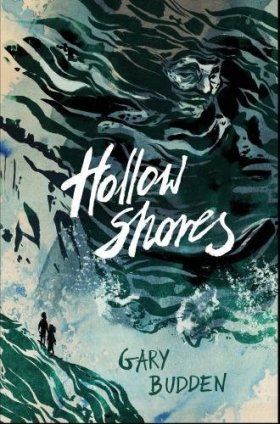
HSMike John Harrison, a veteran of the 60s New Wave SF scene, and Gary Budden, an award-nominated short story writer whose first collection Hollow Shores (Dead Ink Press) is out now, discussed how weird fiction is indispensable for processing contemporary political realities.

Mike recounts JG Ballard at a party held by seminal SF magazine New Worlds predicting how the world would become ever more fantastical and psychopathic. At the time, everyone thought Ballard was overstating the case; now, Mike says, his own ferocious, mythic engagement with the culture feels redundant. Indeed, far from our culture inhabiting an exciting new realm of limitless possibility, some reality would be rather welcome. Gary says that the current fractured, nonsensical nature of the world means that weird fiction is resurgent; that the genre is merely reporting on the psychological state of our culture. Indeed, a contemporary writer of ‘realist’ fiction would now need to accommodate the weird simply to reflect what is going on.

Both writers engage with landscape in ways that challenge its conventional certainties. For example, Gary read a short piece about the actor Peter Cushing, who lived in Whitstable. In the story, the actor is referred to via his greatest roles, like ‘the Vampire Hunter’, as he wanders around the seaside town accompanied by his best friend, ‘the Vampire’ (presumably Christopher Lee). They meditate on their great fictional battles, surrounded by the everyday bustle of modern life, and meditate on an uncertain future. This blending of myth and reality has personal note: Gary grew up in Whitstable and the area has a strong folkloric identity. He writes weird fiction because that is the only genre that reflects his understanding of this familiar landscape. One way to reconcile the desire for his home space to be closer to its mythical – but not idealised – identity, and further from its proximity to prime UKIP country, is to use techniques of psychogeography, or as Gary calls it ‘landscape punk’. The Hollow Shores are a real place; the name is drawn from history like some treasure previously submerged that has slowly come to light.

However, the stratification of the English landscape brings political peril. The online Hookland project, which explores a fictional English county using folklore, spent the day of the discussion fighting off an English neo-Nazi who wanted to use the site to justify national/racial purity. Mike says that writers should make their position on landscape politics clear, and maintain awareness that landscape itself has no sentimentality at all. It has its own language, often weird, that should be used with full awareness to avoid the descent into easy nationalism.

Gary is interested in the fringe elements of our island; how its marginal landscapes change over time in a way that seems arbitrary, even absurd. For example, Whitstable would not even have been on the coast when the area now known as Doggerland linked Kent to mainland Europe 10,000 years ago. Doggerland was flooded at the end of the last Ice Age, a prospect we face on the attenuated landmasses of our own time. But for a few degrees’ variation in temperature, the Britain we know would not have existed and neither, in our current form, would we. There is a sense of possibility, only just missed, that folkloric weird fiction reflects so well.

harrisonCreation of a fictional Doggerland-like continent lay behind one of Mike’s projects for New Worlds, in which elements of a series of seemingly unconnected narratives would reveal that a new continent had appeared. Although the book never came to fruition, the stories evolved and formed part of his new collection, You Should Come With Me Now, published by Comma Press. He read a story from the collection called Psychoarcheology. Ostensibly a satire about the unending discovery of royal remains beneath car parks, it also looked at how the royals themselves are as trapped by their DNA into a life of rule they may not want, as their bodies are trapped beneath tarmac. This layering is an example of one of the different narrative techniques Mike uses to draw the reader through stories that do not have conventional narrative plots. Another is ‘reframing’, in which characters are moved through different landscapes as if on a journey, placing them in unfamiliar locations to accentuate the essential quality of strangeness. The weird, then, is as much to do with the way the story is told as its subject matter.

2018 Science Fiction Foundation Masterclass in Science Fiction Criticism

Applications are now open for the 2018 Science Fiction Foundation Masterclass in Science Fiction Criticism. The 2018 Masterclass, the Eleventh, will take place from Friday 29 June to Sunday 1 July. This year we will be at Anglia Ruskin University.

The 2018 Class Leaders are:

Nick Hubble (Brunel University) – Nick is co-editor of the Science Fiction Handbook (2013) and London in Contemporary British Fiction (2016)

John J. Johnston (Egypt Exploration Society) – John is co-editor of the mummy anthology Unearthed, his introduction for which was shortlisted for the BSFA Award for Non-Fiction.

Stephanie Saulter (author) – Stephanie is the author of Gemsigns and its sequels

Price: £225; £175 for registered postgraduate students.

To apply please send a short (no more than 3,000 words) piece of critical writing (a blog entry, review, essay, or other piece), and a one page curriculum vitae, to farah.sf@gmail.com.

Applications received by 1 March 2018 will be considered by an Applications Committee. Applications received after 30 March may be considered if places are still available, on a strictly first-come first served basis.

A deposit of £50 will be payable within a week of acceptance.  This deposit is only refundable in the event of another student taking your place

Past Masterclass students are encouraged to apply again (though we will prioritise applications from those who have not been previous students).

Information on past Masterclasses can be found at http://www.sf-foundation.org/masterclass. Please direct any enquiries to masterclass@sf-foundation.org.

#SciFiSessions: Adam Roberts & Jeff Noon

The first of Sci-Fi Sessions with Glyn Morgan, at Waterstones (Gower Street, London). Click here for details of future events, #SciFiSessions return in January 2018.

scifi1

Andrew Wallace

Host Glyn Morgan (a former editor of Vector) was joined by two distinguished science fiction authors: Adam Roberts and Jeff Noon. Adam is a lecturer in nineteenth-century fiction at Royal Holloway and the author of seventeen books, including the British Science Fiction Association Award-winning Jack Glass. Jeff is a former punk, doyen of the 90s Madchester rave scene and author of eleven books, the first of which, Vurt won the Arthur C Clarke Award in 1993. Both have recently published new novels; Jeff’s A Man of Shadows is published by Angry Robot; Adam’s The Real Town Murders by Gollancz.

rtown2017Both novels blend crime fiction and science fiction, challenging the genre boundaries. A Man of Shadows is the film noir-influenced story of a 1940s-style gumshoe private eye searching for a teenage runaway, while The Real-Town Murders follows another private investigator trying to solve a case that seems impossible. The idea for the murder came from Alfred Hitchock, who posited: what if a dead body was discovered in the boot of a car that had been assembled by an automatic factory with no human intervention? Hitch said that if he could work out how the body got there he would make the film. He couldn’t, so never did and now Adam Roberts has picked up the challenge.

Continue reading “#SciFiSessions: Adam Roberts & Jeff Noon”

Sometimes a spaceship is just a spaceship: Lavie Tidhar interviewed by Konrad Walewski

The British Science Fiction Association holds regular events in London, usually on the last Wednesday of the month, at the Artillery Arms near Old Street. These events are free, and open to members and non-members alike. Keep an eye on the BSFA website for news of future events. In September, award-winning author Lavie Tidhar was interviewed by critic and editor Konrad Walewski.

Andrew Wallace engages the metadata…

lavieLavie Tidhar’s style is well-suited to original narrative forms that subvert Western genre fiction tropes, while still engaging with them almost as props. For example, he says this year’s Clarke Award-nominated ‘Central Station’ gave him the opportunity to employ Golden Age imagery, like the action around a spaceport, and then let it fade into the background as if it’s being ignored. However, it’s an approach that can backfire. Another twentieth-century genre that appeals to Lavie is noir detective fiction, and he recalls a synopsis he wrote using the idea of a gumshoe searching for his niece, only for the story’s editor to point out that Lavie had forgotten to include the fate of the girl at any point in the story.

The noir angle could be the reason Lavie has been linked with cyberpunk, although he considers the association inaccurate, describing ‘Neuromancer’ as ‘Chandler with computers’. He decries the ten years between that novel and ‘Snow Crash’, in which people emulated what they thought was a new formula for success. Also, there is nothing hard-boiled about ‘Central Station’. While cyberpunk is about cool, hi-tech cowboys saving the world from a rogue AI, Lavie’s books are about people who get the kids to school and then go to work defeating the AI. Indeed, he sees ‘Central Station’ as a romance novel; its wedding-and-funeral climax more Richard Curtis than William Gibson.

Continue reading “Sometimes a spaceship is just a spaceship: Lavie Tidhar interviewed by Konrad Walewski”