
Torque Control
Vector #160
Vector #158

As a utopia, the Culture’s a utopia that needs this ruthless edge: Special Circumstances, manipulation of other societies and so forth.
Yes, that’s me bending over backwards to be fair and not make the Culture look so goody-goody. The idea that this is something of the Culture that occurs very very rarely indeed, the fact that it’s the most interesting thing that I can write about, is probably more an indication of my failings as a writer than any possible failings of this totally theoretical civilisation.
Is it possible that there’s nothing interesting that can happen in a utopia?
When actually there is. Even in a utopia you still have heartbreak, you still have unrequited love, you still have ambition that’s unfulfilled; so there’s lots of things, all the sort of human things you can write about in a utopia. But in what I’ve been wanting to write about for the last few years, you have to go to the outside edge of the Culture where there’s the interface between Culture and non-Culture, as it were, where interesting things are happening. It’s the old Chinese curse, “May you live in interesting times.” They’re good to read about but hell to live through and that’s – the very fact that they’re good to read about – what I want to write. And the Culture has always got a good reason for what it wants to do. It claims that it actually is doing it not for its own – not for imperialistic reasons or anything, but things which have to be done. Basically it’s a utilitarian argument.
Iain M. Banks interviewed by Andy Sawyer
One question remains unasked (and thus unanswered) – the subject of this article: given that sf uses the future to reflect today’s preoccupations, why did the appearance of a major new technology evoke such a trivial response? Because the use of computers in cyberpunk is trivial. This technology is, today, evolving so rapidly that it is possible to look at a machine built only ten years ago and describe it in terms of archaeology. Current research in virtual environments and nano-technology is threatening to render reality itself obsolescent within a time scale of two to five decades. The possibility of creating a true artificial intelligence remains questionable, but the question is still fundamentally an open one. Surely the cyberpunks, with their position somewhere between the poles of rigorous techno-extrapolation and humanist self-scrutiny, should have been able to identify and address these questions. But why didn’t they?
Charles Stross
But how did I come to this though? There are several reasons. I was brought up during the war; as a child there wasn’t any food to speak of. A treat for us was a slice of potato and onion done in the oven in Oxo gravy. Any meat that come into the house went to the father, I remember one slice of bacon on a Sunday morning if we were good, as an absolute treat, and so on. Windfalls, of plums and pears in Autumn, were a much looked-forward to treat, and so when food started to come back into the shops and then lots of foreign influences came into play. I also had dreams, I don’t know where these came from, of being a great hostess of fantastic banqueting entertainment, and I just got very very interested. I was just astounded to realise that there was actually such a thing as SPaghetti outside of a Heinz tin, and it’s just been a long voyage of discovery. And then I found out that I was in fact a very excellent cook, so when I got a family and also started doing dinner parties, it was just a very creative thing. I just enjoyed it. I’ve also been very interested in vitamins and biochemistry. I was in school when I realised that health could possibly be got by the right diet, so between all these influences, and also liking describing them in detail, it was inevitable that all my work should include food. My greatest discovery about food, paradoxically, is that the cleanest zen macrobiotic diet is the one which makes you feel absolutely wonderful if you stick to it.
Josephine Saxton
[…] It’s all a bit heavy really, but there’s no reason why this shouldn’t be done with lots more humour. As I said, we should lighten up, it doesn’t have to be a miserable world.
Well, Queen of The States does have some very funny scenes though I’m not sure if it’s a happy ending.
Well she escapes, she escapes both from the aliens and from her husband.
Yes, but it is a neutral ending in that it comes down to “Right I’m free… Now what?”
True, but that is quite a good place to end a novel about the struggle to straighten your head out, get your strength together, and not be dominated by society or whatever.
To go back to your being picked up by The Women’s Press, they’ve labelled your first two books for them as Science Fiction, but you say you aren’t a Science Fiction writer.
Well, I’m not, if you look at Robert Heinlein and say that is Science Fiction. I’m not that well up on it, but to me it is the same scenes and the same things all churned out every time by hundreds of authors all writing the same thing. I do read all the time, I’ve just read Peter Ackroyd’s Chatterton, yet another history of the Brontes and an Australian writer whose name eludes me. A few years ago I was doing some reviewing for The New Statesman, and I had to read a lot of Science Fiction for them, and it was the hardest piece of work. You have to read them all, you can’t discard the things you don’t like.
Josephine Saxton, Thank you very much.
You’re very welcome.
Josephine Saxton interviewed by Kev McVeigh
Vector #150

Vector #140
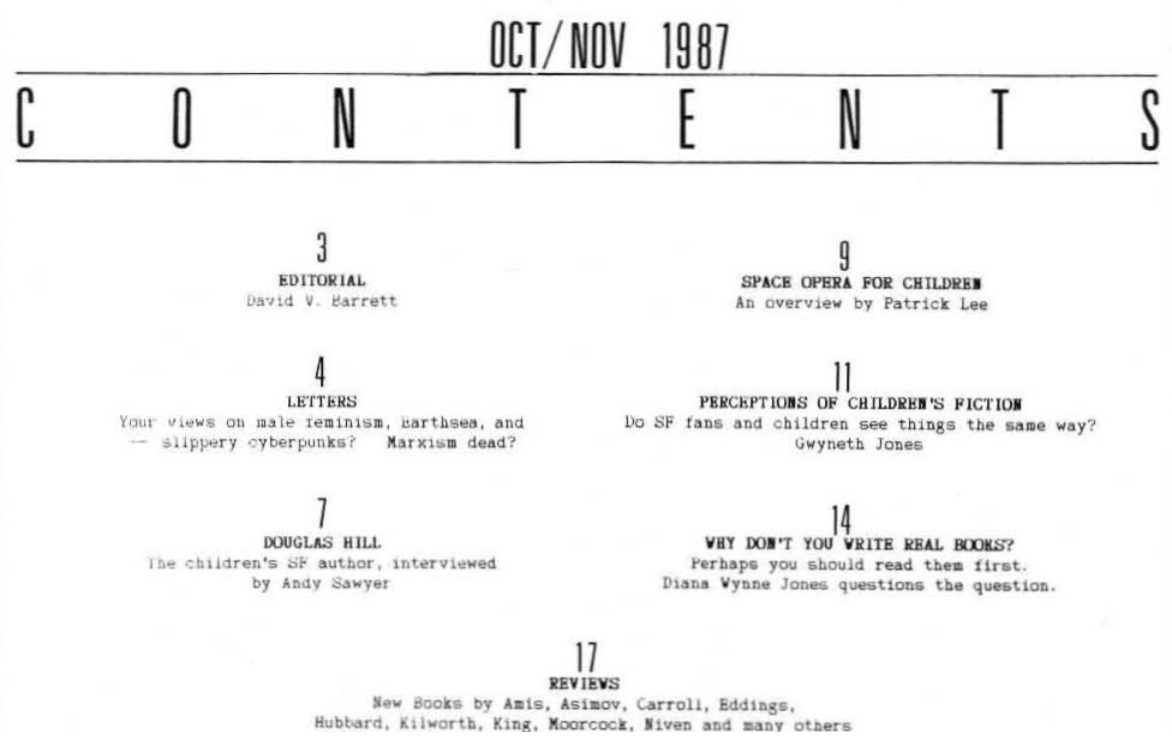
Why devote an issue of Vector to something many BSFA members said goodbye to years ago? Why should adults read something written for 10 year olds? Who is children’s SF actually written for? And why? Why should children read it? Does it have any value? Why should there be such a thing?
David V. Barrett
In writing SF, you try to achieve the shock of the new by inventing or distorting the world of your fiction. Children’s writers do not have to try with the externals, the readers’ inexperience is enough. The journey they must make is into their own past. But the technique is the same: a kind of cleaning of the needle — re-cognition of a world that is strange but also your own.
Gwyneth Jones
But the main thing I set out to do, at the start, was to break the two really restrictive old taboos. Taboo One stated that all adults, particularly parents, must be shown as wise, powerful, kind, understanding — in fact, faultless. Adults with faults were Baddies and had to be killed or reformed on the last page. Taboo Two permitted one child in each book to have one fault in order that he or she could be punished horribly, thus making the book Moral.
Diana Wynne Jones
So I decided to recognise this and treat every character of whatever age as a real person. The resulting freedom astonished me. The battle-line stopped seeming grim. I saw it as just a set of people with fears and foibles like anyone else. And there was no need to wonder what children wanted. I knew, since children are people too. I could write about the whole human race (ad any non-humans I cared to devise) and the only limit turned out to be that anyone reading the book has to be able to say, “Oh yes, we would react just like that!”
Diana Wynne Jones
Vector #130
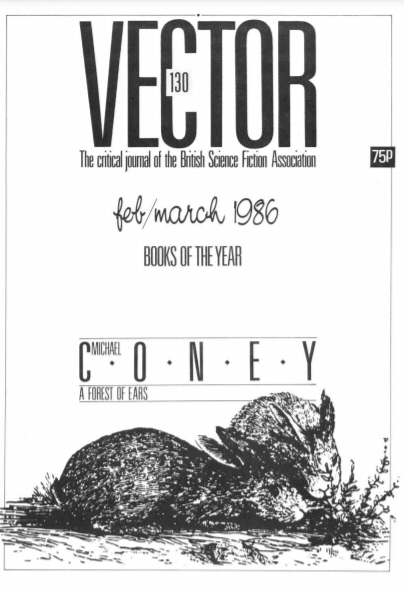
As writers we have the ability to create perfection, however: which may be another good reason for writing science fiction. From the biological standpoint we have a choice of two kinds of perfection: expanding or stable. The expanding kind postulates a dominant race, usually human, colonizing an ever-increasing number of worlds. There can be no end to the process of expansion because, like economic growth rates and the Roman Empire, the only alternative is collapse. Conflict is provided by the opposition of other races and such stories tend to be technological in content. An undeniable attraction lies in the headlong progression towards a vast Unknown, but the drawback is an uncomfortable similarity to our present situation on Earth.
I chose the second alternative for my recent novels because of its inherent optimism: it is theoretically possible to reach and sustain a stable perfection. The end product is a planet which a perfect ecology with a diversity of plants and animals dovetailing into a balanced whole. Conflict is provided by the arising of an occasional imbalance, either internally or externally inflicted. There is little room for technology in this kind of story because it would eventually be defeated by the finite nature of global resources, despite recycling and solar power. British SF often uses this introspective approach, although not always stating openly that life will go on after the difficult period that it often describes. Perhaps here there is an over-preoccupation with human life. The fact that the story is set at a point well before ecological stability is achieved sometimes brands it as ‘pessimistic’ in American eyes. This rather shortsighted view ignores the optimism inherent in the struggle for a stable perfection – as well as the practical impossibility of achieving an expanding perfection.
Michael Coney
Vector #120


Vector #110


I fervently hope that the attitude displayed by my previous article for Vector was not that of an embittered, ‘alf-arsed, unsuccessful, menopausal, hard-drinking, drug-taking, chaotic-rather-than-anarchistic, sexually frustrated, mixed-up-never-had-a-decent-teenage, half-and-self-educated, ivory-tower, fascist-middle-class-Bolshy-uptight-aggressive, dilettante, feminist, lesbian, Outsider, misfit, sour-grapes, never-even-had-a-slice-of-the-cake-never-mind-the-whole-bloody-cake, insufficient-self-sufficiency-freak, would-have-been-a-hippy-except-she-was-stuck-with-kids-on-a-housing-estate, been-through-the-mill-and-came-out-milled, doesn’t-give-a-fuck-about-the-proles, Hitler-must-have-been-okay-kids-and-animals-adored-him, talks-to-plants-they-are-the-only-people-who-understand-me, hide-her-head-in-the-sand-it’s-awful-out-there-and-my-bum’s-worth-viewing, apathetic, sit-on-the-fence, apolitical, mystical, nothin-better-to-do-than, why-doesn’t-she-get-a-decent-job, when-I’m-dead-‘they’-will-make-a-fortune, mere-self-indulgent-self-seeking-sensualist, pie-in-the-sky-dreamer, if-she’d-really-suffered-she-wouldn’t-have-time-for-all-that-psycho-surreal-crap, champion-of-lost-causes-better-lost, lives-in-her-own-world, put-on-dressed-as-sham, atavistic, anti-technology, unrealistic, pretentious, portentous, superior, writes-hairy-things-which-would-benefit-from-Occam’s-razor, obscurantist, Madame-Ovary-hides-again, can’t communicate-with-the-masses, thinks-the-world-owes-her-a-living, intellectual-bluestocking, dumb-woman-Chip-Delany-on-shoulder, penis-envying, message-carrying-nothing-relevant-to-say-really-writer sort of person, because, although all of the above descriptions have been made of me at one time or another, and many of them were, are or will be in some measure true, depending upon the point of view, none of them is all of the picture, but they also describe not only myself but all science fiction writers and readers. That above sentence incidentally is not my longest to date; I think the longest counted was 497 words counted by some angry reviewer with a short-attention span but time to count words who was delightfully misprinted as stating that one of my sentences contained ‘497 worlds’ — pretty good going for any science fiction writer. And the reason also for the fervent hopes at the beginning of this article is because, even if most of Science Fiction fandom either disclaims me or has never heard of me, I wish to be recognised as and am, one of the boys – er – sorry, club.
Josephine Saxon
Vector #103


So now ‘Towards A Critical Standard’ is complete, and forms a good bedrock basis for criticism. I must say that for me it had the effect of crystallising (and expanding) the method I try to employ in my own reviews. Any standard should be able to evaluate such diversities as, say, Dostoievsky, Le Guin, Iris Murdoch, John Norman and Barbara Cartland; and I think Muir’s categories might just cope. Still it is only a basis: I would like to see a standard that takes into account certain novels that break all the rules and still end up as good books. Criticism is to some degree a branch of pathology; the whole of a book is often greater than the sum of its autopsied parts.
And that, of course, while analysing the divisions of literature, leaves untouched the whole question of what books are ‘for’; and why anyone in their right mind should want to read 200-odd pages of total falsehood. A fiction is a lie: there is the paradox that a writer is a person who can only tell the truth by telling lies.
As a subpoint: does this mean that in future Vector might be reviewing books other than those published with the labels of SF and fantasy?
Still on criticism, and David Shotton’s point about slating any kind of serial or series: I think the main requirement is that (however many volumes it runs to) the sequence should have been conceived as a whole. There are obviously books that grow organically from the author’s previous works, like Eddison’s Zimiamvian fantasies and Donaldson’s new Covenant trilogy, but this is still legitimate. The objection is to interminable commercial follow-ups cashing in on the success of a first work — the Dune books, or the McCaffrey dragons, for example which were quite tolerable on their first appearance, but have since been diluted down to total bullshit. Commercialism isn’t a bad touchstone for hackwork.
Speaking of hackwork, I note that a certain Mr T Wogan has got his fangs into Carl Sagan’s Cosmos and the repeats of Blake’s 7. Is nothing sacred?
Mary Gentle


