Torque Control

Automation and Utopia: Human Flourishing in a World without Work by John Danaher

Reviewed by Michael Pitts.

Danaher, John. Automation and Utopia: Human Flourishing in a World without Work. Harvard UP, 2019. Hardcover. 248 pg. $99.95. ISBN 9780674984240.

Automation and Utopia: Human Flourishing in a World without Work is crafted as a response to fears over an automated future in which humans are made obsolete by technological developments. Written by John Danaher, senior lecturer of law at the National University of Ireland, Galway, the text consists of two main sections, which cover automation and the possibility of a utopian future, respectively.

After outlining the scope and purpose of his research, in the first chapter Danaher forecasts the obsolescence of humankind in an automated world. But this is not as catastrophic as it may sound since, for Danaher, “Obsolescence is the process or condition of being no longer useful or used; it is not a state of nonexistence or death” (2). In the rest of the automation section, Danaher responds to two propositions: that automation in the workplace is both possible and desirable, and that automation outside of the workplace is potentially dangerous and its threats must therefore be mitigated.

After making his case for why automation should be conditionally embraced, in the second section Danaher turns to two possible, ‘improved’ societies with automation fundamental to their economies, the cyborg and virtual utopias. While the cyborg utopia enables humankind to remain valuable members of the economy, occupying the cognitive niche that has historically provided an initial evolutionary advantage to the species, Danaher posits that such a future will likely maintain the degradations of employment, enhance our dependency upon machines, and disrupt humanist values while, due to the technological advancements it requires, ensuring no worthy improvements to human wellbeing in the near future.

Following up this analysis of the cyborg polity, Automation and Utopia concludes with a presentation of what Danaher views as the ideal, improved society, the virtual utopia. This improved society, in which humankind ventures into the virtual world to enhance its flourishing, is presented by Danaher as an ideal goal towards which humankind may aim since, as the author posits, it will ensure human agency, pluralism, stability, a myriad of alternative utopias, and a meaningful connection to the non-virtual, real world. 

Pivotal to Danaher’s assessment of automation, and a possibly utopian future, are his views on labor and the avenue he identifies as optimal for human flourishing, the virtual utopia. For the purposes of his argument, he adopts a definition of work which he acknowledges as unusual and likely controversial, since it excludes “most domestic work (cleaning, cooking, childcare)” as well as “things like subsistence farming or slavery” (29). Defining work as “any activity (physical, cognitive, emotional etc.) performed in exchange for an economic reward, or in the ultimate hope of receiving an economic reward,” Danaher builds the case that obsolescence is almost certain and could result in as low as 10% or as high as 40% of the future population remaining employed (28). Such a development is framed as a positive result since work, he emphasizes, has a negative effect upon employees and improving it in the current economic milieu is, according to him, a more difficult route to take than shifting towards a virtual utopia. Specifically, Danaher argues that improving work, which often involves fissuring, precarity, colonization, classic collective action, domination, and distributive injustice is unlikely in our current system since it “would require reform of the basic rules of capitalism, some suppression or ban of widely used technologies as well as reform of the legal and social norms that apply to work” (83). Though this dismissal of the possibility of improving working conditions is short-sighted and ignores the likelihood that labor organizing will prove necessary as technological advances continue, this weakness of the text stands on its periphery. More important to Danaher’s vision of the future is his adoption of an approach that is interestingly more radical than such efforts to protect workers: the introduction of a universal basic income and the normalization of technological unemployment in current economic systems. 

Danaher envisions this radically different distribution of economic power as a salient feature unique to the virtual utopia. Danaher rejects the cyborg utopia, believing it will threaten the prospect of universal basic income and technological unemployment and ensure the continuation of work and the injustices endemic to capitalistic systems. In considering the virtual utopia, Danaher’s audience must consider the ethics and consequences of a nation in which utopian games and escape become a salient feature of its culture. This ideal society is marked by its focus upon virtual worlds as the mechanism by which human flourishing may take place. By venturing into simulations that are shaped to satisfy the desires and needs of individual users, it avoids the problems of a single utopian ideal that must be enforced upon all citizens. It can therefore, as Danaher explains, “allow for the highest expressions of human agency, virtue, and talent… and the most stable and pluralistic understanding of the ideal society” (270). 

Yet as with the cyborg utopia, the virtual utopia is plagued with ethical complications. The question of what actions are permissible in such a simulated environment is closely related to the ethical considerations surrounding cyborgs and artificial intelligence. In very briefly confronting this topic, Danaher asserts that the same moral constraints that shape human interactions in daily life will impact those occupying the virtual world. He supports this argument by pointing out that some of the characters inhabiting the simulation will be operated by human players and that interactions with such players will have ethical dimensions. In addition, he asserts that other actions may be deemed intrinsically immoral even without a corresponding ‘real-life’ consequence.  Danaher asserts that, though there will be some moral frameworks unique to the virtual utopia, there will be no major alteration to human ethics. The virtual utopia, he claims, is therefore a reasonable goal for the post-work society since it enables human flourishing and protects values such as individualism and humanism.

Danaher is also keen to emphasize that “the distinction between the virtual and the real is fluid” (229). He rejects the “stereotypical” science fictional view of virtual reality, as something that is only produced within immersive technological simulations, like the Matrix or Star Trek’s Holodeck. On the other hand, he also rejects the “counterintuitive” view that everything humans experience is virtual reality in that our reality is constructed through language and culture. Instead, Danaher offers a middle position. Some things may be more virtual than others, but nothing is wholly virtual or wholly real. He sees virtual utopia as being filled with emotionally and morally meaningful interactions, but in the context of relatively inconsequential stakes (rather than survival, or struggle for hegemony). A Holodeck-style simulation is only one of many ways this could be accomplished. 

Automation and Utopia delves significantly into the topic of possible futures at the intersection of ethics, technology, and humanism. It is a valuable resource for scholars, students, and laypeople engaged with conversations surrounding the advancement of automation in the 21st-century, its impact upon economics and workers, and optimal approaches to accommodating such new technologies through the advent of a post-work society. The work continues discussions at the intersection of technology and labor, but necessitates broader considerations related to the virtual utopia Danaher proposes. Namely, it does not convincingly explain how virtual utopia will avoid the ethical pitfalls outlined in relation to the cyborg utopia. It also does not thoroughly discuss how such simulations may be safeguarded from economic exploitation at the hands of those owning or operating these systems, or address the potential for intersectional inequalities. Finally, Danaher does not comprehensively discuss how such escapism and the further minimization of human interaction in the natural world may impact climate and the environment. Though it is difficult to accurately predict, estimations of both the ecological and psychological effects of a society in which the main mechanism of human interaction is not within nature but instead within a virtual world are vital to identifying optimal utopian aims.

Overall, Automation and Utopia productively dives into the topics of technological advancement and labor policy, proposes thought-provoking socioeconomic policies related to the challenges of automation, and necessitates further discussions concerning ‘the ideal society,’ its connection to technology, and the impact it may have upon human psychology and the environment. 

Creative Commons License
This work is licensed under a Creative Commons Attribution-NonCommercial-NoDerivatives 4.0 International License

“Do we want that?” Mackenzie Jorgensen interviews Eli Lee

Mackenzie Jorgensen is a Computer Science doctoral researcher working on the social and ethical implications of Artificial Intelligence. We invited Mackenzie to chat with novelist Eli Lee about her debut, A Strange and Brilliant Light (Jo Fletcher, 2021), and representations of AI and automation in speculative fiction. Should we fear or embrace the “rise of the robots”? Or perhaps the robots rose a long time ago, or perhaps that whole paradigm is mistaken? How might AI and automation impact the future of work? What would it mean for emotional work to be automated? How do human and machine stories intersect and blur?

This is part one of two.

A Strange and Brilliant Light, By Eli Lee

Hi Eli, I’m really excited to talk to you today. I gave myself plenty of time to read A Strange and Brilliant Light, but I ended up going through it super quickly, because I enjoyed it so much.

Oh, thank you! 

So I was curious – what made you decide to showcase three women’s stories?

Well, the genesis of the three stories was unexpected even to me. When I started, I wanted to write about a pair of best friends whose lives go in different directions. That’s based on my own relationship with my best friend, who became an incredible political activist whilst I just sat around and watched TV and read books. So that was the real kernel.

But as I wrote, it felt like something was missing. Lal and Rose came to me immediately – Rose was very passionate and active in the world whereas Lal had some of my own flaws – she was bossy, ambitious, and somewhat selfish.

But the dynamic needed a third person who was a contrast to both – and that’s when Lal’s sister Janetta came in. She works in AI, and she’s driven by her own hopes and fears. Once I had those three characters, it felt complete.

Did you see parts of yourself in Lal?

I did. I felt she was a good vehicle for the parts of me I’m less proud of – so she’s a bit selfish and insecure, and she feels belittled by her older sister, stuck in her shadow and ignored, but she’s still a decent person. She wants to work to make money for her family, but she’s just more … petty!

Got it!

And then I put what I would aspire to be in Janetta. Janetta’s very self-sufficient. She’s dedicated to her work and pure of heart. She has insecurities and flaws like the rest of us, but she always works for the greater good. So I kind of separated some of my worst qualities, and the qualities I wish I had, and put them in those two.

And you made them sisters, which works well in that sense.

I’ve got two brothers, but I don’t have a sister. Have you?

No, I have a younger brother.

I mean, this is the thing. Sibling relationships can be so gendered. I wanted to investigate what it’s like if there’s an older sister who is very successful and leaping ahead academically, and then you’re the younger sister in that dynamic. What’s for you? How do you stand out – how are you different, or memorable? So that was Lal.

“I kind of separated some of my worst qualities, and the qualities I wish I had, and put them in those two.”

How far into the future did you kind of picture the novel to be?

One of the get-outs of setting it in an alternate universe is that you don’t have to specify, “This is ten years in the future,” or, “This is fifteen years in the future.” I could choose the kind of technology that fit with the plot. They’re not mind-reading, they’re using mobile phones.

To me, this says it’s not that far in the future? Eight or ten years, perhaps. I’d be interested to hear what you think, as an AI researcher, about when it could plausibly be set? When that early, deep automation of jobs is filtering through?

Eight to ten years, yeah. End of the 2020s.

Then again, part of me thinks maybe that’s too soon! You know when you watch Back to the Future II, and there’s a flying car. It’s set in 2015. We all watched it in the late ‘80s, early ‘90s, and there was this sense that 2015 would look futuristic like that. Now we’re past that date, and the changes don’t seem that drastic.

Right.

So in ten years’ time, maybe things will look the same as they do now? Maybe AI will still be in our lives, but in a way that’s similar to what it is now – essentially under the surface and hidden. Ubiquitous, but hidden. The robots still won’t be serving us coffee! So I’m willing to be proved completely wrong with my timeframe.

I think you’re good! I feel like oftentimes AI is portrayed, especially in media and films, as taking over everything in the very near future. It’s often a dystopian presentation. But actual AIs right now, they’re always just good at one thing. They’re very task-specific. We don’t really have anything like what Janetta was trying to work on, like emotional AI.

Exactly.

And there’s another question: do we want that? Because I feel like emotion is something that makes us human. At the end of the day, AI and tech are a bunch of zeros and ones. You can’t really instill that with real human emotion and experiences, in my opinion. There are scientists out there who disagree though.

I should say that, in terms of eight to ten years, I’m not talking about emotional intelligence and AI. Consciousness is way off, if it ever will happen. I think probably it won’t. But in terms of AI and automation …

Automation, yeah. No, definitely.

My friend works for an AI start-up. He often looks at stuff in my novel, and says, “What the … This is crazy!” And I say, “I know! It’s not meant to be real!” When you watch Ex Machina or Her, there’s a suspension of disbelief. But I guess as an AI researcher it must be even harder, not to just say, “Come on, come on now. That’s not going to happen!”

“Maybe AI will still be in our lives, but in a way that’s similar to what it is nowー essentially under the surface and hidden. Ubiquitous, but hidden.”

And that question of whether AI can be human is just such a long-running, fascinating topic, isn’t it? We just can’t let go of it. That uncanny other self, reflected in an AI.

Yeah, definitely. I agree with you that I can see automation coming more into play in the near future, especially with big companies like Amazon. Which is scary, because people do rely on those big corporations for jobs. We’ve seen recently that unionizing doesn’t necessarily work in those scenarios. That’s one reason Rose’s character is very interesting to me. She explores the future of social justice activism, in a near-future world increasingly dominated by automation.

I knew that you can’t talk about automation without talking about Universal Basic Income. But I didn’t want someone who straight out of the gate was like, “You guys, UBI: I’m going to sort it out.” I wanted to make sure that Rose’s activism wasn’t disconnected from the rest of her life.

So much of the novel is about these three women in their early twenties, figuring out who they are, especially who they are in their relationships. With Rose, an important part of this is how she relates to men of power, or men who have power. There’s her father, her brother, and this other guy Alek, and initially she’s unable to get out from under them.

And so she needed to come into her own power. So I thought, Rose is going to be this activist, but she’s also going to be not sure of herself initially. So a lot of it was their inner struggles, intersecting with those larger economic, social, political, or technological stories.

There was a quote I made note of. ‘Alek said, “True leisure, true creativity and true freedom are within our reach for the first time in human history. And so we must set up source gain and welcome the auts.”’ This seemed quite ironic to me because relinquishing more control of the world could seem like the opposite of freedom. And Rose did realize this as time went on, which was cool to see, as she was learning and growing. 

So Alek was with these other two academics at that point in the novel. Alek’s initial point of view is: “Auts are bad, AIs are bad. We need to just destroy this stuff.” But then when these two guys come along, one of them mentions post-work utopias. John Maynard Keynes wrote about something similar in the 1930s, an essay called ‘Economic Possibilities for our Grandchildren’, and Herbert Marcus wrote Eros and Civilisation in the 1950s, and there has been lots of writing about post-work more recently. 

Maybe machines can do everything, and then you can sit around and play all day, and not have to do things you don’t want to. This idea floats past Alek this evening, and suddenly he’s like, “Oh, wait! Yeah, we can just be free, because auts will do the boring stuff!” 

But that’s obviously not a realistic suggestion, because if you take it a step further, like Rose does, the question is, “Who owns those auts?” Well, if it’s the corporations, that’s not freedom. So that brings Alek back to his original idea: we need source gain. We need some kind of UBI. So in that moment when he talks about post-work leisure, he’s speculating. He’s not thinking about what’s necessary now.

Can you see a world where AI grows in importance alongside human creativity and freedom? Or are they opposing forces?

In a post-work scenario, the AIs are doing the grunt work, doing the kind of cleaning and tidying, and fixing things, and all the behind-the-scenes organisational work, so humans can play and fulfil ourselves. So that’s what Alek would mean by welcoming the auts, I think. But do you mean in terms of AI more as an equal?

I guess, or at least AI growing in social importance, and taking on more and more roles?

The way Alek envisions AI, in that moment, they would be this kind of sub-caste. They’d work away in the background, and you wouldn’t need to worry about them because they wouldn’t be conscious. But I think for us, even without AI consciousness, this could still be a very unsettling and unnerving vision.

We’re already seeing that when AI creeps into more and more areas of life, that ideal of true leisure and creativity gets compromised. You’re surrounded by stuff that’s monitoring you, surveilling you, collecting and analysing your data, perhaps even filtering your reality, and steering you in various ways. It’s almost like the more AI we have, the more inhibited we might feel.

Right, and the more potential problems we might face. On the surveillance point, there’s that moment where Janetta and Taly discuss helping the government with docile spy dogs —

This is one of my cringe moments. I read it now and think, “Spy dogs? What?”

Well Boston Dynamics has a robotic dog. The New York City Police Department had a test run, and there was a huge backlash. So they said, “Okay, actually, no. We are not going to use this.” But about Janetta and Taly’s conversation, I was curious: were you critiquing how governments and the private sector collaborate over surveillance? How do you feel about that? 

Attitudes about surveillance are deeply personal. I’ve got one friend who just does not care about his privacy – he’ll happily give all his data to everything and everyone. It’s not because he believes that it might make society better; he just doesn’t care. I suspect he’s not alone in that.

“We’re already seeing that when AI creeps into more and more areas of life, that ideal of true leisure and creativity gets compromised. You’re surrounded by stuff that’s monitoring you, surveilling you …”

The bird on the front of the novel, illustrated by Sinjin Li, is a CCTV bird. If you look closely, it’s got a little robot-y eye. Taly’s company, Mutants, is all about making stuff that looks friendly and cutesy, but it’s actually spying on you.

Personally, I think we should be very scared about surveillance. And not just visual surveillance, but also the amount of data that we’re giving up to companies more generally. So yes, the book definitely includes a critique of DARPA and agencies like that, who are using AI to further cement their military power.

Early in the book, there’s a humanoid robot that looks like Lal. I wondered if you could talk about that choice? It felt like it might be symbolic of Lal’s almost robotic existence at that point.

That’s a fantastic interpretation of it! Even my editor asked me why I did that. Basically, I just wanted one of the main characters to get the experience of the uncanny valley. It was nothing more than that – a moment of AI spookiness.

It definitely was.

I wanted Lal to have that experience of gazing at a factory produced version of herself.

Another reason for Lal to have that experience is that she hasn’t quite figured out how she feels about the auts. She wants to be part of that world, so this is saying: “Here are versions of you who are part of that world … but they’re just auts. They’re just nothing. They’re also praised and loved by everyone. But they’re still soulless machines. Do you really want to be a soulless machine, Lal?” So you’re right, it does touch on the idea that she becomes a bit of a soulless machine.

Okay.

People ask about that moment, and whether it’s a clue to a big conspiracy. But it’s not there for plot reasons. It’s more about Lal herself, and about the social experience of sharing a world with these uncanny others.

It was an intriguing thing to include early in the novel.

Well, I learned a lot about novel plotting during the writing of this book. And there are some things I’d probably change, because I think that ended up feeling like a red herring.

Lal goes to Tekna and gets absorbed into that world. She expects it’s going to be this shimmering, exciting experience. But actually it’s quite dreary.

Dhont is like an industrial estate. The Tekna Tower is where all the glamour happens, where Taly works, and where the conferences are. Lal sees that and she thinks, “That’s where I’m going to work! That’s where it’s going to happen for me!” 

And then she’s deposited in the backend of nowhere instead. Dhont is meant to imply precarity and being low down on the chain at Tekna; it’s the opposite of the Tekna Tower.

Dhont has also been denuded of people, because of the automation. I don’t know if you saw the Richard Ayoade film, The Double?

I haven’t.

It’s based on a Dostoyevsky novella, I think. Jesse Eisenberg goes to work at this very grim, dystopian factory. But after a while, he’s kind of struggling. Then there’s a double, like another version of him that turns up and aces everything. The film is about their conflict. It’s really good, and the surroundings are very grim and derelict. So I had that industrial dystopian feel in mind. With automation on the rise, and Lal fighting for her survival, I wanted her to realise that working for a glamorous company might not be so glamorous after all. Work in an Amazon warehouse is horrible. So I wanted to pull the rug out from under her.

And she could see the Tower from afar.

From her sad little room!

She does work her way up. But it doesn’t feel like she’s happy with that.

All that glitters isn’t gold. When she does get promoted, she’s aware that there’s something lurking underneath. Something’s not right. She thinks, “Well, okay. This is great, and I’ve got loads of money, loads of time. But things are a bit off…” But then, she’s also competitive, especially with her sister, so she also wants to believe everything’s great. I wanted capitalism to pull her in with all its glories, and then wring her dry.

Yes, it definitely did. At the end, we don’t quite know for sure what she decided. I got the impression she made the right decision.

I’m glad you think she made the right decision. 


Keep your surveillance apparatus peeled for part II, coming soon.


Creative Commons License
This work is licensed under a Creative Commons Attribution-NonCommercial-NoDerivatives 4.0 International License
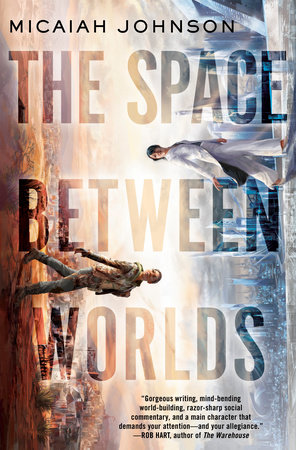
The Space Between Worlds by Micaiah Johnson

Reviewed by Anne F. Wilson. This review first appeared in The BSFA Review.

“Even worthless things can become valuable once they become rare. This is the grand lesson of my life”.

Cara is a survivor. Literally. She is a traverser between 380 alternate worlds, each fractionally different from the next. But she can only travel to worlds where her alternate has already died. Only 8 of the 380 still house living versions of her. All the others have died of natural or unnatural causes. Illness, neglect, abuse, murder. This is because she is a poor child from the deprived area of Ashtown, not a protected citizen of the neighbouring city of Wiley. 

The Space Between Worlds by Micaiah Johnson

Cara is employed by the Eldridge Institute, headed by the charismatic Adam Bosch. Alone of his alternates, Bosch discovered the technology for travelling between the worlds. Cara’s job is data mining on the different worlds. What needs to be changed to achieve a particular effect? Go to the world where it has changed. What is going to happen in the future? Go to a world which is slightly ahead in development. Because she is so rare she is valuable, in that the Institute doesn’t have to employ so many other traversers. But her time is running out, as the Institute is expecting an imminent breakthrough that will make traversers redundant.

But Cara has secrets. She isn’t supposed to bring back trophies from her visits to other worlds, but she does. She isn’t supposed to interact with the inhabitants of those worlds, or get involved in their local disputes, but she does. And it’s from these interactions with the alternates of people in her own world, with lives and relationships slightly shifted, that she starts to put together a very different picture of what is happening on her own world, and what Adam Bosch really wants.

I thoroughly enjoyed this novel. It’s full-on science fiction, exploring that most fundamental question: “What might be changed?” Cara is a thoroughly believable character: bolshy, rough-edged, insecure. She is brutalised by her upbringing, but she’s still human. And in a world where merely surviving is the main aim, or (in Wiley), maintaining or improving one’s position, she is willing to act to improve things. 

The space between worlds isn’t just the space between the 380 worlds that Cara traverses, it’s also the space between Wiley, where she maintains a precarious existence, and Ashtown, her birthplace. It is no coincidence that the original inhabitants of Wiley are pale-skinned and fair-haired, and the Ashtowners are black and brown. “People brought for labor, or come for refuge, or who were here before the first neoliberal surveyed this land and thought to build a paradise”. It’s a dystopia, and in most of the alternate worlds things are getting worse, the gap widening between the privileged in Wiley and those outside, who are prey to brutal gangs and suffer the effects of lack of money, of healthcare, of opportunities. 

Johnson is that most excellent of things, a storyteller. I was caught up in the action and kept reading to find out what happens next. The surprises keep coming. The tight focus on Cara’s viewpoint means that the author can slide in little bits of information that turn out to be significant later. It’s always great to read a novel where what’s next is completely unexpected, and yet when it has happened you think: yes, that fits.

I liked the way that Cara develops as a character. She begins the novel as someone who is defensive and belligerent, scrambling not to lose her hard-won place in Wiley. Once she begins to find out the rules that govern her existence, Cara discovers that she can make choices, and unsurprisingly these lead her and others into danger. It is only by using the ingrained knowledge from her harsh upbringing outside Wiley that she has a chance of surviving and saving those that she cares for.

Copyright Anne F. Wilson.

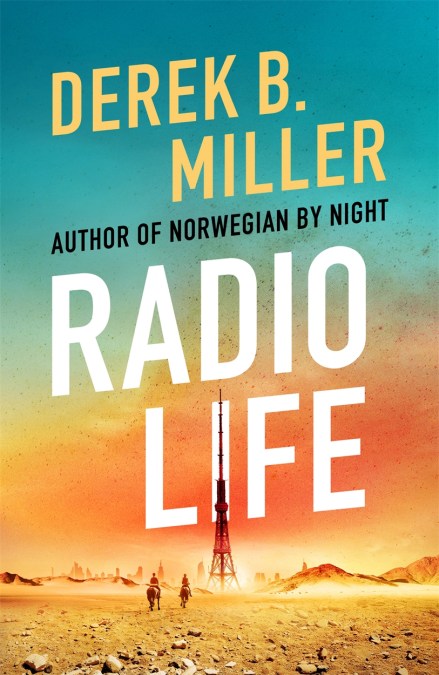
Radio Life by Derek B. Miller

Reviewed by Andy Sawyer. This review first appeared in The BSFA Review.

Our world collapsed in chaos and war at the end of the 21st century after a solar flare disrupted information networks. Now, the Commonwealth, devoted to rescuing knowledge from the Gone World, is sending out expeditions and creating an Archive. Fifty years ago, Lilly’s discovery of the “Harrington Box” inspired a renaissance based upon the collection of books and the “Trivial Pursuits” set it contained. Lilly is now Chief Engineer of the Commonwealth, whose headquarters is a sports centre built for the Olympics. One of her projects is rebuilding technologies including a radio, on which voices from elsewhere were heard until it ceased to work. A new fuse has been found by a pair of scavengers and given to Lilly. But a tribe known as the Keepers are threatening the networks of Raiders and Explorers and Runners, and the Commonwealth itself. Meanwhile, sixteen-year-old Elimisha, an Archive Runner, is pursued into a building which collapses, leaving her injured and unable to escape – but in a room containing an “artificial intelligence entity” which identifies itself as a Librarian . . . and a radio.

When Elimisha’s voice is received by Lilly’s radio, another Runner, Allesandra, is sent to rescue her. Her mission is critical, because it is suspected that Elimisha has found the secret of the Ancients’ success – the Internet.

Radio Life

The joke here – it rapidly becomes clear that Lilly etc. don’t actually know what the Internet is – is certainly one of the reasons to read the book: running through it is a vein of humour which counterpoints the bleak post-apocalypse scenario without undermining a serious core: an examination of the nature and purpose of knowledge. Miller has acknowledged the influence of Walter M. Miller’s (no relation) A Canticle for Leibowitz in Radio Life. In some ways he has written a parallel to – or even a parody of – the earlier classic. (There is even a religious community, in which the telling of another joke, an old and hoary music-hall item, somehow underlines the story’s essence.) Like Leibowitz, which itself reveals a dark, even despairing joke at its core, Radio Life is about regaining knowledge, even at the cost of not fully understanding the extent and implications of that knowledge. Derek Miller distributes the hazy search for uncovering the history of this precarious society among a number of interestingly-imagined characters: Lilly, Allesandra and Elimisha, but also Henry (Henrietta) and Graham, (Allesandra’s parents), and Birch, the “Master of the Order of Silence” (one of the interesting things about the Commonwealth is the complicated web of organisations, networks and rivalries within it).

For a while, this is a standard if well-imagined and told tale of post-Apocalypse recovery. But as the complexities within the Commonwealth and its immediate history become apparent, things get deeper. A confrontation between Graham, captured by the Keepers, and the Keeper leader makes us face the question begged by too many of these fictions: are they right to want to regain the knowledge of the past? During their conversation we learn why the Keepers are called the Keepers, and what they want to keep. This is not necessarily a debate between right and wrong. The Ancients had wonderful technology. (The generic term for material scavenged and brought back is telling: “shinies”). One of the delightful “histories” of the pre-catastrophe decades uncovered by Elimisha and Allesandra is the up-until-then undiscovered treasure trove of recorded music. But the legacy of previous days also includes war, genocide, slavery, racism: “So many categories of people, all attacking other categories”. The Ancients did “awful things to each other”. Should those memories be brought back, risking shame and anger and revenge?

Or could the world be rebuilt, better? Walter M. Miller’s theology seemed to suggest not. His namesake, possibly more secular, seems to prefer otherwise. Radio Life rather slips, at the end, into hand-waving improvement, but the arguments are worth confronting.

Copyright Andy Sawyer. All rights reserved.

Fearless by Allen Stroud

Reviewed by Dev Agarwal. This review first appeared in The BSFA Review.

Allen Stroud’s name will be well known to readers in this parish. He is currently BSFA Chair and has long been prominent in genre circles. His latest novel has been positively reviewed, including in Amazing Stories, where Ernest Lilley recommended Fearless and observed that Stroud brings “a Clarkian feel that grounds the story in the best tradition of science fiction.”

Fearless is, by flavour, not only science fiction, but specifically, space opera. Space opera, as a subgenre, has arguably two sets of defining characteristics. There is its iconography of spaceships, colony worlds, disasters, piracy and spaceship battles. However, equally important are its tonal choices of larger-than-life characters, intrigue, extravagant settings and fast-paced plotting.  Which Brian Aldiss neatly captured in his term “widescreen baroque.”

While it is fallacious to say that space opera is enjoying a renaissance (as it never went away) it is true to say that prominent names, including James S.A. Corey, Charles Stross and Ann Leckie, have boosted space opera and broadened its appeal. They built on the founding ideas of the original space opera and the popularity of the New Space Opera that came after it.  This number of books has inevitably crowded the field and the challenge for any writer is how to make their space opera stand out. 

Allen Stroud throws us into his version of the “widescreen baroque.” The novel is set in AD 2118 with habitats across the solar system (where humanity has colonised the Moon, Mars, Ceres and Europa). Fearless feels confidently New Space Opera, as it melds pyrotechnic action with ethical dilemmas and strong characterisation. This is particularly evident where Stroud challenges the male-dominated narratives of the past, to put a woman, Captain Ellisa Shann, in command of the space going vessel Khidr. Shann is one of the novel’s three first person protagonists (which also include two junior crew members, Johannson and Sellis). Shann is the most distinct of the narrators, in part because she was born without legs. Ordinarily, her story, or backstory, would include how she overcame this disability, or is defined by it.  However, Stroud has said that he “wanted to portray a disabled character in space who was not attempting to overcome her disability.” Shann’s disability is a part of her, rather than all of her.

Khidr is a rescue ship and this feels like a distinct social point that Stroud makes. He is writing space opera, and enthusiastically opening its toybox for the reader. But he is not revelling in the violence of a warship. Khidr has been described by other reviewers as analogous to the coast guard or an emergency service and its purpose ordinarily, is to assist other vessels, rather than fight. New Space Opera is able to widen the narrative to include people like Shann, physically disabled but still capable, who are in space with altruistic intentions––rather than opportunistic ones.

The Khidr’s role also allows Fearless to explore similar motivations to the work of writers like Frederick Pohl and Alistair Reynolds, who have looked at blue collar workers living in space and looking to make a living rather than warriors and world-beaters. These are the people who do the unglamourous and necessary work that often gets overlooked in the widescreen baroque.

Fearless begins with a routine emergency when Shann receives a call for help from the spaceship The Hercules. They expect to offer routine assistance, but this soon leads the crew into an attempted mutiny and Shann into a political drama that spans the colony worlds. Stroud’s use of three revolving viewpoints offers differing perspectives on the mounting crises both on and off the ship.

Space opera is well known for the speed at which tension mounts and the range of the catastrophes that its characters face. In Fearless, the plot develops fast, with all the narrative acceleration and pyrotechnic action that we might expect. The Khidr deals with an onboard murder, external attack by an unidentified spaceship, and intrigue and battles across the solar system. 

This setup gives Stroud an opportunity to turn a fresh authorial eye to a number of familiar tropes. Cliques in the space-going Fleet, hidden colony worlds and a tantalising alien manifestation dating back to Apollo 10 all appear. This makes for a story that is both a high-octane adventure and a character study for each of the three viewpoint characters.

In terms of plotting, Stroud walks the tightrope of completing the arc of his characters’ story by the final page and also setting up a sequel. He puts in motion a number of threads (starting with that alien manifestation that Apollo 10 encountered in real life) and it would have been unwise to try to neatly tie off all of these strands (and dissatisfying to the reader). By the end of the novel, the Khidr has discovered and abandoned artifacts and several political players remain unmasked and still working against the Fleet. At the same time, Stroud brings his novel to a satisfying dramatic crescendo.

Lastly, a mention for a stylistic decision that Stroud made. This is his use of present tense.  Stroud has said that this was a deliberate choice, having experimented with the form at shorter length. Ultimately, he found that present tense added more immediacy and tension to his writing. While it can be off-putting to read a long work in present tense, Fearless may just be the right place for readers to start.

And if you like Fearless, more is on its way as Stroud is currently at work on a sequel.

Copyright Dev Agarwal. All rights reserved.

A Diary in the Age of Water by Nina Munteanu

Reviewed by Paul Kincaid. This review first appeared in The BSFA Review.

There is a tide in the affairs of men which, taken at the flood, drowns us all. Not quite what Brutus was trying to say, but a sentiment much closer to the common impulse of humankind. We are drawn to disasters and catastrophes, to worst-case scenarios and conspiracy theories. Even if the thing we dread the most is no more likely to occur than the thing we hope for most fervently, still it is the dread that seems to prevail. And so we tell ourselves tales of the end of the world and the hopelessness of existence, perhaps secretly believing that the more we detail the worst the less chance there is of the worst occurring.

undefined

A sense of collective guilt runs through our fictions of a dying earth. At one point it might be nature, or perhaps more commonly god, reacting against the hubris of humanity. In time that became a common dread of the finger poised above the nuclear button. Nowadays, our visions of finality seem to fall into one of two variants. Either we dread the failure of the technology we have become so reliant on, as in Moon of the Crusted Snow by Waubgeshig Rice (2018) or The Silence by Don DeLillo (2020); or we dread the failure of our ecology. Since the natural disaster that is climate change is most commonly caused by human technology, these two variants are perhaps not that far apart.

A Diary in the Age of Water by the Canadian author and environmental activist, Nina Munteanu, clearly belongs in the second camp. It is a step-by-step guide to the way that human malfeasance, greed, and ignorance exhaust the water that we all rely upon for our very existence. One of Munteanu’s recent works, Water Is … (2016), is a non-fiction account of the role that water plays in every aspect of our lives. The influence of that earlier work in shaping Munteanu’s new novel is illustrated by the frequency with which the phrase “water is …” is repeated throughout the work.

Except I hesitate over the word “novel”. I’m not exactly sure what this book is, but it has few of the novelistic virtues – well-drawn characters, story, sense of place – that we might normally expect to find. Apart from relatively brief opening and closing scenes set in an undefined but relatively distant future, the bulk of the book is made up of extracts from a diary written over a period of some 20 years starting in 2045. The author of the diary, Lynna, (like the author of the book) is a limnologist, someone who studies the relationship between lakes and rivers and their ecological context. As the diary opens, she is an academic at the University of Toronto whose work is sponsored and controlled by an outfit called CanadaCorp. CanadaCorp, it turns out, is really an American company owned by China, and it is concerned with channelling Canadian water to the drought-stricken USA, leaving Canada itself subject to severe water rationing. Despite Lynna’s tendency towards self-deception (during the course of the book she is apparently responsible for the firing of one colleague and indirectly for at least one murder) her doubts about her political masters grow until she is forced out of her job, only to watch as her daughter, Hilde, takes to dangerous but only vaguely described activism.

Outlined like this, the book might seem dramatic enough, but none of this is centre stage. There is nothing that might be considered dramatic that does not occur off-stage; and even the overall story I’ve imputed to the book is mostly drawn from reading between the lines. The entries in the so-called diary are not accounts of the events of the day, but are rather meditations on the behaviour of rivers and lakes and their impact on the surrounding environment. These are almost invariably couched in technical language that is not, for the most part, interpreted for a non-technical reader. Sometimes, particularly when they are given over to ferocious (and well-deserved) denunciations of the ecological policies of the Trump regime, these entries rise to the level of polemic. For the most part, however, they read like lectures aimed at undergraduates, particularly given their frequent and extensive quotes from academic texts on the subject, most consistently Limnology by Robert G, Wetzel (2001).

Typically, as we begin to suspect that Hilde’s actions might be giving the book a belated plot, the diary comes to an abrupt end and the scene jumps forwards decades to when a blue-skinned, four-armed girl who may be Hilde’s descendant is reading the diary. What happened in the interim, and how a blue-skinned, four-armed girl modelled on a Hindu deity is supposed to be the answer to surviving the environmental collapse caused by the loss of water is never made clear.

Ursula Le Guin talked about the lure of the pulpit, the writers who were more interested in expounding their ideas than in exploring them. Munteanu has succumbed to the lure of the lectern. She is so intent on layout out her scientific ideas about water that these ideas never acquire the novelistic weight of metaphor. They seem, therefore, divorced from the polemical aspects of the book. While the polemic, focused as it is upon the Trump presidency, a quarter of a century or more before the setting of the book, is similarly divorced from what passes for story here. There are interesting and important ideas underpinning the book, something that we should be paying urgent attention to. But the structure, a series of technical lectures pretending to be a polemic disguised as a novel, is not the best way to convey these ideas.

Copyright Paul Kincaid. All rights reserved.

From Our Archive: Meetings With Remarkable Men By Christopher Priest

This talk was first delivered at Novacon 9, in November 1979, and is reprinted from Vector 98, June 1980.

I have borrowed the title of my talk today from the Armenian mystic Gurdjieff, who wrote a semi-autobiographical account of his quest for knowledge and understanding. He sought out a number of philosophers and mystics, became their disciple, and absorbed their wisdom. I’m telling you this in the hope that it will set a high intellectual tone to this convention. In fact, it sets the intellectual tone of this talk exactly … because I’m bluffing. Not only have I not read Gurdjieff, but I haven’t even seen the film. However, it’s a good title, and it’s somewhere to begin.

When I first started to go to science fiction conventions I did so for very simple motives. I was a fan of science fiction. Or, to put it more accurately, I was a fan of certain writers who had published science fiction. When I went to Peterborough in 1964 I did so in the hope of meeting John Wyndham, Ray Bradbury, J G Ballard, Robert Sheckley, Brian Aldiss … even, if I was very lucky, H G Wells. I wanted to be a science fiction writer, and I hoped that by rubbing shoulders with people like this that some of their talent might rub off on me. I soon discovered that if you rub shoulders with science fiction writers the only thing that’s likely to rub off on you is dandruff.

When I first thought about what I should say to you today I felt a slight sense of panic. It might come as something of a surprise to some of you, but this is the first time that I have ever given a talk at a convention. I’ve often taken part in panels — usually the sort where we set out to talk about literature and end up arguing about money — but never before have I been given a whole hour of the convention’s time.

I started to go to sf conventions because I was a fan, and to a large extent I continue to come to cons for fannish reasons. They are above all fannish events, and any writer who comes along has to do so more or less on fannish terms. I’m proud of the fact that I have maintained fannish links for more than fifteen years, and it was this that gave me a clue as to what I might be able to talk about today. I saw myself as a sort of latter-day Gurdjieff, passing through the sf world for fifteen years, in contact with the great minds. Perhaps, I thought, I could give you a series of anecdotes about the remarkable men I have met over the years, passing on to you what grains of wisdom, or dandruff, I have picked up. So, with this in mind, I started making a list. Isaac Asimov, Arthur C Clarke, Brian Aldiss, John Wyndham, John W Campbell, Frederick Pohl, Rob Holdstock … all these I have met. And, because in these liberated times remarkable men should really be called remarkable people, Ursula Le Guin, Vonda McIntyre, Leigh Brackett, Anne McCaffrey, Judith Merrill. The list extended indefinitely, easily filling an hour of your time.

But then, the more I thought about it, none of my meetings with remarkable men were all that remarkable. I could have told you about how my father-figure, Harry Harrison, cuffed me about the ear and said, “Get out of the way, you fucking fan.” Or how the very first words ever spoken to me by Arthur C Clarke were, “What about the variable albedo?” … something which to this day is worrying me. I could tell you how I stood next to Harlan Ellison, and loomed over him. Come to that, I could tell you how Douglas Adams stood next to me, and loomed over us both.

A reader’s experience of science fiction is, in a sense, a meeting with remarkable minds. It was this that first surprised me when I encountered sf. Through their work, I met, for the first time, writers who could show me a different way of seeing things, who were way above the mundane things in life and were getting on with a kind of fiction that made me think for myself. Years later, I came across a passage in an essay by George Orwell, which describes this feeling exactly. Orwell was describing the effect on him of reading H G Wells as a boy:

It was a wonderful experience for a boy to discover H G Wells. There you were, in a world of pedants, clergymen and golfers, with your future employers exhorting you to “get on or get out”, your parents systematically warping your sexual life, and your dull-witted schoolmasters sniggering over their Latin tags; and here was this wonderful man who could tell you about the inhabitants of the planets and the bottom of the sea, and who knew that the future was not going to be what respectable people imagined.

Orwell always has the ability to pinpoint a feeling exactly, and this describes the effect science fiction as a whole can have on people who come to it with open minds. I myself came to it with the open mind of adolescence, as many of us do. The ideas of science fiction work on two levels. Firstly, there is the element of surprise or novelty, and secondly there is the less specific quality of making us think for ourselves, of applying a freshness of approach to our own lives.

Continue reading “From Our Archive: Meetings With Remarkable Men By Christopher Priest”

Railhead by Philip Reeve

Review by Christopher Owen. This review first appeared in The BSFA Review.

Nominated for the Carnegie Medal and the Andre Norton Award for Young Adult Science Fiction and Fantasy, Railhead and its sequel, Black Light Express, are set in a future where sentient trains travel the galaxy. The Great Network is an intergalactic railroad that connects planets across the universe through mysterious portals. It is controlled by the rich, and obsessed over by railheads, riders who travel for no reason other than to see strange and distant planets. Zen Starling is a railhead.  

Zen Starling is a thief. With a sick mother and an overworked sister, Zen steals so they can afford to survive. But he also does it for the adventure, hopping trains to escape the law and travel the universe in the process. When a mysterious stranger named Raven approaches Zen and offers to pay him a fortune to steal a mysterious box from the Emperor, Zen agrees to pose as a distant relative of the Emperor’s large family and board the Emperor’s train. He is accompanied by a motorik, a humanoid robot, named Nova, and on the train he befriends the Emperor’s daughter, Threnody Noon. After a series of mistakes, Zen and Nova are forced to destroy the Emperor’s train, killing many (including the Emperor himself) and fleeing as terrorist outlaws.

Railhead by [Philip Reeve]

Their adventures lead them to the answers of the secret history of the K-gates, the portals that allow the trains to travel across the universe. It is a widely held belief that the K-gates were built by the Guardians, Artificial Intelligence so powerful that they became like gods, worshipped by humanity through digital prayers. But the Guardians are hiding the true origins of the K-gates, and Raven knows that the answer lies with the mysterious box Zen has stolen for him. 

Meanwhile, Rail Marshal Lyssa Delius has decided that Threnody Noon will be the next Empress. But Lyssa Delius fully intends to control Threnody, and in turn the Great Network. This sets off a civil war, causing Threnody and her criminal servant Chandni Hansa to flee into hiding and inadvertently join Zen and Nova on their adventures to learn the truth about the origins of their intergalactic society. 

The two novels feature imaginative world building with fascinating societies, complex systems of power and intriguing characters. The majority of characters are people of colour, and several protagonists are queer, including a gender non-conforming robot, a gay soldier and an asexual criminal. The borders between who is a human, who is a machine and who is a god are played with in a society that is as diverse as it is oppressive. 

The first novel, Railhead, is set in a universe in which a complex and unfair system of power pervades in the background of a thrilling adventure set on several different planets. The characters are well developed and interesting, and the story takes many surprising twists and turns. While it is unfortunate the book features the tired trope of a human boy falling in love with a robot girl, the book otherwise features some really unique and interesting characteristics in a richly imagined universe. 

Unfortunately, the sequel, Black Light Express, falls off the rails. This book really wants to be two books. The plot is unfocussed with a disconnecting structure. The ending feels incredibly rushed, and instead of tackling the system of power in a nuanced way, the story takes an easy and violent out that leaves several social issues unresolved. 

Railhead deserves all of its praise and award nominations, but its sequel, Black Light Express, is rather disappointing. Yet both books feature diverse characters, exciting adventures, and strange new worlds, demonstrating Philip Reeve’s famous imagination. 

Copyright Christopher Owen. All rights reserved

AfroSF Vol 3 edited by Ivor W. Hartmann

Reviewed by Andy Sawyer. This review first appeared in The BSFA Review.

Bookended by two very strong stories which show just what can be done with the “standard” sf theme, AfroSF returns with a third volume which takes a specific theme (“space”) and explores what it means, from out-and-out epic to stories of simple poignant humanity.

“Njuzu” (T. L. Huchu) combines sf and traditional story in a way which succeeds in bringing out vivid imagery and emotional strength. Following an accident on Ceres, the narrator takes part in traditional rites to appease the spirit-being who has “taken’” her son. There’s a lot in this story, which hinges on her being “forbidden” to cry, as this will ensure the entrapment of the lost boy. There is also the element of mutual resentment with her partner. As I read it, the ending of the story is an acceptance of the necessity of giving up comforting myths of hope, in order to keep hold of memory and love. Not all the stories that follow have the same sense of really experimenting with different interpretations of the fantastic, with sentences and half-descriptions suddenly causing you to think about what is being said, but Huchu is a strong writer to begin with.

“Home is Waiting for You” — The Space-faring Futures of AfroSFv3 | Tor.com

In Cristy Zinn’s “The Girl Who Stared at Mars”, the narrator, on an expedition to Mars, takes refuge in simulations, encountering the memory of a family tragedy. A crew member, trapped by his own inability to convince himself that their experience is “real”, makes things worse, but Amahle successfully confronts her own hesitations. Humanity is not lost simply because we are not on Earth: instead, Amahle is moving from one state to another (evoking, in a political sense, diaspora rather than colonisation?) yet keeping her sense of belonging.

“The EMO Hunter” by Mandisi Nkomo is ambitious but hazy; involving a post-Earth scenario and an “Earth Mother” religion. It’s not entirely clear whether the “Earth Mother Knights” (of which Joshua is one) are the good guys or whether Joshua’s wife Miku, who activates a clone to destroy him, is combating tyranny or trying to deal with her failing marriage. In contrast, “The Luminal Frontier” (Biriam Mboob) takes the flavour of space opera, which infuses several of the stories (not always to their advantage) and applies it to something larger. A ship in Luminal Space is messaged by the police. The crew are clearly involved in something illegal, and this means having to dump their cargo: something that, according to the religious ideas that infuse their views of the Nothing around them, is sacrilegious. And the cargo, we soon find out, is slaves. Later parts take place within a kind of dreamworld, following a time-paradox. The final part of the story is miles away from the beginning, and Mboob is clearly a writer who has a firm grip upon what he wants to say and how he wants to say it. 

This strange story, effectively mingling the science and spiritual aspects of the scenario, is followed by Gabriella Muwanga’s “The Far Side”. A spaceship captain smuggles his five-year-old daughter onto his ship despite a ruling that her asthma means he has to leave her behind. It’s story that features simple human relations: perhaps over-sentimental but calming the more experimental aspects of the collection. Wole Talabi’s “Drift-flux” is in many ways, a standard “Federation/Confederacy” trope of the type that space-opera writers are too fond of and, at times, marred by excessive infodumping. The Igodo witnesses the explosion of another ship, the Freedom Queen.  Orshio and Lien-Adel are “arrested” on suspicion of the bombing, but it soon becomes clear that there is an ulterior motive. “Drift-flux” would probably make a better tv episode than a short story, though that is not so much a criticism as an acknowledgement of way the strengths of its pace, action, and well-imagined scenario overcome its faults.

Possibly the most effectively-written story is “Journal of a DNA Pirate” (Stephen Embleton). The narrator is part of an experiment in human transformation, an experiment which is actually a terrorist enterprise. With its fusion of discontent, anger, and fleeting human contact, this, along with “Njuzu” and Mame Bougouma Diene’s closing story, best gives what transforms entertaining fiction into something memorable: a genuine sense of difference in worlds carefully and coherently imagined. For “formal” rather than “aesthetic” reasons several of the following stories don’t work like this. “The Interplanetary Water Company” (Masimba Musodza), in which the secret of a super-technology is hidden on a planet dislodged from its orbit, reads like the first chapter of a longer work. Dilman Dila’s “Safari Nyota: A Prologue” certainly is such. It is the space-opera beginning of a multimedia project with great potential; one that intrigues and invites you to follow it up, but about which snap judgement is unwise. “Parental Control” (Mazi Nwonwu) and “Inhabitable” (Andrew Dakalira) are competent but flawed. In “Parental Control”, the son of a human father and an android mother suffers taunts and prejudice until taken up again by his father. The father-son relationship works effectively. The “revelation” at the end doesn’t, though the story remains an effective use of science fiction to talk about painful aspects of everyday humanity. In “Inhabitable”, explorers find aliens needing their help, which they give. The action leads, however, to an unsettling end. Basically, competent traditional sf, the story needs room to breathe to become more.

Mame Bougouma Diene’s “Ogotemmeli’s Song” is the closing “bookend” strong story of the anthology. Though partly another space opera with Trekkish overtones, it soon moves to another plane entirely to features alien conversations and cultural conflicts on an epic scale with occasional flurries of topical locations and references and memorable images like “Ogotemmeli paddled his fishing boat of space dust along the solar winds”.

On this basis, AfroSF still has much to look forward to. This third volume’s thematic approach perhaps constrains as much as it liberates, but the best stories are those which pick up the theme and wrestle with it. To use a clichéd expression that I dislike intensely but which seems appropriate, there is a strong sense that the best writers here are taking up science fiction and owning it. Another successful snapshot of the talent to be found in Africa and the African diaspora.

Copyright Andy Sawyer. All rights reserved.

Accelerated History: Chinese Short Science Fiction in the Twenty-First Century

By Niall Harrison. Published as part of Vector 293 exploring Chinese SF.

1. Introduction

This coming August will mark the tenth anniversary of Clarkesworld Magazine’s English-language publication of “The Fish of Lijiang” by Chen Qiufan. It’s the first-person account of a middle-aged businessman sent to a commercial beauty spot for some forced rest; he is recovering from “time sense compression,” an experimental procedure to make him a more productive employee. He meets a woman who has undergone the reverse procedure, enabling her to work as a carer for rich old men who are having their last days stretched out to subjective years. They bond; they go their separate ways. 

“The Fish of Lijiang” was not, of course, the first translation of genre science fiction from China into English — there have been occasional stories for decades; just a couple of years earlier, in the first Apex Book of World SF, Lavie Tidhar included stories by Han Song and Yang Ping — but it was still a milestone. It’s a neat if-this-goes-on commentary on class, wealth, and labour conditions, and as an ambassador story for Chinese SF, I think it was a smart pick: following on from novels like Lauren Beukes’ Moxyland (2008), Paolo Bacigalupi’s The Windup Girl (2009) and Ian McDonald’s The Dervish House (2010), its sardonic take on a near-future non-Western setting felt comfortably familiar. It went on to win the (short-lived) Science Fiction and Fantasy Translation Award the following year.

It also became the foundation for Clarkesworld’s ongoing collaboration with Storycom, a Chinese ‘story commercialization agency’ with a focus on SF; and it was the first published translation by Ken Liu. Many readers of Vector will be familiar with the outline of what happened next. Liu became a powerhouse of translation — according to his website, he has translated over 50 works to date — and when his translation of Liu Cixin’s novel The Three-Body Problem was published in 2014, it became not just the first translated novel to win a Hugo, but a genuine commercial success. A trickle of Chinese SF has become a healthy and continuous flow, with the volume of new stories, collections and novels probably exceeding the ability of most readers to keep up with it (Figure 1).

Continue reading “Accelerated History: Chinese Short Science Fiction in the Twenty-First Century”