Founded by Dr Kadija George Sesay, the International Black Speculative Writing Symposium and Festival was a three-day in-person event at Goldsmiths, University of London, held in February 2024, alongside a single-day online event for global audiences. The festival offered workshops for writers, readings and performances, speakers’ panels, interviews, and group discussions. The festival’s many partners included Comma Press, Spread The Word, New Writing South, Writing East Midlands, TLC, Writing Our Legacy, Peepal Tree Press and Yaram Arts. The event was supported by Arts Council England, Professor Deidre Osborne and the Department of English and Creative Writing at Goldsmiths. The festival’s authorised bookseller was This is Book Love. The BSFA had a stall featuring its publications, showcasing African writers from the Luna Press and launching Kampala Yénkya – an applied African speculative culture project on imagining climate futures by Dilman Dila and Vector editors.
As the first of its kind, the festival promised all the thrills of a new experience, alongside the anticipation of a skilfully curated event. Across its online and in-person events, titans of Black Speculative Fiction abounded, including Sheree Renée Thomas, Professor Reynaldo Anderson, Dr. Karen Lord, Dr. Courttia Newland, and Leone Ross. I spent three days at Goldsmiths absorbing new fiction in all its forms, building new personal and intellectual connections, and exploring new ways of thinking about Black Speculative Fiction.
The Faculty of Natural Sciences (FoNS) at Imperial College London held a speculative fiction contest on the subject of education in 2045. Here is the story that won first place.
The world is changing and there is little doubt that the future will be different from today, possibly profoundly.
In the face of these possible futures, what could this mean for education and for FoNS? What do we teach and how do we teach it? What is it like being a student or a lecturer here?
We invite you to join FoNS in the year 2045. What will you be doing? How will you be learning or teaching? We do not just want to hear about futuristic technologies or subject matter, nor do we want a purely dystopian vision. Instead, we invite you to write about what life is really like using those technologies or learning about relevant subjects in the context of a challenging world. Build us a world where we can look around and see the fabric of our faculty and university in all its detail.
I’m sat on the bench and I’m cold, and I’m tired, and here is what I can see:
1. The prim lawn, stretching off into the haze of dusk. An upswelling wind pulls a few leaves across the grass and mud towards me. My eyes water in the chill blast.
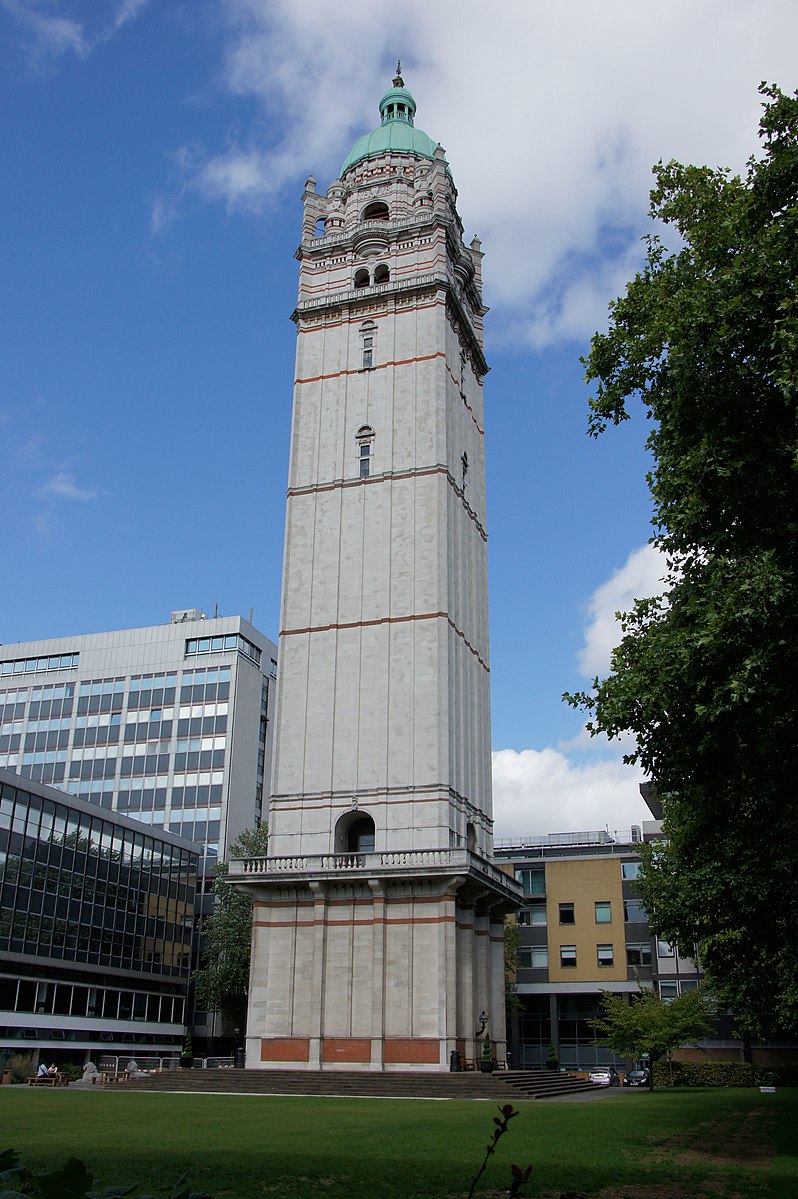
2. The tower, emerald dome still set afire by a sun which from my vantage has long since sunk into the ravenous outline of the library.
3. The statue, looking almost conventional from this angle. Lines of neon-red graffiti adorn its torso, too remote to read but I can guess at their essence. They must be recent, really recent – unmolested by caretakers or rainwater.
4. The grey buildings across the road, featureless in the dark, only two or three windows glowing. As I watch, a silhouette appears in the highest, backlit by bright fluorescence. It recedes after a second or two.
5. The sky, a pale azure turning to brilliant orange in the west. Something is unzipping it – over my head extends a lengthening streak of slate, diffuse at the back but hardening to a strict point at its end. There is a steady roar, like waves crashing somewhere far distant. Four turbines thrashing like crazy, modified fuselage churning out aerosol in immense volumes.
6. No stars. Not these days, thanks to our long and fruitful efforts.
When Leo arrives he approaches from my left and stands over me, grinning to hide his exhaustion. Two fingers tap behind his ears, and the implants are disabled. I ask him what he was listening to and the band he names sounds like a crossword clue. He calls me Al, because he finds it funny and he can’t pronounce Alparslan off the cuff.
‘Come on, Al,’ he says, ‘project time,’ He tries to take my hand.
‘Yeah,’ I respond, manoeuvring out of the way. ‘I know.’ I stand and stalk off towards the library. Unprepared for these English winters, I’m wearing just thin jeans and an Oxford shirt. The cold wraps around me. It burrows into my flesh. I imagine there might be frost tomorrow, emergent in the lee of buildings and bushes. I don’t think I’ve never seen frost before, not in my country, except maybe as a very young child. I have a vague memory of the fountain pool in our town square turning to ice, of the smooth and glittering surface like a mirror under my palm. Still, they say half your early memories are just subsequent inventions. I can’t trust myself to know.
In the library’s glass façade I see Leo following me. He’s dressed more sensibly than I am in a long, thick jacket. He fiddles with the lapel; I suspect he wants to shed the coat and drape it caringly over my shoulders. I walk a little faster and step gratefully indoors, sirocco air from the heaters a welcome relief. The rooms are largely empty, and I recognise many of the sparse occupants from our own course. Most degrees don’t set assignments this close to Christmas, but most degrees don’t have to justify their existence to the extent that Maths does. The department has been on death row for years, and they apparently feel that increasing the workload will present an image of vitality and necessity.
We find a spot on the fourth floor, by the western windows. The setting sun shines over the rooftops like a lighthouse from out across a black and frozen sea. Leo removes a silver rod from his pocket and fans it out into a screen and keyboard with a languid flick of his wrist. I try to ignore him and bring out my own laptop, firmly and consistently rectangular. It recognises my face and lights up, a picture of my parents frowning at a museum in İstanbul. I lean back in the chair until it starts to creak, and pull up the project. Spreadsheets and code, code and spreadsheets. Local Precipitation Effects of Marine Cloud Brightening, 2036-2039.
‘I can’t believe this,’ mutters Leo. ‘That we have to waste time on this crap.’ ‘Whatever. Just get on with it.’ I keep looking at the screen, but I hear him swing around to face me.
‘I mean, we’re supposed to be maths students, for god’s sake. I know it’s important, but there’s thirty other courses doing exactly this.’
I click my teeth together. ‘You realise that we are doing maths. You know, with the numbers and the sums and everything.’
‘Come on, you know what I mean.’
I do know what he means, unfortunately. My feet kick the ground and I rotate, not to look at him but back at the window. The sunset is unbelievably beautiful, a deepening bloodstain on the sky. The sulphur we’ve been pumping without end into the stratosphere has spread to every reach of the earth, making the Wild Blue Yonder that little bit whiter, making every evening shine that little bit more like burnished gold. They say you used the get the same effect after tests of nuclear weapons. The final formula for the aerosol was developed here, actually, at Imperial. It reflects enough heat to offset hundreds of thousands of times its weight in carbon dioxide. If you believe the press releases, it’s going to save the world.
Yes, we are the beating heart of progress. One of the last few universities in the UK, but we’re immune to the closures now. Practically every degree has turned its gaze towards the roiling, boiling planet, to the neglect of any other frontiers. Besides medicine, it’s the only
thing governments are willing or able to fund. There’s no time for any other pursuits. No time left at all.
‘Fifty people died in Kiribati last week.’ I say flatly. Leo pauses.
‘Yeah, I saw that. In Tuvalu or something…’
‘Tarawa.’ I still don’t look at him.
‘That’s it. Damn shame.’
‘A rogue wave took out the foundations of an emergency shelter. Whole thing just collapsed into the sea.’
‘Sure, tragic, but that’s not our fault.’ This now, this I laugh at. The sound of it rings with impertinence across the low-ceilinged space. From far behind me another student coughs, while a third drums their fingers on the table. In abject silence, noise can be contagious.
‘Of course it’s not our fault. By and large, it’s not the fault of anyone born this century. Still our planet though, isn’t it?’
‘Hmm.’ He folded his arms. ‘I think you’re looking at this wrong.’
Honestly, he’s a lot more tolerable when he’s arguing instead of flirting. ‘Go on, what do you think?’
‘You see Al, for me it’s about the principle…’
The sun disappears at last, and the starless sky presses down on the city like a bandage, like a hand.
***
I’m standing under a dark alder and I’m warm, and I’m tired, and here is what I can feel.
1. The rough bark behind me, uncompromisingly alive. My fingers trace its contours, the solid grooves slick with moisture and moss.
2. The leaf litter under my feet, crushed and crackling between bootheel and pavement. The little flakes carry their deaths with them, darting, dancing along the breeze.
3. The air, frigid and all too warm for this time of year. I sometimes imagine I can taste the changes in the wind, all the new and pervasive chemicals. What weaknesses we can find in the belly of the beast.
4. Leo’s coat across my shoulders. It’s heavy, and it smells of rain. I promised to return it tomorrow, and it’s a promise I intend to keep to the bastard. He left his gloves in the pockets and I play with the idea of pulling them on.
5. Hope, unexpected, maybe unwarranted. It wells up inside me and I exhale, my breath freezing instantly into a mist that swirls and drifts outwards into the night.
6. The world, spinning softly, dawn-bound, older than it has ever been before.
Inspired by my belief in the all-consuming severity of the climate crisis, and current theories of the geoengineering efforts that may have to be spearheaded by scientific institutions. I’m interested in how an increasingly singular focus for the natural sciences might be perceived, both in terms of its necessity and what other avenues might fall by the wayside amid such a pragmatic approach to research.
Eve Smith is the author of three speculative thrillers. Her latest novel, ONE, published in 2023, is set in a one-child policy Britain that has been ravaged by climate change. It was longlisted for the 2023 British Science Fiction Association Best Novel award. Her debut, The Waiting Rooms, set during an antibiotic crisis, was shortlisted for the Bridport Prize First Novel Award and selected as a Guardian Book of the Month. Off Target, her second novel, imagines a world where genetic engineering of children has become the norm. It was a Times Book of the Month, who described it as ‘an astute, well-researched and convincing novel of ideas.’ Eve’s books are published by Orenda Books. Her website is www.evesmithauthor.com
Before writing full-time, Eve worked for an environmental charity on research projects across Asia, Africa and the Americas.
This interview developed out of an in-person event held at Ewell Library, UK, in September 2023.
Thanks for your time, Eve. Let’s start with ONE. It’s a chilling speculative thriller that covers many themes, from climate change to women’s rights. How did the novel come about and what was your process for writing it?
The premise for ONE was born out of two ideas. First, what if birth was a crime? How might a one-child policy play out in Britain? Second, how might the climate emergency change the UK, not only in terms of environmental impacts, but also the social and political ramifications? How would it affect how we’re governed and how we treat people?
During my research, I read Shen Yang’s More Than One Child, a powerful memoir about growing up as an illegal excess child in China under their one-child policy. The author had committed a crime just by being born. During China’s one-child policy over half a billion birth control procedures were carried out over more than three decades. Many of those sterilisations and terminations were forced. Given the recent abuses of abortion rights in the US, with Roe vs Wade being overturned, the fact that such a thing could happen today in a Western democracy made me question what else a government in the West might do to curtail reproductive rights.
In ONE, I also wanted to explore how a totalitarian party might take advantage of the climate crisis to secure power. In Europe, several far-right groups have adopted the clothes of an environmental agenda to promote nationalist policies. In my novel, on the surface, the UK appears to be doing pretty well. Through climate tech investment and radical shifts in policy and laws, the country has adapted to cope with many climate change effects. Britain is self-sufficient in food, water and energy. Jobs are plentiful. Healthcare is good. But it has come at a cost: freedom and choice.
Michael Butterworth is a UK author, publisher and editor. He was a key part of the UK New Wave of Science Fiction in the 1960s, contributing fiction to New Worlds and other publications. In 1975 he founded Savoy Books with David Britton, co-authoring Britton’s controversial novel Lord Horror. In 2009 he launched the contemporary visual art and writing journal ‘Corridor8’. His latest works are the eponymously titled Butterworth (NULL23, 2019) – a collection of his New Wave-era fiction – and a novel, My Servant the Wind (also NULL23), based on his 1971 writing notebooks, which develops themes found in his early writing and Complete Poems.
Jean-Paul L. Garnier is the owner of Space Cowboy Bookstore, producer of Simultaneous Times Podcast, and editor of the SFPA’s Star*Line Magazine. He is also the deputy editor-in-chief of Worlds of IF & Galaxy Magazines. He has written many books of poetry and science fiction.
JPG – On top of being the author of many books (SF and otherwise), you’ve also had a tremendous output as an editor. How have these two roles played off each other, or interfered with each other, and how have you found a balance between the two?
MB – They are not separate. I started publishing and editing magazines and later books when J. G. Ballard, who collaborated with me on two pieces of fiction for New Worlds, told me I needed to be more prolific. I’m not a prolific writer, or wasn’t then, so I began exploring the idea of publishing. I published work that I liked, and discovered I could move between the two literary forms in alternation, and that they fed off one another, and writing and publishing are all the stronger for it. The only sense in which they ‘interfered’ with one another is that I sometimes got impatient with the view that a publisher is not a creative entity. I felt that I was not being properly assessed as a writer, and that my contribution to the New Wave of SF, and the direction in which I eventually took it with Savoy Books, was being overlooked. I still feel that only parts of my career have been seen, and that the dots haven’t been joined. I am using past tense because, apart from a couple of Savoy projects, still ongoing, publishing may have finally run its course with me, and I’m busy writing. But never say never.
The Other Shore by Hoa Pham(Goldsmiths Press, 2023)
Review by Harry Slater
The Other Shore, by Hoa Pham, winner of the Viva La Novella prize, deals with some of the biggest questions there are. It’s about life and death and legacy, about power and control, colonisation and oppression, ancestry and the price we pay for the future we want. And it’s all told from the perspective of a sixteen-year-old Vietnamese girl, Kim Nguyen. That makes for some interesting stylistic choices; the prose can sometimes feel stilted, lacking in the emotional clout that an older voice might add. At the same time, though, there’s a visceral naivety at play here, the realisations of the state of the world are ever more compelling because they’re wounds delivered fresh, for the first time. In one way, then, The Other Shore is a coming-of-age story, and at the same time a brutal indictment of human cruelty, an examination of the structures of power that bind Vietnam, and the world, and how they’ve come to be. After a brush with death, Kim discovers that she can read people’s minds by touching them, a gift bestowed upon her by the goddess Quan Âm. More than that, she now has contact with the titular Other Shore, the place where the dead go after passing on. At first her father uses her newfound powers to earn money from his business associates, but it isn’t long before the government comes knocking. Kim is taken to a mass grave by Bác Phuc, another apparent psychic working for the communists. There she’s tasked with reconnecting buried soldiers with their families, giving their restless spirits the chance to finally find some solace. But there’s a catch – if she discovers southern Vietnamese remains, they’re tossed to the side, left to their haunted afterlife. This forms one of the core moral quandaries of the book; Kim knows she should be helping everyone to find peace, but the powers-that-be simply won’t stand for it. This burgeoning sense of responsibility, of behaving in ways that shake off the ideas of the past, leads her to Khôi, a second-generation Vietnamese American working as an interpreter for a US MIA mission. There’s an idealism to him, and a freedom, that Kim finds alluring. Interspersed with this trauma is a strange love triangle between Kim, Bác Phuc and Khôi that doesn’t quite ring true, feeling more like an extended metaphor for the possibilities that are opening and closing in Kim’s life. The Other Shore deals with complex cultural issues with a deft hand, showing Kim’s innocence slipping away as she starts to confront decades-old actions that have shaped the life she lives today. At times it can be quite clunky, though, and there are decisions and story beats that seem to come too quick, sometimes occurring in the space of a paragraph. Kim’s relationship with her dead grandmother is the beating heart of the story, tying together the past, present and future with a kindness and a spirituality that the modern world Kim inhabits appears to have left behind. There are heartbreaking moments, and the confusion, excitement and terror of adolescence is captured within the staccato rhythms of the piece. While The Other Shore might lack fluidity and fluency, it poses its questions with a steady hand and doesn’t flinch away from showing us Kim’s strife in harrowing, gut-wrenching close-ups. There’s no easy ending here, no final resolution, and that’s fitting for a book that confronts such fundamental and difficult topics. This is a book layered with the spiritual and the political, a meditation not just on life and death, but on our attitudes towards them. It’s hard going sometimes, in several different ways, but The Other Shore leaves you with deep questions about what it means to be human, and for that alone it’s worth checking out.
Imagine fighting your way across dangerous terrain to finally enter The Library, a vast stronghold containing thousands upon thousands of priceless arcane tomes, each one filled with the world’s most valuable knowledge… and then imagine that you can’t look at any of the books. Most of them have no titles on their spines, the majority are identical copies of each other, and the only one you can read opens to a single page, containing a single paragraph of text that immediately sends you away on yet another quest.
The above description applies to any number of digital games, in which impressively beautiful libraries are common but functional ones are rare. Most in-game libraries exist as graphically interesting settings with little-to-no interactivity, and those with readable books or bookcases present only snippets of information, often limited to minor world lore, game hints, or easter eggs. Players rarely interact with an in-game library in a meaningful way, and more rarely still take any game actions that mimic or simulate the way libraries are used in real life. In short, libraries as a concept are underused by speculative game developers.
Fortunately, a small but growing sub-genre of games center on library-like mechanics, in which players spend most of their time collecting, organizing, and distributing or protecting information about the game world. In these games, players are not using an in-game library as much as they are creating and maintaining one, and can even be seen as embodying the library itself. Two recent examples are In Other Waters (2020), in which the player helps a xenobiologist explore, catalogue, and understand an alien ecosystem; and The Return of the Obra Dinn (2018), in which the player must extrapolate the names, positions, and ultimate fates of the crew and passengers of a missing merchant vessel, information they are responsible for reporting, or choosing not to report. These examples and others suggest the existence of a “library game,” in which the player’s interactive experience focuses on collecting, organizing, and distributing in-game information, regardless of whether a traditional library appears in the game at all. The library game makes use of the naturally archival structure of digital games, in which massive amounts of in-game information and content is organized and efficiently presented to players, and allows for game experiences focused on the aggregation and understanding of knowledge, as well as the player’s ethical responsibility as the curator of that knowledge. Ultimately, the library game is an appealing new direction for speculative game design, and is particularly effective when it positions the player not as a patron but as the librarian, or the library itself.
Obra Dinn logbook
Libraries in Speculative Digital Games
The relationship between libraries and games is less straightforward than it seems. An online search for the term “library games” often turns up libraries looking to add digital and analog games to their collections (Snyder Broussard 2012; Forsythe 2021; Haasio, Madge, and Harviainen 2021), or discussions about the difficulties of archiving and cataloging games for reference (Kaltman, Mason, and Wardrip-Fruin 2021; Sköld 2018; McDonald et al. 2021). In game development, a “game library” is a collection of code or assets intended for reuse, often as part of a larger framework or game engine (“GameDev Glossary: Library Vs Framework Vs Engine” 2015; Unity Technologies 2022). Additionally, game engines can be used as platforms for large-scale projects in citizen science such as Foldit (2008), an experimental puzzle game in which thousands of users folded protein structures and catalogued their results; or for the curation and dissemination of real-world information. The most famous of these is the Uncensored Library, a collection of banned reporting from countries without press freedoms that exists in a free-to-access Minecraft server (Maher 2020; Gerken 2020). Libraries also make for popular content for analog and other non-digital games, including Biblios (2007), Ex Libris (2017), Gutenberg (2021), and The Big Book of Madness (2015).
In addition to the above, there are a remarkable number of fictional libraries in digital games, especially those with speculative content. Libraries appear in games as varied as the action-horror game Bloodborne (2015), indie games Night in the Woods (2017) and Undertale (2015), classic platformers like Castlevania: Symphony of the Night (1997), action games like Assassin’s Creed Origins (2017) and Shadow of the Tomb Raider (2018), adventure games like The Longest Journey (1999) and Darkside Detective (2017), numerous role-playing games from Chronotrigger (1995) to Octopath Traveler (2018), nearly every game in the Final Fantasy series, most games in the Legend of Zelda series, and most major ongoing massively multiplayer role-playing games from World of Warcraft (2004) to Final Fantasy XIV (2014). Dungeons & Dragons’ Candlekeep Library appears in multiple digital games, mostly notably Baldur’s Gate (1998). An accurate recreation of the Boston Public Library appears in the post apocalyptic Fallout 4 (2015). Even Halo: Combat Evolved (2001), best known as a fast-paced multiplayer shooter, includes the infuriatingly difficult and famously reviled level “The Library” in its single-player campaign (Burford 2016). In short, libraries are so common in digital games that they are arguably harder to avoid than to seek out.
In-game libraries vary widely in both content and use. Games with fantasy settings often include a traditional book-and-scroll-laden library inhabited by scholars or spellcasters who provide information, share secrets, and send players on quests. In these non-technological spaces, books are valued as physical objects that can be retrieved, collected, or stolen, as with the lost tome that begins Cyrus’ story in Octopath Traveler (2018) or the numerous books that can be collected, read, and organized in the player’s home in The Elder Scrolls V: Skyrim (2011). In addition to physical libraries, science fiction games often also feature a digital archive that serves as either an extension of the player’s user interface or a technological macguffin that must be found, hidden, repaired, or destroyed. All three are present in Horizon Zero Dawn (2017), in which heroine Aloy uses a Focus, an information-gathering augmented reality device, to uncover the Zero Dawn project, both a digital archive and physical library space that originally protected the core knowledge of human civilization from an extinction-level event. Horror games commonly present libraries as ruined or abandoned spaces in which the player’s only goal is to survive, as with the Duke’s Archive in Dark Souls (2011). As with much popular media, games rarely make a distinction between libraries and archives (Buckley 2008), but both are prevalent in speculative digital games, regardless of whether they are appropriately labeled.
Despite their prevalence, most in-game libraries exist more as graphical backgrounds than truly interactable spaces. Generally, players can interact with only one or two plot-important books or with bookcases that provide a single relevant paragraph of information, as in Garregh Mach Library in Fire Emblem: Three Houses (2019). It is also common for a game’s books to be represented by a few duplicate art assets, as with the beautiful but heavily replicated piles of books in What Remains of Edith Finch (2017). Few games present libraries of a specific type: exceptions include the explicitly academic library that serves the students of the College of Winterhold in Skyrim (Lai 2022) and the rural, small-town library in Stardew Valley (Lai 2021). Even fewer games allow players to take library-like actions, such as checking out books or searching through the stacks for specific pieces of information.
“The computer” – a character unnamed save its technological form – is one of the most enduring characters of Star Trek, spanning multiple generations of hardware and software over a 250-year period ranging from Enterprise in the 2150s to Picard in 2399. The prominence of the computer as an information agent, and the repeated deployment of “the archive” as a mysterious space of potential discovery[1] has the effect of overshadowing a more familiar figure from our own era: the librarian. In this article, we take the librarian as the starting point for understanding the information landscape of Star Trek. What, in the universes of Star Trek, do librarians do, and how do those activities relate to the scope of librarianship in the real 21st century? We find the visible librarian pushed into a stereotyped corner, where a large swath of activities associated in particular with modern data librarians simply disappear from view. In this future landscape, it is as if data organizes itself – or at least, we are led to assume as much. We see the utopian embodiment of this process through Data, who both has access to these vast knowledge stores, and a positronic brain to deploy that data and interact with the world at a level where he is deemed sentient. But another form that data takes is “the computer”, which is narratively relegated to the background as a service worker, however complex that service may be upon closer interrogation. As one of the services computers perform, often hyper-invisibly, in the Star Trek universe is translation, we conclude with a case study of how translation depends not only on advanced computation, but an enormous amount of data – including cultural and linguistic information we might assume resists datafication. We pair examples from a few novels with a corpus of 774 Star Trek novels, using digital humanities text analysis methods to draw together those examples – much as one might do by calling upon the computer.
We open issues to the public after about two years. An index of back issues of Vector can be found at the ISFDB. For the availability of individual print issues, please contact us.
To subscribe to Vector, join the British Science Fiction Association. Membership is open to anyone in the world. Members receive Vector, FOCUS, the BSFA Review, special one-off publications, and other benefits. The BSFA is a nonprofit organisation, entirely run by volunteers.
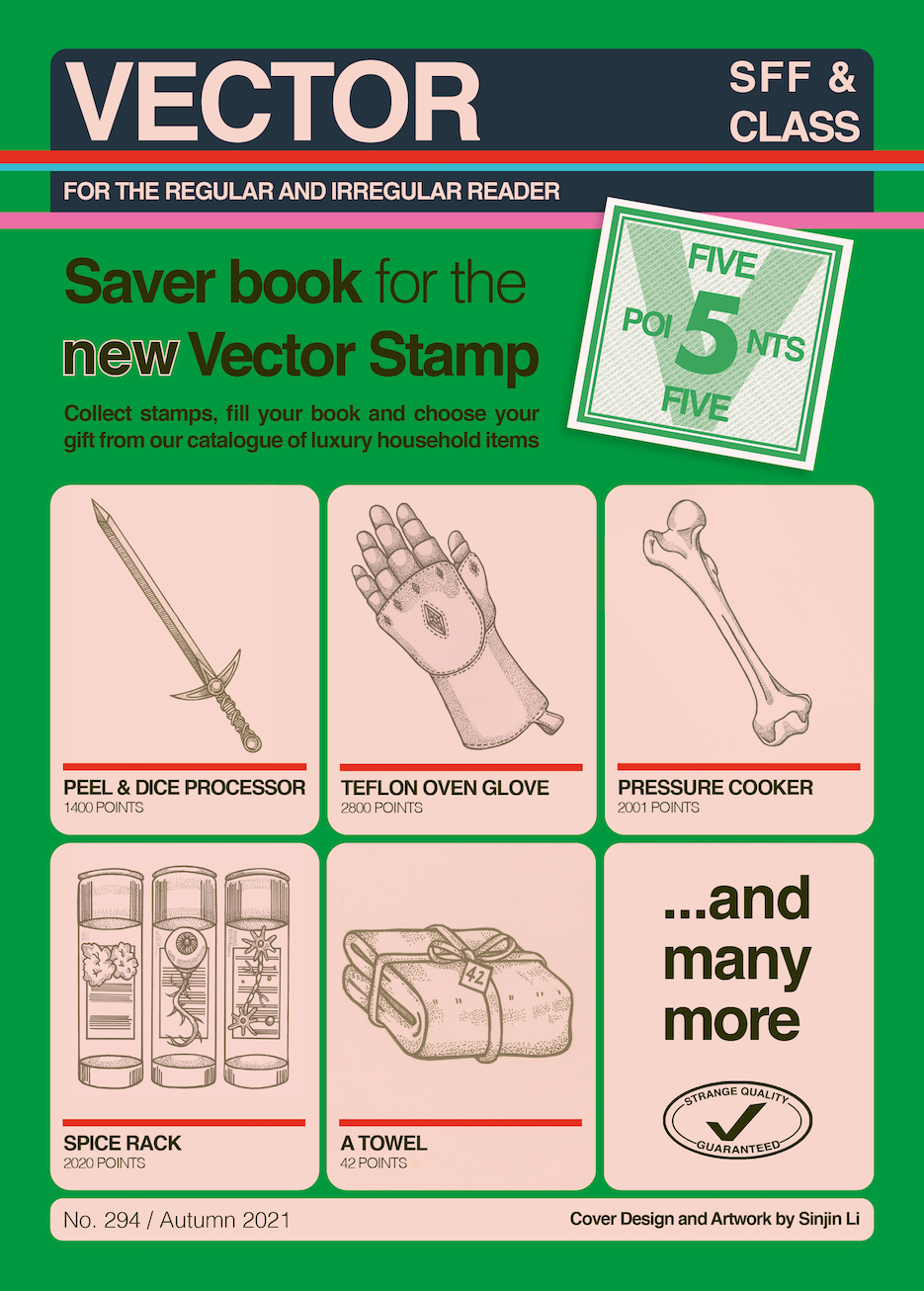
Vector 294, SFF and Class, is guest-edited by Nick Hubble. Featuring ksenia fir on labour in outer space, Paul Kincaid on Priestley’s An Inspector Calls, GuangzhaoLYU on Wei Ma’s “Formerly Slow” and Hao Jingfang’s “Folding Beijing,” So Mayer on Star Trek: Discovery, Marie Vibbert‘s survey of class representation in SFF, Farah Al Yaquot on Petrosyan’s The Gray House, Ali Baker on de Larrabeiti’s Borribles, Andi C. Buchanan on Cipri’s Finna, and an extensive guest editorial from Nick Hubble.
By Linna Fredström, Laura Pereira, Simon West, Andrew Merrie and Joost Vervoort
Examples from a small city in the middle of a Swedish forest
‘We live in capitalism. Its power seems inescapable. So did the divine right of kings. Any human power can be resisted and changed by human beings. Resistance and change often begin in art, and very often in our art, the art of words.’ Ursula K Le Guin
Intro and motivation for study
A growing body of research is calling for radical transformation of society to avoid catastrophic levels of climate change and create a more sustainable and just future (Adger et al., 2009; Westley et al., 2011; Kates, Travis and Wilbanks, 2012; Patterson et al., 2017; Fazey, Moug, et al., 2018). Such transformation will disrupt political and economic structures as well as knowledge and value systems, and require fundamentally changing “norms, values, and beliefs; rules and practices, such as laws, procedures, and customs; and the distribution and flow of power, authority, and resources” (Moore et al., 2014).
Many researchers studying such transformations are also acknowledging that their own role must change: rather than simply producing knowledge, they are beginning to actively participate in making knowledge actionable, with the explicit goal of enabling radical change (Cornell et al., 2013; Sala and Torchio, 2019; Fazey et al., 2020). In this new task, the social sciences can offer valuable insights on how to approach the value-laden and political dimensions of using science to bring about change (Wittmayer and Schäpke, 2014; Fazey, Schäpke, et al., 2018; Vervoort and Gupta, 2018; Woroniecki et al., 2019; Miller and Wyborn, 2020; Scoones et al., 2020; West et al., 2020). Critical social theory and critical perspectives in particular are believed to offer tools for sustainability transformation research (Death, 2014; Lövbrand et al., 2015; Stirling, 2015; Blythe et al., 2018). Critical social theory focuses on illuminating and challenging the power dynamics and hidden biases of science and knowledge itself. This focus on reflexive and critical perspectives is now gaining traction within the field of transformation toward sustainability. Conversely, researchers within the field of sustainability are reaching conclusions that point toward the need for critical theory. It’s becoming clear that to enable transformation to a more sustainable and just society we must be willing to challenge not only political and economic systems, but also the value and knowledge systems that brought us to this point in history (Stirling, 2015, 2019; Gottschlich and Bellina, 2017; Fazey et al., 2020).
Scenarios have become a frequently used approach to explore radically different futures and to identify transformative potential in the present (Pereira et al., 2019). As a tool, scenario development is versatile and allows for transdisciplinary exploration, combining scientific, local, practical, and emotional insights (Oteros-Rozas et al., 2015; Merrie et al., 2018; Pereira et al., 2018; Sweeney, 2018; Wangel et al., 2019). Scenario exercises in times of impending climate crisis can be a way to practice imagining the future, and through this practice to see potentialities in the here and now. We need new understandings of the world, new stories: alternatives to both climate catastrophe and naïve never-ending growth narratives. But how do we make space for such visions?
Beyond the Library as Utopia: Conditional Belonging, Representative Collections and Science Fiction Librarianship
Gina Bastone and Adriana Cásarez
Introduction
When we tell strangers or new acquaintances that we are librarians, we hear reactions like “Oh, how wonderful that you get to read books all day!” Sometimes, we might get the response, “You’re doing such important work. The public library changed my life as a kid!”
While we much prefer the latter response, both reflect a stereotype of libraries as utopian institutions necessary for a healthy democracy and immune from criticism. Some people even hold libraries in holy regard, comparing librarians to clergy with a vocational calling, as Fobazi Ettarh notes in her groundbreaking article on vocational awe.[1] For many readers and SF fans, the library is a sacred place where knowledge is preserved and where they have treasured memories of encountering their favorite books for the first time or discovering their favorite SF authors.
We share a love for books, particularly SF stories, but we have a realistic view of libraries beyond these utopian visions. Margaret Atwood discusses the paradoxical nature of a similar utopia/dystopia binary in her book, In Other Worlds: SF and the Human Imagination. She says, “[W]ithin each utopia, a concealed dystopia; within each dystopia a concealed utopia. …”[2] It is from this tension that we draw similarities in libraries. Our idealized values of unfettered, egalitarian access to information and strong nostalgia for the love of books have a shadow side, especially when interrogated around white supremacy and patriarchy.
In her article “Concealing White Supremacy through Fantasies of the Library: Economies of Affect at Work”, Michele R. Santamaria describes “The Library” as “a fantasy space that denies its role in white supremacy.”[3] Santamaria builds on Gina Schlesselman-Tarango’s work on the concept of cuteness and how it insidiously reinforces the status quo in libraries. Schlesselman-Tarango says,
“By promising safety through gesturing to a pre-technological past, books preclude exposure to and engagement with the nasty realities of contemporary society. Inasmuch as they are associated with books, libraries too might be understood to provide an outlet for this sentimental yearning. …”[4]
We see library nostalgia as a crucial underpinning to the romanticized utopian stereotype of libraries, yet Santamaria, Schlessleman-Tarango, and Ettarh all point to the dystopian shadow side of our shared profession. We will explore this further as we unpack our collecting philosophy.
Additionally, Santamaria’s use of “The Library” denotes a sense of institutional authority and is a direct reference to librarian, writer, and poet Jorge Luis Borges’ concept of the “library as a universe”.[5] In particular, Borges’ famous short story The Library of Babel comes to mind. The Library of Babel has dystopian elements, such as meaningless books that are never accessed, used, or even seen by the librarians doomed to wander its endless halls.[6] This Borgesian “library as universe” may seem the product of a dark fantasy far from the reality of working in libraries, but it is a helpful metaphor for challenging the equally unrealistic stereotypes underpinning library nostalgia and vocational awe.





 vector-bsfa.com