The British Science Fiction Association is delighted to announce the shortlist of nominees for the 2020 BSFA Awards. The BSFA Awards have been presented annually since 1970. The current categories have been in place since 2001. The awards are voted on by members of the British Science Fiction Association and by the members of the year’s Eastercon, the national science fiction convention, held since 1955. This year Eastercon, ConFusion, will be held online 2nd-5th April 2021, where the winners will be announced.
The BSFA Awards ceremony will be free to attend for all BSFA members, all members of Eastercon, and all shortlisted nominees: details will be released closer to the date. Members of the BSFA will additionally receive a PDF with excerpts of many of the nominated works in advance of the convention, and a physical copy of the Awards Booklet at a later date. If you are not currently a member of the BSFA and are interested in joining, please visit the main BSFA site.
Best Artwork
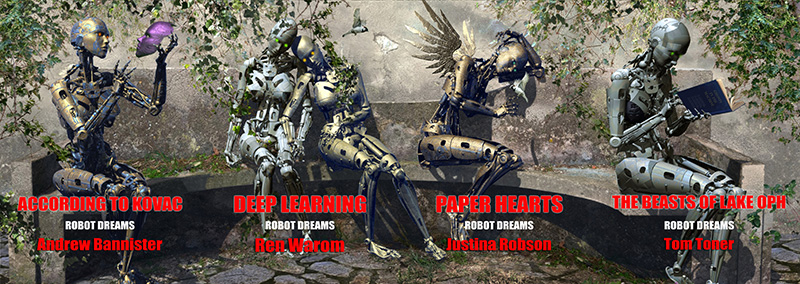
Fangorn, Covers of Robot Dreams series, NewCon Press.
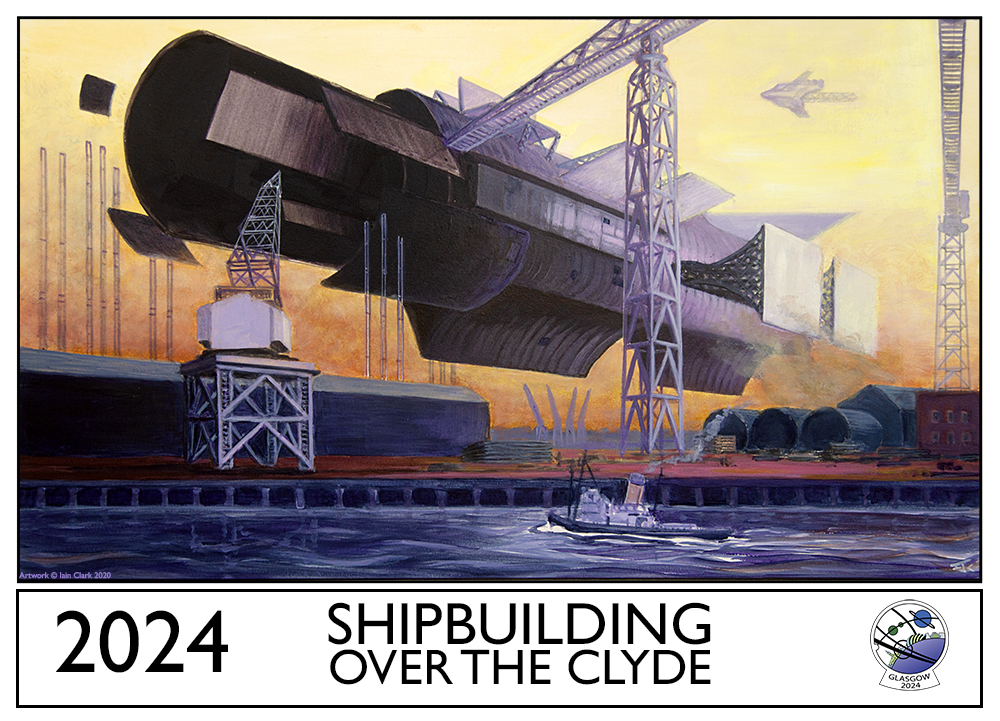
Iain Clark, Shipbuilding Over the Clyde, Art for Glasgow in 2024 WorldCon bid.
Ruby Gloom, Cover of Nikhil Singh’s Club Ded, Luna Press Publishing.
Sinjin Li, Cover of Eli Lee’s, A Strange and Brilliant Light, Jo Fletcher Books.
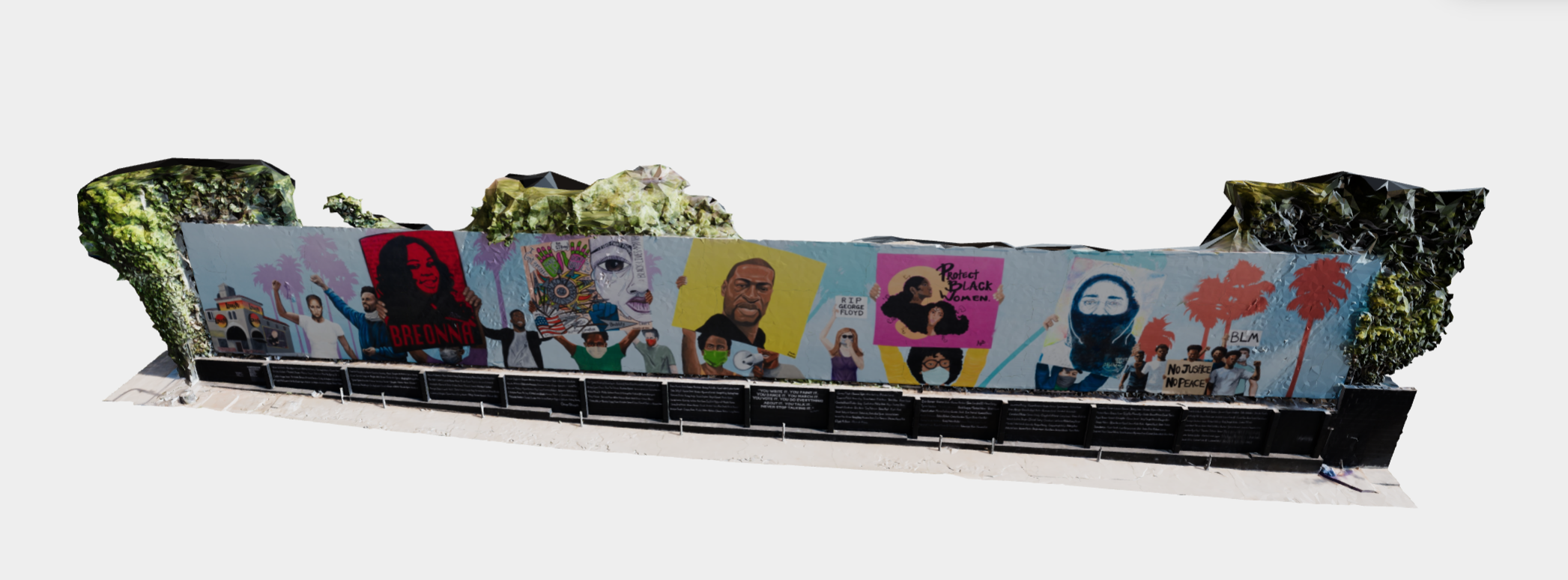
Four Black Lives Matter Murals in AR
Nani Walker, Four Black Lives Matter Murals in AR. Using drone photogrammetry, Nani Sahra Walker produced 3-D models of four Black Lives Matter murals as memorials to George Floyd, Breonna Taylor and others killed by police. Published by the Los Angeles Times in collaboration with RYOT and reported by Dorany Pineda.
Oghenechovwe Donald Ekpeki, ‘Ife-Iyoku, the Tale of Imadeyunuagbon,’ Dominion: An Anthology of Speculative Fiction From Africa and the African Diaspora, Aurelia Leo. Edited by Zelda Knight and Oghenechovwe Donald Ekpeki.
Ida Keogh, ‘Infinite Tea in the Demara Cafe,’ Londoncentric, Newcon Press. Edited by Ian Whates.
Note that there was a multiple tie for fifth place this year. The committee decided that instead of abbreviating the shortlist, all nominees would be included.
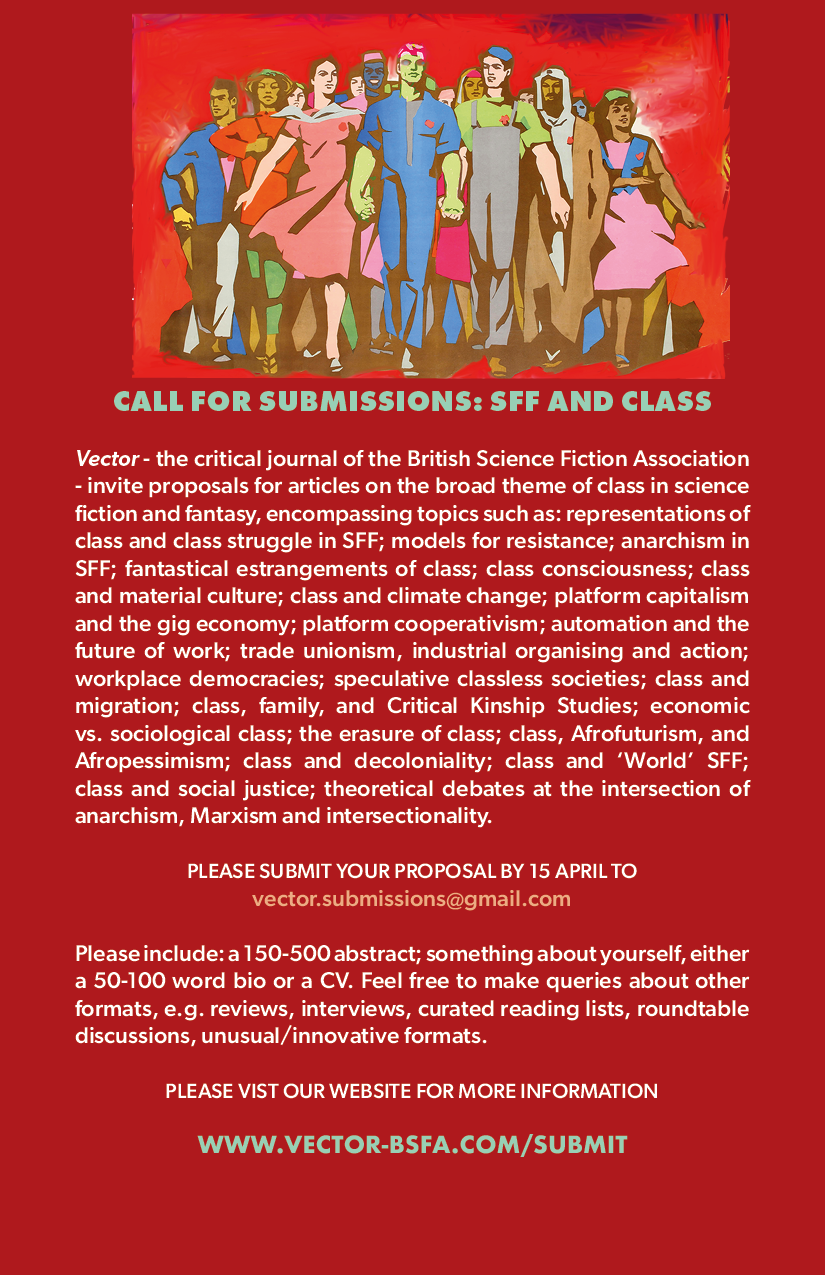
Vector and Focus are inviting submissions on the theme of class, with proposals due 15 April, and articles due 15 July. Please see the full call for more information. Vector will be publishing a special themed issue, guest-edited by Nick Hubble.
Keep an eye out for more CfPs for future special issues to be edited by Stewart Hotston, Stephen Oram, Phoenix Alexander, and Nina Allan.
By Jo Lindsay Walton. This is an excerpt from a chapter published in The Science Fiction of Iain M. Banks, eds Nick Hubble, Esther MacCallum-Stewart and Joseph Norman (Gylphi, 2018).
Introduction: What’s in a Game?
On an estate belonging to the Ancraime family, at the edges of Stonemouth, a Scottish coastal town, a group of boys gather to play paintball. They come from a range of economic backgrounds: Stonemouth is not large enough for the boys to be segregated according to class. The poorest member of the group is Wee Malky. As dusk draws in, the boys begin the last game of the day, a hunting scenario in which, in consequence of a “complicated arrangement of scoring across the various [earlier] skirmishes” (Banks 2012: 146), Wee Malky finds himself the quarry, and the rest of the group, hunters.
Eventually, “near the furthest western extent of the house gardens […] [on the edge of] the rest of the estate and the grouse moors and plantation forests beyond,” (ibid. 149), the scattered group begins to converge. Wee Malky is making a perilous crossing along the round-topped, weed-slicked stone of the top lip of a reservoir, which feeds various water features in the gardens. He has the undertow-prone, peaty reservoir water to one side, and the steep, slimy slope of the overflow, dotted with concrete pillars, on the other.
George Ancraime, “the older brother, nearly twenty at this point but with a mental age stuck at about five” (ibid. 142), suddenly appears near the bottom of the slope. He has been back to his parents’ mansion and retrieved a large antique sword, which he brandishes smilingly at Wee Malky. If Wee Malky can make it across, he wins the game. But if he loses his balance, he loses his life.
The scene, a suitably cruel allegory of class violence, is in many ways typical of how games often appear in Banks’s fiction. It raises the question of what makes a game a game, and at what point it stops being a game. Game studies theorists Katie Salen and Eric Zimmerman, after a survey of existing definitions, define a game as “a system in which players engage in an artificial conflict, defined by rules, that results in a quantifiable outcome” (Salen and Zimmerman 2003: 96). Another good starting point is the philosopher Bernard Suits’s succinct formulation: playing a game is “a voluntary attempt to overcome unnecessary obstacles” (Suits 2005 [1978]: 55). […] Banks’s games resist both definitions. There is a sustained interest in Banks’s work in involuntary games, necessary games, games-within-games, games that burst their boundaries, games that overcome their players, games with hidden purposes, fragmentary games, games that arise spontaneously, games whose rules change, and games whose outcomes are nebulous and defy calculation. More generally, there is a fascination in Banks’s writing with ludic affordance: the capacity of any situation to absorb and be transformed by play.
There is no particular issue with the timeline of the original 1973 film, Westworld, written and directed by Michael Crichton. It is set in the then near future, 1983, and the linear action takes place entirely within the Delos theme park. But when the film became the basis for the television series created by Jonathan Nolan and Lisa Joy, Westworld (2016-present), time became a complex and confusing issue.
Nolan had already displayed a rather cavalier attitude towards time in his earlier television series, Person of Interest (2011-2016). The first series, first broadcast in the autumn of 2011, was set in 2012, but contained multiple flashbacks to events over the previous decade. Although these flashbacks are often dated, it can be difficult to construct a coherent timeline for the two principal characters, Harold Finch (Michael Emerson) and John Reese (Jim Caviezel). But when it came to Westworld, that tendency to play fast and loose with chronology became an often understated but defining characteristic of the series.
To date there have been three series of Westworld (it has subsequently been renewed for a fourth season). For convenience I will refer to Westworld Season One: The Maze as WW1 (2016), Westworld Season Two: The Door as WW2 (2018), and Westworld Season Three: The New World as WW3 (2020), each of which presents time in a different way, even though theoretically each is a direct sequel to the series before.
Reviewed by Paul Kincaid. This review first appeared in The BSFA Review.
History is, as the word tells us, a story. It is the narrative of the events that created our present compiled from whatever accounts, records and other documents may be available, and that are, inevitably, partial, generally incomplete, and often unreliable. History is not a science, since it is not open to empirical examination and cannot be repeated, and as any criminal lawyer will tell you, no two witnesses of the same event will agree on every detail. The relationship between history and fiction, therefore, is intimate and inescapable. The best historical fictions will attempt to use psychological insight and imagination to fill in the gaps in any historical record (for example, Wolf Hall by Hilary Mantel); or to tell a story about those people who are largely absent from the historical record (for the same historical period we might consider, for example, the Shardlake novels of C.J. Sansom).
The relationship between history and the literature of the fantastic (in which we might include fantasy, horror and science fiction) is perhaps rather less obvious, but it is there nonetheless. For the sake of this discussion we will exclude time travel stories, which might be considered a special case of the historical fiction already discussed (although time travel can often play a key role in alternate histories, as for instance in Bring the Jubilee by Ward Moore or The Guns of the South by Harry Turtledove). Even so, there are several different ways in which history plays a part in the fantastic. I use the following terms simply to help me distinguish one form from another: there are apocryphal histories, in which legends and stories from the past are assumed to be true accounts; secret histories, in which major events are said to have been deliberately or inadvertently expunged from the historical record; revisionist histories, in which shameful or unfortunate events are recast in a more positive light; literary histories, in which characters from fiction are presented as being real historical figures (Sherlock Holmes being probably the most popular); and alternate histories, in which the consequences of one historical change are played out. For the record, the term “counterfactual” is often used as a synonym for alternate history, though I tend to see counterfactuals as dealing with the moment of change while alternate histories deal with the future consequences of that change. None of these divisions is hermetically sealed, the borders between them are inevitably porous, but these are, in broad terms, the most familiar ways in which science fiction imaginatively engages with history.
These ways of playing with history vary from thought experiments that are perhaps as close as we might come to scientific testing of history, to linking history to the more fantastic reaches of the human imagination. All have played their part in science fiction pretty well for as long as we have had science fiction, though, apart from periodic upsurges in time travel stories, they have never really been the most fashionable form of the literature. The occasional classics – Lest Darkness Fall by L. Sprague de Camp, The Sound of His Horn by Sarban, The Man in the High Castle by Philip K. Dick, Pavane by Keith Roberts – always seem detached from what else is happening in science fiction at the time, and rarely if ever generate anything that might pass for a movement. There are repeated tropes – the South wins the American Civil War, Hitler wins the Second World War – but really any study of alternate histories is going to look at a series of disconnected moments, of individual exemplars, rather than anything more coherent or overarching. (On a philosophical level, trends in alternate histories and secret histories and revisionist histories might reveal something interesting about the way any particular present regards the past and its study, but that is not an approach I have so far encountered in science fiction scholarship.)
The disjointedness of these engagements with history suggest that a collection of essays, such as the volume in front of us today, is perhaps the best way of approaching the topic. Except that this volume suggests there is a disjointedness also in the approach. Although the subtitle tells us firmly that these are “Critical Essays on Alternate History Fiction” (and I am uncomfortable with the need for that final word, since it implies there might be such a thing as alternate history fact), that is not necessarily what we get. Using the terms I have laid out already, there are essays on revisionist history (“Forever Being Yamato: Alternate Pacific War Histories in Japanese Film and Anime” by Jonathan Rayner, which looks at the way recent fictions have revisited the story of the battleship Yamato in order to present the defeat in a more noble and positive light; though Rayner doesn’t really question how much this revisionism chimes with Japan’s pre-War militaristic mythology); literary history (“Weird History/Weird Knowledge: H.P. Lovecraft versus Sherlock Holmes in Shadows Over Baker Street” by Chloé Germaine Buckley, one of the weaker essays which looks at a literary mash-up that hardly seems to warrant the word history); and apocryphal or perhaps secret history (“Between the Alternate and the Apocryphal: Religion and Historic Place in Aguilera’s La locura de Dios” by Derek J. Thiess, one of the better essays in the collection about a novel involving the legend of Prester John). That’s three out of the ten essays that, to me, seem to have nothing to do with the implied subject of alternate history.
And of those that do deal directly with alternate histories there seems to be little agreement on the characteristics of their subject. Take, for example, two of the best essays in the collection: Anna McFarlane, in “Time and Affect After 9/11: Lavie Tidhar’s Osama: A Novel”, presents alternate history as a form of stasis, an inability to deal with the trauma of the present; while Chris Pak, in “‘It Is One Story’: Writing a Global Alternate History in Kim Stanley Robinson’s The Years of Rice and Salt”, makes it dynamic, a consistency of development and growth whatever the present may throw at us. What this tells us, of course, is that alternate history is not one thing but rather a concatenation of ways in which we might confront the hopes and terrors of the present.
In their “Introduction” and “Afterword”, the editors attempt, not altogether successfully, to tie all of these different essays into a coherent whole, whereas in many ways it is their very incoherence that is most interesting about them. Here we see alternate histories being used to undermine the “great man” theory of history (Molly Cobb’s account of a couple of Alfred Bester’s short stories in “The Subjective Nature of Time and the Individual’s (in)Ability to Inflict Social Change”) or to extol the “great man” theory (Adam Roberts on what is probably the earliest alternate history in “Napoleon as Dynamite: Geoffroy’s Napoléon Apocryphe and Science Fiction as Alternate History”); to challenge gender assumptions in science fiction (“‘Her Dreams Receding’: Gender, Astronauts, and Alternate Space Ages in Ian Sales’ Apollo Quartet” by Brian Baker) or to play out a slight variation on a conventional Hollywood romance (Andrew M. Butler considering the film version of a John Wyndham story in “Quest for Love: A Cosy Uchronia?”). Leaving aside the revisionist or literary histories, which seem to me more consolatory than disruptive, and therefore do not appear to belong in this volume, alternate histories represent a deliberate disordering of what we understand as the past, and therefore of the present. Since such disordering can take many forms, and play out in so many ways, it is inevitable that a collection such as this can do no more than start to feel out some of the nuances of alternate history. At its best, notably the essays by Roberts, Pak, McFarlane, and Karen Helleckson’s take on the way alternate history is used on television, this volume does the job well and interestingly. Though other essays, including a slick but superficial survey of the field in Stephen Baxter’s “Foreword”, tend to slide past the subject without ever fully engaging. It is, in the main, an interesting book, but we do need many more of them to even hope to cover the field adequately.
Reviewed by Andy Sawyer.This review first appeared in The BSFA Review.
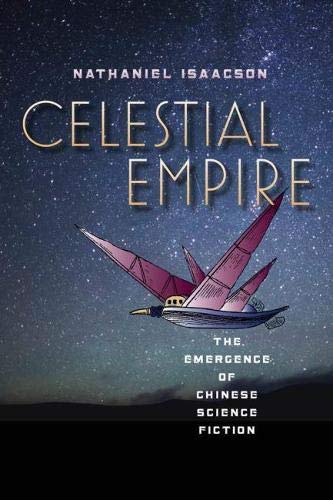
A few years ago, when I wanted some examples of new Chinese science fiction, I had to ask a contact in China to send me some and I was reliant on various websites for summaries. Now, Liu Cixin (one of the writers I was pointed to) has won a Hugo. While for the general reader it has some of the drawbacks of being a revision for book publication of his phd thesis, and it only covers the beginnings of modern Chinese sf, it’s essential reading for anyone curious about the cultural background to the current scene.
The first chapter deals with definition and context, especially sf’s relationship with imperialism. This is discussed frequently throughout, but it’s something that cannot be left out of the relationship between China (and Japan, which nation seems to have served as a kind of mid-point in some of the developments here) and the West, especially Britain. As such, it’s occasionally dense, but frequently rewarding. China’s vast store of marvel-tales and utopias is rather skimmed over here because the focus is upon how a modernsf tradition grew out of Chinese intellectuals’ and writers’ engagements with clashes of culture. It’s interesting that science fiction (kexue xiaoshuo) was used as a term in China earlier than in the West (p. 7), and “science” is linked here with the question of modernisation in the nineteenth and early twentieth centuries. We are told that Chinese sf can deal as much with the question of the country’s own indigenous traditions as it does with confronting foreign powers or alien invasions, but that often “[t]he alien other than Chinese sf confronts is China itself” (p.45).
Lu Xun was one of the most significant Chinese writers of the 20th century, who translated Jules Verne into Chinese in 1903. In chapter 2, Isaacson discusses the debates about science in Lu Xun’s essays and his adaptation and reinterpretation of From The Earth to the Moon. Two more chapters look at two early Chinese sf works. The first is the utopian New Story of the Stone (1905) by Wu Jianren, a “sequel” to a classic novel which, in this version, takes its hero into a technologically “advanced” future inhabited by mythical creatures. The next is the first work actually labelled as science fiction in China, Huangjiang Diaosou’s Tales of the Moon Colony, serialised (though never completed) 1904-5. Both works can be seen as exploring Chinese anxieties over whether, and how far, it is possible to emulate the technologies and internationalism (read “colonial aspirations”) of the West and what can be gained and lost by this. (The latter, which largely takes place outside China, seems particularly interesting.)
“New Tales of Mr Braggadocio”, a kind of sequel to a Japanese story which, it has been suggested was a loose translation of Rudolf Erich Raspe’s Baron Munchausen, is the focus of chapter 5. The next chapter describes Cat Country serialized 1932-1933 by Lao She, one of the great figures of modern Chinese literature, and, like Lu Xun a fierce critic of Chinese culture. Partly inspired by World’s First Men in the Moon, Cat Country is a dystopia on Mars which the narrator quickly realises is doomed to collapse. The description is enhanced by translated extracts. The satirical flavour is given by a piece that tells how Martian “concubines” are titillated by the idea of foot-binding (which the narrator explains has been abolished though replaced by the wearing of high-heeled shoes which has equally grotesque effects). Other descriptions uncannily foreshadow the ideological battles of the Cultural revolution, during which the author was driven to suicide. The final chapter is a general exploration of how other forms such as the pictorial newspaper supplement and the science essay tackled the themes and anxieties that were highlighted in science fiction.
As a phd thesis, Celestial Empire is a genuine and welcome contribution to scholarship but written with a specific need to look to current scholarship, and in the first instance for those with some sense of the historical context. For instance, Isaacson draws upon recent work on sf and “Empire” by John Rieder and on locating sf in a world context by Andrew Milner. While it is eventually clear what the issues of the New Culture Movement and its “political” version the May Fourth movement were, Isaacson doesn’t hold our hands by starting with a reader-friendly summary. A “Glossary of Chinese terms” is concerned with presenting the Chinese characters rather than explaining their meaning. The ignorant reader (myself) who wants to know more about the literary conventions and context may struggle. Part of the problem of these early forays into thinking anew about the world, we’re told, is how to express it and what kind of literary Chinese is suitable for these speculations. Some of the discussion, such as that on the complex (in genre terms) “New Tales of Mr Braggadocio” focuses upon the vocabulary, diction, syntax and other literary features of the text in terms which see them as deliberately blurring a number of lines between aspects of Chinese culture and also between Chinese and Western culture.
Do we then get a full understanding of how writers like Liu Cixin are now part of the sf mainstream? Because Isaacson is focussed on the period up to around 1934, by which time there was a “long draught “ during which “very few works of original SF were published in China, and publication remained anemic after 1949” (179), the answer has to be no. Still, anyone interested in the background to the recent successes of Chinese sf will find it extremely helpful.
2020 started out dangerously for me. A volcano erupted near Manila just as I was flying into the city to transit back to Kuala Lumpur and we all watched with concern as the pilot had to dodge the dust and volcanic ash cloud to get us into the city. Exciting. Or not. We were the last flight to land before the airport was shut down for 3 days for safety so we were stuck there. It was a mess. One could say it was an omen of what was to come because what followed that in quick succession within the first few weeks of the year was political turmoil, an oil price crash, and then the pandemic and all that followed it.
What a difference a year makes.
Despite all that though, some good things did happen and I look forward to 2021 with cautious optimism that things will get better by the end of it.
Although I didn’t have any new stories published in 2020 (I was just far too busy with personal life and work and research and other things) I did sow the seeds of things that could/should pay off in the future, especially for my writing. I signed with the excellent Van Aggellen African Literary Agency and edited a book I’m quite proud of – Africanfuturism: An Anthology with the good folks at Brittlepaper and it includes stories by some excellent authors: Nnedi Okorafor, TL Huchu, Dilman Dila, Rafeeat Aliyu, Tlotlo Tsamaase, Mame Bougouma Diene, Mazi Nwonwu, and Derek Lubangakene. Its gotten (two!) great reviews from Locus and I personally think it contains some of the best African SF stories of the year. I suppose that makes me eligible for best editor (Short Form) for the Hugo awards and stuff so that’s nice. It is available for free download and you can also read the individual stories online.
Africanfuturism: An Anthology is just one of several places to find excellent African SFF in 2020. There was a lot to choose from. If you want a working list of (almost) everything that came out last year, check out THIS link. (I’d also like to encourage you to please fill this form with any works that might have been missed out, it is growing increasingly difficult to keep up with everything published – which is a good problem to have – but with constraints on my time tightening, its also a problem that’s getting worse). This gives us all plenty of material to be considered for this year’s Nommo awards. Especially in the short fiction category which I have repeated multiple times is the category I enjoy writing, reading and keeping up with most because I basically grew up on SF short fiction – Asimov’s Hugo winners collections and Dozois’s Years Best SF kept me tethered to the field even when I went through the valley of the shadow of my SF reading-death. So as it is now a tradition of sorts, I’d like to highlight the African speculative fiction short stories I read and enjoyed most from the wildly disruptive year gone by.
[Before we begin, as always, a few notes: these are my personal favorites or those that left a lasting impression on me based on my own tastes. They are largely stories I’d personally recommend. Also, while I’ve read a lot of the African SFF short work put out this year, I’m sure I haven’t read everything. I am also really restricting myself to just 10 in this list, as difficult as that is, unlike in previous years where I would use ties to sneak more works in by pairing them with others that are thematically similar. And finally, I usually don’t include my own stories published that year for obvious bias and while Africanfuturism: An Anthology easily contains many of my favorite stories of the year, given how involved I was in shaping those stories, I have decided not to include any of them on this list. So without further ado, here are my 10 favorite African speculative fiction short stories of 2020, in no particular order.]
Reviewed by Nick Hubble. This review first appeared in The BSFA Review.
Reading this book about an infection changing us in the middle of a ‘lockdown’ in which an infection is changing us turned out to be a strangely calming experience. The topic of invasive biological agents is a not a new one, but even so it has reached an intensity in recent years in works as varied as Adrian Tchaikovsky’s Children of Ruin, Tade Thompson’s Wormwood trilogy and, most recently, Paul McAuley’s War of the Maps. Following these exotic species of fantastika, The Breach’s cold, sharp bite of Northern realism is a welcome anaesthetic that numbs the pain once the shock has worn off. Whether the invasive force are fairies, insect lifeforms, parasites or a type of virus is never made clear and doesn’t really matter to Shep, the trainee steeplejack, who only comes alive when climbing or urban exploring. As he says, with shrugging acceptance, ‘I think they turned up here, and now they just are.’
‘Here’, at least in the opening two thirds of the novel, is the North sometime in an all-too-foreseeable post-Brexit future when even the promise of ‘ENGLAND’S YEAR OF REGROWTH’ is only a faded slogan on one of Freya Medlock’s retired father’s old corporate planners. Freya is living in the box room of her over-fussy parents’ bungalow following the breakup of her relationship and barely going through the motions of her job as a reporter on a dying local paper. An assignment to cover the death of a local climber leads her to the night-time world of ‘urbex’ and Shep. Shep is basically a dangerous chancer and something of a cowboy but he has a redeeming innocence. His only mode of expressing agency is through the equivalent of enacting slapstick pratfalls, rather like Buster Keaton performing his own stunts. The first three meetings between Freya and Shep are by turns charming, funny, and like something from a found-footage horror film. Rationally there is no reason why Freya should feel responsibility for Shep after this but emotionally it makes perfect sense.
In the England Hill depicts, everyday life is attenuated to the extent that all meaning seems to have been leached out of the blighted, post-industrial landscape. This present haunted by the ghosts of a future that never came is not so much tragic as farcical. A trip to the (gene) splicer’s market is neither the utopian or dystopian marker it might once have been but simply an excuse for a coffee in the garden centre on a Sunday morning. Yet while Freya has the skills to head to the place in England which has drained all the rest, London, she never really contemplates this possibility. She is still looking for something else even though there is nothing indigenous left.
The existence within this world of the attempt of an English corporation to build a version of the space elevator from Arthur C. Clarke’s The Fountains of Paradise is not just incongruous but in itself a form of extraterrestrial intervention. On the one hand, this is a parody of past dreams of the future in which the once industrious engineers who peopled the golden age are replaced by no-nonsense Northern steeplejacks and riggers like Shep. On the other hand, Clarke would probably enjoy the black humour of Hill’s novel, with its twisted take on Childhood’s End. Indeed, in some ways The Breach is the most optimistic novel I’ve read for some time. Let’s face it, the best hope for a future in most parts of England is probably alien invasion. As the cryptic text Freya reads on an urbex forum thread proclaims, ‘The path for its replicants is decided, for the extremities of worlds are essential’. Even as experience recedes further into memory, The Breachimparts a visceral sensation and promises an awakening. And while this might be like Shep’s at the beginning of the novel, in the back of his van, face pressed numb into the cabin bulkhead and with a tin of cheap lager spilled inside his sleeping bag, it’s still a new day with the promise of something actually happening.
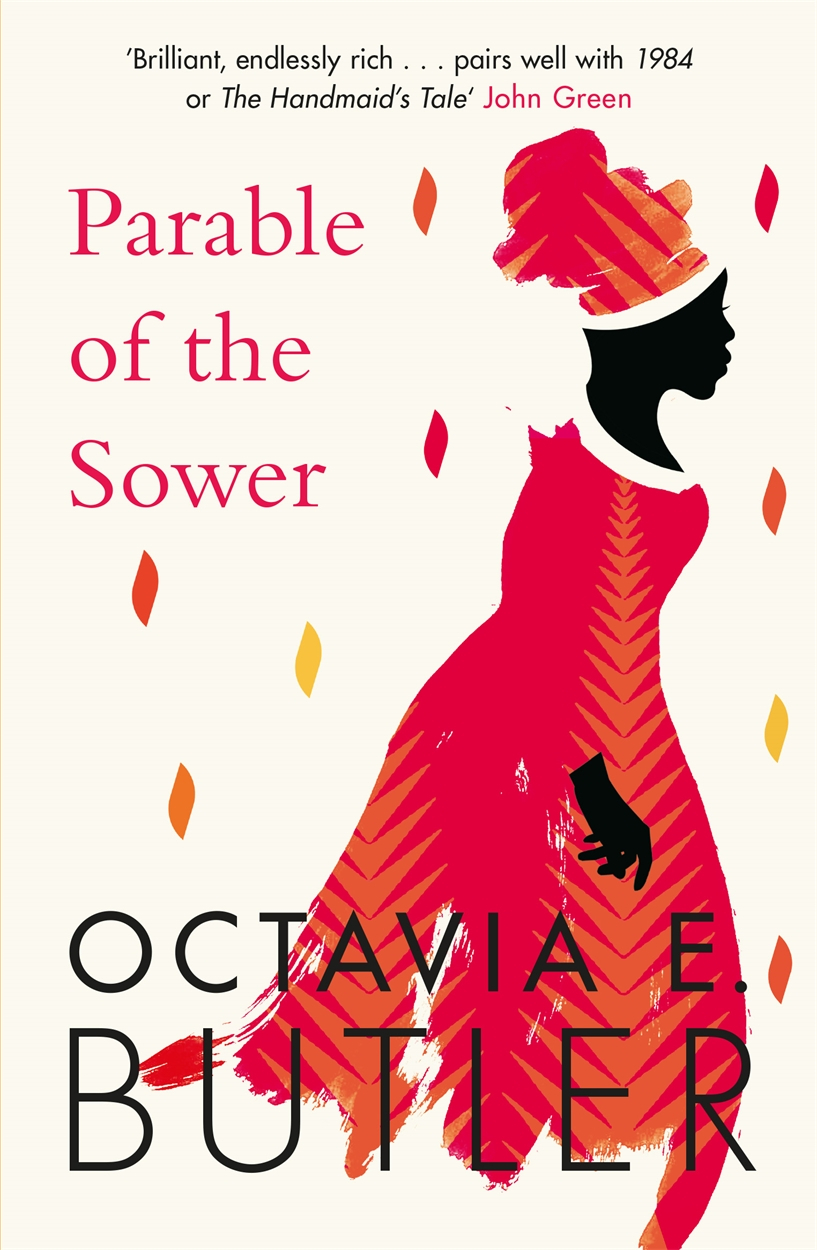
This academic article explores Octavia Butler’s 1993 novel Parable of the Sower and its 2020 graphic novel adaptation by Damian Duffy and John Jennings. It analyzes the medium-specificity of the adaptation by applying a combined theoretical approach that incorporates cognitive narratology and narrative empathy. A discursive dialogue between the two media facilitates a critical evaluation of the potential for Parable to evoke character empathy leading to prosocial action. The prescient themes in Parable, and the timing of the adaptation’s publication facilitates informed ongoing dialogue around change.
Review: This article underwent editorial review from two editors.
“This book lives. It breathes, moves, feels, clamors for your attention, insists on bearing witness, insists on being heard,” declares Nalo Hopkinson in her introduction to Duffy and Jennings’s (2020) graphic novel adaptation of Octavia Butler’s Parable of the Sower. After decades hovering conspicuously on the periphery of literary acceptance, science fiction and graphic novels refute their much-maligned reputations, and produce an alternative canon by joining forces. Narratives of space exploration, time travel, aliens, and meta-human superheroes disturb the grand narratives because they employ such tropes to explore the notion of the ‘other.’ Challenging the presumptions of texts that adhere to the model of white Western hierarchy, many contemporary speculative fiction narratives stage encounters between vastly different perspectives and cultures, and give agency to the ‘other.’
Octavia Butler’s Parable of the Sower (1993)
Graphic novel adaptation by Damian Duffy and John Jennings, with an introduction by Nalo Hopkinson (2020)
An early and powerful influence on Afrofuturism, award-winning author Octavia E. Butler (Womack 2013, 109) proposes a more diverse future through her palimpsestic style of rewriting narratives of race, gender, and disability, thereby challenging the status quo and repositioning previously sidelined characters center-stage. By defamiliarizing human experience, by blurring the lines of ideological expectation, and by broadcasting survival strategies that necessitate major, almost impossible change, Butler complicates the concept of ‘othering’ whilst evoking feelings of empathy for her characters. Suzanne Keen’s (2015) theoretical model of authorial strategic empathy, particularly “broadcast strategic empathy,” is the touchstone for demonstrating how Butler evokes empathic responses in her readers. Since reading is a cognitive action, I combine elements of David Herman’s inquiry into cognitive narratology and Suzanne Keen’s research into narrative empathy to shine light on Butler’s work and its enduring relevance. The remediation of this speculative fiction text into the graphic novel medium, with its metamorphic affordances, facilitates more explicit readings of the tropes of change in Butler’s Parable of the Sower, and opens up empathic dialogue about the medium-specificity of re-reading such a powerful narrative.







 vector-bsfa.com