Cargo (Arati Kadav 2019 Hindi): A meandering rumination about the weightlessness of human existence
Reviewed by Abhishek Lakkad
Please note that this review contains spoilers.
Death can be understood as a scientific/biological phenomenon, but its gravity is experienced as a spiritual phenomenon. Both the scientific and the spiritual perspectives allow one to contemplate death. But when the makers of Cargo (2019) choose science as merely a veil for religious/spiritual ideas in order to comment on alienation and abandonment rampant in contemporary societies, they could have made sure that the film is passionate (or at least compassionate) enough to sustain its slow-paced narrative. Cargo (now available on Netflix) is the first feature length film of Arati Kadav, although she has written and directed several science fiction shorts in the last decade. Cargo highlights the theme of ‘loneliness’ in these times of pervasive social media that creates the impression that one is always connected and hence never alone. Hindu spiritual/religious ideas about karma and the cycle of life, death and rebirth are central to the narrative. The action mostly takes place on a spaceship orbiting Earth where human-like demons called rakshasas are essentially technicians enabling the transition from death to rebirth in a mundane, technocratic and institutionalised process — reminiscent of an airport security checkpoint, medical lab or a prison admissions office. The film terms this process as “post-death transition”, supervised by a department called Post-Death Transition Services (PDTS) that operates under the aegis of Inter-Planetary Space Organisation (IPSO) that has been established by the rakshasas. Owing to the film’s stance of deriving its fictional futuristic technology from elements of Hindu spirituality and mythology, the film has a distinct retro-futuristic feel. Perhaps the datedness of the film’s visual effects is meant to reinforce the 80s inspired aesthetics.
In this academic article, Alexei Warshawski explores themes of architecture, fragmentation, and ontology (in the sense of existence or Being as such) in two speculative fiction novels, China Miéville’s The City and the City (2009) and Ken MacLeod’s Learning the World (2005). MacLeod’s and Miéville’s engagement with postmodernism, read alongside Heidegger, reveal that no matter how fragmented our architecture, and whether we do or don’t truly dwell, our ontology is greatly contingent on the architecture which surrounds us, and our ability to exist within and alongside architectural constructs is an undeniably and increasingly precarious one.
Review: This article underwent editorial review from two editors.
License: Copyright Alexei Warshawski, all rights reserved.
Keywords: architecture, China Miéville, dwelling, fragmentation, Ken MacLeod, ontology
The relationship between architecture and its inhabitants is a powerful one which can be liberating or repressive, inclusive or exclusive, reflective or reductive. These relations are neither cohesive with one another, nor mutually exclusive, so they problematise our relationship with architecture in spatial, temporal and ontological terms. Examples may be found in China Miéville’s The City and the City (2009) and Ken MacLeod’s Learning the World (2005). Miéville’s The City and the City follows Inspector Tyador Borlú as he investigates the murder of a foreign student whose body is found in Besźel, a city which is topographically twinned with another city called Ul Qoma. These two cities are on the same physical site and their residents are expected to ignore the city which they don’t live in, ‘unseeing’ any elements that they accidentally notice. Ken MacLeod’s Learning the World follows a future human race’s attempts to find a new planet to colonise as they travel on their planet-sized generation ship, and grapples with the problems they face in understanding a temporary architectural construct as a seemingly permanent and homely environment. Both novels engage with one of postmodernism’s key architectural concerns – the question of fragmentation, which this paper will argue is a necessity in sustaining the architecture of the worlds of both texts. While The City and the City explores fragmentary architecture through its twinned cities, Learning the World presents architecture as an inherently fragmentary construct, both in spatial and temporal terms. This paper will suggest that the ‘necessary fragmentation’ of the architecture in these texts proves the untenability of postmodern, neoliberal architecture as something permanent or fixed, in both spatial and temporal terms. Furthermore, this paper will argue that the idea of necessary fragmentation in this context give credence to Martin Heidegger’s understanding of ‘building’ and ‘dwelling’, a distinction he outlines in ‘Building, Dwelling, Thinking’(1951) which suggests that ‘dwelling’ as an ontological condition is not a guaranteed effect of building or settling within architectural constructs, and that the ability to ‘build’ in an ontologically authentic manner requires one to possess the capacity to ‘dwell’ in the first place. This paper will outline how these paired concepts of building and dwelling can affect the formation and occupation of architecture, as well as architecture’s relationship to nature. Drawing together the fragmentary elements of architecture and their relationship to Heidegger’s thinking in both texts, this paper will conclude with an analysis of the reflective properties of architecture – in both literal and metaphoric senses – to demonstrate the extent to which architecture can affect not just our social and domestic lives, but our ontology itself.
In this academic article, Josephine Wideman explores themes of temporality and capital accumulation in Samuel R. Delany’s Dhalgren (1975).As Fredric Jameson suggests, we must find new methods of spatial and social mapping in order to navigate the geographical and cultural landscapes of late capitalism.Delany’s Dhalgren is deeply concerned with the fate of US hegemony, and with the uncertainty that capitalism has produced: the duality of its unsustainability and seeming inevitability. Bellona is a cityscape which has been devastated by the cycle of accumulation and taken off the map. Delany’s creation ultimately should not be read as a prophecy of what will come of late US capitalism, but it gives insight into the complex historical and apocalyptic consciousness that has been cultivated.
Review: This article underwent editorial review from two editors.
License: Copyright Josephine Wideman, all rights reserved.
Keywords: accumulation, Giovanni Arighi, postmodernism, Samuel R. Delany, temporality, urban space
Samuel R. Delany’s 1975 novel Dhalgren is lengthy, hallucinatory, and at times unnavigable science fiction. Its form is as dense and as wavering as the urban landscape it depicts, where Delany’s protagonist, Kid, can wonder whether ‘there isn’t a chasm in front of me I’ve hallucinated into plain concrete.’1 Bellona – the fictional city where events take place – is a space ‘fixed in the layered landscape, red, brass, and blue, but […] distorted as distance itself,’ a place where ‘the real’ is ‘all masked by pale diffraction.’2 Although the scenery and scenarios of Bellona may be fictional, and perhaps even fantastic, they are also true representations of real experience. The unfixed landscape we live in becomes ‘fixed’ before us in Delany’s book. The distortions and diffractions by which it is fictionalised only increase its representational precision. The gaps in our experience, usually masked, are made visible. For although it takes an unusual form, we can recognise
this timeless city […] this spaceless preserve where any slippage can occur, these closing walls, laced with fire-escapes, gates, and crenellations are too unfixed to hold it in so that, from me as a moving node, it seems to spread, by flood and seepage, over the whole uneasy scape.3
In looking at Dhalgren, I have borrowed from the political theorist and sociologist Giovanni Arrighi in order to trace the presence and effects of capitalist accumulation in Delany’s fiction. Arrighi, in The Long Twentieth Century, describes the ‘interpretative scheme’ of capitalism as a ‘recurrent phenomena.’4 Drawing on work by the historian Fernand Braudel, Arrighi follows the Genoese, the Dutch, and the British cycles of accumulation to the current North American cycle. By examining past economic patterns and anomalies, he suggests that we may be able to gesture at the fate of our current cycle. Arrighi sets out to demonstrate that the rise and fall of these hegemonies, while never identical, tend to follow a set of stages that begin ‘to look familiar.’5 To make his argument, he proposes a new use for Marx’s ‘general formula of capital’:
Marx’s general formula of capital (MCM’) can therefore be interpreted as depicting not just the logic of individual capitalist investments, but also a recurrent pattern of historical capitalism as world system. The central aspect of this pattern is the alternation of epochs of material expansion (MC phases of capital accumulation) with phases of financial rebirth and expansion (CM’ phases).6
In Das Kapital, Marx initially proposes the formula CMC to theorise how capital functions. This theory begins with the assumption that people have needs and desires they can’t satisfy by themselves. Thus we create the commodities we know how to make (C), which are sold for money (M), which allows us to buy the commodities we want (C). As this cycle repeats, those who are skilled presumably accrue more value than others, being able to sell their commodities for a greater profit. This theory centres around the individual and his role in a capitalist system. But Marx then sets CMC aside in favour of another formula – the formula borrowed by Arrighi in The Long Twentieth Century – MCM’. In MCM’, circulation does not begin with the dissatisfied individual, but with capital itself. Money is invested (M) into the materials and labour necessary to produce a commodity (C), which is then sold for money (M). The difference between CMC and MCM’ is subtle but crucial. The first formula implies that capitalism recurs, and things are made and exchanged, in order to satisfy human desire and need. The second formula implies that money is in charge, that production and exchange are ultimately subservient to profit, and that money begets more money. For Marx, what drives capitalism is not only MCM, but MCM’ – the apostrophe signifying ‘prime’ – or the concept that money increases in value through circulation. The source of this additional, or ‘surplus’ value, is where capital really loses its lustre. This value is gained within labour – in the time spent on the creation and production of a commodity from raw material – and for Marx, its appropriation by capitalists is inherently exploitative.
In this academic article, the authors explore two contemporary movements associated with the literature and art of the Amazon region: Amazofuturism and Indigenous futurism. Amazofuturism is understood as a subgenre with ties to cyberpunk and/or solarpunk, in which the future of the Amazon region is portrayed in a broadly optimistic light. Indigenous futurism refers primarily to speculative artwork and writing by Indigenous people, which expresses Indigenous perspectives and epistemologies, and/or which centres Indigeneous experience. Indigenous futurism opposes reductive, pessimistic, and exoticising discourses about the Amazon region and Indigenous peoples, challenging Western stereotypes and allowing the complexity of Indigenous voices and perspectives to be shared. Together, both these interconnected movements attest to the power of the speculative imagination in social and political resilience and regeneration.
Review: This article underwent anonymous peer review.
License: Copyright Vítor Castelões Gama and Marcelo Velloso Garcia, all rights reserved.
This essay will explore two contemporary movements associated with the literature and art of the Amazon region: Amazofuturism and Indigenous futurism. We hope that it will increase the visibility of these two interconnected movements, in order to enrich diversity within the art world, and contribute toward a broadening of cosmologies and worldviews beyond dominant Western imaginaries [1].
But to do so, let’s start by trying out some definitions. First, Amazofuturism is a subgenre of SF where the Amazon region is represented in a more positive light, often with an aesthetic akin to cyberpunk and solarpunk. Indigenous futurism, on the other hand, focuses on Indigenous worldviews in the context of the SF megatext, and, while doing so, challenges ingrained colonialist assumptions about Indigenous people. Ideally it is also created by Indigenous people. Finally, Brazilian SF, the broadest of these three terms, is simply science fiction from Brazil. It does not necessarily represent either the Amazon region nor Indigenous people at all, and when it does, may do so either positively or negatively [2]. Now, let’s expand a bit on these definitions.
The AGM is happening this weekend, 23 of August, 2.30pm till 5.30pm, on Discord. Hope you can make it! We’ll be discussing some reasonably big developments, including the new BSFA constitution.
Currently, the horror renaissance sweeps through mainstream cinema and television at a pace that’s hard to keep up with. Horror narratives have always been out there, lurking in popular culture, but until recently they felt like a niche interest, ghettoised with fantasy monsters played by actors in thick make-up and rubber suits, tucked alongside the bug-eyed aliens of science fiction.
However, like science fiction, by the mid-2010s, horror is everywhere, reaching huge cinema audiences and, through Netflix and terrestrial television, coming right into our homes. The horror genre, appropriately enough, has now infected a wider host body, and it is mutating, challenging viewer expectations as to what horror is and what it is capable of. I would suggest that horror as a genre has always carried the power to challenge our thinking, to make us consider what defines a monster, and to pull back the veneer of everyday life to expose what’s going on underneath. However, you once had to be a horror aficionado to appreciate that the genre was more than just jump scares and screams. What’s new is that, by busting out of its culturally marginal position, horror is now expanding its narrative, satirical, and critical powers in front of the very mainstream society that it challenges.
‘On Afrofuturism’ was an important topic at the virtual 2020 WorldCon in New Zealand. The conversation paid attention to the term generally applied to embrace literary works that use the frame of science fiction, fantasy or horror to re-imagine the past and present experiences of the African diaspora, and to explore what black futures could look like.
On the panel were Suyi Davies Okungbowa—a renowned Nigerian author of fantasy, science fiction and horror inspired by his West-African origins, including David Mogo, God Hunter; Brandon O’Brien—a writer, performance poet and game designer from Trinidad and Tobago, also the editor of Fiyah Magazine; Ekpeki Oghenechovwe—a Nigerian writer with honourable mention (twice) by the L. Ron Hubbard Writers of the Future Contest, and an award-winning best story in the Nommo Awards for speculative fiction by Africans; myself; and skilfully moderated by Maquel A. Jacob—a multi-author and owner of MAJart Works—who propagated stimulating questions, many from the audience, across the panel.
The introduction to the session stated:
According to Yes! magazine, the concept of Afrofuturism may only go back to 1966, when the Black Panther first appeared in a Marvel comic and Lt. Uhura appeared first appeared on Star Trek. The recent MCU movie, Black Panther, shone a bright light onto this subgenre. Our panel explores its origins, what it encompasses and what works they recommend for getting more familiar worth the subgenre.
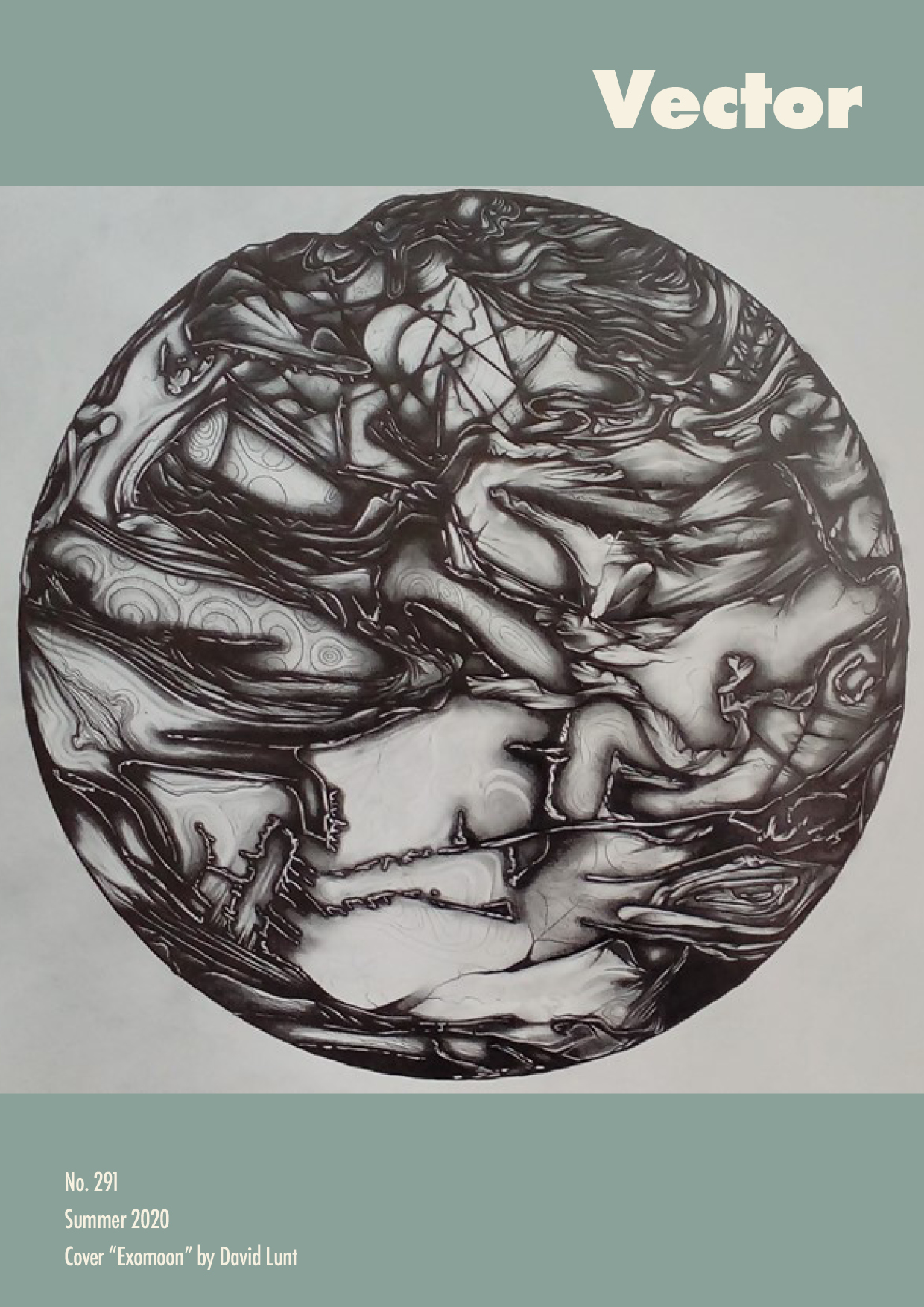
In this issue you’ll find several insightful articles: “The Dystopian Narrative: an Analysis of Texts that Portray Nightmarish Futures” by Giovanna Chinellato; “The Needle and the Wedge: Digital Games as a Medium for Science Fiction” by Monica Evans; and “Amazofuturism and Indigenous Futurism in Brazilian Science Fiction” by Gama and Garcia.
There’s also an exciting array of interviews, including “This Is How You Produce The Time War”: Powder Scofield interviews Amal El-Mohtar and Max Gladstone; “Another Kind of Party”: Vector interviews Catherynne M. Valente; “The Science and the Politics”: Vector interviews Nancy Kress; “Actions and Reactions and Ripple Effects”: Liz Lutgendorff interviews Valerie Valdes; “Living among the Leviathans”: Robert S. Malan interviews Stewart Hotston; and “More Politics, More Magic, and More Queer”: Alison Baker interviews Juliet Kemp.
Paul Kincaid‘s regular column, “Kincaid in Short,” is devoted in Vector 291 to a short story by Brian Aldiss, “The Girl and the Robot with Flowers”. There are three highlighted book reviews from The BSFA Review by Andy Sawyer, Maureen Kincaid Speller and Kate Onyett, as well as a special review-essay by Nick Hubble about Sideways in Time: Critical Essays on Alternate History Fiction, edited by Glyn Morgan and C. Palmer-Patel. Finally, this issue features a review-essay by Dev Agarwal “Us: A film about ‘Them’?”, a conference report by Jasmine Sharma on “Productive Futures: The Political Economy of Science Fiction,” and several artworks by the artist David Lunt.
Loosely based on H.G. Wells’s classic novel, Creation Theatre’s The Time Machine: A Virtual Reality is a piece of theatre that has 2020 written all over it. A zany and thought-provoking eleganzoom extravaganzoom, the show is simultaneously set in your own living room or kitchen, and in a vast, strange multiverse where “the present is endlessly shifting and the future is strange and uncertain,” and where time travellers “tinker with timelines causing people’s names, faces and indeed the colour of their socks to change without warning.”
We were lucky enough to be joined by director Natasha Rickman for a deep dive into the process of creation and re-creation. Beyond the original site-specific production of The Time Machine, and this new version reimagined for the digital stage, Natasha’s directing credits also include Twelfth Night (Rose Bankside), Rhino (Kings Head), Hilda and Virginia (Jermyn Street), Honour (The Royal Court), and as associate director, A Little Night Music (Storyhouse), Shirley Valentine (Bury St Edmunds), Comedy of Errors (RSC), and Romeo and Juliet (The Globe). Natasha is also an artistic associate at Jermyn Street Theatre and co-founder of Women@RADA.
Hi Natasha, thanks so much for speaking with Vector. Are you hearing me OK? My internet’s been a bit funny recently.
Yeah, hopefully we’ll be lucky. My internet’s been actually great the whole time I’ve been making the show, and then just recently it’s like it knows the show is open and it’s just doing its own thing now …
So I guess that’s my first question! When you’re creating a remote theatrical experience like The Time Machine … how do you deal with people’s internets being a bit funny?
It’s definitely one of the challenges of the show. All of the performers are in their living rooms or bedrooms, performing in a variety of locations around the country with varying levels of wi-fi reliability. And yes, performers do sometimes get thrown out of the call. They’ll break up, or their microphone will go. We’ve literally had them be chucked out of a call for a couple of minutes before.
So we’ve had to create a variety of back-up plans. For example, we’ve got some pre-recorded video which only gets shown if people are having sound issues. We’ve also got a thing called parallel reality. The part of the Time Traveller is played by multiple people. That means if one actor needs to jump and take over, they can shout “Parallel reality!” and do that. We actually had a version of that in the original show as well.
Perhaps the material lends itself somewhat to the uncertainties of the medium? The Time Machine is already about a kind of glitching, melting reality.
Yes, definitely. Jonathan has imagined this world where suddenly you can change where you are, or you can change who you are. Another thing we use is what we call elastic content. That’s content that only happens if it’s needed in the show. We have a piece of elastic content in case someone gets thrown out of a call. It’s a scene that could happen at any time. Basically, there’s a whole load of backup material that only makes it into the show if something goes wrong.





 vector-bsfa.com