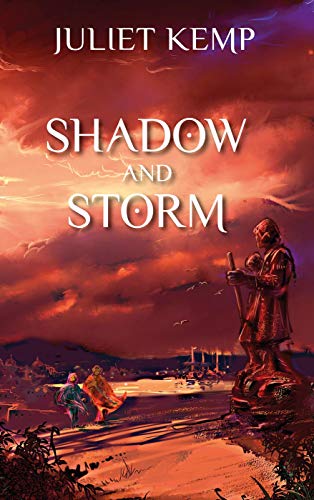
Juliet Kemp’s second novel Shadow and Storm is hot off the presses. Rivers Solomon calls it “the literary equivalent of sinking into the embrace of a dear friend.” Ali Baker caught up with them to chat all things writing and reading …
Let’s start with your new book! How would you describe it?
Shadow and Storm takes place a couple of months after the events of The Deep and Shining Dark. My protagonist Marcia is dealing with the aftermath of the first book, and the other political problems that inevitably appear. Then a sorcerer on the run from Teren arrives in Marek hoping they’ll be safe there, which might have worked, until a demon comes looking for them. And the demon may be more involved with the politics than everyone would prefer. So there’s more politics, more magic, and more queer, basically.
That sounds amazing!
I like writing politics — I have a background in it — but it’s hard to make it convincing. On the other hand, recent real-world events have demonstrated that sometimes people really do make very short-sighted political decisions for reasons that might not be the smartest, so …
Some might say that epic fantasy has very problematic roots, politically. Is that ever something you find yourself encountering when you write –that the material you’re working with tries to tug you in directions you don’t want to go?
That’s a really interesting question, and the answer is yes, definitely.I am consciously trying, in the Marek series, to write characters frommultiple backgrounds, but there’s definitely a tendency in epic fantasyto focus on the people at the top of the pile, and one of my maincharacters is in that position. I also find that I’m drawn towardsvarious forms of violence both as problem and as solution, simply Ithink because that’s one of the approaches I’m used to reading. Thestories we tell shape how we think about both stories and the world ingeneral. So I do try to push back against that — I want people tosolve problems in other ways — but I have noticed the pressure in what I expect a story to look like and have to consciously stop and rethink.With greater or lesser success…
Amal El-Mohtar and Max Gladstone’s This Is How You Lose The Time War (Jo Fletcher, 2019) has been gathering a glowing reception. It’s an intense, lyrical, tragicomic novella about two elite warriors, Red and Blue, who strike up a correspondence across the millenia and across enemy lines. Adam Roberts, in his pick of SFF of the year, calls it ‘one of a kind.’ The novella has also made the shortlist for the 2019 BSFA Award. Late in 2019, Powder Scofield joined Amal and Max to shoot the breeze. This interview is a two-parter, with Part 2 dropping next week. Special thanks to Robert Berg for all his help with the interview.
PART I: ‘So we were in this gazebo …’
Powder: You’ve said one of the foundational premises of your friendship was writing physical letters to one another, and obviously that shows up in This Is How You Lose The Time War. Are there other bits of real life embedded in Time War? When you’re working on a project, how much are you intentionally processing past experience?
Max: Some of it’s intentional, but in my experience, intention is like a raft that’s on an ocean that’s in the middle of a storm. You’re aware of what you can see, but you’re not in control of it as much as you think you are. There’s a little rudder, and you can maybe try to paddle. But if a wave is driving you east, you’re going east. So I think when we sat down to write, we both knew that we were drawing on our experience of writing letters to each other, and of correspondence more generally, and the particular strange kind of time travel that you do when you’re writing a letter, especially a physical letter. But at the same time, there’s the raft, there’s the ocean, and there’s the storm.
Powder: There’s a line in the book, like, “There’s a kind of time travel in letters.” I can see that. The time it takes to write a letter, the time it takes to get there. The way letters can sometimes cross each other in transit.
Max: Exactly. You’re imagining who the other person is that will be receiving this, you’re imagining where you’ll be when they’re receiving the letter in a week or two. You’re wondering sometimes about the many forces that could stand between you dropping the small and very fragile piece of paper into a confusing and vast and twisty basically state system with the hope and trust that the $1.35 stamp will see it across the international border to someone else’s actual house just because you happen to put some words on it. So all of these steps create many different versions of yourself and of the recipient and of your respective spaces. I think that was the intent with Time War. But there are other things that I think were beneath and driving that intent.
Amal: And to answer really literally, when we were writing the book, we were also in a gazebo with no internet. So we were sitting across from each other and we only had recourse to our own bodies of knowledge. The book is built primarily out of no research, but instead what we both brought to the literal table between us in a literal gazebo as we wrote things! There’s so much in there built out of, for one thing, the surroundings. It was a gorgeous late June, early July in the Midwest. There were trees and birds and plants and things that were finding their ways into the things we were writing, for sure …
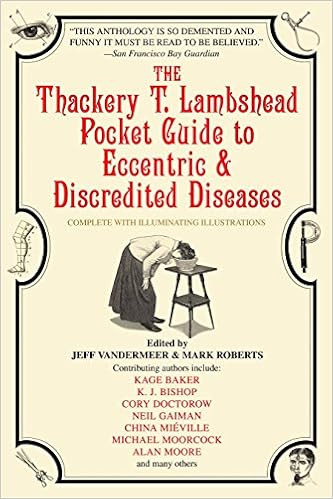
A day or so later, the outer layer of the epidermis splits at the temple into a series of lotus-like petals, apparently causing the victim to force his/her head into the nearest narrow gap (such as a window frame) rather in the manner of a snake attempting to aid the shedding of its skin. Rejecting all offers of help and attempts at restraint, the victim bloodlessly sloughs the skin, ‘scrolling it down the torso and limbs in the manner of a tantalizingly unrolled silk stocking’ (Mudthumper, p.1168).
OK, we’re starting with one that’s not really contagious (as far as I know). So it only manages to scraape its way onto the top ten. But it can also be considered a calling card for Thackery’s, which is a good source of plagues generally. But is whimsy what we need now? I’m not sure. Continue reading “Ten Literary Plagues”→
Mushrooms: The Art, Design and Future of Fungi, curated by Francesca Gavin, can be seen at Somerset House until the 26th of April. It is part of The Charles Russell Speechlys Terrace Room Series and is free to visit.
Mushrooms and fungi have a specific place in the imagination as strange and otherworldly, often associated with the fantastical or magical, but Gavin’s exhibition on the “future” of fungi posits them as significantly more science-fictional than fantastical. They are a technology – for use in the future of fashion, biotechnology or ecological industries, or an alien – an unexpected invader via decay or rot, part of the aesthetic that makes a landscape feel truly not of this world. The exhibition achieves this through the mix of mediums, beginning with some of Beatrix Potter’s botanical illustrations of mushrooms and fungi, and progressing through dance (in video form), textile arts, sculpture, collage, fashion, and an extensive display of books.
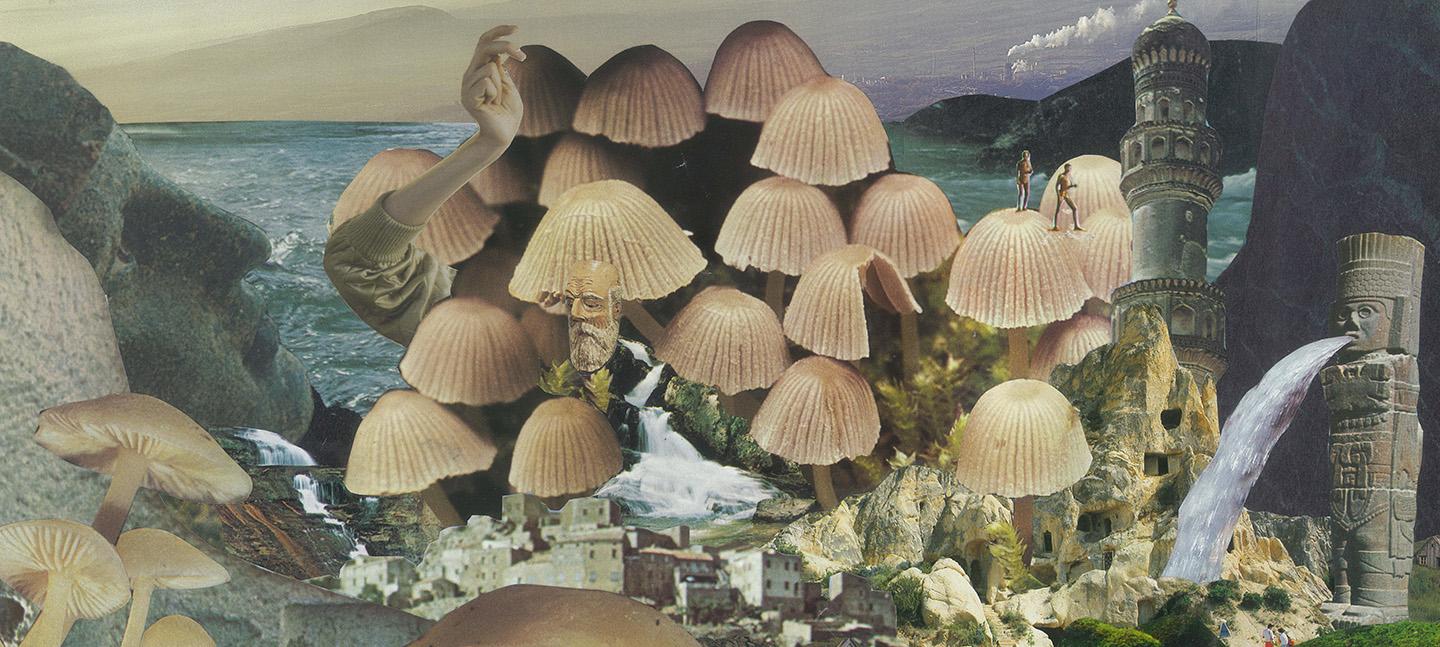
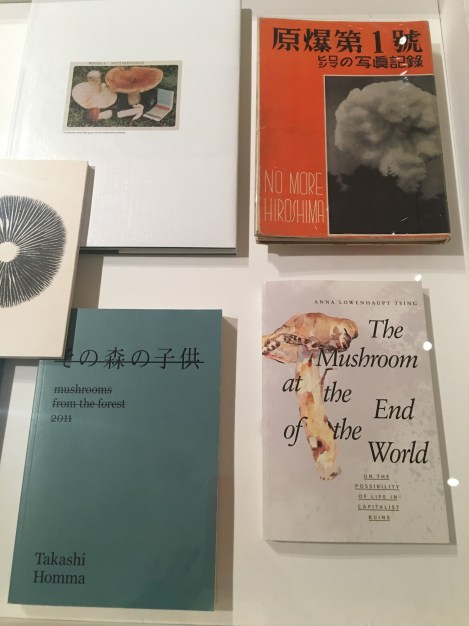
The effect is an exhibition that feels unfinished, if visually engrossing. Amanda Cobbett’s sculptures of mushrooms, perfectly rendered in thread and paper, are an illusion good enough to trick you, and Seana Gavin’s collages are alien worlds where mushrooms form otherworldly buildings, or fungi have unsettling human features. The small setting of the exhibit gives little room for in-depth exploration, and its high goal is undermined a little by the content. A display of mushroom-focused non-fiction literature amounts mostly to a display of book covers, which maybe spark thoughts but ultimately feel superficial. However, for a mushroom lover or for those interested in how the natural world can be positioned in a futurist mindset, it’s a fun way to explore how many different artists have used many different mediums to explore the world of mushrooms and fungi.
While the first two rooms of the exhibit largely explore mushrooms as an aesthetic or fascination, the final ‘Futures of Fungi’ room positions mushrooms as a future technology, one that humanity has not yet fully exploited, with potentials unexplored, with displays including experimental leather made from mushroom, and a typeface generated to ‘spore’ organically as mushrooms do. The strangeness of mushrooms, their in-betweenness between plant and animal, their interconnectedness, are all ways in which they challenge humanity to experiment with their potential. Not all science-fiction, after all, is an exploration of an alien world. Some are discoveries of the strange in our deep seas or our high peaks. Perhaps the next frontier is neither, but instead will be the forest floor.
Chilling Effect, Valerie Valdes’s resplendent debut novel, was published last month in the UK by Orbit. It’s an action-packed space opera bursting with wit and wacky hijinks. Liz Lutgendorff caught up with Valerie Valdes to spill the space tea …
Right from the start, Chilling Effect throws you into the deep end. Was that a deliberate choice?
I do usually prefer novels that approach their stories through immersion rather than exposition. I like to create context while something is happening, rather than trying to explain everything up front. That’s how I tend to build my worlds as well: by having things be introduced as the character thinks about them or interacts with them, a very tight POV that can mean some things aren’t immediately clear and some readers will be frustrated by the lack of explicit description.
It can be a difficult approach to manage because you want the reader to be engaged, and sometimes starting on action or dialogue means the whole thing is occurring in a void and they have no reason to care about what’s happening yet. But also the first chapter, “Save the Cats”, is an allusion to the technique where you get the audience to empathize with your main character by having them do something noble like … save a cat! So I was not only beginning with as much immersion as I could manage, but also joking about the method usually used to get the buy-in from audiences.
That makes sense. Chilling Effect is filled with great worldbuilding, and a lot of action and intrigue, but it’s also very funny and silly! Did you worry about how silly you could be? Or did you leave that your editor if you went too far?
At the point where I started writing this book, I’d spent years trying to write “serious” sci-fi and fantasy and horror stories, because that seemed like the most important thing I could do with my time and energy. The world is a mess, and we need thoughtful fiction to help us find a way to deal with our problems meaningfully, both externally and internally. But as important as catharsis is, as important as it is to engage with contemporary issues, I think it’s also important to imagine a future where humanity has more or less transcended some of those problems.
The Design Museum used to be tucked away somewhere on the south bank of the Thames but since relocating to Kensington in 2016 has established itself as a premier cultural venue in the capital. Those of us a little longer in the tooth would recognise its newish home as having once held the Commonwealth Institute. Today the array of flags has gone but the building is still nestled next to parkland. It’s drizzling on the longish walk from the tube station. It’s the final week of “Moving to Mars” and it’s also half-term; which, as a sometime supply teacher, I should have taken into account. Let’s face it, what do kids love most? Dinosaurs. And second most? Space. (Witches are third, in case you’re wondering.) Continue reading “Mars By Design”→
With H.G. Wells’s classic and hugely influential work The Time Machine celebrating its 125th anniversary, Creation Theatre has teamed up with Jonathan Holloway, The London Library, and a host of consultant scientists and experts from The Wellcome Trust, to create an immersive theatrical experience inspired by Wells’s work. The Time Machine is on Wednesday through Sunday till the 5th of April at The London Library, with a future run taking place in Oxford. We asked playwright Jonathan Holloway to reflect on his process for Vector. Here’s what he had to say …
Jonathan Holloway
Creation’s production of THE TIME MACHINE at the London Library is billed as an ‘adaptation’. That’s not really quite what it is. When I was asked to do it, I hadn’t re-read the book for more than forty years, and on doing so, my heart sank. There isn’t really enough story to allow for an ‘adaptation’ as such. To make something that was going to be worthwhile, the task needed a different approach. The original is basically a yarn about a man who builds a time machine in his conservatory, travels forwards in time, finds the human race has evolved into two halves, one of which lives underground and eats those who live on the surface, then travels back to the present appalled by what he found. The theatre can’t do what a movie can – it doesn’t present ‘actuality’, instead it’s about a collusive relationship with the audience which forefronts ideas. We don’t necessarily ‘show’ it, we describe it, and you create the pictures in your head.
On the set of The Time Machine (Photo by Richard Budd)
Creation Theatre Company put me in touch with the Wellcome Centre in Oxford and I visited on several occasions, meeting scientists, philosophers and ethicists, and hearing what they had to say about the future – over roughly the next fifty years. So, inspired – as it were – by H.G. Wells’ THE TIME MACHINE, I penned a journey through the labyrinth of the iconic London Library, where the author was a member, and imagined a future in which time travel has generated thousands of parallel universes. Effectively, I rather unceremoniously pulled apart this classic sci-fi novel, re-invented it, and pieced it back together to create a world in which the present is endlessly shifting, and the future is strange and uncertain. Travellers have tinkered with timelines causing people’s names, faces and indeed the colour of their socks to change without warning. It is a very ‘theatrical’ evening which requires that we suspend our disbelief and enter into the fanciful creation of an alien dramatic world. Humour sits alongside appalling predictions. It’s a hybrid kind-of show wherein dramatic situations surrender ground to an event that alternates between being a play and something approximating to a TED talk. The script was pretty much done by the end of October, but alarmingly some of the material that seemed farfetched back then concerning climate change and the possible threat of pandemics has subsequently appeared on our TV’s in the form of Australian wild-fires and the spread of Coronavirus. Wells has offered myself and Creation an opportunity to work the fantasy of time travel into a theatrical event that now sometimes feels more like a documentary.
The audience are divided into groups, each of which is accompanied by a time travelling guide. This character bears more than a passing resemblance to Wells’ protagonist – The Time Traveller – and s/he leads our groups through the wonderfully atmospheric interior of the London Library, where they meet other characters, see projected images and listen to recorded speech as if it’s leaking from the many thousands of books on the shelves. The logistics of a show like this are themselves mind-bending. Each group will see the same show, but staggered, as they process in series from room to room. Each group must be kept separate from the others. It’s a theatrical Rubric’s Cube which, thank Heavens, is organised by a wonderful director called Natasha Rickman.
Wells’ THE TIME MACHINE remains one of the great science fiction novels of all time. In this production we have to demonstrate how important a thinker like Wells is to the fabric of how we see ourselves, the purpose we find in existence and what we bequeath to our children. So, I’d ask you please to leave your preconceptions at the door. Yes, you will receive something of Well’s brown furniture and tobacco-soaked club-land atmospherics … but more importantly, we hope you may feel a connection being made between the socialist author and today’s activists.
Personally I can’t believe my luck as I add THE TIME MACHINE to a list of adaptations of great science fiction I have done for the theatre and the BBC including Alfred Bester’s TIGER TIGER, Philip K. Dick’s DO ANDROIDS DREAM OF ELECTRIC SHEEP, Waugh’s BRAVE NEW WORLD and Orwell’s NINETEEN EIGHTY-FOUR.
The Science Fiction Research Association has just released the call for its annual conference, which this year takes place in Indiana. Abstracts are due 15 March. The conference title is ‘Forms of Fabulation,’ and the full call can be read here.
As I’ve done in past years, this won’t be a comprehensive overview of genre films and television of 2019. Instead, this is a selection of titles which are worth your attention. All were commercially released or reissued in the UK last year.
If in Groundhog Day it was Sonny and Cher’s “I Got You Babe” which heralded its protagonist’s recurring day ahead, in Russian Doll (on Netflix, eight episodes of just under a half-hour each) it was Harry Nilsson’s “Gotta Get Up”. It’s Nadia (Natasha Lyonne), again and again in the bathroom of her friend’s apartment while her own birthday party goes on. A cynical, New York thirtysomething, Nadia certainly has her share of damage, manifesting itself in casual drug use and equally casual sex. At the end of today, Nadia will die, she finds out … and then she’s back in that bathroom with Nilsson on the soundtrack. After several go-rounds she finds Alan (Charlie Barnett) in the same predicament.
Russian Doll
Although she was one of three creators (along with Leslye Headland and Amy Poehler), Lyonne dominates the show. She wrote and directed the final episode and co-wrote another. Her chartacterisation inevitably brings resonances of her own personal history, including publicly-known issues with substance abuse. It’s a commanding performance in a miniseries which works out its premise in several interesting ways. The music works perfectly, from Nilsson at the outset to Love’s “Alone Again Or” in the final scene. A second season is on its way.Continue reading “2019 in TV and Cinema”→
Although this Worldcon had about 5,500 paying members who divided their time between, on average, ten simultaneous program items, many sessions, especially the ones connected to Irish mythologies and history’s connection to SF, garnered enthusiastic interest. This provided a chance for academic fans and general fandom to interact and share their expertise. Most of the presenters also tailored their content to a larger audience […]






/cdn.vox-cdn.com/uploads/chorus_image/image/62980741/1461496_15619_zoomedR.0.jpg)
 vector-bsfa.com