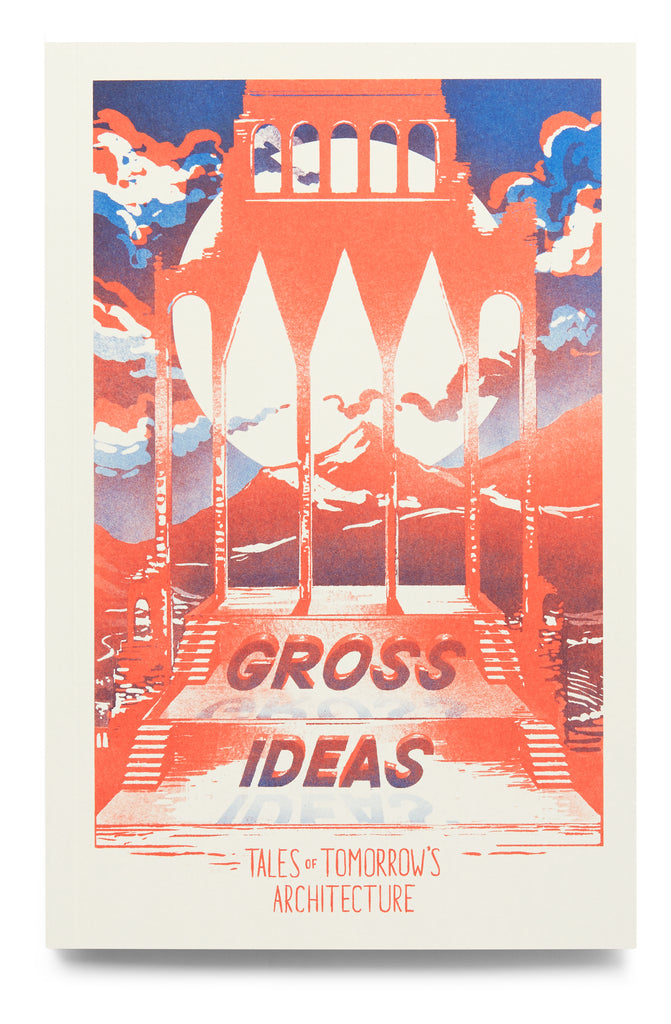
Edwina Attlee, Maria Smith, and Phineas Harper, eds. Gross Ideas: Tales of Tomorrow’s Architecture (London: The Architecture Foundation and Oslo Architecture Triennale, 2019)
Reviewed by Carl Abbott
To understand Gross Ideas, start with the Oslo Architecture Triennale to which this book is a companion. The Triennale is “a member organization that unites the major architecture and urban planning networks in Norway” for conversations and public programs about the role of architecture in society. Participants and supporters include national associations of design professionals, architecture schools, Norwegian government agencies, and international architecture firms with Norwegian roots. The 2019 Triennale in the fall of 2019, was the seventh iteration.
Some of the contributors identify as writers and some as architects, and a few work both sides. There are two poems, one graphic narrative, and fourteen prose narratives of widely differing character …
The book itself is a miscellany of contributions that is more a curated exhibit in verbal form than a tightly edited collection, a characterization that I suspect the curator-editors would find quite acceptable. Some of the contributors identify as writers and some as architects, and a few work both sides. There are two poems, one graphic narrative, and fourteen prose narratives of widely differing character. Some of these latter are stories that could easily find homes in science fiction magazines. Others range from Will Self’s takeoff on Invisible Cities to Lesley Lokko’s essay on women and transnational remittances that includes a fictional vignette, a short factual summary, and scholarly endnotes (it is quite effective).
Architects have long delighted to imagine grand buildings and building schemes—Arturo Soria y Mata’s Ciudad Lineal, the arcologies of Paolo Soleri, Walking City and other thought experiments of the Archigram group, a linear supercity from Michael Graves, the mile-high skyscraper of Frank Lloyd Wright (even Burj Khalifa gets only halfway there). Science fiction has appropriated the taste for the grandiose from Trantor and Coruscant to countless artists’ depictions of imagined urban futures full of soaring towers in shimmering color.
What naïve readers might expect from the “architecture” in the subtitle is often absent …
There is no such here. What naïve readers might expect from the “architecture” in the subtitle is often absent. Instead we get one story in which the largest building is a village house (Sophie Mackintosh, “Placation”), a second set in a caricature of a dusty, unchanging town of the old American Southwest (Joel Blackledge, “Fountainwood”), and another in derelict and abandoned Edinburgh (Camilla Grudova, “Deliberate Ruins’). The only story to center a single building uses an unfinished and abandoned Persian Gulf skyscraper (Deepak Unnikrishnan, “Cat”). The other entry in which architecture is the explicit focus is the graphic narrative “Exile’s Letter” by Mill + Jones, which chronicles efforts to build in a low-technology future (temple, town, giant fishing pier) that are laid low by fire and flood and end with the triumph of unbuilding in a sort of Nature-driven version of the Tower of Babel.
Some of the entries posit future engineering rather than architecture—a distinction that the curators and the Triennale folks would likely disregard anyway. For example, Robin Nicholson projects the green retrofitting of London in 2039. I had the most fun with “The Aqueduct,” which presents a scenario for replacing Britain’s rail and road transportation with a set of canals. It is a fascinating think-piece that painlessly introduces elementary physics to extrapolate from Britain’s current restored canals. If he hasn’t, author Steve Webb should look up Railroads and American Economic Growth by my old graduate professor Robert Fogel, which includes a long counterfactual to test whether the United States might have had the same robust economic growth had it invested in canals and river improvements rather than railroads in the nineteenth century.
As she starts work and experiments on her own small house, she finds herself slowly absorbed by the microbes …
The contributors took to heart the theme of the 2019 Triennale—“Enough: The Architecture of Degrowth.” Some stories imagine the built world in decay (Grudova, Unnikrishnan), others the natural world actively triumphant (Mackintosh). Lev Bratishenko, “You Wanted This,” reports a future United Nations conference at which national representatives offer their own favored ways to drastically reduce the world population—the Russians want to use thermonuclear bombs, the Japanese want to weaponize the Internet of Things, the Americans want to drug everyone to euphoric death (cue up Serenity). One of the most powerful stories is Rachel Armstrong’s “Bittersweet Building.” A new architecture graduate in desperate need of a job catches on with a Norwegian firm that is trying to incorporate bacteria as part of a building’s metabolism (waste into clean water, heat, oxygen). As she starts work and experiments on her own small house, she finds herself slowly absorbed by the microbes into their own complex world and finally merging fully into the “metabolic community of the landscape.” It is both a chilling and a comforting variation on the natural process of bodily decay. For the theme of degrowth, score a big one for the Earth.
Having considered the “architecture” half of “tales of tomorrow’s architecture,” what about the “tales” part? To no surprise, the pieces run a wide span from interesting but undramatic speculation to engaging story. For an example from the didactic side, Edward Davey, “Oli Away,” uses the mechanism of a report on a gap year journey to explicate some favored energy and transportation options. The entries by Nicholson, Bratishenko, and Webb are additional examples of scenario-building rather than storytelling. They have a lot of information without much surrounding story, which is not to say that we should not think about the ideas they present. After all, nobody read Looking Backward for its compelling characters and plot, but it had enormous influence.
Several of the contributions that are strong as stories are, not surprisingly, by people with lots of writing experience who know how to create engaging characters. For many Vector readers, the biggest name in the collection is Cory Dotorow, who contributes an interesting variation on his Disneyland obsession with “Materiality.” He posits a theme park in which high school classes spend a week inhabiting reconstructed towns from different eras. Think Main Street USA meets the living displays of colonial “savages” found at early twentieth century world’s fairs (also see the living diorama in Colson Whitehead’s fantastic alternative view of American history in The Underground Railroad). The theme park contrasts with a present in which recycling and three-dimensional printed make the objects of everyday life ephemeral if not immaterial. Doctorow’s teenaged protagonist indirectly confronts the lasting imprint that seriously stupid Old Timey People left on the landscape by considering whether his favorite old tee shirt is still cool (it is).
… architecture as a practice of designing individual buildings should be and is being swallowed up by the all-consuming impacts of climate change and necessary transformations in global energy systems.
Maria Smith in “Lay Low” uses the familiar frame of singles gossiping in a bar to introduce a society of scarcity in which everyone has monetized allowances for necessities like water, food, and electricity. Her variation on a familiar science fiction future is a new way to get ahead on your budget—perhaps—by going into hibernation for a few months to lower your consumption levels and build up points. The women in the bar, who are just learning about the new option, don’t think that monetizing unconsciousness is going to go well.
Jo Lindsay Walton contributed the longest, most complex, and perhaps most readable story (no, there was collusion with your book review editor). “In Arms” is cleverly constructed with two parallel threads—a woman waiting for a date to show up and an ecoterrorist launching an operation—that slowly grow more complex and intertwine in unexpected ways. Radical changes in building styles are slipped in as background, including the cool idea that rising seas have forced the seat of British government to shift to a mobile seastead platform nicknamed Wetminster.
Without the subtitle and the wraparound material describing the Triennale, someone who casually reads through Gross Ideas would think it is about economic transition and “degrowth” in general, with architecture one of many avenues of exploration. The overall message is that architecture as a practice of designing individual buildings should be and is being swallowed up by the all-consuming impacts of climate change and necessary transformations in global energy systems. Some contributors see a complete devolution to a nonindustrial future, others a society of scarcity, and still others an adapting world. Tomorrow’s architecture, the book suggests, will be valuable to the extent that it is subordinated not just to social needs—an architectural truism, if not always heeded—but rather to fundamental institutional and social transformation.
Carl Abbott is author of The Metropolitan Frontier: Cities in the Modern American West, The New Urban America: Growth and Politics in Sunbelt Cities, and Political Terrain: Washington, D.C., from Tidewater Town to Global Metropolis.