Torque Control

Book Reviews: ‘The Murders of Molly Southbourne’ and ‘Rosewater’ by Tade Thompson

mollyTade Thompson, whose novel Rosewater was reviewed in Vector earlier this year (see below), has just published a new work of fiction. The Murders of Molly Southbourne is set to appear on screen as well, which is not surprising given the beautifully harrowing images that the novel fosters. It is a work of science fiction which reads like a thriller. It might be bloodier than Cormac McCarthy, yet it has the sweetness of a coming-of-age romance. The emotional confrontation with one’s reading self that ensues (‘should I be enjoying this scene?’), as well as all other inner conflicts, are put into perspective by the novel’s narrative of self-destruction. The science-fictional world of Molly Southbourne is a combination of Cold War past and a low-fertility future. The latter is particularly refreshing given the dominance of overpopulation scenarios in both science fiction and everyday conversations. Tade Thompson’s medical and psychiatric knowledge is always put to good use in his novels, the characters are entirely plausible in their contradictions, and the science is internally consistent and evidently very carefully thought through.

Continue reading “Book Reviews: ‘The Murders of Molly Southbourne’ and ‘Rosewater’ by Tade Thompson”

The Geography of Fear: Dave Hutchinson interviewed by Tom Hunter

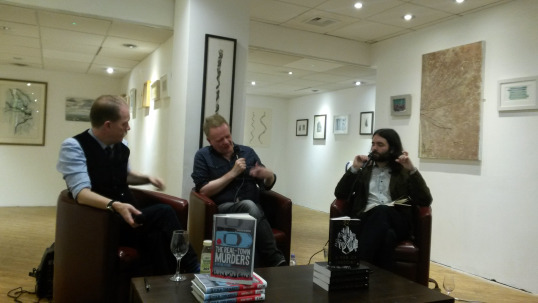
The BSFA holds regular events in London, usually on the last Wednesday of the month, at the Artillery Arms near Old Street. These events are free, and open to members and non-members alike. Keep an eye on the BSFA website for news of future events. In June 2017, Tom Hunter rendezvoused with Dave Hutchinson, author of the acclaimed near-future spy series, Fractured Europe. Our asset Andrew Wallace returns safely to HQ with the following intelligence …

Any writing career has its highs and lows, and in Dave Hutchinson’s case, quite literally. One of the jobs he applied for after leaving university (he graduated from Nottingham with a degree in American Studies), before beginning a career in journalism, was air traffic controller. Dave credits the absence of planes falling from sky to the fact that he didn’t get the job. Still, it’s intriguing to think of Dave Hutchinson, author of the award-winning near-future Fractured Europe series, as an air traffic controller in a parallel universe … managing the borders between nations, between earth and sky …

Continue reading “The Geography of Fear: Dave Hutchinson interviewed by Tom Hunter”

Exhibition Review: Haroon Mirza/HRM199

Haroon Mirza hrm199_Chamber for Endogenous DMT (Collapsing the Wave Function), 2017. Tim Bowditch, courtesy the artist and ZC Low Res-7734

Haroon Mirza/HRM199 reviewed by Polina Levontin

The Zabludowicz Collection in North London is hosting an art exhibition until December 17, which is of particular interest to the sf community. The commissioned work is by Haroon Mirza, whose own studio is located nearby. The exhibition is titled ‘For a Partnership Society’ and the word partnership is key to thinking about the works presented. Firstly, the exhibition itself is a collaborative project on many levels and in almost all of these collaborations science plays a role. Science is invoked in the exhibition as a subject, for example, when the production of scientific knowledge is being compared to a process of forming other sorts of beliefs. Science appears as an object when the standard theory of physics or excerpts from topology lectures become the material parts of an art installation. A history of science serves as a context for the conversation about the fundamental building blocks of a belief system. Furthermore, both technology and scientific methods are intentionally employed as tools for making the artwork, as well as appearing as subjects for Mirza’s artistic explorations.

The premise of Mirza’s work is that the fictional, the religious, the artistic and the scientific are not separable modes, that ‘science, like art, politics and religion often relies on system of beliefs in its pursuit of truth’ [Zabludowicz Collection]. References to a Pythagorean society which practised mathematics as religion remind the viewer that the pretence of decontextualized objectivity in science is a relatively recent phenomenon.  In his 1984 essay ‘No Apocalypse, Not Now’ Derrida gives another reason for why we should no longer pretend that beliefs and science can be disentwined: technological powers have passed the threshold where the science itself poses an existential threat to humanity. Derrida was referring to nuclear physics, something which Mirza references in almost all the works that are part of the current exhibition. Since 1984, when Derrida wrote ‘one can no longer oppose belief and science, doxa and episteme’ because modern/atomic technology ‘coexists, cooperates in an essential way with sophistry [imagination]’, new technological threats such as AI have emerged.  Mirza’s work is a manifestation of this quote:  the AI and other forms of technology coexist and cooperate in an essential way with his art.

Haroon Mirza hrm199_Pathological Theology, 2017. Tim Bowditch, courtesy the artist and Zabludowicz Collection Low Res-6038

At least one part of the exhibition is literally a scientific experiment, conducted with researchers from Imperial College. In ‘Chamber for Endogenous DMT (Collapsing the Wave Function)’ Mirza constructs a confined sensory deprivation space which is being used by the scientists to explore human perception. Like the scientists, Mirza is interested in the potential of art to influence a state of mind, or even alter the state of mind as much as some psychotropic chemical substances or meditation practices. In a spirit of experimental design and following a framework for scientific investigations, Mirza’s art installations produce a range of sensory input levels – from near complete deprivation to sensory overload.

The scientific method is used by Mirza not just in setting up progressively increasing levels of exposure to sensory inputs, but also in taking a deductive approach as the principle for creating artwork. He dissects, breaks down and analyses various materials (including works of other artists) as a scientist would in trying to understand the basic principles of how something works.  His approach is hierarchical, making explicit different meta-levels. For example, Mirza takes a ‘found’ YouTube video where young Bjork is seen examining the functions of a cathode ray tube and, echoing her curiosity about technology, breaks the wholeness of the video down to expose its more elemental aspects: the RGB (Red, Green, Blue) system of colour projection, the individuality of video frames and how these are cropped, sequenced and made to follow one another at predetermined intervals (24 frames per second).

Haroon Mirza hrm199_The System, 2013, installation view, Tim Bowditch, Courtesy Zabludowicz Collection_Low Res-7017

Mirza’s thesis is that a partnership first and foremost requires the dismantling (or at least the questioning of) barriers. Mirza successfully makes the viewer (even a scientifically trained one like myself) uncertain of where scientific knowledge ends and the pseudo-scientific begins. Science is never presented as an isolated subject, more poignantly, videos with snippets of lectures on topology are shown side-by-side with a commentary on a history of colonialism. The idea that there is only one true system of knowledge is questioned as the viewer is invited to contemplate the standard theory of physics alongside indigenous knowledge systems, shamanic rituals and AI. Topology, colonialism, quantum physics, environmental catastrophes and political upheavals dissolve into one another with the aid of the AI Deep Dream technology.  Cumulatively all these ideas are given an inorganic but seemingly living presence by Mirza who uses an Emerging Paradigm (hrm199) technology to forge a coalescence of synchronised video, sound and led lights.  Mirza’s genius of generating meaning out of seemingly inarticulate materials is evident in the title of this work. It is simply a pair of numbers, ‘9/11 11/9’. Mirza uses the succinctness of mathematical notation to tell a complex story, where an attack on the World Trade Centre becomes conjoined with the 9th of November, the date Trump’s victory in the American election was declared.

Mirza’s many disruptive dualities are designed to induce the kind of ‘cognitive estrangement’ (Darko Suvin) that is characteristic of sf. Further, his preoccupation with science and technology and their interactions with human perception and understanding of reality places his work in the critical space occupied by the theorists of science fiction.

Haroon Mirza hrm199_Pathological Theology, 2017. Tim Bowditch, courtesy the artist and Zabludowicz Collection_Low Res-6124

Space Age: Mapping’s Intelligent Agents

Navigational chart from the Marshall Islands, made of wood, sennit fiber, and cowrie shells. [Wikimedia/UC Berkeley]

With the stakes so high, we need to keep asking critical questions about how machines conceptualize and operationalize space. How do they render our world measurable, navigable, usable, conservable? […] In a coming age of robot warfare and policing, we could see designers specializing in the creation of robot-illegible worlds rather than machine-readable ones […]

Shannon Mattern: ‘Mapping’s Intelligent Agents’ at Places.

From Our Archive: Biographical Fantastic

Framing the Unframeable

What does the fantastic bring to the storying of lives? By Gary K. Wolfe

441px-Novalis2

“Unser Leben ist kein Traum, aber es soll und wird viellicht einer werden”.
(“Our life is no dream; but it ought to become one, and perhaps will.”)

– Novalis (Friedrich von Hardenburg), as quoted in George MacDonald’s Phantastes (1859)

“And do not rely on the fact that in your life, circumscribed, regulated, and prosaic, there are no such spectacular and terrifying things.”
– C. P. Cavafy, “Theodotus,” as quoted in Elizabeth Hand’s Last Summer at Mars Hill (1998)

When one looks at the published memoirs and autobiographical sketches written by science fiction and fantasy authors, mostly for the benefit of their fans – the sort of thing collected in Brian Aldiss and Harry Harrison’s Hell’s Cartographers (1975) or Martin Greenberg’s Fantastic Lives: Autobiographical Essays by Notable Science Fiction Writers (1981) – one is initially struck by the relative thinness and lack of genuine introspection of many of the essays. Typically, such pieces read as a variety of Augustinian conversion tales, depicting a precocious childhood, often solitary and bookish, sometimes sickly, sometimes featuring battles with parents to get into the adult sections of the library, and characteristically leading toward a moment of revelation: “And then came Hugo Gernsback” (Alfred Bester) [1] “Then I saw and bought an issue of something called Amazing Stories” (Damon Knight) [2] “So science fiction entered into and began warping my life from an early age” (Brian Aldiss) [3] etc. In one of the still-comparatively rare autobiographies of SF writers, Wonder’s Child: My Life in Science Fiction, Jack Williamson ends a chapter with the following cliffhanger:

Something else happened, however, in the spring of 1926, the first year I was out of high school. Something that changed my life. Hugo Gernsback launched a new pulp magazine, filled with reprinted stories by Jules Verne and H.G. Wells and A. Merritt and Edgar Rice Burroughs, stories he called “scientifiction.”

The magazine was Amazing Stories. [4]

Following these road-to-Damascus moments, however, these memoirs and autobiographies seldom become genuine testaments, instead amounting to not much more than narrative resumés, filled with anecdotes of encounters with fellow writers and editors and often with almost obsessively detailed accounts of sales figures and payments; one comes away with the sense that (a) science fiction writers all clearly remember the first SF story they read, and (b) they keep really good tax records.
Continue reading “From Our Archive: Biographical Fantastic”

Southern California Science Fictional Thinking in Mundos Alternos: Art and Science Fiction in the Americas

Boom California

UCR Arts Block-28

Tyler Stallings

History is written in retrospect. Patterns are sought among seemingly unrelated events at the time of their occurrence. There is never just one historical narrative. Historians make choices about what events to represent and from which perspective, often to the disadvantage of people on the losing end—for example, the colonized or enslaved. Mundos Alternos: Art and Science Fiction in the Americas provides a space-time continuum for reimagining the past from the perspective of the “alienated” and the “other,” from the peoples marginalized by the powerful. The exhibition includes over thirty contemporary artists who explore interactions of science fiction and the visual arts in Latin America, the U.S., and the intergalactic beyond; collectively laying out a provocative view of arts in the Americas told in the present but with an eye toward future, alternate Americas.

Mundos Alternos is an 11,000-square-foot exhibition, with an accompanying book of the same title…

View original post 7,039 more words

Superhero_ines: Rebooted Comics and Trans* Identity

By Christina Scholz

Centre for Intermediality Studies, University of Graz, Austria

Manteau: Seriously? Bust? – What kind of things’ve you dialed so far? You been a giant metal spring, yet? A super-disco dancer? A boomerang? Now it’s bust because you’ve got ovaries? Every few dials, this happens, Baroness.
(Miéville & Santolouco, Dial H #3, 2012)

In this academic article, Christina Scholz explores trans* identity within comic books. Gender is a discursive and performative construct, and mass media such as comic books play a role in how it is constructed. Problems arise from discrepancies between prescriptive models of gender and individuals’ actual lived experience. Now, in the era of the reboot, comic book writers have the opportunity to change the identity politics inherent within well-known series, reaching a wide audience through iconic figures, and contributing to changing cisnormative perceptions of gender. Comic books are particularly crucially placed in this regard, since superheroes, as established metaphors of otherness, may in some sense already be ‘queer’ figures. However, although important and exciting steps have been taken toward better representation of trans* identities within superhero comics, we still have a long way to go. Drawing in particular on the theory of Judith Butler and Antke Engel, as well as lived experience, this article explores the past and present representation of trans* identities in comic books, and looks with hope toward the future.

Continue reading “Superhero_ines: Rebooted Comics and Trans* Identity”

From the BSFA Review: Lagos_2060

Lagos_2060 curated by Ayodele Arigbadu (DADA books, 2013)

Reviewed by Polina Levontin

Lagos_2060

Writing about present day Lagos, Rem Koolhaas warns that already ‘the city itself has mutated into something’ quite unrecognizable to Westerners who think of cities in terms of European or North American models.  ‘What will the city be like in 2060?’  This was the question posed to 8 Nigerian science fiction writers during a workshop that yielded an anthology: Lagos_2060. The resulting eight stories, three of which are written by women, represent a diverse range of imaginaries all set in Lagos, the year 2060.  These stories engage with science and governance, city infrastructure and climate change, co-evolution of technology and social norms, urbanization and the future of global capitalism. Yet these scholarly themes emerge from stories that are first and foremost exciting, often romance-filled adventures.  There are man-eating frogs and time-travel inducing herbs, girls with luminous tattoos and zero-gravity bedrooms, albeit in separate stories…

Individual writers approached the remit to imagine the future of one of the world’s greatest cities each with their own genre pallette and a remix of intellectual priorities.  But what these stories share is a sense of dynamic liveliness that can only be a feature of a work in progress, their various literary forms reflective of the chaotic process by which the city itself is shaped. Their gift is the recklessness of trying out new things. These are pioneering works, regardless of how one decides to date science fiction in Nigeria.

What interested me in particular were the discourses on science.  The first story of the anthology, ‘Amphibian Attack’ by Afolabi Muheez Ashiru presents the dangers of leaving the sciences in the hands of the private sector.  The private company ‘Bright Life Group’ is so efficient in curing diseases and supplying energy that it has to use science also to undo the progress, secretly engineering catastrophes, so that it can keep itself profitable and powerful by fixing its own ‘accidents’.   The discourse in the second story ‘Animals on the Run’ by Okey Egboluche is that of conflict between technological progress on one hand and society and environment on the other.  The value of robotics in particular is questioned because it reduces employment in conditions where large numbers of people need jobs.  Robotics is critiqued on an intimately personal scale in another story in the collection, ‘Metal Feet’ by Temitayo Olofinlua.

Technological advances such as land reclamation to expand Lagos are questioned as risky and as a violation of ‘natural order.’  In ‘Mango Republic’ by Terh Agbedeh scientific rationalism is instituted in Lagos, making it ‘the most beautiful prison in the world ever conceived by man’ (p. 197).  But even supreme scientific achievements are shown to be powerless against the forces of nature unhinged by climate change. Floods and rising sea levels threaten Lagos, while environmental destruction elsewhere in Nigeria swells the city’s population beyond capacity. In ‘Mango Republic’ the discourse of science is survivalist – science is our last hope to adapt to a perilous future.  Yet, exemplifying the complexity of the narratives in Lagos_2060, other stories demonstrate the political danger of seemingly desirable scientific solutions.  On the extreme opposite spectrum from ‘Amphibian Attack’, scientific knowledge becomes highly guarded government property in ‘Cold Fusion’.  A new way to produce cheap renewable electricity reinforces the government’s control over the people of Lagos and stirs political ambitions to secede from the rest of Nigeria.   Science promising energy independence actually does enable the politicians who rule Lagos to secede from Nigeria in another story – ‘Coming Home’ by Rayo Falade.

The collection is full of ideas pertinent not only to the future of Lagos but the future of humanity in general. The writers don’t envision Lagos in isolation but as an integral part of the global economic and natural system. Their visions and hopes for Lagos, their individual philosophies and fears are expressed with humor and showmanship. Their ability to ask urgent questions about the direction we are heading is made invaluable by their skills to entertain.

Sputnik Award: The Final

By Jo Lindsay Walton.

Some time in early 2016, I and a few others decided to set up an award for speculative fiction, the Sputnik Awards. The idea was to do things a little differently, and to spark thinking about what literary awards can and should be. Or, um, shouldn’t be. Because we are so very scrupulous in our awarding, we are only now ready … almost ready! … to announce the winner. So without any further ado, here is some further ado, giving the story so far:

And the winner is …

Elsewhere:

Trivia:

The Sputnik Award 2016 was primarily a popular award (voted for by about 200 fans, mostly courtesy of File 770’s signal boost) with just a tincture of a juried award (I chose the shortlist, mostly guided by the shortlists of other then-major awards).

The name Sputnik, by the way, came courtesy of Ian Sales, although he had something a bit different in mind and is blameless in this affair. The notion that the Sputniks could do this genre-jump for its final showdown, from dungeoncrawl to duel, came from Zali Krishna and Christina Scholz. Christina happens to be published here this week: check out her article, “Superhero_ines: Rebooted Comics and Trans* Identity.”