Haroon Mirza/HRM199 reviewed by Polina Levontin
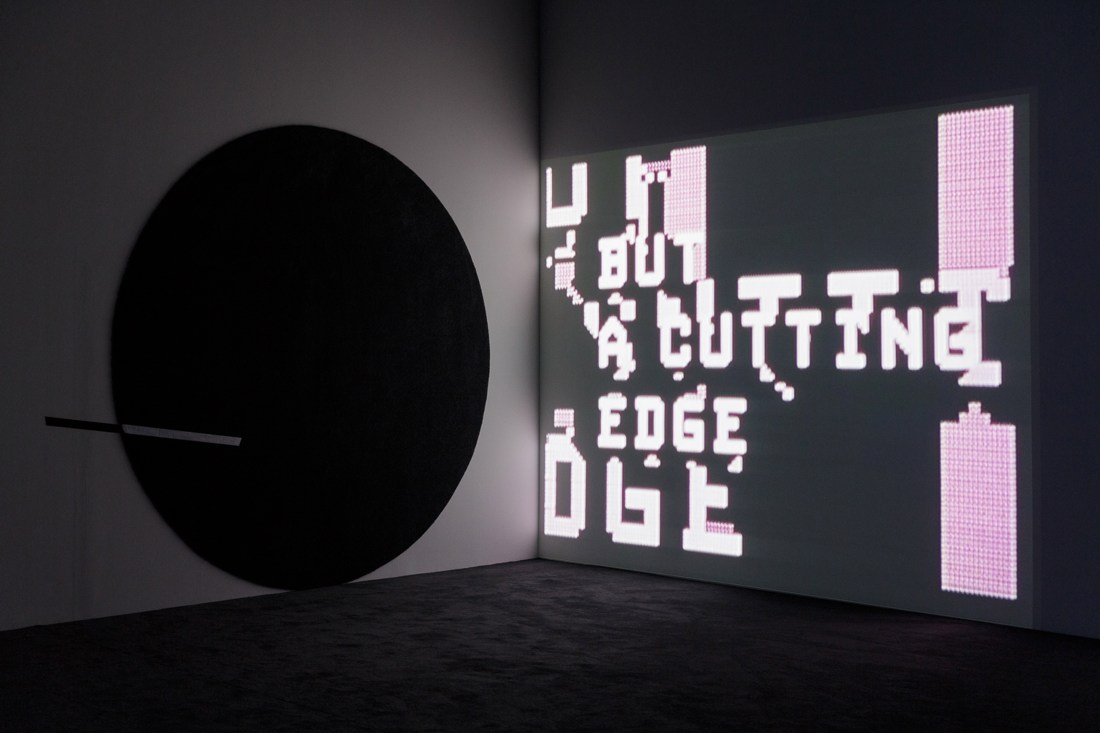
The Zabludowicz Collection in North London is hosting an art exhibition until December 17, which is of particular interest to the sf community. The commissioned work is by Haroon Mirza, whose own studio is located nearby. The exhibition is titled ‘For a Partnership Society’ and the word partnership is key to thinking about the works presented. Firstly, the exhibition itself is a collaborative project on many levels and in almost all of these collaborations science plays a role. Science is invoked in the exhibition as a subject, for example, when the production of scientific knowledge is being compared to a process of forming other sorts of beliefs. Science appears as an object when the standard theory of physics or excerpts from topology lectures become the material parts of an art installation. A history of science serves as a context for the conversation about the fundamental building blocks of a belief system. Furthermore, both technology and scientific methods are intentionally employed as tools for making the artwork, as well as appearing as subjects for Mirza’s artistic explorations.
The premise of Mirza’s work is that the fictional, the religious, the artistic and the scientific are not separable modes, that ‘science, like art, politics and religion often relies on system of beliefs in its pursuit of truth’ [Zabludowicz Collection]. References to a Pythagorean society which practised mathematics as religion remind the viewer that the pretence of decontextualized objectivity in science is a relatively recent phenomenon. In his 1984 essay ‘No Apocalypse, Not Now’ Derrida gives another reason for why we should no longer pretend that beliefs and science can be disentwined: technological powers have passed the threshold where the science itself poses an existential threat to humanity. Derrida was referring to nuclear physics, something which Mirza references in almost all the works that are part of the current exhibition. Since 1984, when Derrida wrote ‘one can no longer oppose belief and science, doxa and episteme’ because modern/atomic technology ‘coexists, cooperates in an essential way with sophistry [imagination]’, new technological threats such as AI have emerged. Mirza’s work is a manifestation of this quote: the AI and other forms of technology coexist and cooperate in an essential way with his art.

At least one part of the exhibition is literally a scientific experiment, conducted with researchers from Imperial College. In ‘Chamber for Endogenous DMT (Collapsing the Wave Function)’ Mirza constructs a confined sensory deprivation space which is being used by the scientists to explore human perception. Like the scientists, Mirza is interested in the potential of art to influence a state of mind, or even alter the state of mind as much as some psychotropic chemical substances or meditation practices. In a spirit of experimental design and following a framework for scientific investigations, Mirza’s art installations produce a range of sensory input levels – from near complete deprivation to sensory overload.
The scientific method is used by Mirza not just in setting up progressively increasing levels of exposure to sensory inputs, but also in taking a deductive approach as the principle for creating artwork. He dissects, breaks down and analyses various materials (including works of other artists) as a scientist would in trying to understand the basic principles of how something works. His approach is hierarchical, making explicit different meta-levels. For example, Mirza takes a ‘found’ YouTube video where young Bjork is seen examining the functions of a cathode ray tube and, echoing her curiosity about technology, breaks the wholeness of the video down to expose its more elemental aspects: the RGB (Red, Green, Blue) system of colour projection, the individuality of video frames and how these are cropped, sequenced and made to follow one another at predetermined intervals (24 frames per second).

Mirza’s thesis is that a partnership first and foremost requires the dismantling (or at least the questioning of) barriers. Mirza successfully makes the viewer (even a scientifically trained one like myself) uncertain of where scientific knowledge ends and the pseudo-scientific begins. Science is never presented as an isolated subject, more poignantly, videos with snippets of lectures on topology are shown side-by-side with a commentary on a history of colonialism. The idea that there is only one true system of knowledge is questioned as the viewer is invited to contemplate the standard theory of physics alongside indigenous knowledge systems, shamanic rituals and AI. Topology, colonialism, quantum physics, environmental catastrophes and political upheavals dissolve into one another with the aid of the AI Deep Dream technology. Cumulatively all these ideas are given an inorganic but seemingly living presence by Mirza who uses an Emerging Paradigm (hrm199) technology to forge a coalescence of synchronised video, sound and led lights. Mirza’s genius of generating meaning out of seemingly inarticulate materials is evident in the title of this work. It is simply a pair of numbers, ‘9/11 11/9’. Mirza uses the succinctness of mathematical notation to tell a complex story, where an attack on the World Trade Centre becomes conjoined with the 9th of November, the date Trump’s victory in the American election was declared.
Mirza’s many disruptive dualities are designed to induce the kind of ‘cognitive estrangement’ (Darko Suvin) that is characteristic of sf. Further, his preoccupation with science and technology and their interactions with human perception and understanding of reality places his work in the critical space occupied by the theorists of science fiction.

![Navigational chart from the Marshall Islands, made of wood, sennit fiber, and cowrie shells. [Wikimedia/UC Berkeley]](https://vector-bsfa.com/wp-content/uploads/2017/10/navigational-chart-from-the-marshall-islands.jpg?w=1100)