How strange are your horizons? It’s the Strange Horizons annual fund drive.
This year’s milestones …
How strange are your horizons? It’s the Strange Horizons annual fund drive.
This year’s milestones …
A roundup of some recent SF and SF-adjacent trailers.
Infinity Chamber, Marjorie Prime, It, Thor: Ragnarok, Justice League, Ready Player One, Blade Runner 2049, Close Encounters of the Third Kind, Wonder, Goodbye Christopher Robin, Flatliners, Legend of the Naga Pearls.
Continue reading “Near Future: August/September Movie Trailers”
New research shows that African wild dogs, bless them, use sneezing to vote.
At least, that’s kind of what it shows. As usual, a few details are finessed in the jump from scientific journal to popular science press …
The BSFA holds regular events in London, usually on the last Wednesday of the month, at the Artillery Arms near Old Street. These events are free, and open to members and non-members alike. Keep an eye on the BSFA website for news of future events. In February 2017, Ian Whates caught up with SF and fantasy novelist Adrian Tchaikovsky. Andrew Wallace chronicles the encounter …
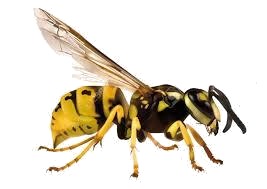
Adrian Tchaikovsky is known for his ten-volume epic fantasy series, Shadows of the Apt, whose clashing civilisations are based around insect species. More recently, Adrian has been lauded for his science fiction, with his novel Children of Time winning the 2016 Clarke Award. Children of Time starts from the premise of a nano-virus sent across the stars to seed life on a distant world. Unexpectedly, it is the spiders and ants – species meant to play mere bit parts in the glorious epic of mammalian expansion – who get sped towards sentience, and the kind of richly detailed space-faring society that great SF does so well.
So the question we all want to ask Adrian Tchaikovsky is: what’s with the bugs?
Adam Roberts’s 2017 The Real-Town Murders, which features a near future SF take on Hitchcock’s The Birds, is feeling quite timely this evening …
Nominations for the BSFA Awards are now open! Members of the BSFA can nominate in four categories:
Read about the Awards on the BSFA site, then get nominating. You only get a limited number of nominations, but if you have a lot of love for SFF in 2017, you can always spill over into the informal suggestions spreadsheet. If you’re not yet a BSFA member, here’s where you can rectify that.
This is also a good moment to remember last year’s winners:

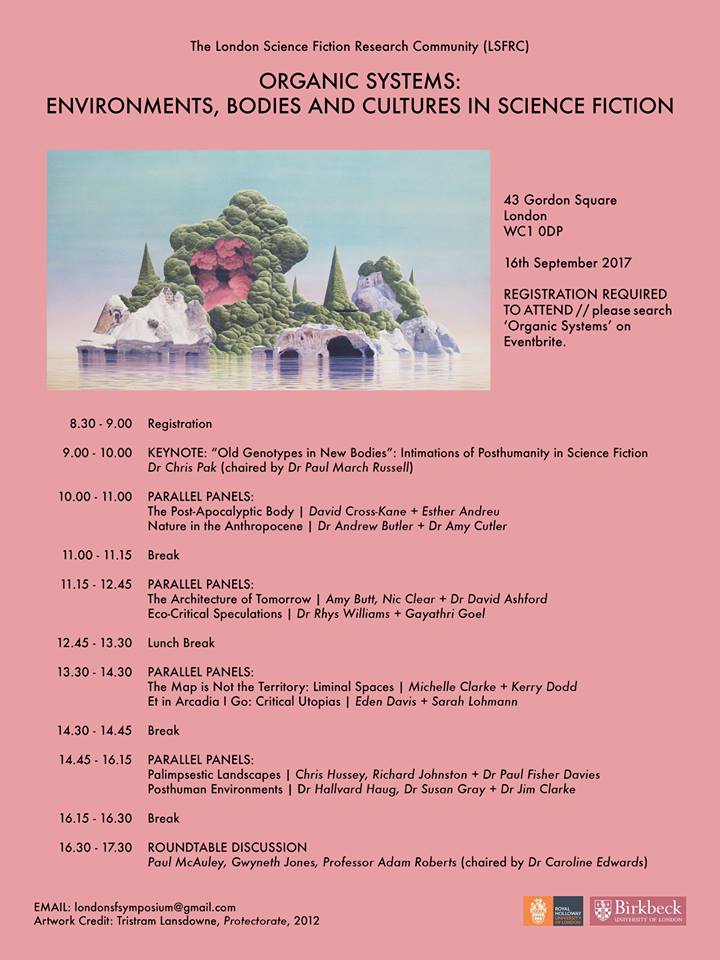
Here’s a roundup of some recent calls for academic papers:
Reports, reflections, and other bits on WorldCon 75 last week:
By Jo Lindsay Walton

It is Wednesday. I am in Helsinki. So is everybody else.
There are a few issues of Vector and FOCUS on the freebies table, courtesy of Dave Lally; but, of course, not for long.
I put in time in Messukeskus 209, the academic track. On Wednesday, Merja Polvinin introduces the Finnish Society for SFF Research (Finfar), its journal Fafnir, and the theme of the next five days. The theme is ‘estrangement.’

Speculative fiction isn’t about other worlds, it’s about this world! In speculative fiction, we encounter real, familiar things, only made strange! There is a kind of political value to such encounters. In the movie Elysium, we encounter something real and familiar (unjust access to healthcare), only that thing is made strange.
By making the world strange, we can unsettle the distinction between what is possible and what is not. By making the world strange, we can see the world for what it really is, including all its promise and possibility.
At least, that’s the idea. Over the five days, I am struck by how accommodating and flexible and familiar the concept of estrangement has become.

