
Torque Control
SF Theatre: The Phlebotomist
The Phlebotomist
Science fiction theatre at Hampstead Downstairs, London.
Bea meets Aaron. He’s intelligent, handsome, makes her laugh and, most importantly, has a high rating on his genetic profile. What’s not to like?
Char is on the brink of landing her dream job and has big plans to start a family – but her blood rating threatens it all.
In a world where future happiness depends on a single, inescapable blood test – which dictates everything from credit rating to dating prospects – how far will people go to beat the system and let nature take its course?
Apparently, some of the technologies that The Phlebotomist presupposes are already here, it was disconcerting noticing the Tube ad for a blood testing company called Medichecks right after seeing the play:

Augment the Poetic
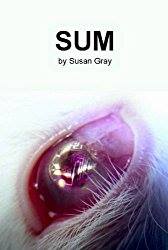 Andrew Wallace will be interviewing Dr Susan Gray about the power of science fiction theatre, interactive poetry and writing for augmented reality at the British Science Fiction Association this Wednesday 23 May at the Artillery Arms, 102 Bunhill Row, London, EC1Y 8ND; doors 6.30pm for a 7.15pm start. Entry is free.
Virtual Futures: Tomorrow’s Wars

Virtual Futures: Tomorrow’s Wars – 17th April 2018
Inspiration & Terror by Andrew Wallace
Virtual Futures began in the early 1990s, when writers, thinkers, performers and scientists got together at Warwick University to grapple with the implications of technological changes sweeping society. Now that we are in that feared and fabled future, a new incarnation of Virtual Futures has been taking place in London. At the inception, one of the most popular elements of the events, or ‘salons’ as they are known, proved to be a short piece of science fiction written and read by science fiction author Stephen Oram. These pieces were so popular that science fiction got its own night within Virtual Futures, with Stephen as the curator. Mixing fiction specially written around the evening’s theme with keynote introductions by noted speakers often prominent scientists in the relevant field, the nights are unlike any other science fiction event in London.
April’s Salon explored the future of warfare, asking these crucial questions:
War has, so far, been inevitable throughout human history – but what will the future of conflict or cooperation look like? Will the discoveries of the future lead us to a world without violent disagreement, or just result in us killing one another in more creative ways? Continue reading “Virtual Futures: Tomorrow’s Wars”
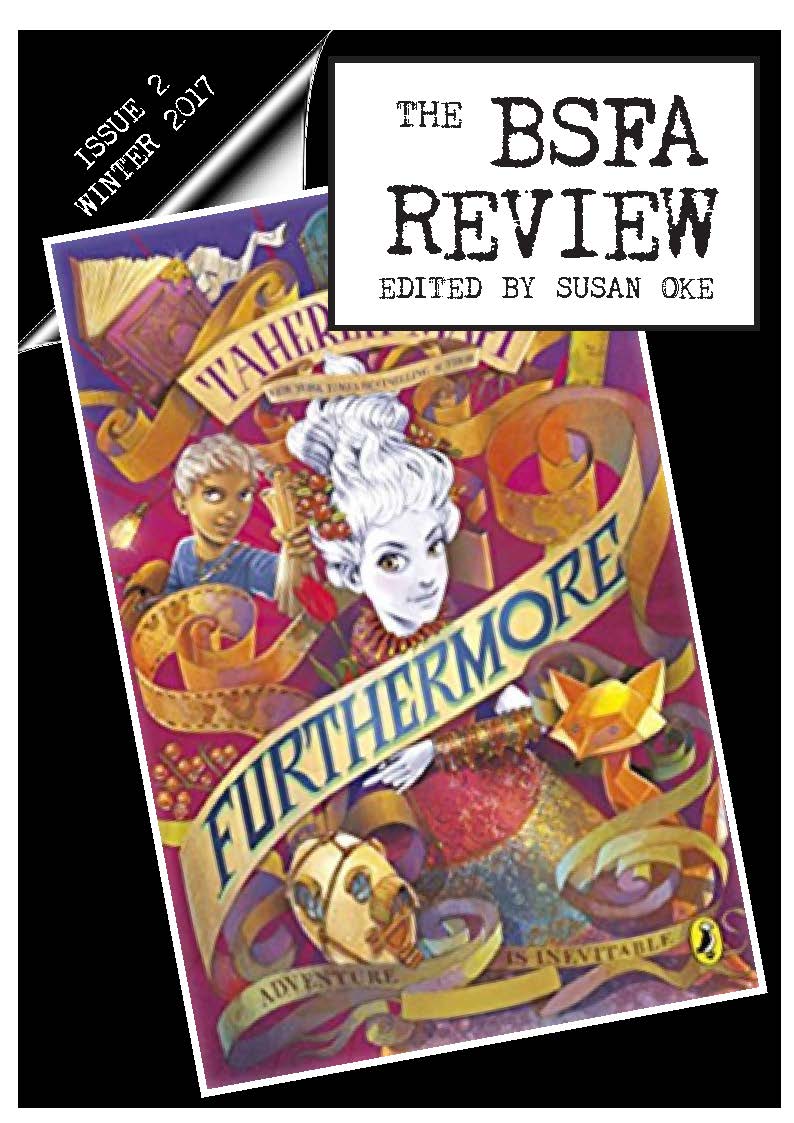
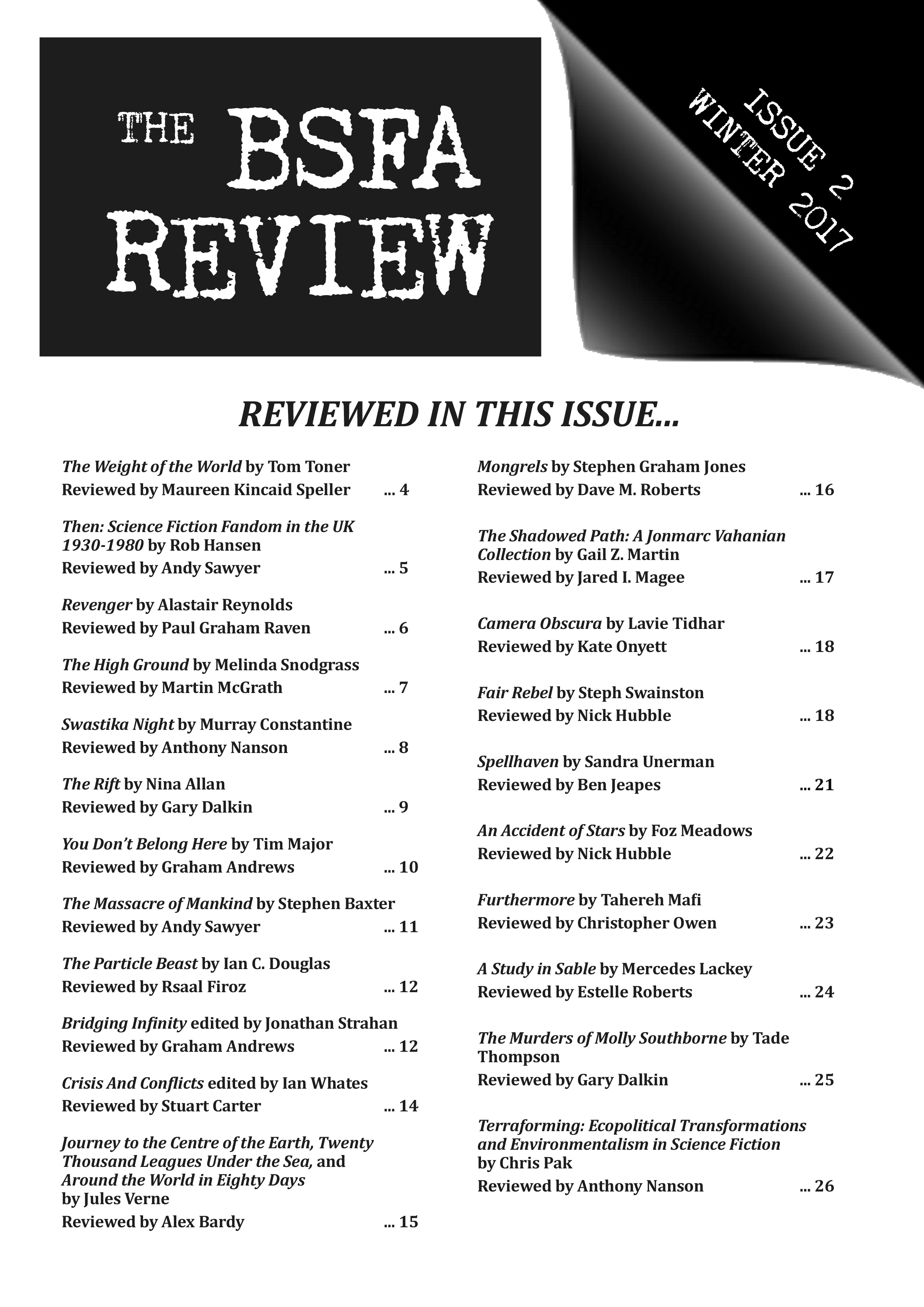
The BSFA Review Issue 2
History of Science Fiction on Audio
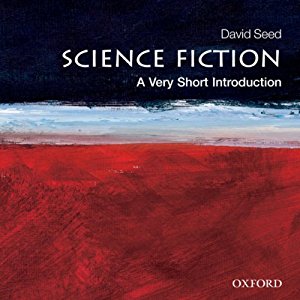
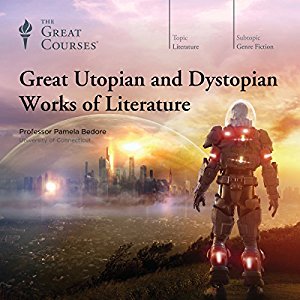
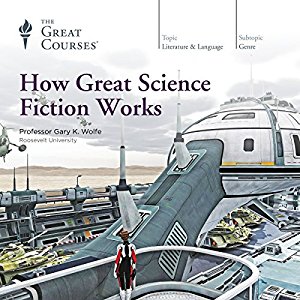
Here are a few of the recent history of science fiction overviews that are available in audio format.
Gary K. Wolfe’s 24-lecture series as also available as video lectures. David Seed’s introduction is the most succinct – it is about 5 hours as opposed to about 12 hours for each of ‘The Great Courses’ series.


Vector 287: Some films from Cameroon and SA/Canada
By Dilman Dila
Last year, after a long wait, I got a chance to see Jean-Pierre Bekolo’s Naked Reality, which he describes as an afrofuturistic/sci-fi. Shot in black and white, it is a time-travel tale in which the protagonist searches for her identity, this being allegorical for a continent’s search for its identity. Like his earlier films, including Les Saignantes (2005), it does not use visual effects or mise-en-scène to portray the future. But while strong storytelling with an offbeat style carried his previous works, Naked Reality turned out to be difficult to watch. Its website suggests it “is a new science-fiction interactive and collaborative cinema concept where we make feature films with a story as usual but take out certain aspects like sets, music, dialogues, costumes…” While there is a call for collaboration, it is not clear if it would mean re-editing this film. What made it drag was the miming, the near complete lack of sets, and the attempt to compensate using overlays, where two video clips are blended together – kind of the cinematographic equivalent of Instagram filters – creating a style more suitable to music videos. If ten years ago a lack of props or effects could be a consequence of low budget, today, more resources are available to a filmmaker, especially in a collaborative venture, and there is free software to achieve photorealistic visual effects.
One such software is Unity. In 2016, the company behind it made a short film, Adam (available on YouTube), to showcase its cinematic creation tools and to test out the graphical quality achievable. Adam is short and sweet to look at, though does not have much of a story. The main protagonist, a prisoner, wakes up in a robot’s body along with scores of others. They meet a mystical figure, who leads them away into a bleak horizon. In 2017, Unity partnered with Neill Blomkamp – the South African director well-known for District 9 – to make two sequels to Adam, where we learn of a government called The Consortium, which harvests the body parts of prisoners but, rather than kill them, puts their brains in robots, for unknown but possibly legal or even mercantile reasons. I like the series so far, and although both plot and character development are still thin, it is a visual joy.
Neill will be making more episodes of Adam alongside other short films in his own Oats Studios, which he set up to develop ideas without years of waiting for Hollywood. The first film he made was Rakka, set in a dystopian, post alien-invasion world. The obsession of seeing aliens as the evil other echoes colonialist era fears (e.g. H.G Well’s War of the Worlds) but also resonates with anti-immigration sentiments of today. Rakka features Sigourney Weaver, whose great performance failed to save the film from a clichéd plot that does not add anything new to an alien invasion narrative.
I thought other Oats Studios films would be similar, but was pleasantly surprised. Firebase starts off like an alien-contact film, and ends up something like a revenge-ghost story, with US soldiers in Vietnam encountering something called the River God. Like the other shorts from Oats Studios, Firebase could develop into a feature film, and a recent tweet from Neill suggests he is planning to crowdfund its production – this might explain its abrupt and unresolved ending.
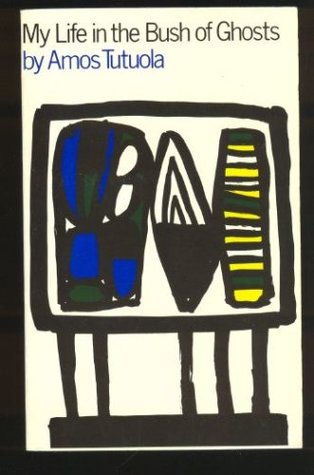 Zygote is the film I liked the most. Though it also seems to be the first twenty minutes of a feature, it works beautifully as a stand-alone short. It’s a sick horror, a good old-fashioned monster tale redolent of Frankenstein, and it may be difficult for some people to watch. I liked the monster very much because it reminded me of Amos Tutuola’s My Life in the Bush of Ghosts, and the awesome “flash-eyed mother,” which is a ghost made up of “millions of heads which were just like a baby’s head,” each with two hands and two eyes that shone day and night. Zygote gripped me right from the start, and the suspense did not relent. It is set in an asteroid mining operation, and the story opens with two survivors from a catastrophe that is never fully explained, though we deduce it coincided with the creation of the monster. One survivor is a slave, an orphan bought in her infancy, and the other a synthetic human, who sacrifices himself to help the orphan escape. Like most of Neil’s films, this one is very entertaining, and yet still packs in social issues, in this case genetic engineering and a critique of corporate capitalism.
DILMAN DILA IS THE AUTHOR OF A CRITICALLY ACCLAIMED COLLECTION OF SHORT STORIES, A KILLING IN THE SUN. HE HAS BEEN LISTED IN SEVERAL PRESTIGIOUS PRIZES, INCLUDING THE GERALD KRAAK AWARD (2016), BBC INTERNATIONAL RADIO PLAYWRITING COMPETITION (2014), AND THE COMMONWEALTH SHORT STORY PRIZE (2013). HIS FILMS INCLUDE WHAT HAPPENED IN ROOM 13 (2007), WHICH HAS ATTRACTED OVER SIX MILLION VIEWS ON YOUTUBE, AND THE FELISTAS FABLE (2013), NOMINATED FOR BEST FIRST FEATURE AT AFRICA MOVIE ACADEMY AWARDS (2014), AND WINNER OF FOUR MAJOR AWARDS AT UGANDA FILM FESTIVAL (2014). HIS SECOND FEATURE FILM IS HER BROKEN SHADOW (2017), A SCIFI SET IN A FUTURISTIC AFRICA. MORE OF HIS LIFE AND WORKS ARE AT DILMANDILA.COM
Excerpt: How to Suppress Women’s Writing by Joanna Russ
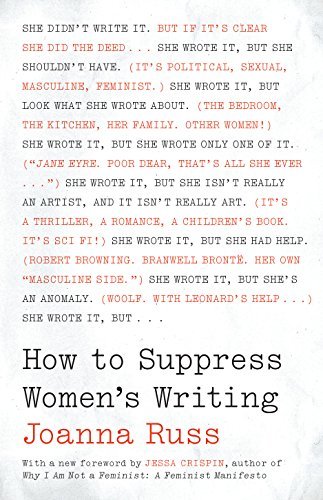
From How to Suppress Women’s Writing, by Joanna Russ
I HAVE A VISION. The streets of midtown Manhattan are filled with all of the professors, professional critics, editors, and judges of award panels. They are all dressed in their ill-fitting suits—they could afford better tailoring but that of course would indicate to their audience that something like beauty is important—but they are tearing them off to replace them with sackcloth. They are on their knees, they are decorating themselves in ashes.
Slowly they crawl out of their blue glass skyscrapers, their suburban commuter rail stations, their off-campus housing to join the mass. It’s not a howl that you hear but a low, unceasing moan. A few, the more dramatic and in need of attention of the group, flog themselves with branches and nylon rope. All of these men, all of these white men, every man who ever told a publishing assistant at a party while pinning her to the wall “you know I am in an open marriage,” every man who ever used the word “histrionic” to describe a woman’s memoir, “articulate” to describe a black man’s performance, or spent two paragraphs speculating about the body of a trans writer in what was supposed to be a review of their work, every professor who used Kanye lyrics in a lecture to show he was with it but taught an all white syllabus, every man who has referred to a Bronte or Emily Dickinson or James Baldwin as a “minor” writer, they are all here.
They have come to atone. They have come to ask for absolution. They have been forced into an encounter with their unconscious, they have finally seen the truth of their bias, the need they have had to believe anyone not of their demographic was a charlatan or a bore, and they have been laid low by this information.The sidewalks are crowded with all they have dismissed and betrayed. Everyone who has been marginalized and written out of the history of literature. They are interested in the spectacle, but skeptical. They have seen this type of performance before, this display of “how could I have been so wrong?”—it was always followed by either a return to previous behavior with slight modifications or an attempt to get laid. But they are transfixed by the image, and they find themselves disappointed that they are still capable of hope, hope that finally they will be seen for their true selves and not through these men’s projections.
When the men finally reach the water, they toss their clothes onto the bonfires that have been burning all night. The stench of burning polyester fills the air. “Forgive us,” they cry, as they hand over their positions to the spectators and write letters of resignation. “We didn’t realize.”
Source: https://thebaffler.com/latest/no-mothers-no-daughters-crispin
Speculative Art at the Serpentine
Ian Cheng populates the Serpentine with artificial life in a two-part exhibition, starting with BOB, until 22 April and continuing with Emissaries from 24 April.
Near Future Fictions Salon: Virtual Persons
Extruded Bodies & Phantom Flesh by Andrew Wallace
Virtual Futures’ March 2018 Near Future Fictions Salon explored the theme of Virtual Persons
Virtual Futures grew out of a series of conferences in the mid-90s that sought to develop a new discipline that would confront the technologisation of culture. Its latest incarnation is a regular ‘Salon’, where philosophical, scientific and creative thinkers combine discussion, performance and fiction to explore current and potential technological extensions of the human condition.
The Near Future Fictions Salons place science fiction centre stage, with previous guest participants including Alan Moore, Pat Cadigan, Gwyneth Jones, Hari Kunzru and Geoff Ryman.
Monday’s event explored the theme of ‘Virtual Persons’:
The digital world is a personality playground that offers us an unprecedented ability to curate and create a public persona – but what does this ability mean for the future of personhood? [from http://www.virtualfutures.co.uk]
Opening keynote by performance artist Stelarc
Stelarc took part in the original Virtual Futures conferences at Warwick University in the 90s. His work explores alternative anatomical architectures, interrogating issues of agency, identity and the post-human. He has performed with a mechanical third hand, a stomach sculpture and a six-legged walking robot; while Fractal Flesh, Ping Body and Parasite are internet performances that explore remote and involuntary choreography. Most recently, he has harnessed surgery and stem-cell technology to grow an ear on his arm.
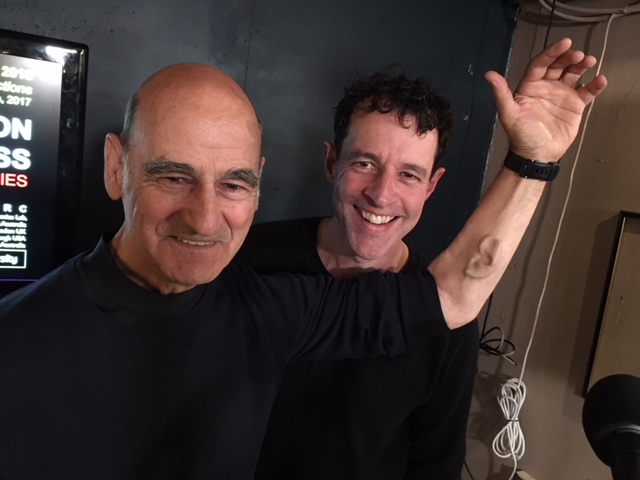
Continue reading “Near Future Fictions Salon: Virtual Persons”

