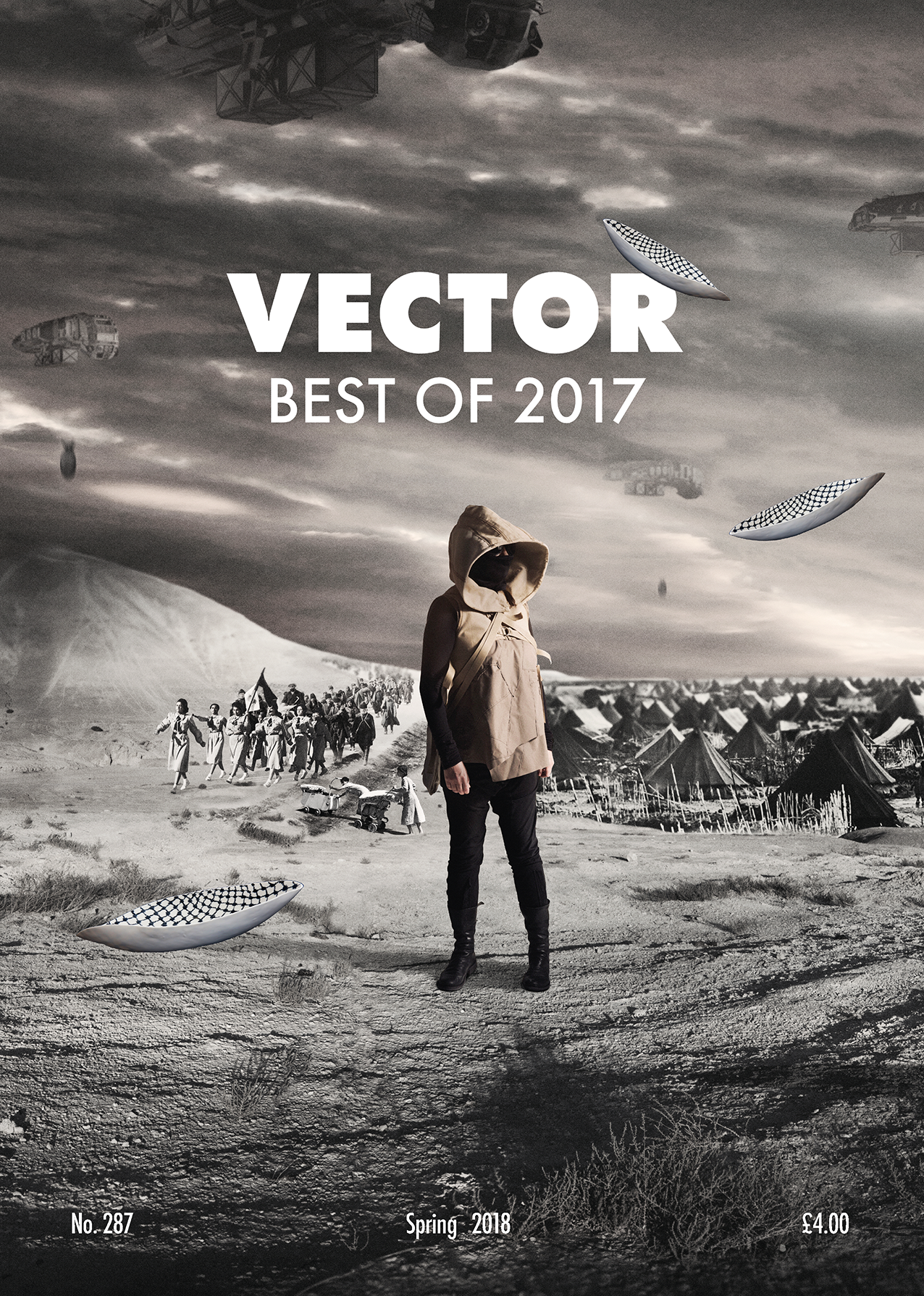
Cover image: Larissa Sansour and Søren Lind from ‘In the Future, They Ate from the Finest Porcelain’
An interview with Larissa Sansour by Polina Levontin and Jo Lindsay Walton, plus a review of Larissa Sansour’s work. TV in 2017 by Molly Cobb and So Mayer.
Film in 2017 by Nick Lowe, Andrew Wallace, Dilman Dila, Cheryl Morgan, Ali Baker, Paul March-Russell, Amy C. Chambers, Lyle Skains, Gary Couzens, and Dev Agarwal.
Ricardo Suazo reflects on SF inspired trends in fashion, and Martin McGrath takes a close look at three panels from Avengers #8.
Games and AR are covered by Erin Horáková, Susan Gray, and Jon Garrad.
With also have an extensive section on audio and podcasts in 2017 with Peter Morrison, Erin Roberts, Laura Pearlman, Victoria Hooper and Tony Jones.
And of course three Recurrent columns with Paul Kincaid, Andy Sawyer and Stephen Baxter, plus the Torque Control editorial by Jo Lindsay Walton.
This one’s a bumper issue — 80 pages! If you are a member of the BSFA, a copy of Vector 287 was mailed to you in March 2018. If you’re not a BSFA member yet, why not sign up now?
Missed this issue? Don’t worry, this one is also available on Lulu.
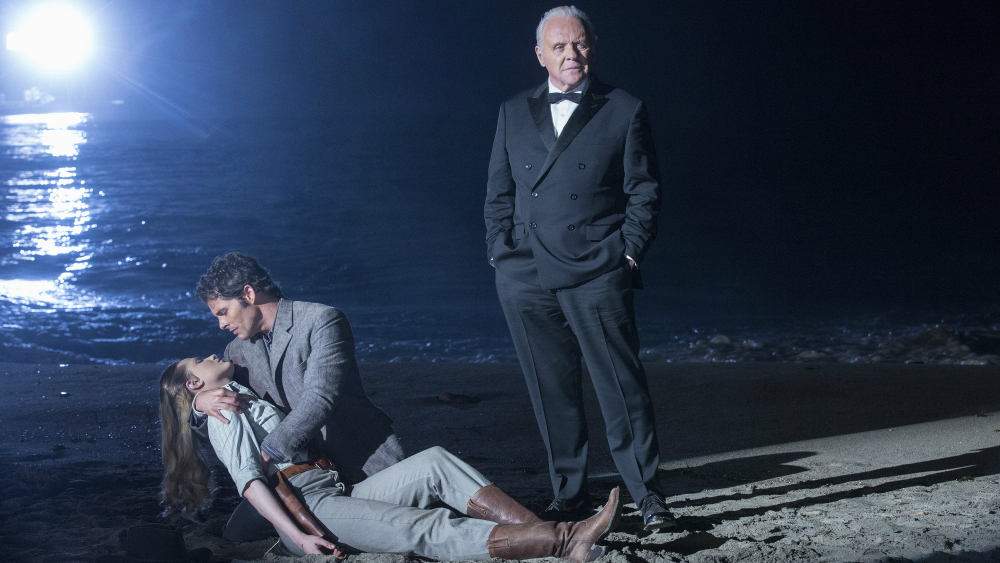
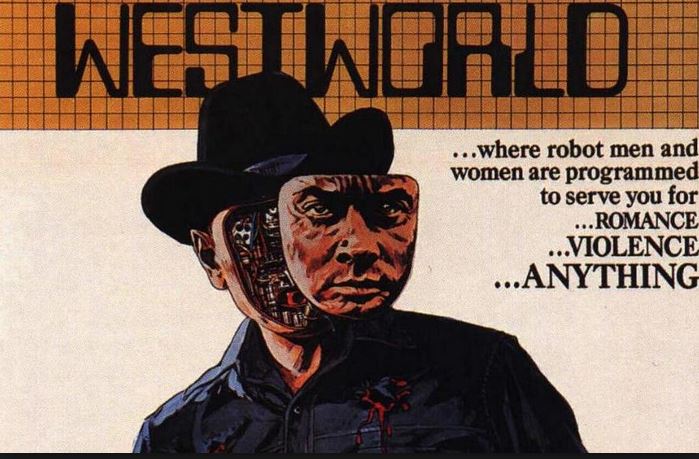
Westworld landed on TV in 2017 and set genre cognoscenti’s tongues wagging. The consensus is that in ten episodes it has sealed its place in our current Golden Age of Television, and surpassed the original film from which it jumps off.
The current HBO-produced series had a long gestation period. It began with the original film by Michael Crichton in 1973, followed by fits and starts that may be better forgotten – the misfiring 1976 sequel Futureworld, plus a TV series, Beyond Westworld, that appeared in 1980 and was quickly cancelled – and the long haul of dormancy for the concept until 2016, when the first season of the contemporary reboot appeared. Season two is awaited this spring.
Westworld (1973) by Michael Crichton
Overall, the 1973 Westworld was more a monster chase movie than a meditation on what it means to be human – the central theme of the current re-incarnation of the story. The Westworld reboot series so far has focused on just one park, the West, largely ignoring the film’s orgiastic Romanworld and castle-based Medievalworld (albeit there have been some allusions to samurais). However, fans of the original film should find that the rebooted series remains faithful to the original concept.
In both incarnations, 70s film and modern TV series, Westworld is squarely a science fiction idea (our genre gave the film nominations for the Hugo and Nebula). It’s hard SF in that technology is central to the premise: advanced AIs engage with people as “hosts” in a theme park. But it’s certainly also soft SF, in that the drama unfolds by exploring the social implications of technological change rather than by examining how the science works. Continue reading “Westworld Then and Now”→
On the final day of this year’s Gallifrey One convention in Los Angeles, fifteen women stepped on to the main stage for a monster of a panel titled “Gallifrey Waits No More.” […] What occurred over the next hour was an experience that was simultaneously harrowing and cathartic as a #MeToo moment unfolded on stage.
Check out the expanded and updated website of the African Speculative Fiction Society here.
“The ASFS will provide a place where writers, readers, and scholars can come together to find information, connect with each other, and act as watchdogs for their collective interests.”
Chinelo Onwualu, chief spokesperson, ASFS.
The African Speculative Fiction Society is an organization of African
Writers
Editors
Comic and graphic artists
Filmmakers
in the fields of speculative fiction such as fantasy, science fiction, stories that draw on traditions, horror and philosophical fiction.
Members nominate any published work for one of the four Nommo Awards. They are given free access to many of the nominated works. And they vote for the winners of the Nommo awards.
The Awards will be presented at Follycon, the 69th Eastercon, which this year is taking place at The Majestic Hotel, Harrogate, from 30th March – 2nd April 2018.
Our ballot is now live! BSFA members who wish to send advance votes, can do so here. We will also have a printable ballot form available from this web page in a few days, in case you would prefer to vote by post.
The shortlisted works are:
Best Novel
Nina Allen – The Rift (Titan Books)
Anne Charnock – Dreams Before the Start of Time (47North)
Mohsin Hamid – Exit West (Hamish Hamilton)
Ann Leckie – Provenance (Orbit)
Best Shorter Fiction
Anne Charnock – The Enclave (NewCon Press)
Elaine Cuyegkeng – These Constellations Will Be Yours (Strange Horizons)
Greg Egan – Uncanny Valley (Tor.com)
Geoff Nelder – Angular Size (in ‘SFerics 2017’ edited by Roz Clarke and Rosie Oliver, Createspace Independent Publishing Platform)
Tade Thompson – The Murders of Molly Southbourne (Tor.com)
Best Non-Fiction
Paul Kincaid – Iain M. Banks (University of Illinois Press)
Juliet E McKenna – The Myth of Meritocracy and the Reality of the Leaky Pipe and Other Obstacles in Science Fiction & Fantasy (in ‘Gender Identity and Sexuality in Current Fantasy and Science Fiction’ edited by Francesca T Barbini, Luna Press)
Adam Roberts – Wells at the World’s End 2017 blog posts (Wells at the World’s End blog)
Shadow Clarke Award jurors – The 2017 Shadow Clarke Award blog (The Anglia Ruskin Centre for Science Fiction and Fantasy). The 2017 Shadow Clarke jurors are: Nina Allen, Maureen Kincaid Speller, Victoria Hoyle, Vajra Chandrasekera, Nick Hubble, Paul Kincaid, Jonathan McCalmont, Megan AM.
Vandana Singh – The Unthinkability of Climate Change: Thoughts on Amitav Ghosh’s The Great Derangement (Strange Horizons)
Best Artwork
Geneva Benton – Sundown Towns (cover for Fiyah Magazine #3)
Jim Burns – Cover for ‘The Ion Raider’ by Ian Whates (NewCon Press)
Galen Dara – Illustration for ‘These Constellations Will Be Yours’ by Elaine Cuyegkeng (Strange Horizons)
Chris Moore – Cover for ‘The Memoirist’ by Neil Williamson (NewCon Press)
Victo Ngai – Illustration for ‘Waiting on a Bright Moon’ by JY Yang (Tor.com)
Marcin Wolski – Cover for ‘2084’ edited by George Sandison (Unsung Stories)
How to Vote:
Mark your choices in each category in order of preference: ‘1’ for first place, ‘2’ for second place, etc. You are not required to rank all the nominees in any category. Advance votes must be received by Monday 26th March 2017, either electronic or postal. If you intend to send votes by post instead of via the e-ballot form, please remember to include your BSFA membership number (you will find this on the envelope of your latest mailing) and your name and address. Return your postal votes to: BSFA Awards, 9 Montgomery Road, Cambridge CB4 2EQ.
January’s Sci-Fi Sessions was a conversation between three very different contemporary fantasy authors. Each one has a trilogy in progress. Lucy Hounsom has just released the final book of her acclaimed Worldmaker series (Starborn, Heartland and Firestorm). Tarnished City, the second novel in Vic James’s Dark Gifts trilogy, was published last year. It follows the success of book one, Gilded Cage, as a BBC 2 Book Club Choice. Finally, Anna Smith Spark’s Court of Broken Knives, the opening volume of her Broken Empire sequence, has already been nominated for numerous awards for best fantasy novel of 2017, with second and third volumes yet to follow. Continue reading “Fantasy Fiction with Vic James, Anna Smith Spark & Lucy Hounsom. A SciFi Sessions conversation, hosted by Glyn Morgan at Gower Street Waterstones in London.”→
In late December 2017, a group of writers and scholars of SF, scientists and technologists, and defence analysts and policymakers, gathered at Dstl (UK government’s defence science and technology laboratory) in Salisbury to explore science fiction’s contribution to defence policy. Vector caught up with Dr Ping Zheng from Canterbury Christ Church University Business School, to ask her about her impressions of the day, and a few other things …
During the first breakout session, you were in the Human Behaviour in Smart Environments group. How did that go?
Dr Ping Zheng
We had some inspiring discussions about how humans may react in smart environments. I think the group dynamics probably extended the scope of planned discussions, and allowed us to engage in more diversified discourse, ranging from individual perspectives, to emergent impacts at a societal level, and also to policy perspectives. For example, two prominent issues were debated: national and cultural differences, and ethical concerns such as privacy.
Perhaps the value of events like these is that you might discover that your original questions can be re-framed, or that your stakeholders are not precisely who you imagined them to be. Your other breakout session was ‘Defence (In)efficiency: What Does the Future Hold?’?
In other exciting fluid-related news, scientists have made a fluid with negative mass. In the face of our growing global water crisis, maybe this development doesn’t feel quite so relevant as the other two … but then, the usefulness of inventions can be hard to judge at first. Story prompt, writers?
The New York Times is not a place where one expects to find encounters between the Navy and UFOs. Then again, the NYT in 2017 has felt like a distinctly genre venue, as the reality around us grows far-fetched and more than a little dystopian. So it has been worth the extra effort to look for technoscience news which seemed less likely to transform our world in drastic and unpredictable ways (as AI or CRISPR), and more likely to offer tangible and specific benefits, like eyesight for the blind.
Although some writers could surely imagine a downside to artificial eye retinas, many have already questioned science’s quest to prolong life or enable reproduction without women, or bodies for that matter. Wait, so we’ve had nearly 50 years to figure out the ethics — Shulamith Firestone’s The Dialectic of Sex: The Case for Feminist Revolution was advocating cyberwombs in 1970 — and we still don’t know?
In 2017, the world got more of its energy from renewables and technology continues to improve. Fast enough? The outlook for climate change in 2017 was not especially comforting. What humanity learned to speed up in 2017 is evolution. Gene drives could increase the rate at which genes spread in ways that could be beneficial. Worth the risks?
If we get it all wrong, it may come as a consolation that at least Earth is not the only habitable planet. In 2017, NASA identified hundreds of planets similar to Earth. Does this make Earth less precious? Not if we love it. Most scientists do. Many strive to help here and now, such as buying time for corals so they can adjust to climate change rather than die off, taking down entire ecosystems with them.
Other scientists conduct research on different dimensional scales. 2017 saw an end to the Cassini mission, which plunged to Saturn in order to avoid contaminating its moons (that Cassini revealed so much about). And the year’s most abstractly beautiful piece of new knowledge has been the discovery of gravitational waves – ripples through spacetime – predicted by Einstein’s theory. What caused these ripples on the spacetime surface that we learned to observe? A kilonova — a collision of two neutron stars… But could we process this new knowledge if our imaginations had not been prepared for it by, say, Samuel Delany?
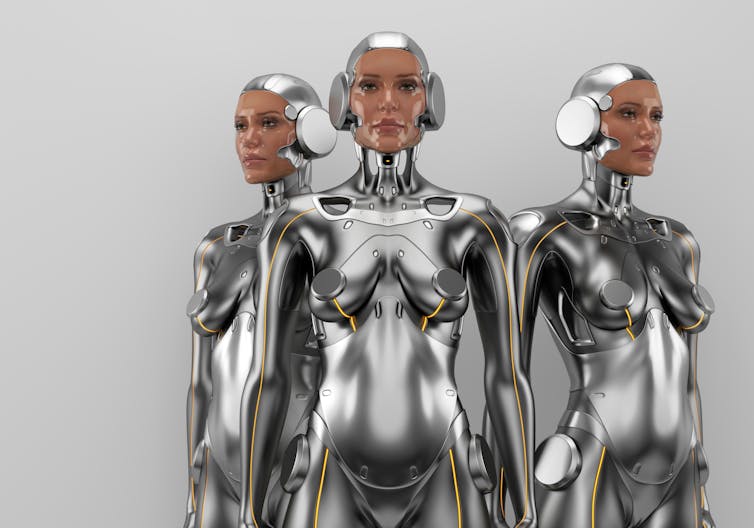
Three photographs have been shortlisted for 2017’s Taylor Wessing Photographic Portrait Prize, hosted by the National Portrait Gallery in London. But there is something out of the ordinary about one of this year’s contenders for the prize. One of the portraits – by the Finnish artist Maija Tammi – is not of a human, but a female android.
The android in the photograph is Erica, described by her creator, Osaka University professor Hiroshi Ishiguro, as “the most beautiful and intelligent” robot in the world. The hardware beneath her silicone skin helps her achieve facial and mouth movements, but these can be rather unnatural, out of sync with her synthesised voice. She is cognitively sophisticated, though still unable to work out answers to complex questions from first principles, and she cannot move her arms and legs.
If this seems like something out of science fiction, you’re not far off. One of Ishiguro’s first female robots was named Repliee Q1 and he himself has said that the name derives from the French for “replicate” and from the “replicants” in Blade Runner: science fiction and robotics have always been entwined. Indeed, in a documentary made by the Guardian about Erica, Ishiguro reveals that he wanted to be an oil painter and insists on the similarities between his work and artistic creation.
It is difficult not to see here a masculine Pygmalionesque desire to create the perfect artificial woman. “Ishiguro-sensei is my father and he understands me entirely,” Erica pronounces in the documentary. Her vaunted autonomy seems more like a projection on the part on the roboticists who programme her thoughts, but also occasionally anthropomorphise her: the scientist who introduces himself as Erica’s “architect” also thinks that she is “really excited to interact with people”.



 By
By