Torque Control

Out of this World: Three Days Left / El Anacronópete

I made it back to Out of this World at the British Library for a last look yesterday. The room was relatively crowded, enough so that there were plenty of cases I skipped and came back to when space became available.

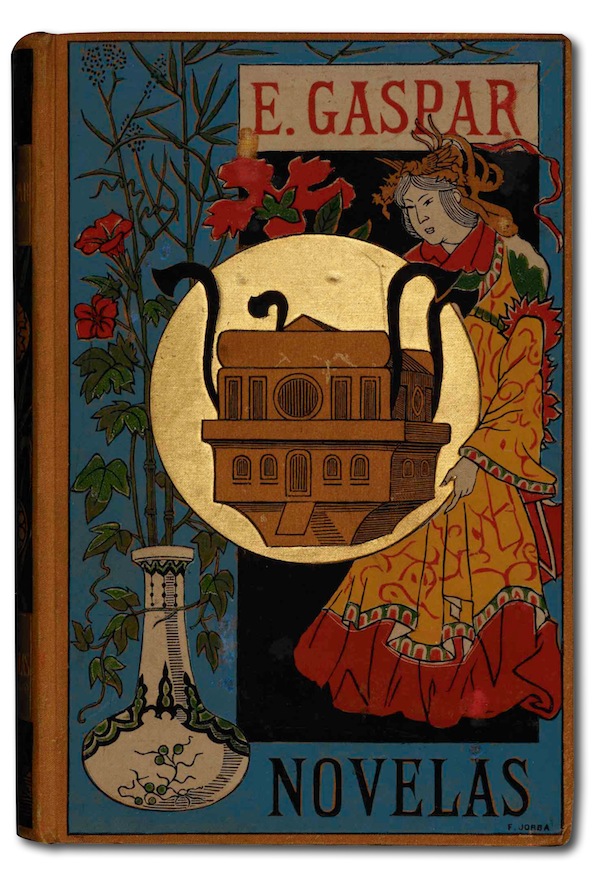
The one I had to check on more than once before I could come back, thus seeing it toward the very end of my time in the show, was Enrique Gaspar’s 1887 story, “El Anacronópete”, collected in Novelas. The reason the book as garnering so much attention is because it’s the oldest known story involving a time machine. The BBC posted a fairly extensive article on the story and its translation back in April.

It is forthcoming in English for the first time in 2012 from Wesleyan University Press as The Time Ship: A Chrononautical Journey, translated by Yolanda Molina-Gavilan and Andrea L Bell. In the meantime, those of you who read Spanish can download a digitized version here.

Good to see so many people at the show!

Out of this World: Science Fiction but Not As You Know It is available to see for free for three more days, including day, at the British Library.

Out of this World: Four Days Left / Frankenstein

Until I started reading up for my short presentation on Lucian and Mary Shelley’s Frankenstein for the “Science Fiction and Religion” panel* at Bradford the other weekend, I had no idea that Shelley had notably revised the text between its first 1818 edition and the better-known 1831 edition.

Small, frequent amendations and revisions** altered the text’s focus towards a much greater concern with Christianity, in particular, giving Victor Frankenstein a greater religious consciousness. Frankenstein, in the later text, refers at various points to a guardian angel, and to an angel of destruction leading him on. Although these need not necessarily have come at the cost of sacrificing descriptions of Frankenstein’s scientific practice, they have, such as a youthful scene in which he experiments with electricity, cut from the later version. Even the references to historical practices of natural magic are revised, in order to cast them in a more negative light.

I was conscious that there were many versions of Frankenstein simply because it has been memorably reworked in film numerous times over the years. I hadn’t realized how much the focus of the story was adjusted in Mary Shelley’s own revisions as well.

Some edition of Frankenstein (offhand, I cannot tell you which one!) is currently on display at the British Library as part of the Out of this World: Science Fiction But Not As You Know It exhibition. You have four days left, including today until 18:00, to see it.

*  See also the contents of the talk which Una McCormack gave, on sf and religion in Dr Who and Star Trek, for the same panel.

** I used the Oxford World’s Classics edition of the 1818 text with its list of changes by Marilyn Butler in Appendix B.

Out of this World: Five Days Left / More’s Utopia

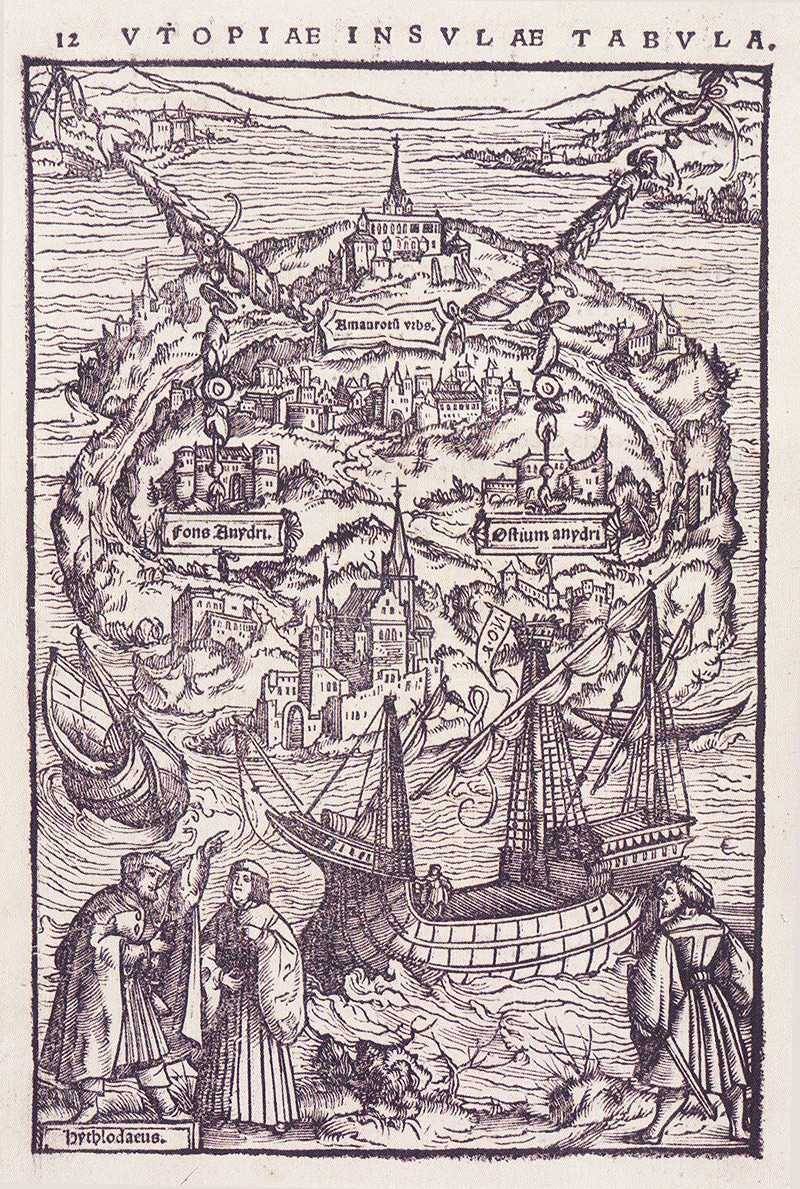
What I love most about Thomas More’s Lucian-inspired (among other sources) text Utopia isn’t the descriptive text, the building of a somewhat egalitarian community, the observations on crafts, the framing narrative, or its dual-purpose as satire. It’s all of the visual world-building which it, in turn, inspired.

There are earlier maps of imaginary places, although I love the ones made for Utopia, this one from 1516, this one from 1518 edition, or these later ones. (The 1518 Ambrosius Holbein edition is available online for browsing in its entirety. See also this selection of eighteenth-century illustrations of Utopia.)

But I know of no earlier instance of an alphabet being developed for a fictional world. Either More, or his friend Peter Giles, developed it for the book. You can see the full version of his Utopian alphabet and a sample use of it on the British Library’s website. And, if you really like fictional languages, the alphabet is even available to download as a True Type Font.

Utopia is on display currently at the British Library as part of its Out of this World: Science Fiction But Not As You Know It show which is available, for free, until this Sunday. The library is open until 18:00 today.

Out of this World: Six Days Left / Lucian of Samosata

Lucian is sometimes referred to as the first author of a journey to the moon. It’s not true on either count. He wrote two, not one, moon journey tales; and his work includes just the oldest surviving moon journeys, not the oldest per se. He himself mentions older ones.

Lucian lived in the second century CE and, among his other accomplishments, was a prolific writer. Eighty or so of his works survive, including the Icaromenippus and his better-known moon journey, The True History. Not only is The True History a longer and more wide-ranging work, but it was to later help inspire More’s Utopia and Gulliver’s Travels, among other things.

Out of this World: Science Fiction but Not as You Know It includes a 1647 Dutch edition of The True History.  The image from it released as part of the publicity packet for the show is of an action-packed moment in the plot, the people of the Moon and the people of the Sun at war for the right to colonize the Morning Star. Their aerial battle is fought on an enormous battlefield woven by enormous spiders (each much bigger than the Cyclades islands), and the warriors, many of them half-food, half-creature, attack in a fraught, prolonged combat sequence. Note the cabbages, the lethal radish, and, in the lower-left, the Millet-shooter.

Both The True History and the Icaromenippus are highly readable and fairly short. At Tony Keen‘s recommendation, I used the Oxford World Classics edition, Lucian: Selected Dialogues, translated by C.D.N. Costa (2005).

Out of this World: Science Fiction but Not as You Know It, curated by Andy Sawyer, traces science fiction from Lucian to Lauren Beukes. There are six days left, including today, in which to catch it (for free) at the British Library. Today, the library is open until 20:00, so if you work in central London, you may even be able to drop by after work to see it.

Out of this World Countdown

Here in London, it’s been a fantastic summer of science fictional events at the British Library, thanks to the show Out of this World: Science Fiction but Not as You Know It; but it’s not over yet.

After today, there are still six days left in which to go to the British Library and see the (free!) show.

There is still one more scheduled event remaining in conjunction with it, on J.G. Ballard, this Friday.

I’m planning on going back one more time. And just in case you’ve been thinking about it, haven’t gotten around to it, live vaguely in or around London or will be passing through in time…. I’m planning on posting something on science fiction history each day for the remaining six days of the show as a reminder that the show is still on.

Also, conveniently, this takes advantage of recent reading I did in preparation for the British Science Festival’s panel on “Science Fiction and Religion”.

The good news is that major shows in London on inspirations for science fiction and fantasy won’t be stopping when Out of this World closes, since John Martin: Apocalypse at the Tate opens on Wednesday.

Life: Recap

(Isn’t that a fantastic title for a post?)

Over the last few weeks, Nic has posted a series of thought-provoking explorations of Gwyneth Jones’ Life, looking at its relationship with institutions and attitudes towards scientific practice; its self-consciousness as feminist sf, as a commentary on the role of women in a science fictional world; the core of the relationships which define the plot of the book; and the fictional scientific discovery at the heart of the story and how it affects gender.

Life, the seventh book we’ve examined in the Future Classics series here on Torque Control, is our last book from 2004, the end of the first half of the decade this book list covers.  The remaining four books cover the rest of the decade. For planning ahead, those are

  • Jo Walton, Farthing (in late September)
  • Sarah Hall, The Carhullan Army/Daughters of the North (October)
  • Ursula Le Guin, Lavinia (November)
  • Gwyneth Jones, Spirit (December)

My thanks to Nic for joining us for this discussion (and perhaps more in the future?), and to those of you who read along and participated in the discussion. It’s never too late to come back to these posts and do so.

Discussion: Part 1 – Science and Sensibilities; Part 2 – Feminisms; Part 3 – Roles and Relationships; Part 4 – Gender and Conclusion

A recent, related post:

bookgazing asks for insights into what new things cis-gendered women could become “in the middle of a pre-existing world full of pre-conceptions about gender and behaviour?”

Life, #4

Having discussed science, feminism, and character relationships in my earlier posts on Gwyneth Jones’ Life, it seems only natural that I should bring this series to a close with some remarks on how the book deals with gender. In many ways, this is likely to be more recap and summation than a substantially new discussion, because gender pervades all the aspects of the book I’ve looked at so far.

The novel’s central sfnal idea – the discovery that Anna spends her professional life finding and demonstrating – is that there a virus has emerged which affects how genes, and the traits associated with them, are “shuffled” during sexual reproduction (198). Usually, only the parents’ X chromosomes take part in this process; the Y chromosome, which (by and large) only males possess, is too small and unlike its counterparts to do any swapping. Genes on the Y chromosome, therefore, are passed only from father to son, whereas X-linked genes can show up in either male or female offspring. Where the phenomenon that Anna calls Transferred Y deviates from this pattern is that it allows the Y chromosome to get involved in gene-swapping. In the long run, according to experiments and simulations run by Anna – and, later, by other teams around the world – TY looks set to lead to the disappearance of the Y chromosome from the human race.

As far as I understand it (and not being a scientist, I’m not completely sure I do…), there is no suggestion, at least from the scientist characters, that this will lead to the end of biological sex differences within human beings; there will still be biologically-male (and fertile) individuals, but they will, like females, have two X chromosomes. Gender, however, is a rather different matter.

Anna steadfastly refuses to spend much time worrying over the implications of all this, focusing on it as a purely scientific issue – a question to investigate in the lab – and ignoring the warnings of colleagues that she could be playing with fire. It is, after all, already happening (indeed, there are already a number of unknowingly-XX males around, living perfectly ordinary lives but for a higher risk of infertility); she is not the cause of the phenomenon, and she had no intention of interpreting it, either. But science does not happen in a vacuum.

It is only late in the book, when her TY investigations have become a media storm – nothing stirs up public fear and anger like a perceived threat to masculinity – and her marital problems with Spence are coming to the surface, that Anna faces what she has learned. Angry and upset over the revelation that Spence is having an affair with insipid Meret (“the not-too-clever sweet feminine younger one” (326), as Anna puts it), Anna finds the temptation to fall back on gendered ways of thinking and fighting about their relationship horribly alluring. “I have become woman”, she reflects; in the Joanna Russ sense, that is: for all her attempts to escape it, she has finally been confronted with her role in the battle of the sexes:

I can be a matriarch like Rosey, who though she loves Wol truly, never forgets to treat him with contempt. Throws him out when he fails to satisfy, allows him back on sufferance. It is what they expect, it is the way relations between the sexes have to be. You have to keep the whip hand, or else they will turn on you. […]

I was afraid of Transferred Y, and I pretended other reasons, but this is why. I didn’t want to think of what it meant for real people because that means me, that means Spence… all that dirt about sexual relations, that I didn’t ever want to handle. (320-1)

I’m not completely sure how to interpret Anna’s thoughts, here (and would welcome suggestions). After some discussion on this point with Niall, my sense is that, regardless of whether or not TY will affect biological sex – or even most of the visible physical traits linked with it – the cultural narratives surrounding gender, and linking gender with sex, are sufficiently powerful that TY is dynamite. Is this Ramone’s “something new”, that will change relations between human beings beyond recognition?

Above and beyond the fact that previously Y-linked (and thus male-only) genes would presumably begin to turn up in females, simply the idea of the chromosomal difference between men and women being ‘lost’ is something that would – and, in the book, apparently does – be profoundly disturbing for some. This is regardless of the fact that, as far as I can tell, there would still be two main biological sexes (my genetics knowledge doesn’t really stretch to speculating upon how this would affect rates or presentation of intersexuality); males and females would all be XX at a genetic level, but nonetheless there would still be as many differences between any given two individuals, regardless of sex, as there ever were.

Consciously and unconsciously, people have so much invested in narratives of gendered thought and behaviour – and, in particular, in narratives of gender and of the battle of the sexes as they shape family life. Rosey, again:

“I used to think Steven and Joe were aggressive because of the childhood they had before they came to us. But boys will be boys. I was so relieved to have a girl.”

If you put a child in frilly ankle socks at birth, thought Anna, by the time she’s three no one will ever know whether genetic predisposition or nurture made her turn out wet as a haddock’s bathing suit. (285)

The possibilities are not spelled out in the book, so I can’t be sure I’m thinking along the right lines, here, and would love to know if anyone has any other suggestions. In particular, does anyone else get the sense from the book that the ‘loss’ of the Y chromosome could make a measurable difference to men – and/or to women – without an accompanying cultural shift? Are there likely to be physical or chemical implications to TY? Or might something like TY itself be enough to prompt a cultural shift? And what about transsexuality and transgenderism?

Life, #3: Roles and Relationships

Following on from my posts on science and feminism in Gwyneth Jones’ Life, it’s time to take a closer look at the two central relationships that shape and define so much of who Anna is and what she does: her marriage to Spence, and her on-off friendship (and more) with Ramone. Both are formed during Anna’s time as an undergraduate, and both send complicated tendrils out through the novel’s various themes.

Neither of them, it has to be said, are particularly easy to like.

Superficially, at least, Spence seems likeable. He’s sensitive, he’s smart, he’s quietly funny; he’s even attracted to Anna’s intelligence. (Well, mostly.)

She had no idea she was sexy. Picture it: Marilyn Monroe is sitting beside you – a brunette Marilyn, which is so much classier, and brainy, which to the male is subconsciously incredibly attractive, resist the dreadful idea as he will. […] He guessed [the other guys] had to be aware, at some level, of her wide shoulders, hand-span waist, and curvaceous little bottom; of the pert, round-as-apples breasts under her clean and modest tee-shirts. (20)

Later in this same reflective passage, Spence goes on to congratulate himself on how his “vintage feminist” mother would be proud of how much he’s not like other guys (“The menfolk of Annandale were an unregenerate lot, stubbornly resistant to the siren lure of female intelligence” (21)). So near, and yet so far; at no point during his panegyric to Anna Apple Boobs does Spence think about his object of desire as a person, whose intelligence is important to her for its own sake rather than as something that exists to attract him, Liberated Feminist Man.

This, I suppose, is the problem with Spence (or at least my problem with him). He has the occasional flash of understanding, but ultimately he never manages to move beyond thinking of Anna as part of his story: the love interest, the adjunct to his narrative arc, the woman that only he can recognise and rescue. Before his writing career takes off and his affair with (young, naive, worshipful) Meret develops, Spence is at his happiest and most focused when faced with Anna’s news of her accidental pregnancy. Oblivious to Anna’s devastation (the knowledge of her pregnancy, coming at such a crucial time in her research and spelling out the ways in which her life is out of her control, is “like a raw bereavement” to her (120)), Spence starts making wedding plans within minutes. This, you feel, is the moment he’s been waiting for: the chance to Do The Right Thing. He never stops to think about whether it is what Anna wants, and Anna is too sunk in her misery and too determined to be self-reliant to tell him, in small enough words, that it is not. This will be the pattern of their relationship.

The fact that Anna has her own story – that, indeed, the nature of Anna’s work means that in many ways Spence is far more a part of Anna’s story than she is of his – is something that he struggles with, throughout. It’s there on the several occasions when he casts himself in the role of house-husband (in Leeds, in Sungai, on the south coast in the final section of the book): he alternates between cheerful ebullience and depressed boredom, frustrated by his lack of purpose. Anna, consumed with her work, is too distracted to need, or be grateful for, his attempts to care for her. Their gender roles are flipped in more ways than the obvious: Spence takes on the job of neglected, long-suffering (whiny, demanding) wife, while Anna is the dynamic husband with her mind on higher things than domesticity (the distant, superior spouse who ignores the household labour – both physical and emotional – she doesn’t see). The problem lies in the roles themselves; the faults of those performing the roles only compound the issue.

Anna’s other major relationship, with gender-challenging Ramone, is less of a constant in her life but still a major influence. Whereas Anna so often takes Spence for granted, she spends a lot of time thinking about Ramone, “this mischievous, erratic guardian spirit” (8). Anna is frequently annoyed with Ramone, cutting off communication with her on more than one occasion, but she is always anxious to understand her: what she stands for, and what she means to her:

Who is Ramone Holyrod? she asked herself. Someone I invented. My exterior soul. The person I wished I could have been; my repository for those parts of my self I couldn’t use or didn’t want in my real life. Ideas that would have made it impossible for me to pursue my life’s work. Truths that would make me an outlaw.

Or a crackpot. (355)

Unlike Spence, Ramone has her own story, which intersects with Anna’s only at intervals: she has a career of her own with as many peaks and troughs as Anna’s does; she has a difficult, devoted relationship with her schizophrenic mentor, Lavinia; she cycles through purpose, despair, desire, turns her words into actions, changes her philosophy of life on several occasions, and adopts new personae for new situations.

Ramone’s story also comments upon Anna’s, both directly – through Ramone’s own, impassioned reflections – and through the implicit contrast between them. Anna knuckles down, Ramone acts out; Anna dresses neatly and unobtrusively, Ramone breaks every rule of cleanliness and self-presentation; Anna marries (in a church, no less) and forms a home with Spence, Ramone goes through a string of complex and sometimes abusive relationships, and has spells of living rough. Above all, Anna absorbs what the world throws at her, as a woman, and tries to make her way through life without rocking the boat too much – whereas Ramone shouts and fights and writes aggressive books and pisses off her closest friends on a regular basis. They make each other think, and deconstruct, and kick out, more than anyone else in their respective lives.

In the end, and quite inadvertantly, Anna does what Ramone never quite manages: she overturns the gender paradigm. Perhaps, anyway; but that will be the subject of the next post.
Cat Women of the Moon, Part 2: Bibliography

Here are the books mentioned in the second and final part of the BBC Radio 4 documentary, Cat Women of the Moon, hosted by Sarah Hall. Some of the duplication from last time is because their authors featured on the both programmes.

  • Mary Shelley, Frankenstein
  • HG Wells, The Island of Doctor Moreau
  • China Mieville, Embassytown
  • China Mieville, Perdido Street Station
  • Ian M Banks, the Culture novels
  • Urusula Le Guin, The Left Hand of Darkness
  • Geoff Ryman, The Child Garden
  • Shulamith Firestone, The Dialectic of Sex
  • Marge Piercy, Woman on the Edge of Time
  • Margaret Atwood, The Handmaid’s Tale
  • Nicola Griffith, Ammonite
  • Nicola Griffith, Slow River
  • Aldous Huxley, Brave New World

Plus Star Trek and the titular Cat Women of the Moon.

Edited: It’s now available, for at least the  next week, on Listen Again.

The BSFA Apologises

The BSFA would like to apologise for a tweet made by one of its committee members on Friday 2nd September. As has been stressed from outset, we do not endorse either the choice of wording or the sentiments expressed in the offending tweet.

The BSFA committee is composed of a group of volunteers, all of whom are passionate about science fiction, all of whom are individuals with their own distinct views. In this regrettable instance a very personal viewpoint was expressed by one such using a personal account, but one still seen as closely linked to the organisation.

This should not have happened and steps have been taken to ensure that it does not happen again. A letter of apology was also sent to Mr Moffat, the victim of the malicious tweet, the same day. Mr Moffat has responded very graciously, assuring us that he understands the circumstances and has taken no offence with the BSFA.

Nonetheless, the BSFA do wish to apologise sincerely to all those who were offended on Mr Moffat’s behalf.