Torque Control

Life, #2: Feminisms

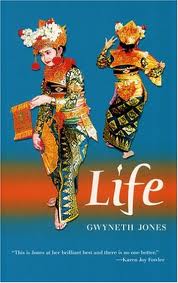
Gwyneth Jones has talked before about the limitations involved in being labelled as a feminist writer, particularly for women writers; her comments have attracted discussion (to which she has responded in turn). Life, as far as Jones herself is concerned, is her last engagement – to date – with feminist sf, which she understands to mean sf that deals explicitly with, as she puts it, the Battle of the Sexes. While I join with L. Timmel Duchamp in disagreeing that the Battle is all that feminist sf is (or should be) about, there can be no doubt that Life places feminism front and centre. Not just feminist issues, but feminism as an explicit, understood and debated body of thought. (As I was writing this, Niall wondered aloud: what other – if any – feminist sf stories feature characters who identify or are identified as feminists? I’d be interested to know if anyone reading this has an answer.)

Put another way, Life is concerned with feminisms, because the novel presents multiple faces of feminist thought and activism – chiefly the wary, accommodationist approach of Anna, and Ramone’s more aggressive desire to clear the decks entirely and start again.

Anna thinks about feminist issues mostly in the breach – on occasions when she has been reminded, beyond the possibility of denial, that the world is not equal, and that she is not, always, judged on her merit ahead of or instead of her gender. Most of time, feminism does not form a part of her life. As Daz Avriti, Anna’s Malaysian contemporary at university, points out to her, the capacity to assume that there is no longer any need for feminism – or that the sum total of feminism is the fight for women to be taken seriously – is a measure of Anna’s (white, western, [struggling] middle-class) privilege. In fact, feminist issues are a continuum; and elsewhere in the world, the issues are about women’s survival:

“Anna, where you and I live, women’s rights is old news. Intelligent women want to be judged on their own merits and find the whole feminism thing embarrassing and whiney. But here, where I live… it’s a can of worms. If you start applying the concept of ‘human rights’ to women, in Asia and Africa, you uncover a holocaust.” (235)

This privilege brings its own layers of complication and difficulty when things do go wrong; it insulates Anna from knowledge of the problem, not from the problem itself. The way Anna reacts to her rape is telling in this regard. Initially she feels only confusion, and a measure of denial: how could this happen to her; she’d always been so careful; how could her control of the situation and of her body be so comprehensively destroyed? “You’re having an awkward conversation with a fellow undergraduate,” she reflects, “and suddenly he comes at you with an axe, I wasn’t prepared. […] I could’t believe it. I’m the one who failed to read the damned body language” (78). Then, thinking about how and why she stopped fighting him off (“he’d never have left if I didn’t capitulate, didn’t withdraw my objection, let him score the point, agree to his version” (78)), she feels for the first time a kinship with others who have gone through the same, shattering experience. She is able to recognise the broader, systemic reasons rape and other abuses keep happening, because she, now, has become a part of that culture:

This is what happens, she thought. Women lie, they keep silent, because no one likes a whistleblower. This is how it all carries on. Now I am doing it. I am part of the machine that destroys women’s chances. (81)

I mentioned the obstacles she faces at work, and her resistance to efforts to change things (for fear, again, that she was be seen as Difficult), in the previous post. But it does not go away, as she hopes it will, when she is older and more established in her career. It takes a few bottles of wine and a comfortable evening with a trusted old friend, but eventually she is driven to vent about the other pressures – subtler, but in their steady, relentless way almost as damaging – that she is subject to as a woman, and supposed to laugh off as just a joke:

“It gets so wearing. They come on to me relentlessly, these male colleagues of mine. I take it lightly, I flirt and act sassy, what else can you do? But of course I know what it means, and it’s not friendly. I’m supposed to have forgotten what ‘fucking someone up’ usually implies, in a professional context? I’m supposed to have not been listening, when a few moments before they were all crowing over the way they shafted some poor loser?” (281)

Still she cannot bring herself to act against these attitudes; she will never be secure enough to stop playing the game.

For Ramone, by contrast, feminism – even if she periodically rejects the concept, or the baggage that goes with it (“Here she was, a fucking professional feminist, basically a sex-worker, a pornographer, making her living out of being female” (222) – is an awareness, a way of seeing the world, that she lives with all the time. It is an itch she can never quite scratch, but can certainly never ignore. Unlike Anna, Ramone – “the rabid one”, as Spence, tellingly, dubs her – can never bring herself to make nice and play the game, because the game destroys women, bit by bit:

As far as Ramone could see, what these women had in common was the same as any woman struggling to have power in a man’s world. The eating disorders, the mysterious illnesses, the hysteria. If you were Albert Einstein and born female in the fifteenth century, you’d end up in some convent fasting yourself crazy, writing liturgical music, and reforming the Carmelites. (73)

She ridicules the notion of feminist history, of finding the women who have been written out of the generally accepted narrative of human progress: “It’s playing into the hands of the enemy to say, see, we were up to your standards all along.” (224) (I am reminded of the stance taken by Caitlin Moran in her new book, although somehow I doubt she put nearly as much thought into her own statement on women’s history.) Where Anna can be optimistic, most of the time, that things are improving for women and will continue to do so, Ramone has no such hopes. The playing field is not and never will be level; the only answer is to abandon it and find something new, “a whole different paradigm” (224).

Ramone’s commentary is disquieting, and it certainly doesn’t win her any friends; even the people who vaguely like her, or at least continue to meet up with her every so often after they all leave university, wonder “why did she have to be so violent, contentious, and unreasonable?” (217). While at times it is hard to avoid the feeling that Ramone takes her feminism to its logical conclusion quite so mercilessly in part because she relishes playing the villain – it beats trying to be liked and failing, or not being seen at all – her fidelity to a truly independent self leads her into such extremes of suffering that it is impossible to believe she’s faking it. Although she relishes the suffering, too, of course; even Ramone herself entertains the uncomfortable idea that her persona is essentially an elaborate method of self-harm.

I don’t think this invalidates what Ramone says, however; her message is liberating and necessary, even if you don’t follow her all the way and despite her cluelessness when it comes to her involvement in the Malaysian human rights protest movement. Both of the times I’ve read the book, I’ve found myself frustrated with her excesses and self-destructiveness, but also with myself, with my own Anna-ishness. Ramone tears off the veil, and there is more than a hint of The Female Man – capital letters and all – to the militant defiance of her thought and expression when she says:

I want to exterminate women, wipe them from the face of the earth. I don’t want to be liberated, I want to be a monster. He didn’t get it. No one ever got it, and Ramone could have straightened them out by saying nobody is born a woman and that what she hated was the way she COULD NOT ESCAPE from the role of second-class person. No woman could, the only escape was to become SOMETHING NEW that had never existed before. And fuck them all; she’d rather be misunderstood than acceptable… But he was impressed by her anger. She saw the alarm coming up in his eyes. It never ceased to amaze her, that fear. For fuck’s sake, she thought, I weigh fifty kilos, that’s about seven stone twelve, o dweller in the shades of departed empire: what do you think I’m going to do? (153)

September BSFA London Meeting: Jo Fletcher Interview – 28th September 2011 – Free entry

 On Wednesday 28th September 2011 from around 7pm:

JO FLETCHER (Editor of Jo Fletcher Books) will be interviewed by Tom Hunter (Arthur C. Clarke Award Administrator).

Venue:

Upstairs Room
The Antelope Tavern
22, Eaton Terrace
Belgravia
London
SW1W 8EZ

Nearest Tube: Sloane Square (District/Circle)
Map:here.
All welcome! (No entry fee or tickets. Non-members welcome.)
Interview will commence at 7.00 pm, but the room is open from 6.00 (and fans in the downstairs bar from 5).
There will be a raffle (£1 for five tickets), with a selection of sf novels as prizes.

FUTURE EVENTS:

26th October 2011 – TANITH LEE interviewed by Nadia Van Der Westhuizen

23rd November 2011* – STEPHEN BAXTER interviewed by Paul Cornell

(No meeting in December.)

25th January 2012 – CHRISTOPHER PRIEST interviewd by Paul Kincaid

* Note that this is a month with five Wednesdays. The meeting will be on the fourth, not the last, Wednesday of the month.

Robert Holdstock Booklet followup

Last night, there was a roundtable discussion at the British Library in honour of Robert Holdstock, entitled “Heartwood: Telling the Matter of Britain”. It featured Stephen Baxter, Lisa Tuttle, Donald E Morse, Paul Kincaid (filling in for Brian Aldiss), and was chaired by Graham Sleight.

At it, Graham mentioned that the BSFA produced a booklet in memory of Holdstock earlier this year. Further, Stephen Baxter, BSFA President (among other things), read an excerpt or two from the booklet, from an interview which Paul Kincaid did with Rob.

Into the Woods: Robert Holdstock Remembered 

  • An Answer? – An Introduction by Paul Kincaid
  • Trone’s Wood – A Poem by Robert Holdstock
  • The Memory of Stories – Robert Holdstock interviewed by Paul Kincaid
  • Robert Holdstock: A Roundtable Discussion – With Niall Harrison, Stephen Baxter, Paul Kincaid, David Schwartz, and Liz Williams

If you were not a BSFA member at the time of that mailing and are interested in getting a hold of it, we still have some copies left!   Contact Martin McGrath  – martin@martinmcgrath.net.

Life, #1: Science and Sensibility

In her recent column ‘On Science, Emotions, and Culture (Part 1)’ at Strange Horizons, Vandana Singh offers the following quotation from Albert Einstein:

The most beautiful thing we can experience is the mysterious. It is the source of all true art and all science. He to whom this emotion is a stranger, who can no longer pause to wonder and stand rapt in awe, is as good as dead: his eyes are closed.

This seems to me as good a place as any to begin our discussion of Life (2004) by Gwyneth Jones, the Future Classics book of the month for August (I know, I know). Because whatever else happens – and it really does all happen – to the novel’s protagonist, Anna Senoz, one of her touchstones remains her passion for science:

[W]hy do I work so hard? Why do I dream of doing something important, even if it’s something only another nerd would understand? It was inexplicable.

[…] They call me Mr Spock and think I’m unemotional: but I like marvels. I have a taste for extraordinary things. That’s why I’m here at the Forest University of Bournemouth, instead of in Manchester: why I’m doing Biology Foundation instead of specializing. I wanted to do something different, to see another world. And to know. I want to know my subject, not just get a job. She returned to her reading, thrilled by a romance and a magic that was invisible to Ramone. (33-34)

It’s a presentation of science – of the why of science, of the compulsion and fascination that keeps someone in the lab until anti-social-o’clock every evening – that perhaps isn’t communicated to the non-scientist world enough. For perfectly understandable reasons – on which I’d be very interested to get the input of Torque Control readers – science is so often thought of as the cold fish, the antidote to wonder. One of the things Life does so well, I think, is reminding us that this is not so: that there is an awe to be found in explanation, in understanding. (And also, of course, that such understanding may not always be comforting, or welcome.)

As an academic, albeit within a non-science field, I also found Jones’ exploration of how intellectual passions come into conflict with egos and institutions both telling and familiar. I’m not just talking about smug Charles Craft, Anna’s contemporary and rival at undergraduate level, whose insecure, destructive posturing Jones manages to draw with some sympathy and nuance even while making me want to kick him for every word that comes out of his mouth. It’s also there in the dynamics of every single one of the labs Anna works in later in her life: the hierarchies that must be maintained, the obstructive nonsense that must be obeyed; the supportive camaraderie and the petty backstabbing that both come with trying to pursue the objective among the hopelessly subjective. And let’s just say that the comment on the woeful inability of her doctoral supervisor, KM Nirmal, to provide anything approaching actual, well, supervision, rung far too many bells (“The better you are what you do, the more time you’re doomed to spend doing things you’re no good at” (98)). Not about my own (entirely splendid) supervisor, though, thankfully…

Being a woman in this environment carries its own set of challenges. Most obviously, during her doctorate Anna is sidelined for her pregnancy, which is taken – by Nirmal and others in the lab – to indicate a lack of dedication to Science on her part, a signal that she is on the “Mommy track” and will thus not put in the hours and never become a serious intellectual force. But the impact upon Anna of, as Ramone puts it, “being born female” (109) is felt in all manner of subtler ways. Charles Craft’s overwhelming and frankly undeserving sense of entitlement may make him deeply unpleasant – and unable to deal with competition from lesser beings without belittling mockery or brittle aggression, to boot – but it is hard to imagine him deciding not to defend his corner, and demand respect, when faced with someone else plagiarising his work (as he does to Anna), or the reflection of low status that is Anna’s below-minimum-wage stipend during her doctorate. Yet Anna has been trained not to call attention to herself; she knows, from everything she sees around her, that unlike men, women who rock the boat get remembered not as go-getters but as trouble-makers.

“No one likes a whistleblower, Simon. Not in any business. I’ve been thinking about it, while I walked. The cheating’s trivial, not worth worrying about. If I make a fuss the story might stick with me. I might never live it down; I’d be an awkward bugger.” (79)

It probably doesn’t help that on the occasions she tries to assert herself, and take control of and credit for her own work, she is slapped down; what is Charles’ rape of her, after all, but a reminder of her status – as an attractive object, so beautiful when she’s angry, not an intellectual equal (or superior) whose objections are to be taken seriously. I’ll discuss this, and how Anna’s reaction to such episodes contrast with Ramone’s, in the next post.

This setting of the science fictional – Anna’s personal mission to understand the phenomenon that she comes to call Transferred Y – within its social, human context, is of course central to the book’s purpose. Science does not stand alone, either in the way it is conceptualised and investigated, or in how it is understood and how its effects are felt; not just because there are limits to human rationality but no limits to the human capacity for denial (as the reaction to Transferred Y shows), but also because society is itself a complex organism. I’ll discuss the sfnal specifics of Anna’s discoveries, and the book’s examination of gender, in the last of these posts on Life. But I think there is room to start that discussion rolling now, in outline: how well do these twin aspects of the novel’s concerns mesh? In what ways do the ups and downs of the lives of Anna, Spence, Ramone and the rest reflect and comment upon the Big Ideas that the book sets out to broach?

Above all, does Life offer some answers to the questions that Singh poses at the end of her column?

Are only some emotions permissible in the culture of science[?] […] What is the connection, if any, between the paucity of female scientists and the culture of science? Is the content of science ever affected by the culture of scientific practice?

Cat Women of the Moon, Part 1 – Bibliography

Cat Women of the Moon, the two-part documentary of science fiction and sex hosted by Sarah Hall, was on BBC Radio 4 just now. (Part 2 will be next Tuesday at 11:30 BST).

Part way through the episode, I realized that this was a prime opportunity for book recommendations, and to consider just what the show has collectively mentioned. Here, then, for your contemplation, are the books mentioned in the program for whatever reason.

The programme is now available on Listen Again.

  • Nicola Griffith, Slow River
  • Nicola Griffith, Ammonite
  • Mike Ashley, Out of this World: Science Fiction but Not as You Know It
  • Margaret Cavendish, The Blazing World
  • Charlotte Perkins Gilman, Herland
  • Mary Shelley, Frankenstein
  • Jane Webb Loudon, The Mummy, or A Tale of the Twenty-second Century
  • Joanna Russ, The Female Man
  • Sarah Hall, The Carhullan Army
  • Geoff Ryman, The Child Garden
  • George Orwell, 1984
  • Aldous Huxley, Brave New World
  • Umberto Eco, The Name of the Rose
  • Iain M Banks, The Player of Games
  • China Miéville, Perdido Street Station
  • Isaac Asimov, Robot series
  • Bram Stoker, Dracula (Mentioned in such a way it could be a film reference instead)
  • John Christopher, Death of Grass

Also, in other media, Bladerunner, the titular movie, Cat Women of the Moon,and Michaelangelo’s Sistine Chapel fresco of the Creation of Man.

Awards to come

This weekend’s awards were the Hugos. (See the survey of initial reactions at Strange Horizons.) The UK and the UK SF community did fairly well out of them, even if this country-as-setting was, by many accounts, the weak point in the best novel winner of Blackout/All Clear. Still, between Claire Brialey, James Bacon, Dr Who episodes, and relatedly Chicks Dig Time Lords, Britain would not have done half badly, if this were a country contest. Which it is not.

But the BSFA awards are to some degree, and, although BSFA members can nominate year-round for them, we are coming up to that time of year when nominations are officially open for the awards: the beginning of September.

In the meantime, the rules and guidelines for the 2012 BSFA awards have just gone live over on the BSFA website.

August: Life

It’s the eighth month of the year already* and we’re still back in 2004 in reading the Future Classics here on Torque Control.

August’s book is Gwyneth Jones’ Life. It is the second of two books from 2004 (the other was City of Pearl) and one of three by Jones on our list this year. It did very well for itself, winning the Philip K Dick award for that year and being shortlisted for the Tiptree Award.

Nic of Eve’s Alexandria, a new poster on Torque Control, should be joining us to discuss the book before the end of the month. I hope you will join us in reading and discussing it!

* It’s almost still the first half of the month, right?

City of Pearl: Recap

The book of this long, lingering July* was Karen Traviss’s City of Pearl, which Niall discussed in a series of posts. It was the first of two 2004 books we are reading here at Torque Control this year as part of the Future Classics series of the best science fiction novels written by women in the previous decade.

Niall examined the difficulty of writing aliens, especially with respect to gender; the role of humans in the context of those aliens, and the problems with the way the book presents scientists; an examination of the main viewpoint character, Shan Frankland; and a look at a few of the book’s other major themes and the way they affect the conclusion.

Continuing the post-9/11 notes, this book too had a plot  thread about terrorism, by that name, in the context of moral ambiguities.

My thanks to Niall for the thoughtful examination of this book, and to all of you who joined in the discussion about it. (There’s always time to do so in future weeks… or months… or years.)

Discussion: Part I (Aliens); Part II (Environment and humanity); Part III (Characters); Part IV (Transparency)

I can’t, offhand, find any other discussions of this novel online from the last month, which is why  I am not providing them for you this month. (I though I did run across another fantastical “city of Pearl” as a result: more in Jeff VanderMeer’s post here.)

* Summer, with all its life disruptions to put us in places we aren’t normally and disrupt posting habits.

City of Pearl: IV

City of Pearl cover

[previously]

Here’s another quote, from rather later in the novel, just after Lindsay, who managed to get herself pregnant before the mission left Earth, has given birth.

“He could do with some more milk, if you’re up to expressing some.”

Not more tubes. He was too weak even to feed properly. She laid him down in the cot again with a breaking heart. Every instinct in her body said she should forget common sense and take him somewhere quiet to comfort and nurse him. But Hugel was a doctor, and knew better. And Lindsay was an officer, the ranking officer now that Shan was out of action.

“I’ll get on with it,” she said. (311)

This is such a brusque examination of the maternal instinct that it feels little more than functional, a device to remind us that humans are animals, but set up and dismissed in a couple of sentences so that Lindsay, and the narrative, can get on with it. Quite a lot of City of Pearl felt like this to me: it is an almost exhaustingly direct novel, with a quite narrow emotional range; like a more cynical John Scalzi, or a less schematic Isaac Asimov. What’s interesting is how this style dovetails with the novel’s content.

Constantine, we are told, is “a transparent sort of place” (61), not somewhere of great complexity or nuance, with a symbolic fascination with glasswork. More than that, the native life on bezer’ej is often see-through, as a camouflage strategy; the planet, Shan concludes, “was a transparent world” (194). The wess’har, as I’ve already described, are a moral position embodied as its extreme to enable contrast and conflict, and deployed with no ambiguity whatsoever, the dilemmas their laws produce being the equivalent of 24’s ticking bombs, in that they distort a situation beyond all likely reality to justify an extreme response. And the grand climax of Shan’s narrative is an audience with a wess’har matriarch for which she is told that she must speak with absolute directness: “Shan made a conscious effort to remove the automatic tendency to edit what she thought before it escaped her mouth. It had taken many, many years to learn to do that. Now she had to unlearn it” (355).

Not infrequently, this all starts to feel like an indulgence of the worst of sf’s world-simplifying tendencies. Yet running alongside all of the above is a determined effort to complicate choices and confuse boundaries. The wess’har are imposing their morality on others, and are resisted by the isenji. A third group of humans arrive completely without warning, with their own agenda. Constantine turns out to be not just as transparent as glass, but as fragile, an artificial ecology maintained within the native bezer’ej landscape. And – most symbolically – towards the end of the book, Aras deliberately infects Shan with c’naatat to save her life, and Shan begins to change. Judged alone, I think I would have to find City of Pearl wanting; but the dynamics it establishes are so clearly set to evolve over successive books that I can easily believe the series ends up in a more complex place.

City of Pearl: III

City of Pearl cover

[previously]

We’re presumably meant to see the decision to arrange the execution of the offending scientist as the sort of thing Shan Frankland’s recruiter had in mind when insisting that the expedition needed “a government representative there who isn’t afraid of hard decisions” (16). And if the decision isn’t that hard in the end, it’s a shame not only because it simplifies Aras for our consumption, but because it diminishes Shan, who is otherwise probably the best thing about City of Pearl.

An efficient ex-cop, Shan is – according to Eddie Michallat, the expedition’s rather irritating journalist – “not plump big, womanly big, but tall, athletic, hard big”, and deeply, occasionally comically, cynical about human nature. She is a baseline human, primarily, we a told, thanks to the pagan beliefs she inherited from her mother, giving her — in a world where the unaltered are becoming less common than the altered — a “hint of wildness and savagery”. She has a temper, and a brain; and most important, to me, she is a professional. For all her physical capability, called on several times over the course of the novel, she is a serious person who takes her job seriously: a rare enough type in science fiction at all, but particularly distinctive amongst the impoverished array of contemporary female characters. Her self-confidence makes her an effective counter to the eternally mutable Aras, and in fact makes her somewhat irresistible to his matriarch-conditioned brain: he finds her no-nonsense manner distinctly wess’har, and increasingly has to fight the urge to defer to her will.

Shan’s other important relationship in City of Pearl is with Lindsay Neville, who would have been leading the expedition had Shan not been installed at the last minute. Lindsay is young military authority, Shan is older civilian authority; unsurprisingly they have rather different ways of doing things. For Lindsay, death is “nothing personal […] all neat and sanctioned and under rules of engagement. After you’d killed them, you would stand at memorial parades and say what an honourable enemy they were”; while Shan “got to know her targets far too well, and honor never came into it” (211). Their headbutting, and eventual tentative respect, is rather nicely done.

It’s hard to say that Shan’s interaction with the rest of her expedition’s members is handled as well. That she doesn’t like the scientists she has to look after – describing them almost exclusively as “payload” – is fine, but there is never an equivalent of the detente with Lindsay, or even the potential for one. What’s missing – aside from brief diary extracts at the start of a couple of chapters – is the viewpoint of a scientist, which leaves them little more than ciphers, and makes incidents like that involving the bezeri child feeling even more lopsided. The payload are the ones who cause trouble, the ones who – astonishingly – we are meant to believe see sentient aliens as just a kind of animal, the ones who just won’t follow orders, god dammit. They are, in fact, the villains of the piece; which would be more interesting if they weren’t also the novel’s truest Other.

[continued…]